
Slow Cognition: The Concept Discovery Canvas
A Canvas for learning Conceptually Difficult Knowlege and Advanced Knowledge Acquisition

In the past three months, some friends asked me to discuss some hard topics such as Wicked Problems, Ecosystem Thinking, Value Choices, Sustainable Development, Collective Design, etc.
To be honest, I am not an expert on any of these topics. My primary interest is connecting Theory and Practice through the Knowledge Curation project. The newest development of the Knowledge Curation project is the Slow Cognition project and the Thematic Space Canvas.
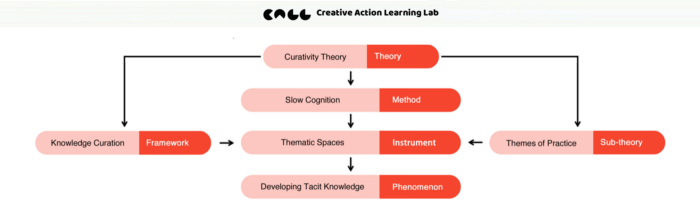
There are some connections between my research interests and my friends’ needs. One connection is called Conceptually Difficult Knowlege and Advanced Knowledge Acquisition. It is about learning and understanding abstract concepts that represent conceptually difficult knowledge.
Yesterday I designed a new canvas called Concept Discovery Canvas for building this connection. See the canvas below.
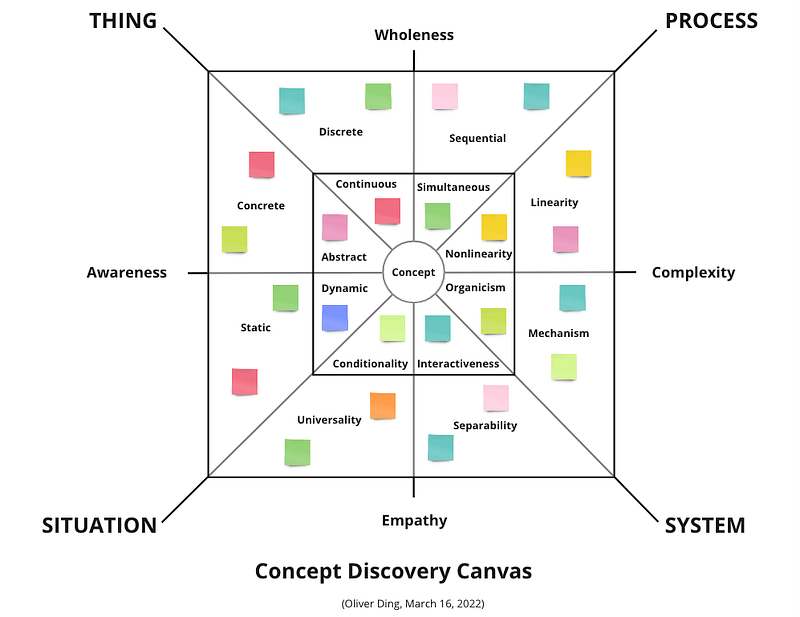
Today I am going to focus on the Content of the Concept Discovery Canvas. If you want to know more about the Form and the Design of the canvas, you can find more details in the following articles about Thematic Space Canvas which is the master version of the Concept Discovery Canvas.
- Slow Cognition: A Meta-canvas for Developing Tacit Knowledge (March 11, 2022)
- The Notion of Thematic Space and Thematic Space Canvas (Jan 5, 2022)
- The Life Discovery Canvas (v1.0) — Part 2: Spatial Structure (Feb 28, 2022)
- The Spark Space Canvas (Feb 9, 2022)
- The Statue Space Canvas (Feb 2, 2022)
- The Life Discovery Canvas (v1.0) — Part 1: Theoretical Background (Feb 27, 2022)
- The Life Discovery Canvas (v1.0) — Part 2: Spatial Structure (Feb 28, 2022)
- The Life Discovery Canvas (v1.0) — Part 3A: Concepts (THINK and LEARN) (March 1, 2022)
- The Life Discovery Canvas (v1.0) — Part 3B: Concepts (SAY and DO) (March 2, 2022)
- The Life Discovery Canvas (v1.0) — Part 4: Inspirations (March 4, 2022)
- The Optimal Context Canvas (March 5, 2022)
- The Lifesystem Development Canvas (March 8, 2022)
The Concept Discovery Canvas is inspired by Paul Feltovich, Rand Spiro, and Richard Coulson’s 1993 paper Learning, Teaching, and Testing for Complex Conceptual Understanding. Though the original paper is about educational psychology research, I think it is also useful for adult learning and life discovery in general.
Too Simple to Fail
Why do I develop the Concept Discovery Canvas? Why do I pay attention to the Conceptually Difficult Knowlege and Advanced Knowledge Acquisition?
In a recent project about an adult life development program and my observation of some people’s daily usage of a professional social network platform, I find some adults tend to use oversimplified heuristic tools for thinking about important and complex issues.
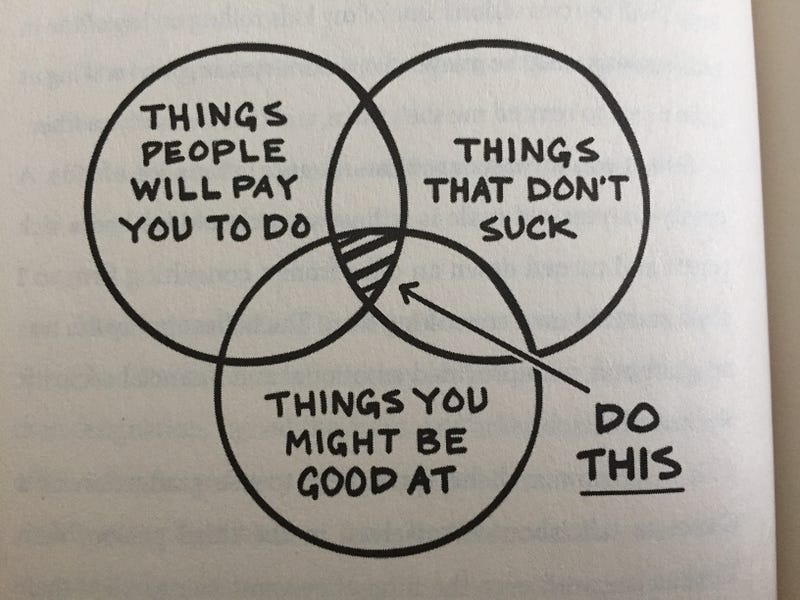
For example, a popular Venn diagram called “sweet spot” is adopted by many authors on discussing career development and life discovery. The below diagram is quoted from Scott Galloway’s 2019 book The Algebra of Happiness.
This “sweet spot” has different versions. For example, you can find the following diagram from G. Richard Shell’s 2013 book Springboard: Launching Your Personal Search for SUCCESS.
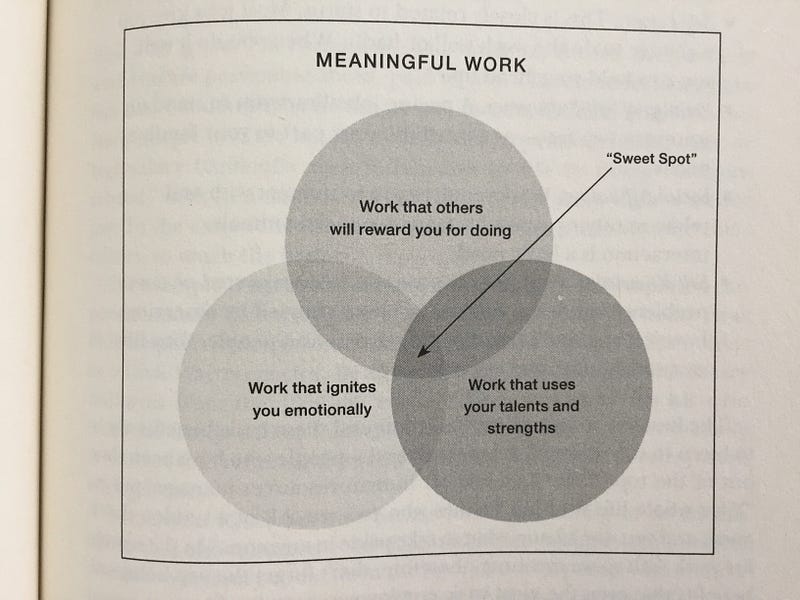
There are several problems behind the “sweet spot” diagram. First, you don’t have to use these three dimensions to define your life, career, or work. You can use two dimensions, four dimensions, five dimensions, etc. Second, you can have more than one “work”, many creative people have more than one work. If you have more than one “work”, you don’t have to search and find the “sweet spot” for each “work”. Third, even if we only use three dimensions and we only search for one “work”, we have to notice that the career is a dynamic process. You can start a “work” from a connection between two dimensions, you don’t have to wait for the ideal sweet spot.
This oversimplified heuristic tool really blocks many young people’s mind and their career choice. Some people just waste their life on an unnecessary “sweet spot”.
Life, Career, Work, these issues are Wicked Problems. We can’t use a simple Venn diagram to solve these issues.
Advanced Knowledge Acquisition
In a 1988 paper titled Cognitive Flexibility Theory: Advanced Knowledge Acquisition in Ill-Structured Domains, Spiro, Coulson, Feltovich, & Anderson defined a theme called Advanced Knowledge Acquisition and suggested a new theory called Cognitive Flexibility Theory.
According to the authors, there are two stages of learning:
- Introductory learning: the goal is exposure to content and establishing a general orientation to a field. The objectives of assessments are more about recognition and recall.
- Advanced Knowledge Acquisition: the learner must attain a deeper understanding of content material, reason with it, and apply it flexibly in diverse contexts.
The content material of Advanced Knowledge Acquisition refers to conceptual complexity and the increasing ill-structuredness. Based on several studies of medical students’ learning, the authors found the following biomedical misconceptions:
- Oversimplification of complex and irregular structure
- Overreliance on a single basis for mental representation
- Overreliance on top-down processing
- Context-independent conceptual representation
- Overreliance on precompiled knowledge structures
- Rigid compartmentalization of knowledge components
- Passive transmission of knowledge
In order to solve the above problems in Advanced Knowledge Acquisition, the authors suggested a new theoretical approach called Cognitive Flexibility with the following themes:
- Avoidance of Oversimplification and Overregularization
- Multiple Representations
- Centrality of Cases
- Conceptual Knowledge as Knowledge-in-Use
- Schema Assembly (from Rigidity to Flexibility)
- Noncompartmentalization of Concepts and Cases (Multiple Interconnectedness)
The Cognitive Flexibility Theory is developed for educational activities such as learning, teaching, and testing around complex conceptual material. A most important application of the theory is designing educational instructions with multiple representations.
Though we don’t have a formal process such as “teacher — complex conceptual material — learner” for Life Discovery, I find that there is a structure of “complex conceptual issues — people — useful knowledge”. As mentioned above, simple useful knowledge might not be suitable for understanding complex conceptual issues.
Thus, the Life Discovery Activity requires people to enter the stage of Advanced Knowledge Acquisition and learn Conceptually Difficult Knowlege.
Eight dimensions of difficulty of Conceptual Knowledge
In a 1993 paper titled Learning, Teaching, and Testing for Complex Conceptual Understanding, Paul Feltovich, Rand Spiro, and Richard Coulson identified the following dimensions of difficulty and complexity of conceptual knowledge:
- Concreteness/abstractness. Are processes concrete and visualizable or abstract?
- Discreteness/continuity. Are attributes and processes discrete or continuous?
- Static/dynamic. Do properties or processes depend on fixed entities or values, or do they depend on change? Are characteristics of a process well represented by a fixed “snapshot” or are characteristics of the process inherently entwined with change in the process from snapshot to snapshot?
- Sequentiality/simultaneity. Do processes occur in a sequential, stepwise fashion, or are there aspects of simultaneity?
- Mechanism/organicism. Are effects tractably traceable to the actions of agents (mechanistic), or are they the product of more holistic, organic functions?
- Separability/interactiveness. Do different processes run independently of each other (or with only weak interaction), or processes strongly interactive?
- Universality/conditionality. Are there principles of function or relationships among entities that are universal in their application or validity, or are regularities much more local and context-dependent?
- Linearity/nonlinearity. Are functional relationships among processes or entities linear or nonlinear?
It is quite interesting that I developed a similar list for a project about Concept-based Creation in 2017. Below is my list:
- Abstract v.s. Concrete
- Deep v.s. Surface
- Indirect v.s. Direct
- Dynamic v.s. Static
- Liquid v.s. Solid
- Inner v.s. Outer
Readers can easily find that the left side of my list refers to Concept while the right side of the list refers to Product. In order words, I thought that the Product should be easily understood by ordinary people. My list is about Concept-based Creation which refers to developing and designing new products.
The Concept Discovery Canvas
Inspired by the above eight dimensions of difficulty of Conceptual Knowledge, I developed the following Concept Discovery Canvas:
The above canvas is based on the Thematic Space Canvas which is designed with the following spatial structures:
- Four Significant Areas
- Four Dimensions
- Two Subspaces: Inner Space and Outer Space
- Eight Pairs of Blocks
- A Primary Theme
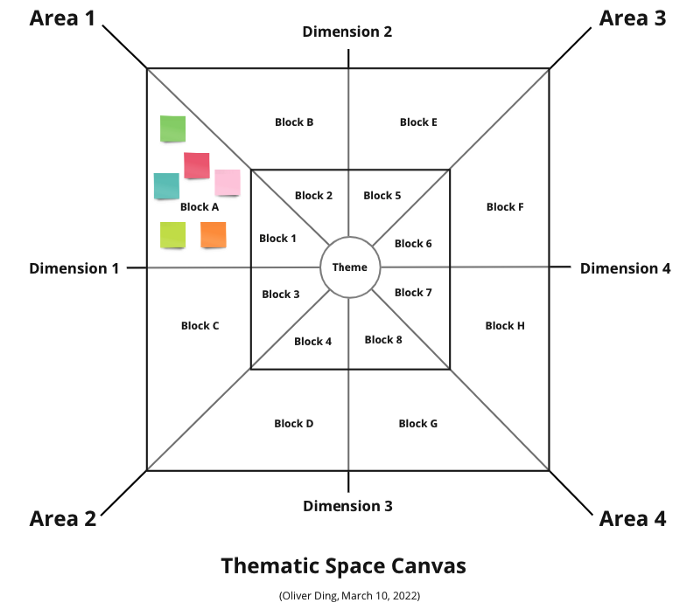
The above canvas is the original Thematic Space Canvas. I use abstract terms such as “area”, “dimension”, “block”, and “theme” for the canvas.
For the Concept Discovery Canvas, it’s easy to define two subspaces:
- Inner Space: It refers to the hard side of 8 dimensions.
- Outer Space: It refers to the easy side of 8 dimensions.
However, I have to define names for four areas, and four dimensions. This process also requires placing the 8 dimensions into 16 blocks. This is not an easy task. Below is the first version of these names:
- Four areas: THING, PROCESS, SYSTEM, SITUATION
- Four dimensions: Awareness, Complexity, Wholeness, Empathy
If you have better ideas to name four areas and four dimensions, pls let me know.
How to Use It?
Though the 8 dimensions are about Advanced Knowledge Acquisition in the field of educational psychology, I think it is also useful for adult development and life discovery in general.
For a particular complex conceptual knowledge, we can use the Concept Discovery Canvas to map our learning and understanding. Then, we can decide the next direction of learning.
For a particular complex conceptual issue, we can use the Concept Discovery Canvas to test our knowledge for coping with the issue. If our knowledge is too easy, we may need to adopt new knowledge.
The above two ways are basic applications. We can expand it from one concept to multiple concepts, and from one person to a group of people.
The Concept Discovery Canvas is an instrument that is part of the Concept Discovery Activity.
You are most welcome to connect via the following social platforms:
Linkedin: https://www.linkedin.com/in/oliverding Twitter: https://twitter.com/oliverding Polywork: https://www.polywork.com/oliverding Boardle: https://www.boardle.io/users/oliver-ding