The Knowledge Curation Toolkit #3: Hamburger for Contextural Curation
Understanding the context of a new knowledge framework
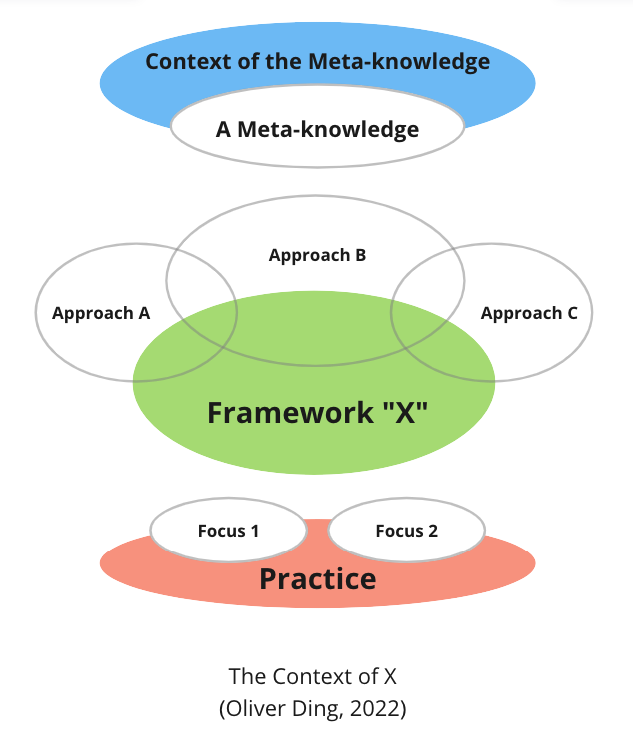
For any knowledge curation project, the context is critical because each piece of knowledge always connects to other pieces of knowledge. In order to make sense of what you are learning or creating, you should pay attention to the context of knowledge.
Today I’d like to introduce “the Context of X” meta-diagram for this purpose. See the above diagram.
The primary project of Curativity Center is Knowledge Curation. For me, the primary outcome of a knowledge curation is a brand new knowledge framework.
What’s a knowledge framework?
A knowledge framework = Concepts + Diagrams + Methods
The Knowledge Curation Toolkit aims to introduce a series of meta-diagrams for building knowledge frameworks. The “Context of X” diagram is for understanding the context of a knowledge framework or a concept.
Contents
1. Contextural Curation 2. The “Context of X” meta-diagram 3. Spatial Structures of “Context of X” 4. Case Study: Epistemic Development 5. Case Study: Activity Analysis 6. Case Study: Slow Cognition 7. “Rethinking Activity Theory” 8. Summary 9. CALL for NEXT: The “Rethinking Activity Theory” Project
1. Contextural Curation
For the knowledge curation project, Content Curation focuses on the process of curating various knowledge resources into a new knowledge framework which is a meaningful whole.
Contextural Curation is different from Content Curation because it is for understanding the context of the knowledge framework. It defines the boundary of the knowledge curation project and the source of knowledge resources.
An important task of Contextural Curation is describing the structure of the context of the knowledge framework. A typical form of structure is a multiple-level hierarchy.
On Jan 11, 2022, I used a metaphor to develop a diagram for understanding the Context of Developing Tacit Knowledge in order to answer a question about the value of the Thematic Space Canvas which is designed for Developing Tacit Knowledge.
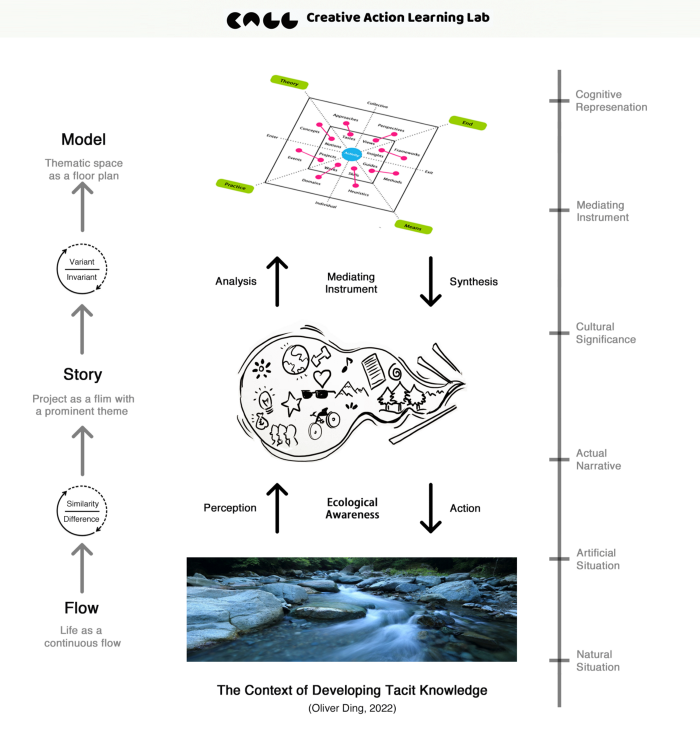
I used “Flow, Film, and Floor Plan” as a metaphor to describe Thematic Space in the context of life development.
- Experience > Flow > Life as a continuous flow
- Story > Film > Project as a film with a prominent theme
- Model > Floor Plan > Thematic space as a floor plan
You can find more details in the original article: Thematic Space: Flow, Film, and Floor Plan.
Today I am going to introduce the “Context of X” meta-diagram for understanding the context of a knowledge framework.
2. The “Context of X” meta-diagram
The “Context of X” meta-diagram is also called “Hamburger” because it looks like a hamburger. See the diagram below.
The above diagram can be seen as a structure of three parts and six levels.
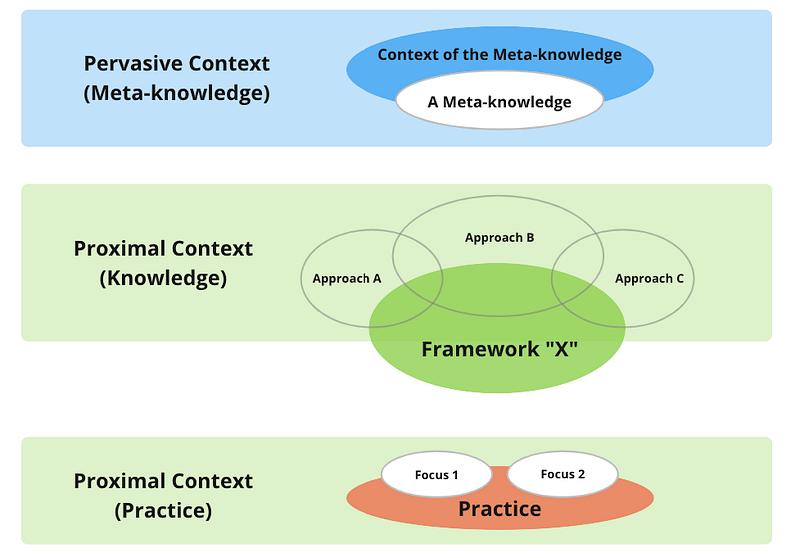
I adopt the Curated Mind framework to define the following three parts:
- Pervasive Context: Meta-knowledge
- Proximal Context: Knowledge
- Proximal Context: Practice
The Knowledge Framework “X” is located between Knowledge and Practice.
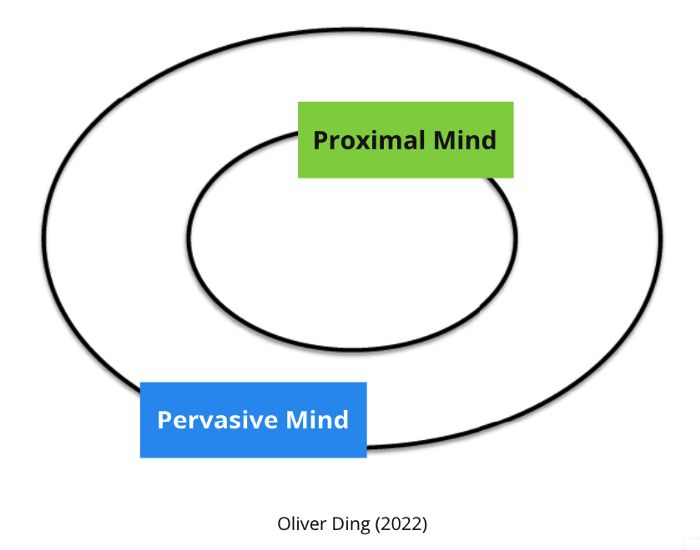
The above diagram is the basic model of the Curated Mind which is defined as an Anticipatory Activity System. As a system, the Curated Mind has two parts: Proximal Mind and Pervasive Mind.
This model adopted the ecological approach to reflect on the Mind. While Proximal Mind corresponds to Proximal Contexts, Pervasive Mind corresponds to Pervasive Mind.
- Proximal Contexts (Proximal Mind)
- Pervasive Contexts (Pervasive Mind)
A special meta-theory behind the model is Curativity Theory. The term Curativity refers to turning pieces into a meaningful whole. The Curated Mind means the ideal status of the mind. If a person claims that her or his mind is a meaningful whole, then she or he can understand the world as a meaningful whole.
Now we can consider the Context of X as an application of the Curated Mind framework. You can find more details about Curated Mind in Slow Cognition: The Curated Mind and Slow Cognition: The Model of Curated Mind.
3. Spatial Structures of “Context of X”
The “Context of X” meta-diagram has three parts and six levels. Each part can be seen as Focus and Field.
A Field is a container that contains many items. Some items are the primary Focus of our knowledge curation projects. We can pay attention to Focus, Field, and the “Focus — Field” relationship and ignore non-focus items.
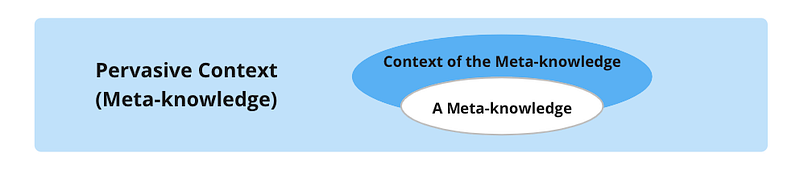
For example, the “Meta-knowledge” part is a Field. We only need to care about a particular meta-knowledge (as a Focus) and its context.
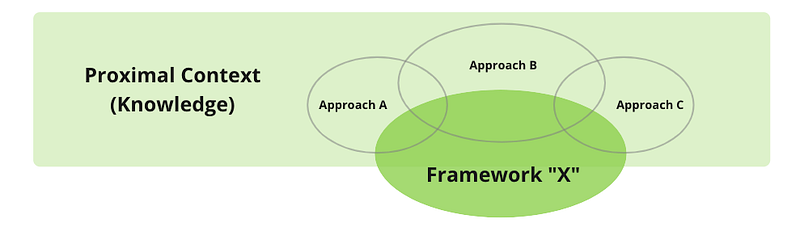
The “Knowledge” part is a Field too. We can highlight three different things in the context. For example, I consider three approaches as knowledge resources for developing a brand new knowledge framework “X” which is the primary Focus.
Framework “X” is the primary creative container of the whole diagram. Its value is similar to the Echozone (Container Z) of the WXMY meta-diagram. Both two containers are spaces for discovering new ideas, creating new concepts, and designing new projects.

The “Practice” part is a Field that refers to the real-life world. I only highlight two focuses.
Why do I only highlight 1 meta-knowledge, 3 approaches, and 2 focuses of the real-life world?
The Context of X meta-diagram is a heuristic tool. The number is defined for two reasons: 1) visual graphic design, and 2) cognitive operation.
We can see this is a basic model of the Context of X meta-diagram. In real situations, you can use different numbers such as 2 meta-knowledge, 4 approaches, and 3 focuses of practice. See the diagram below.
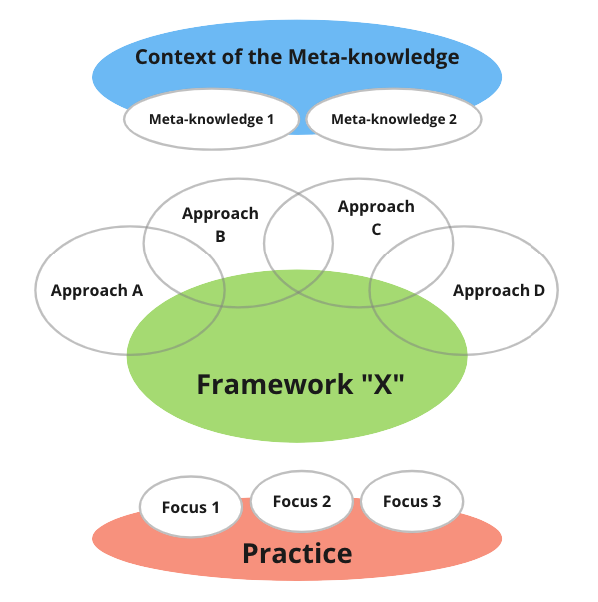
The new diagram keeps the basic ideas and the structure of the Context of X.
Why do we need Context of X since we already have Theme U and WXMY?
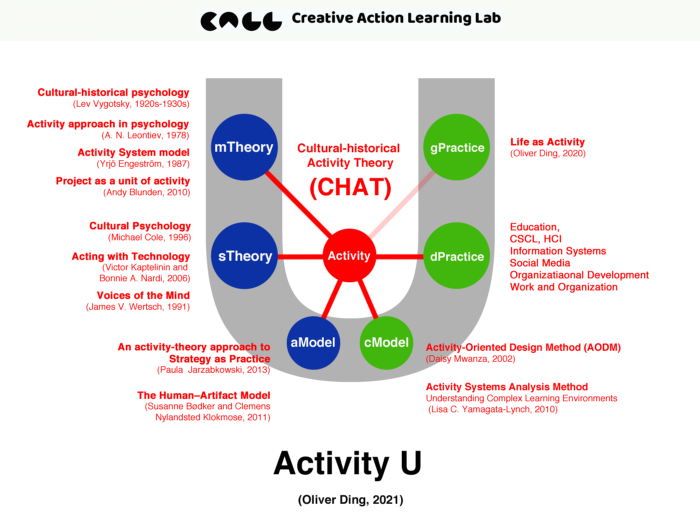
The Theme U is for Single-theory Curation. All six themes are part of one Field which is only about a particular theory. You can understand six themes as six focuses. The diagram below is only about Activity Theory.
The WXMY is for Interdisciplinary Curation, especially for connecting two things. See the diagram below.
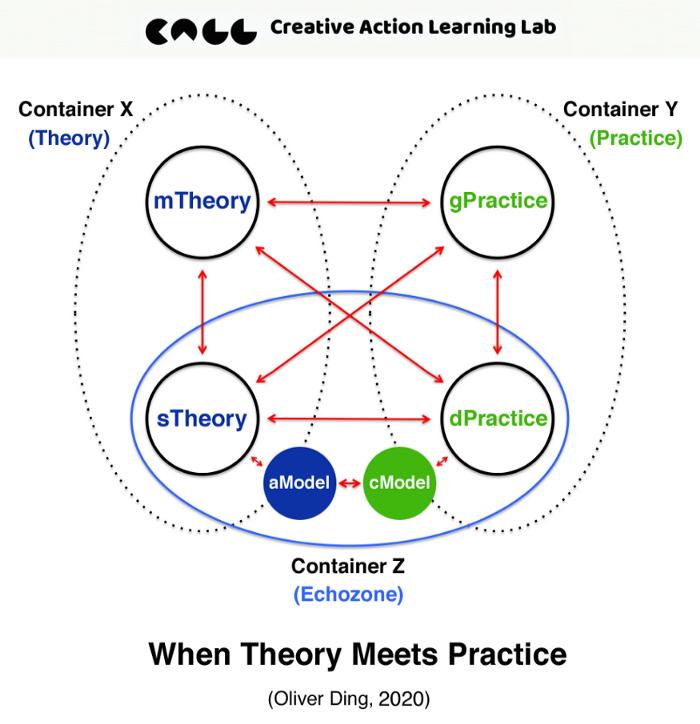
Though the Echozone (Container Z) is similar to Framework X, there are two differences between the two diagrams.
- The Context of X uses levels and hierarchy while WXMY doesn’t have the same structure.
- The Context of X highlight more than one item for some levels while WXMY only displays one item for each type.
For example, if we turn the WXMY diagram into levels and compare it with the Context of X, then we get the following list:
- Context of Meta-knowledge v.s. Meta-Theory (mTheory)
- One or more Meta-knowledge v.s. Special Theory (sTheory)
- Three or more Approaches v.s. Abstract Models (aModel)
- Framework X v.s. Concrete Models (cModel)
- Two or more focuses of real-life world v.s. Domain Practice (dPractice)
- Practice v.s. General Practice (gPractice)
However, there is no real 1:1 mapping between two meta-diagrams. Framework X doesn't only mean Concrete Models.
4. Case Study: Epistemic Development
As a serial creator and a lifelong thinker, I am passionate about intellectual development and life reflection. I wrote my first learning autobiography in 2015 and was attracted to biographical studies. In 2016, I developed a framework called Career Landscape which is inspired by Activity Theory, Communities of Practice, and other ideas. I also developed a series of tools such as Learning Autobiography Guide, Learning & Reflective Cards, Learning & Reflective Canvas, Learning & Reflective Monthly Report Template, etc.
At the end of 2017, I wrote a series of articles on the relationship between Knowledge and Personal Development and developed a framework called Dynamic System of Personal Knowing. Though I quoted many theories about knowledge and development in 2017, I didn’t check the status of Personal Knowing from the perspective of academic research.
In June 2018, I did a rough literature review about personal knowing and found there is an established discipline called Personal Epistemology or Epistemic Cognition.
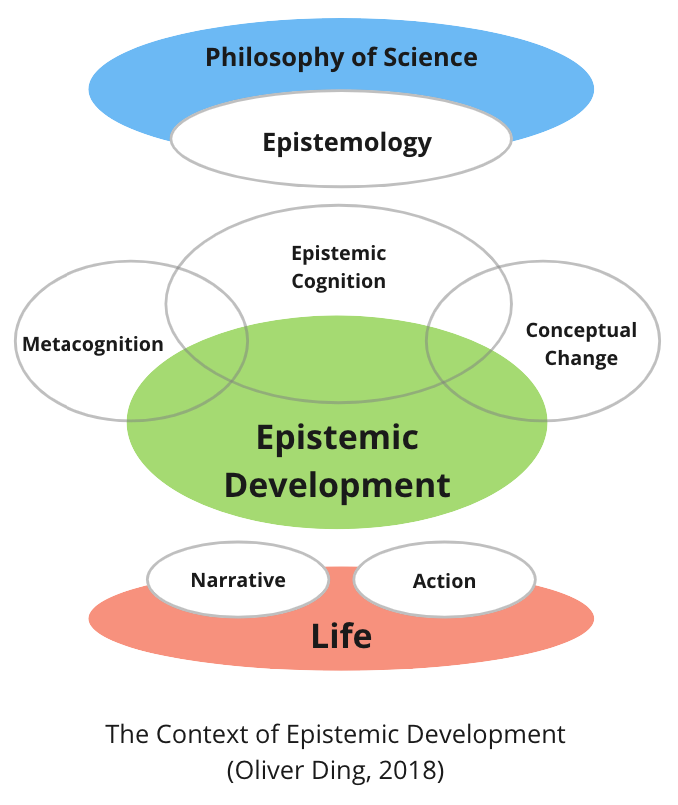
At the top of the Sandwich, there is a branch of philosophy: epistemology. Also, a related discipline is the Philosophy of Science.
At the bottom of the Sandwich, there is a real daily life world. I pointed out two keywords: Narrative and Action. These two keywords refer to two approaches: the narrative approach is about biographical studies while the action science approach refers to Chris Argyris’ Action Science and Donald Schön’s Theory in Practice and The Reflective Practitioner.
In the middle of the Sandwich, there are several areas. One layer is about academic professional research themes such as Metacognition, Epistemic Cognition, and Conceptual Change. These themes belong to different disciplines and different theoretical research traditions. For example, Metacognition is part of cognitive psychology. Epistemic Cognition belongs to educational studies. The term Conceptual Change is only used by North American scholars.
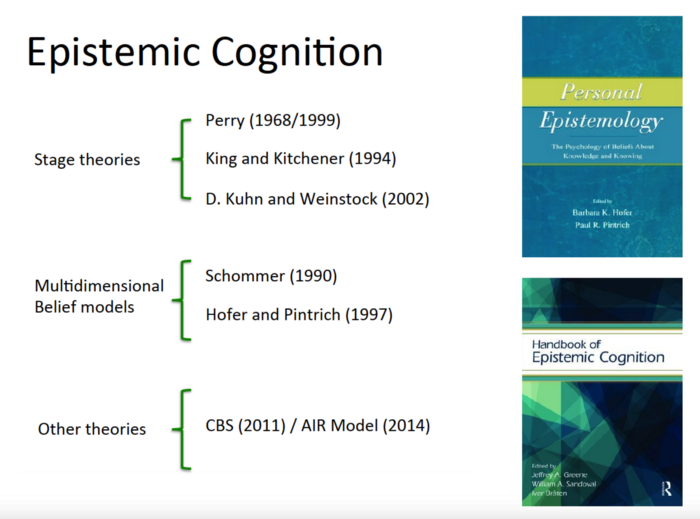
In order to connect academic research and the daily life world, I coined the term Epistemic Development and used it to replace my old terms such as intellectual development and life reflection.
Finally, I found my position on a large map. You can find more details of the story in D as Diagramming: Challenge as Opportunity.
5. Case Study: Activity Analysis
On Jan 13, I developed two new Sparks for the Activity Analysis project. I designed two diagrams to visualize these sparks.
The first diagram is about the knowledge niche of the Activity Analysis project. Inspired by the above diagram, I made a new diagram for Activity Analysis.
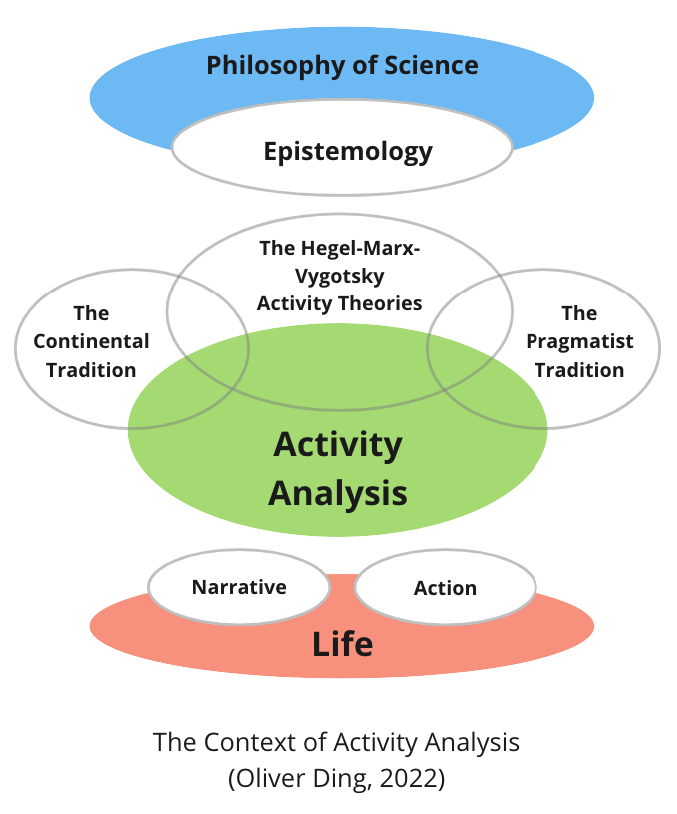
The above diagram points out that there are three types of theoretical resources for the Activity Analysis project:
- The Hegel-Marx-Vygotsky Activity Theories: This is the tradition of Activity Theory
- The Continental Tradition
- The Pragmatist Tradition
What does this diagram mean? It means the Activity Analysis project doesn’t only refer to Activity Theory, but other social theories about social practices and human activities in general.
You can find more details about the story in Thematic Space: The Art of Continuous Discovery.
If you compare this diagram with the above “Activity U” diagram, then you can find the difference between the Context of X diagram and the Theme U diagram.
The Context of X diagram is more about providing broad background as the context of a particular idea while the Theme U focuses on six types of items within one field.
6. Case Study: Slow Cognition
On June 23, 2022, I made the following diagram for the Slow Cognition project.
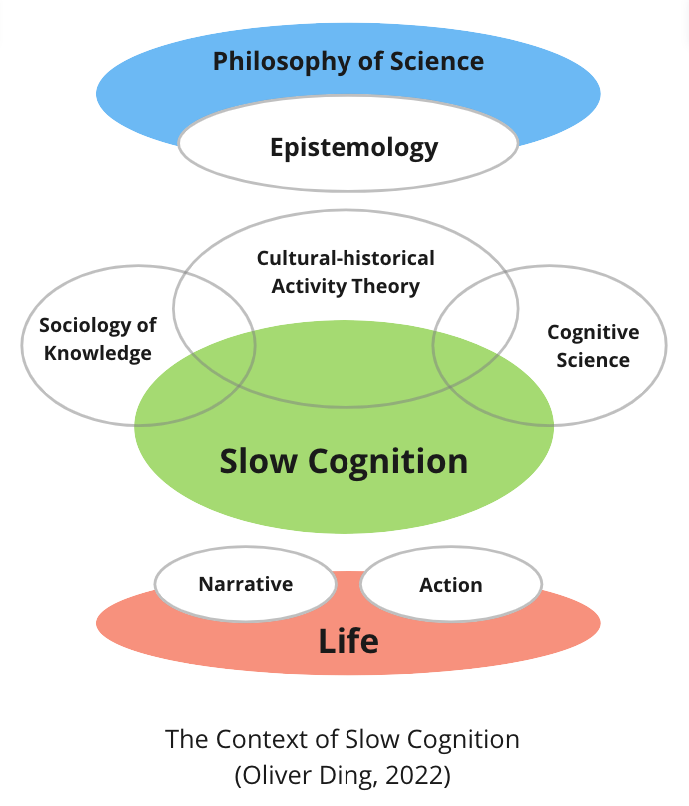
I considered three major knowledge resources for the “Slow Cognition” project.
- Cultural-historical Activity Theory
- Sociology of Knowledge
- Cognitive Science
You can compare this one with the above “Activity Analysis” diagram.
For the “Activity Analysis” diagram, I used the following knowledge resources:
- The Hegel-Marx-Vygotsky Activity Theories: This is the tradition of Activity Theory
- The Continental Tradition
- The Pragmatist Tradition
The major difference between these two diagrams is the item “Cognitive Science”. Why did I make this? Because the “Slow Cognition” project is about the long-term development of thoughts. It should consider “Cognition” from the perspective of Cognitive Science and the “long-term development” from the perspective of Cultural-historical Activity Theory. Also, I focus on professional knowledge works, not scientists. So I believe that Sociology of Knowledge is an important discipline for the Slow Cognition project too.
You can also compare this version of “Slow Cognition” with the following diagram about “Slow Cognition”.
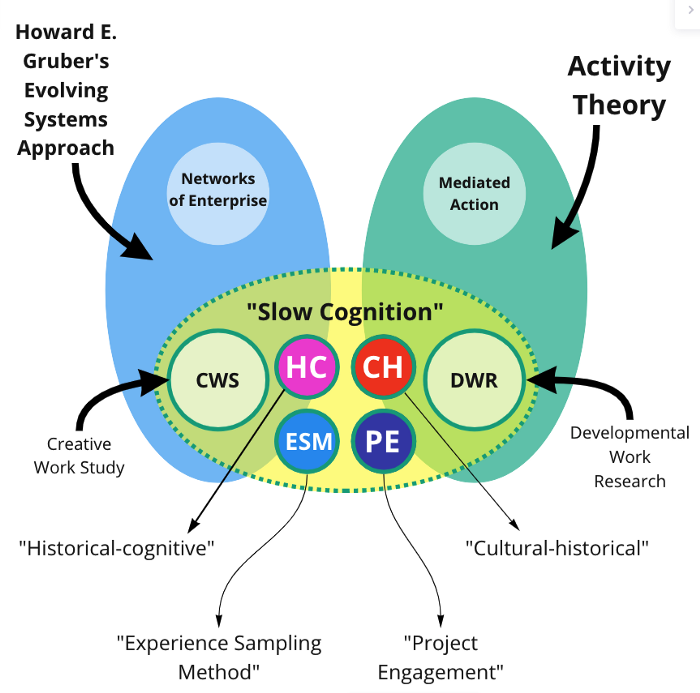
The above diagram is made with the WXMY meta-diagram. I have mentioned the difference between the Context of X and the WXMY. This one is a real example.
We can use both two diagrams because we can use the Context of X to define knowledge resources and the context for a project and use the WXMY to discover internal items of a new idea.
7. “Rethinking Activity Theory”
Yesterday I shared a note titled Re-thinking Activity Theory. In the past two weeks, I returned to theoretical learning of Activity Theory.
Why?
There are three things behind this move: 1) Last week the AAS4LT program roughly closed its first part: Life Discovery Project, 2) I am reading a book titled The Scientific Project of Sociology, 3) I am also reading a book titled Controversy Mapping.
All these things encourage me to re-read papers about Activity Theory and rethink it and my creations about it.
The second thing is reading a book titled The Scientific Project of Sociology (Ping-keung Lui, 2010) which is the second series of lectures on sociology-philosophy, taught in a course for MA(Part-time) students at the Department of Philosophy, The Chinese University of Hong Kong, Fall 2010. Its original title was “The Philosophers, the Sociologists, and the Scientific Project of Sociology”.
Ping-keung Lui aims to build a brand new theoretical sociology as a candidate for the paradigm of sociology. According to Lui, “There are three kinds of theories in sociology, namely, social theory, sociological theory, and theoretical sociology. ”
- Social theories are speculations about the social world. They constitute the speculative project of sociology.
- Some social theories are amenable to positivistic investigation under certain specific conditions. I call them sociological theories.
- Also, some other social theories, being very ambitious, attempt to recruit as many as they can sociological theories supporting themselves. I call them theoretical sociologies. They compete against each other. The winner becomes the paradigm of sociology, and its supporting sociological theories become exemplars of the paradigm. In this way, theoretical sociologies and sociological theories constitute the scientific project of sociology.
Two days ago, I had a short chat with Lui about the term “Social theories”. In fact, he considers all “Social Thoughts”, “Logs”, and “Ideology” as “Social theories”. For example, a political party’s ideology and a professional community’s knowledge framework are “Social theories” from his perspective.
The book was organized into four parts:
- Introduction: Philosophy of Social Science
- Part I: Realism
- Part II: Method
- Conclusion: The Scientific Project of Sociology
Lui developed his account in two steps. First, he curated some theories in sociology and philosophy for his lectures by selecting, quoting, analyzing, and discussing. Second, he created his own perspective by reflecting and responding to these theories. This is an amazing example of Curativity as Creativity.
To be honest, it is a challenge to read this book for me. However, it offers me a guide to reading some social theoretical thinkers such as Schutz, Giddens, Bourdieu, Goffman, etc.
During the process of reading this book, I asked myself a question:
Is Activity Theory a sociological theory?
It’s not easy to answer this question because there are many branches of Activity Theory. In fact, the term “Activity Theory” is not an official name for a particular theoretical account. People just use it as a name to refer to a family of similar approaches.
In the past two decades, scholars also used “Cultural-historical Activity Theory” (CHAT) to refer to a set of approaches and expanded the focus from psychology to multiple disciplines. According to Manolis Dafermos (2015), “A multidisciplinary approach to activity theory has developed at the Center for Activity Theory and Developmental Work Research (University of Finland, Helsinki) led by Yrjö Engeström. Vygotsky, Luria, and Leontiev worked in the context of psychology as a discipline, while the representatives of CHAT developed a multidisciplinary research program.”
In a 2019 paper that reviewed the development of Yrjö Engeström’s account, Clay Spinuzzi claimed that the account “was arguably closer to an organizational sociology. This organizational sociology is specifically oriented to interventionist research: i.e., the consensus-driven codesign of systems of collective action.”
Thus, I started re-read Clay Spinuzzi’s papers about the historical development of Yrjö Engeström’s Activity System model and expansive learning model.
In Sept 2020, I wrote a long article titled Activity U (IV): The Engeström’s Triangle and the Power of Diagram from the perspective of diagrams and diagramming on theoretical building and development.
Now, I am re-reading related papers from the perspective of The Scientific Project of Sociology.
Today I made the following diagram with the Context of X meta-diagram.
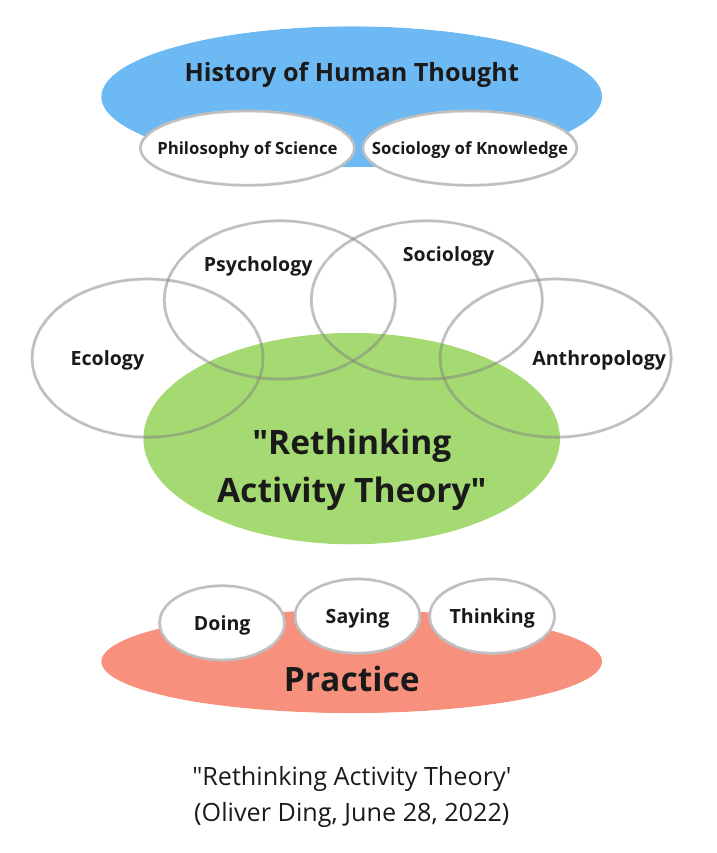
This morning I read several papers about the historical development of Activity Theory, then I realized that there is a new way to “Rethinking Activity Theory”.
Some authors focus on particular thinkers such as Lev Vygotsky. Some authors focus on the historical development of a particular theoretical account such as CHAT or the Activity System Model. Some authors use internal perspectives to reflect on the development of CHAT. Some authors compare CHAT, Activity Theory with other theoretical approaches.
As mentioned above, my idea was inspired by a question:
Is Activity Theory a sociological theory?
This question encourages me to adopt an external perspective to reflect on the historical development of Activity Theory. We can focus on discovering the following aspects of Activity Theory:
- Anthropological aspect
- Psychological aspect
- Sociological aspect
- Ecological aspect
Now we can use the Container P diagram to expand the Framework “X” container. See the diagram below.
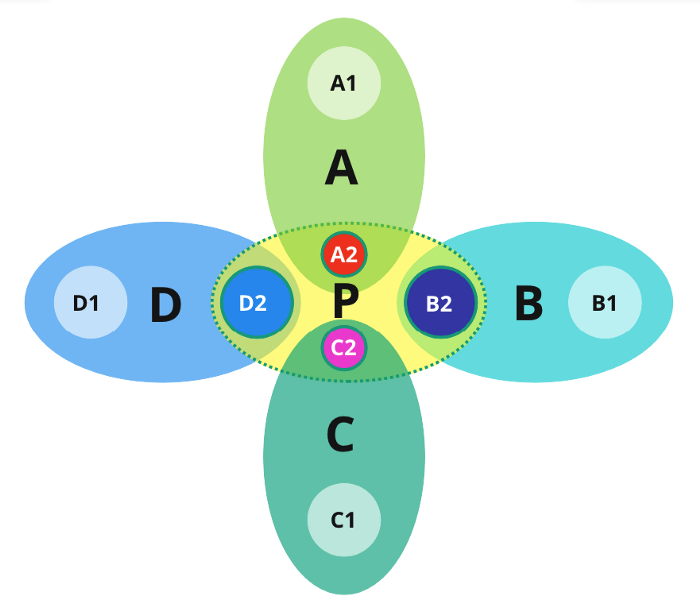
The above diagram displays five containers: A, B, C, D, and P.
Container P is about a Possible new meaningful whole. For the present discussion, it refers to the notion of “Rethinking Activity Theory” and a possible project about it.
The other four containers are four fields, four perspectives, and four types of insights. For example, let’s consider A as the field of Psychology, then we have the following items:
- A: the field of psychology
- A1: an item belong to psychology, but is not part of Activity Theory
- A2: an item is inspired by A1, and it is part of Activity Theory
In this way, we use the Psychological perspective to guide us to discover psychological aspects of Activity Theory.
Now let’s apply this approach to make the first quotation for the “Rethinking Activity Theory” project.
In the theories of Rubinstein and Vygotsky, development is considered primarily as a self-actualization of the individual aiming at his own goals. Mastering cultural tools of mental and motor activity, an individual appears to be a self-determining creator of himself and the “sub’ekt” of his own life.
The concept of self-determination appeared in Western theories in 1970s, and since then it has been developed in the context of a teleological humanitarian approach, viewed as an intrinsic quality of a human being, which can explain human behavior — itself beyond explanation (Deci 1971, 1975; Deci and Ryan 1985). In Russian psychology the concept of self-determination dates back to the1920s, when it was defined by S.L. Rubinstein as “sub’ekt”. Soviet psychology was oriented to the standarts of natural science, and so in the AT foundations a causal approach to self-determination was laid, that was relevant to the natural science. But it was not in the Leontiev school that the ideas of self-determination were developed.
The above quotation is quoted from Irina A. Mironenko’s 2013 paper Concerning Interpretations of Activity Theory (p.381).
We can identify A1 and A2 from the above quotation:
- A1: “The concept of self-determination appeared in Western theories in 1970s, and since then it has been developed in the context of a teleological humanitarian approach…”
- A2: S.L. Rubinstein’s idea of “sub’ekt”
What’s “sub’ekt”? We can find more details in the paper. See the following quotation (p.379):
The concept of Sub’ekt (and “Sub’ektnost” for a quality to be a Sub’ekt) refers to S.L. Rubinstein whose main idea was that Psyche is a procreation of active interaction of individual with the environment. Sub’ekt means somebody whose activity is generated by his own needs, who is choosing and pursuing his own aims, serving his own purposes: a self-determined and self-actualizing agent.
According to Rubinstein, Psyche has developed in the course of evolution as a means for a living being to promote its survival and to pursue its needs. Psychic structure is determined by the inner needs of the individual; so to reveal a psychic set up, the needs should be analyzed. It is the inner sources of activity which Rubinstein focused on.
Vygotsky accepted the idea of “Sub’ektnost” and relied on that in his Cultural- Historical theory. Vygotsky points out: “An infant is a “sub’ekt” of development” (Vygotsky 1982, V. 2, p. 281). He emphasized that culture is not just poured into the child: on the contrary, the child actively enters into culture, and commandeering culture elements which he needs, taking them from the outside and internalizing them.
According to the author, “It should be mentioned that unfortunately ‘Sub’ekt’ is usually translated as ‘subject’, and this translation kills the meaning of a translated text completely, because in English ‘subject’ means something or somebody who/which is put under some pressure, exposed to some action, subjected to some impact…This difficulty of translation of the notion of ‘Sub’ekt’ into English could probably account for the fact that Rubinstein approach caused more interest in Germany and in Scandinavia than in the English speaking countries.” (p.378)
The above quotation is a sample of the possible project “Rethinking Activity Theory”.
The above discussion also shows a case of expanding the Framework of “X” with other meta-diagrams.
8. Summary
For the knowledge curation project, Contextural Curation is for understanding the context of the knowledge framework. It defines the boundary of the knowledge curation project and the source of knowledge resources.
The Context of X meta-diagram offers a solution for describing the structure of the context of the knowledge framework with a multiple-level form. It has three parts and six levels.
- Meta-knowledge
- Knowledge
- Practice
The “Context of X” meta-diagram has three parts and six levels. Each part can be seen as Focus and Field.
A Field is a container that contains many items. Some items are the primary Focus of our knowledge curation projects. We can pay attention to Focus, Field, and the “Focus — Field” relationship and ignore non-focus items.
The above discussion shares three examples of using the Context of X diagram:
- Case study: Epistemic Development
- Case study: Activity Analysis
- Case study: Slow Cognition
I also discussed the notion of “Rethinking Activity Theory” and used the Container P to expand the Framework “X”. I also applied the new model to make the first note for the “Rethinking Activity Theory” project.
9. CALL for NEXT: The “Rethinking Activity Theory” Project
Now it’s your turn to make a project. Life is short. You can transform yourself one project at a time.
You can also join a project. Since the above discussion describes a possible project called “Rethinking Activity Theory”, I’d like to invite you to join the project.

You can read related papers and write notes. I’d like to publish your notes on the Activity Analysis website.
Related Articles:
- The Knowledge Curation Project
- The Knowledge Curation Toolkit #1: Theme U for Single-theory Curation
- The Knowledge Curation Toolkit #2: WXMY for Interdisciplinary Curation
You are most welcome to connect via the following social platforms:
Linkedin: https://www.linkedin.com/in/oliverding Twitter: https://twitter.com/oliverding Polywork: https://www.polywork.com/oliverding Boardle: https://www.boardle.io/users/oliver-ding