
Life Curation: The Container, Double R Analysis, and Challenges
A new model for Life Curation
In Dec 2019, I had a discussion with a friend about her career development. In order to share my insights from the perspective of the Ecological Practice approach and Curativity Theory, I made a file titled Life Curation.
I have been working in the curation field for over ten years. I was the Chief Information Architect of BagTheWeb which was an early tool for content curation (We launched the site in 2010). This experience inspired me to make a long-term commitment to the Curation theme. After having 10 years of various curation-related practical work experience and theory learning, I coined a term called Curativity and developed Curativity Theory which became a book.
The new term Curativity refers to “curating pieces into a meaningful whole” which means general curatorial practice. The reason why I coined the term is that I was not satisfied with the specific view of curation such as “professional curation means art and museum.” I argued that there is a need to redefine “curatorial practice” as a general social activity and a universal experience. In other words, I was calling an interdisciplinary view of curation or curatorial practice.
Curativity Theory adopts James Gibson’s “Affordance”, George Lakoff’s “Container” and Donald Schön’s “Reflection” as epistemological tools. The diagram below shows the basic elements of Curativity: Pieces — Container — Whole. The basic assumption behind the diagram and the new term is: “In order to effectively curate pieces into a meaningful whole, we need Container to contain pieces and shape them.”
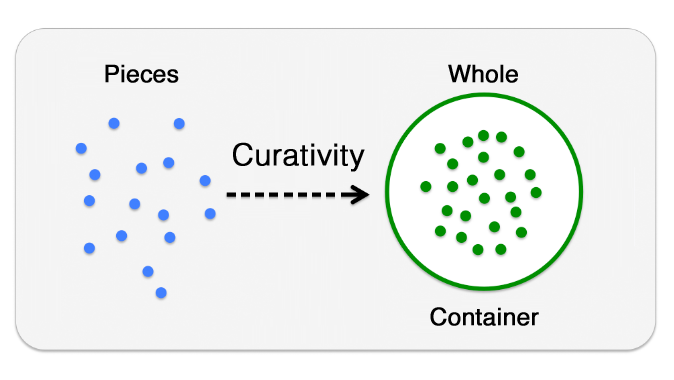
Pieces, Container, and Whole together form a triad which is the basic unit of analysis of Curativity Theory.
Container P
From the perspective of Curativity Theory, Life Curation refers to considering pieces of experience, pieces of concepts, and pieces of actions at a lower level and moving to a higher level to curate these pieces into a meaningful whole.
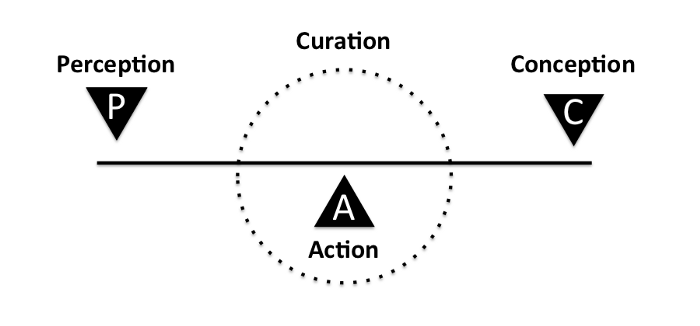
Let’s use five containers to make a visualization of Life Curation. There are four containers and each container refers to a Real Activity/Journey:
- Container A
- Container B
- Container C
- Container D
And there is a container that is not real, but potential. Let’s call it Container P.
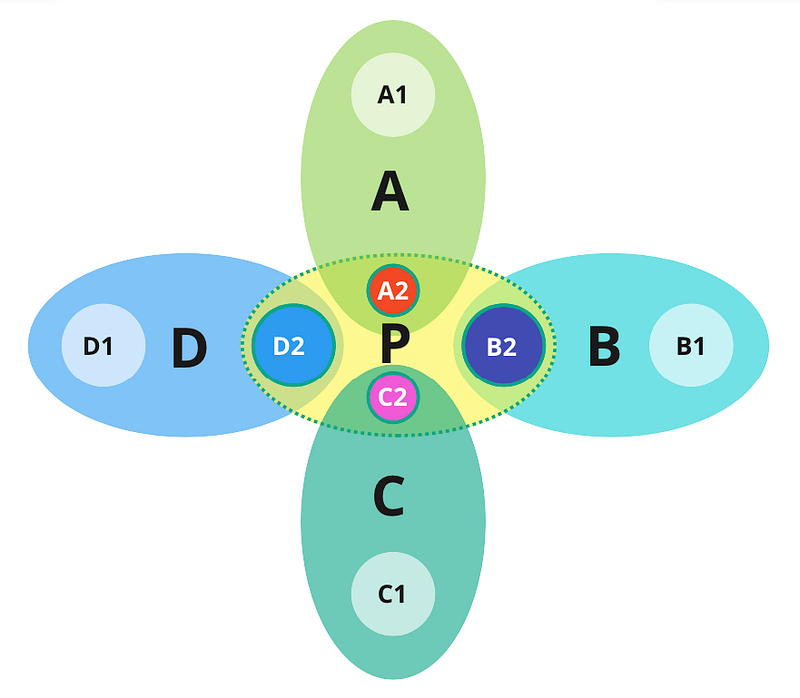
Each container contains several Actions/Events. For example, Container A contains Action/Event A1 and A2, Container B contains Action/Event B1 and B2, and so on.
Usually, we perceive A2 as part of Container A and B2 as part of Container B because each Container has its own situations, motivations, environments, themes, collaborations, etc. We tend to tie an Action/Event to its original context.
How to create Container P which is not a real thing?
Container P is about a Possible new meaningful whole. From the perspective of Curativity Theory, we need a new Theme to define the new whole and a new Environment to contain the new whole.
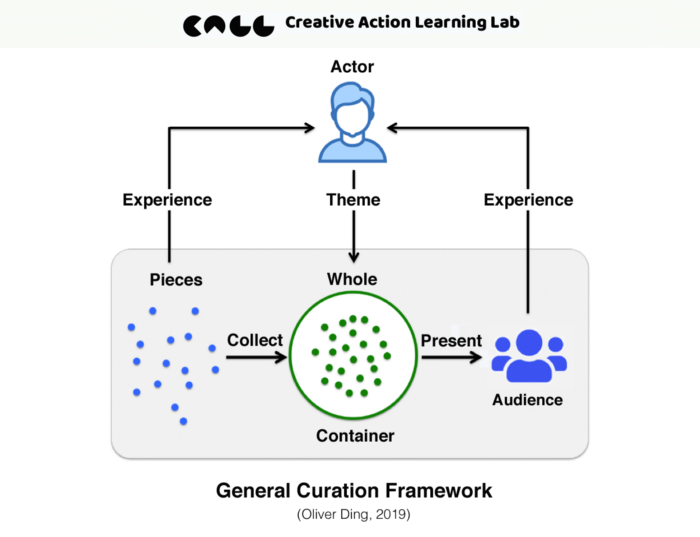
The above diagram is the general curation framework. Let’s apply it to Life Curation with the above example of four containers:
- Pieces: A2, B2, C2, and D2.
- Whole: Container P and a new theme.
- Actor: You.
- Audience: You and Others.
- Experience 1: You perceive new meanings of A2, B2, C2, and D2 from the perspective of the new theme.
- Collect: You detach A2, B2, C2, and D2 from their original containers and attach them to Container P.
- Present: Audiences see a new meaningful whole.
- Experience 2: You see audiences’ feedback about the new meaningful whole, then you change your action of curating.
The key of form Container P is discovering a new theme. It requires creative techniques and strategic techniques.
The Life Curation Framework
The original 2019 Life Curation framework is an application of the early version of the Ecological Practice approach. See the diagram below.
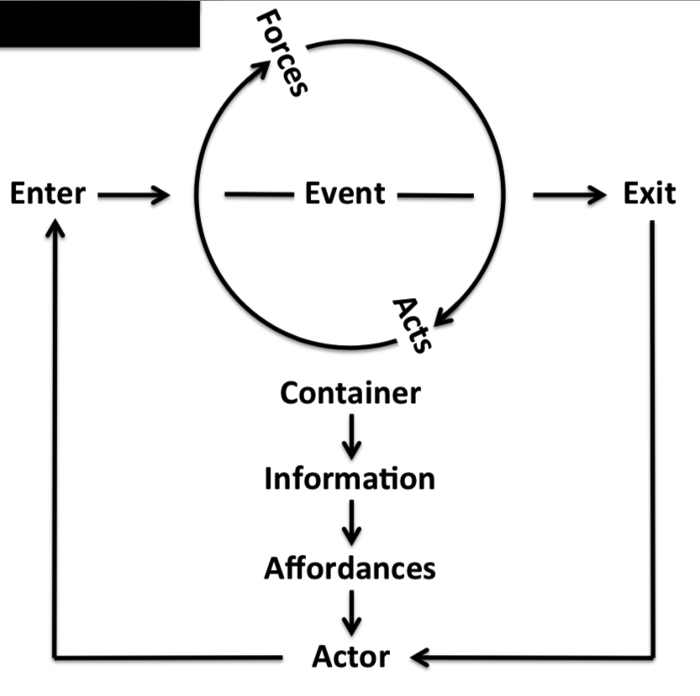
In order to apply the above model to discuss Life Development or Career Development, I translated the above theoretical concepts into operational concepts:
- Container > Social Container
- Forces > Challenges
- Acts > Responses
- Enter > Resources
- Exit > Results
- Events > Social Events
- Information > Information
- Affordances > Opportunities
- Actor > Actor
The new framework has four modules:
- Double R Analysis: the “Resources — Results” Analysis
- Social Event Analysis: the “Challenge — Response” Analysis
- Social Attachance Analysis: the “Exit — Exit” Analysis
- Opportunity Analysis: the “Information — Opportunities — Action” Analysis
I used normal words such as “Resources”, “Results”, “Challenge”, “Responses”, and “Opportunities” as operational concepts. However, I also offered some new perspectives for understanding these words in order to make more creative spaces for life development.
The most important value of the Ecological Practice approach is its perspective indicates the ecological meaning of objects and environments. It is very useful for rethinking Resources and Opportunities.
You can also find a story about the “Challenge — Response” Analysis here.
Why did I name the framework Life Curation? There are two reasons:
- Its core is Social Container and this is the core of Curativity Theory. Social Containers create many boundaries in our life. These boundaries cut our life into pieces. The Life Curation Curation aims to turn these pieces into a meaningful whole.
- The “Resources — Results” Analysis can be applied to different time-scale analyses. The framework suggests that a person could build his or her own creative containers in order to curate pieces of resources into meaningful results.
The essential theme behind the Life Curation framework is the “Pieces — Whole” relationship. I also consider it an important theme for the Life Strategy framework.
Double R Analysis
The Double R Analysis refers to the “Resouces — Results” Analysis.
The concept of “Resouces” is an important concept for strategic thinking. However, I didn’t find it in a popular framework of Activity Theory: Yrjö Engeström’s Activity System model.
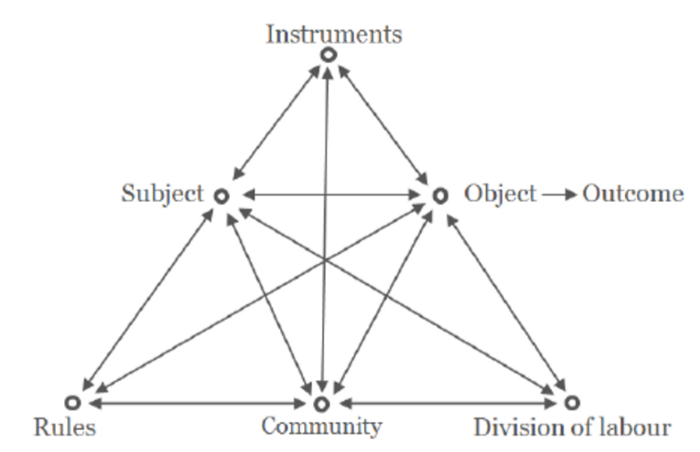
Since the model doesn’t have the concept of Resource, I have to apply some data to Mediation or Object which are two “official” concepts of the model. I even created a new diagram called Activity System Plus which adds “Resource” to the original model for private discussions with my friends.
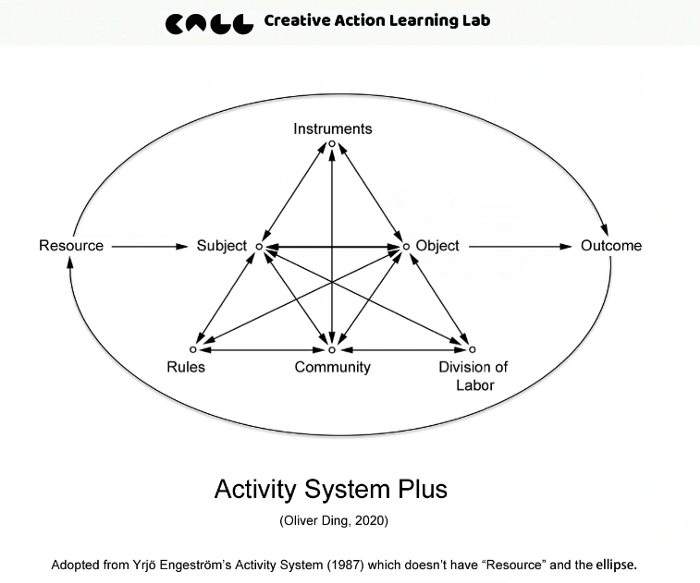
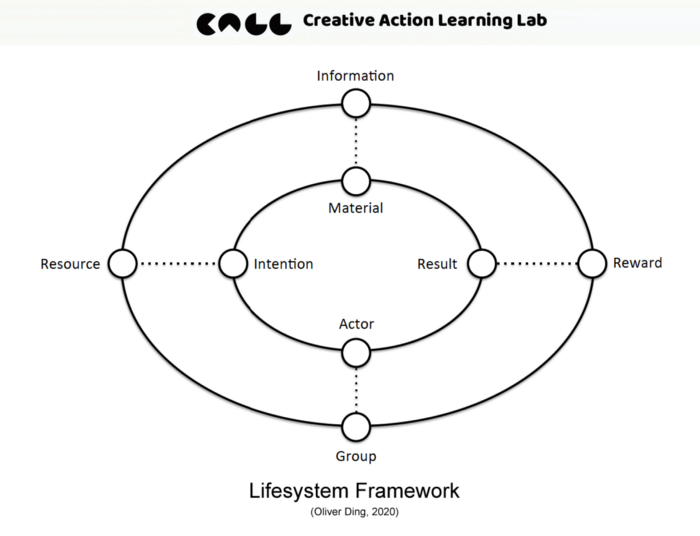
Later, I used the Double R analysis for the Lifesystem framework. See the diagram below. You can find more details here.
The concept of “Resource” is also inspired by the following diagram which is a model of TRIZ. I found the diagram from Kalevi Rantanen and Ellen Domb’s 2007 book Simplified TRIZ: New Problem Solving Applications for Engineers and Manufacturing Professionals.
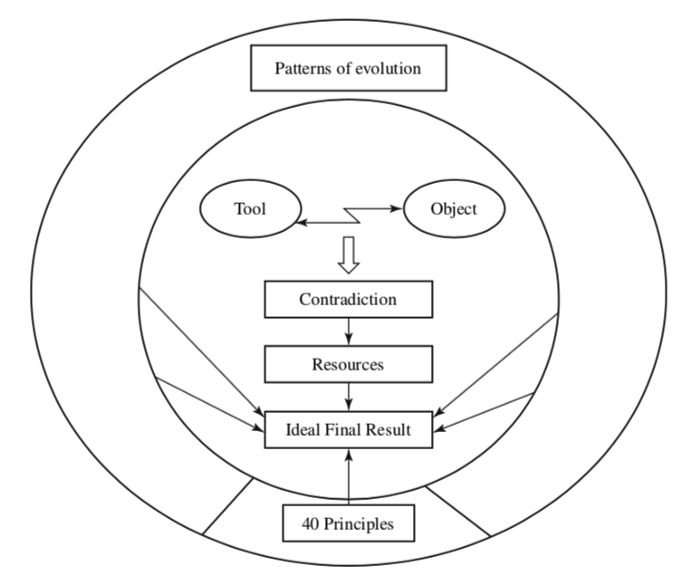
The book uses one chapter titled Mapping Invisible Resources to discuss the topic of Resources.
For the Lifesystem framework, I’d like to point out that the most important value of the Ecological Practice approach is its perspective indicates the ecological meaning of objects and environments. It is very useful for rethinking Resources and Opportunities.
The concept of Result refers to the final outcome of a Lifesystem. One useful way is to distinguish between three types of outcomes: product, by-product, and meta-product. The product refers to the intended outcome within the original objective of Lifesystem and the by-product refers to the unintended outcome beyond the original objective of Lifesystem. The meta-product refers to the transformation of self as the outcome of Lifesystem.
For Life Curation, the Double R Analysis suggests that a person could build his or her creative containers to curate pieces of resources into meaningful results.
Challenge as Opportunity
One part of the Life Curation framework is the “Challenge — Response” module. By curating some theories, I identified three types of challenges. See the diagram below.
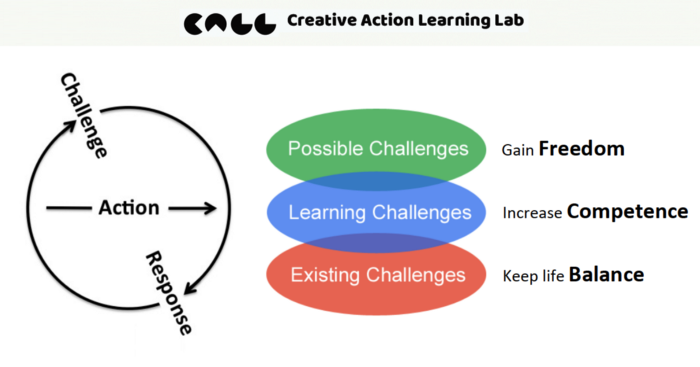
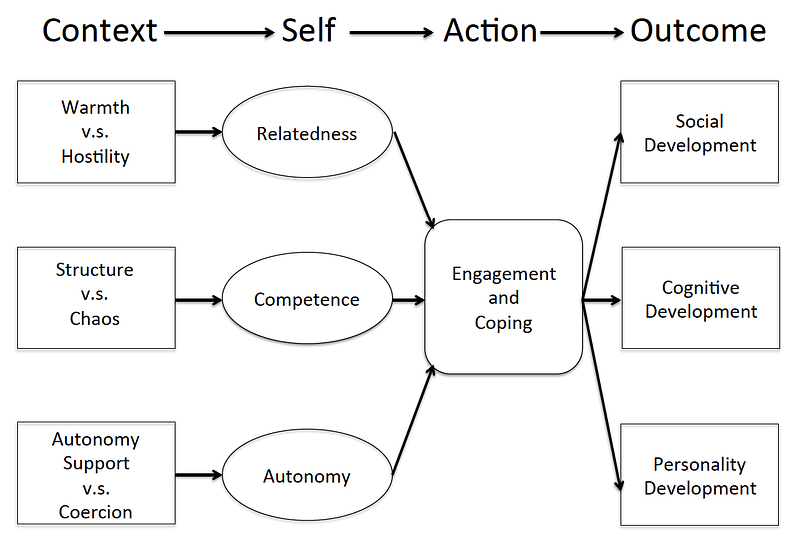
The Existing Challenges are about keeping life balanced. I adopted Ellen Skinner and Kathleen Edge’s motivational model of Context, Self, Action, and Outcomes (2002) as a resource. I defined the Positive Existing Challenges as the actions which respond to aggressive tasks while the Negative Existing Challenges as the actions which respond to defensive tasks. The Positive Existing Challenges refers to Engagement which is a concept of Skinner and Edge’s model. The Negative Existing Challenges refer to Coping.
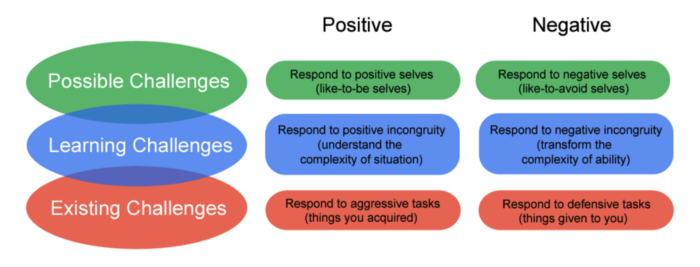
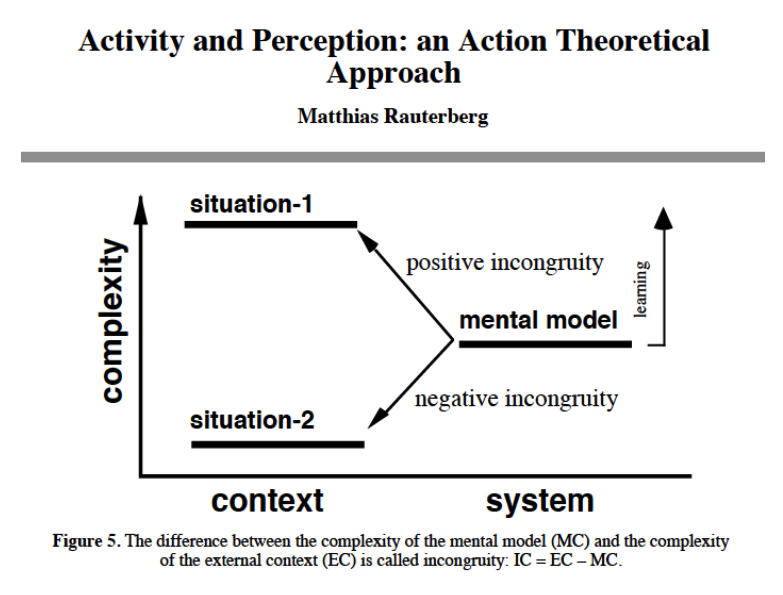
The concept of Incongruity is the core of an action theoretical approach that was developed by Matthias Rauterberg in 1999. According to Rauterberg, the difference between the complexity of the mental model (MC) and the complexity of the external context (EC) is called incongruity: IC = EC -MC. There are two types of incongruity: Positive Incongruity and Negative Incongruity. For Rauterberg, only the positive incongruity leads to learning.
Based on the approach, I defined two types of Learning Challenges. The Positive Challenges refer to actions that respond to positive incongruity (understand the complexity of the situation) while the Negative Challenges refer to actions that respond to negative incongruity (transform the complexity of ability). Based on my own experience, I thought the negative incongruity could lead to learning too. However, it refers to transforming the complexity of ability. For example, an expert faces a negative incongruity if the complexity of a situation is lower than the complexity of his mental model. However, if he wants to teach others how to cope with the same type of situation, he needs to learn communicative skills in order to reduce the complexity of ability for others to learn. My suggestion expanded Rauterberg’s model from an individual perspective to an interpersonal perspective.
The Possible challenges are inspired by Hazel Rose Markus’ Possible Selves Theory (1986). The Positive Possible Challenges refer to actions responding to positive selves (like-to-be selves). The Negative Possible Challenges refer to actions responding to negative selves (like-to-avoid selves).
Now, let’s apply this framework to my decisions in 2018. First, let’s have look at the two options:
- Building a community of inquiry about Epistemic Development
- Keep on the journey of personal intellectual discovery
Both the above two options are not Negative Existing Challenges because they are not things given to me by others. They are not Positive Existing Challenges too because they are not related to my daily life work. Both options are Positive and Possible Challenges because they refer to like-to-be selves. However, I chose one possible self from these two options. I rejected challenge 1 because I knew an expert in community building is my past self. I accepted challenge 2 because I wanted to be an expert in theory-based reflection.
Second, let’s review the process of writing the book Curativity:
- Apply Activity Theory to general curation practice.
- Develop an ecological approach and apply it to general curation practice.
Both challenges are Learning Challenges. For this case, the external context refers to general curation practice while the mental model refers to my understanding of theoretical approaches. There is no incongruity for challenge 1 because I knew both sides. That was the reason that I thought challenge 1 was not enough for me. Challenge 2 is a Positive Learning Challenge because there was a positive incongruity. I didn’t have a clear mental model of the ecological approach. Thus, the complexity of the mental model is lower than the complexity of the external context. This led to learning.
Also, both challenges can be considered Positive and Possible Challenges. Challenge 1 could lead to the developmental direction of becoming an expert in Activity Theory while challenge 2 refers to the direction of the ecological approach. Since Activity Theory is an established theoretical tradition, I chose the ecological approach because there are no established frameworks and that meant a creative space. This is a radical exploratory strategy.
However, I returned to Activity Theory and worked on the Activity U project in 2020.
Why?
Because I wanted to make a balance between exploration and exploitation.
Also, I realized that the complexity of my mental model in 2020 was higher than it was in 2018. Thus, I found that my understanding of Activity Theory was not deep enough. I needed to re-explore it.


