
The Slow Cognition Project (Phase II): Activity Analysis for Creative Work Study
How to Design a Developmental Project?
On April 26, 2021, I sent an email to a friend of mine and introduced my book The ECHO Way which reflects on my journey of writing three books in six months. I coined a new term called Slow Cognition to describe my favorite methods such as Howard E. Gruber’s evolving systems approach to creative work.
Five months ago, I designed the above picture and wrote a short post on Linkedin.
I used “A Theme for Creative Work Study in 2022” as the title of the short post. I spent 30 minutes designing a logo for Slow Cognition. This technique is called Objectification from the perspective of Project-oriented Activity Theory. Cognitive psychologists called it Cognitive Offloading. If an idea is very important to you, you could make a logo, design a picture, write a slogan, and print out these things.
It’s clear that I wanted to apply Howard E. Gruber’s evolving systems approach to conduct a research project.
On May 19, 2022, I closed the Slow Cognition Project (Phase I) with a possible book titled Knowledge Discovery: Developing Tacit Knowlege with Thematic Space Canvas.

In the past five months, I worked on the Slow Cognition project that aims to explore the historical-cognitive approach and the long-term development of thoughts. I used two strategies to conduct the project:
- 1) I use my own real-life experience as data for the historical-cognitive analysis. In the past five months, I recorded ideas of my thoughts and wrote many articles on Medium. These records and articles represent the long-term development of my thoughts.
- 2) I use Donald Schön’s Reflective approach to reflect on the development of my thoughts during the past four months.
The primary project in the past four months is the Thematic Space project. Originally, I used the term “Thematic Space” to name an item for the Knowledge Curation model and canvas. Later, I developed a canvas for the concept of “Thematic Space”. This led to a series of canvases and a series of activities. You can find more details about the book here.
I use “Phase” to manage knowledge projects. Each phase is closed with a milestone and a knowledge product.
When will I start the phase II of the Slow Cognition Project?
In fact, I am currently working on phase II of the project. In order to highlight this new activity, I design a new picture.
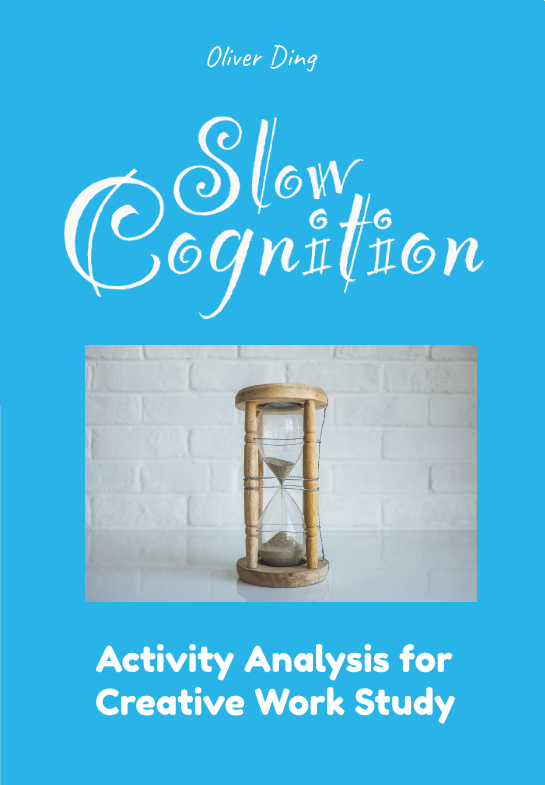
I designed the original version of the above picture on March 10, 2022. The subtitle of the original version is “Developing Tacit Knowledge with Thematic Space Canvas” which is used for the possible book Knowledge Discovery. Today, I use a new subtitle to replace the old one.
The new subtitle “Activity Analysis for Creative Work Study” is a Significant Insight.
Originally, I used “Slow Cognition — A Theme for Creative Work Study in 2022” to announce the project. However, I didn’t consider it as a project of the Activity U project. See the original words below:
On April 26, 2021, I sent an email to a friend of mine and introduced my book The ECHO Way which reflects on my journey of writing three books in six months.
I coined a new term called Slow Cognition to describe my favorite methods such as Howard E. Gruber’s evolving systems approach to creative work.
My original intention behind the Slow Cognition project is to adopt Howard E. Gruber’s approach and method to study creative work.
In the past months, I worked on both Howard E. Gruber’s approach and “Activity Theory” related approaches (especially Project-oriented Activity Theory and the “Anticipatory Activity System” framework). I realized that it’s possible to use the concept “Slow Cognition” to connect these two approaches.
This morning (May 30), I read Creative People at Work: Twelve Cognitive Case Studies (1989, Doris B. Wallace and Howard E. Gruber) and saw the first sentence of the Preface of the book. See the sentence below:
Our book is about how creative people do what they do.
In fact, “How…People do what they do” is the primary interest of Empirical Activity Theorists because they tend to watch how people do their work.
This sentence inspires me to write the new subtitle of the Slow Cognition project. Now I can connect these two approaches together.
Part 1: Present
Why do I say that I am currently working on phase II of the project?
Because I am doing some actions that can be understood as part of the Slow Cognition project.
- The Significant Insights Analysis Project
- Mapping Networks of Enterprise
- The Notion of “Project Network”
1.1 The Significant Insights Analysis Project
In the past two weeks, I worked on the Significant Insights Analysis project which is a sub-project of the Life Discovery Project.
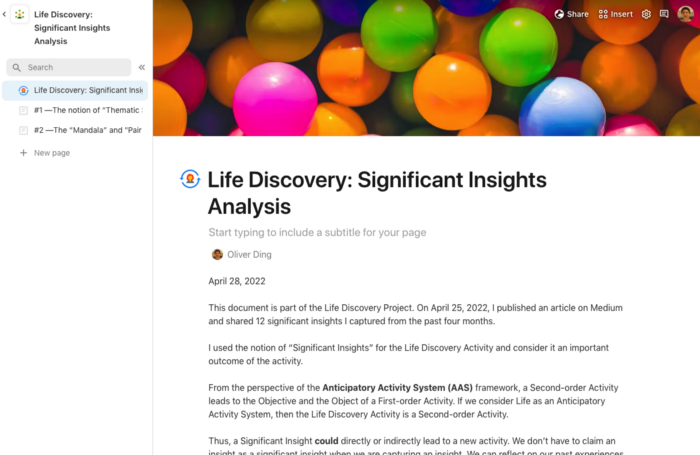
In order to conduct a mini-research for the Slow Cognition project, I selected the following 12 significant insights as samples. I also use a set of questions to discuss each insight. You can find more details here.
There are two questions about the “insight — activity” relationship:
- Activity: Is this insight part of an activity? What’s the activity?
- Activity: Has this insight led to a new action or a new activity?
On May 24, 2022, I published a summary of the mini-research project. However, I didn’t discuss the above two questions because it requires more time to analyze the network of activities.
1.2 Mapping Networks of Enterprise
On May 25, 2022, I started mapping the insight-activity network. See the screenshot below.
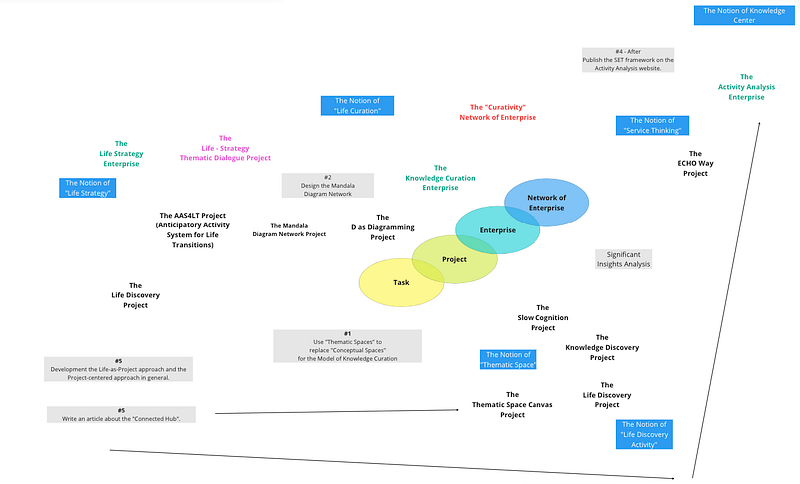
To be honest, it is a challenge to visualize the complex relationship between the 12 significant insights and related actions, activities, projects, and themes.
In the beginning, I adopted Howard E. Gruber’s evolving systems approach as the foundation for the mapping.
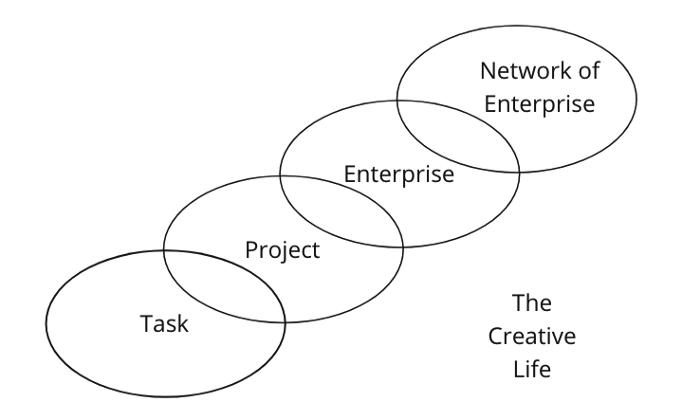
Later, I tried to use other models. However, I returned to Gruber’s model the day before yesterday. See the screenshots below:
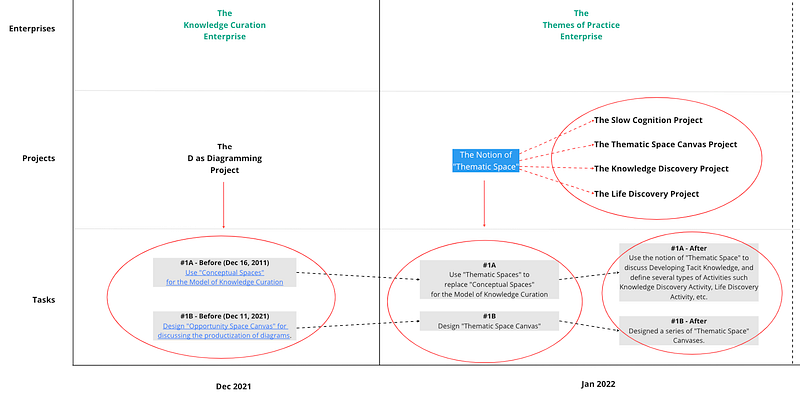
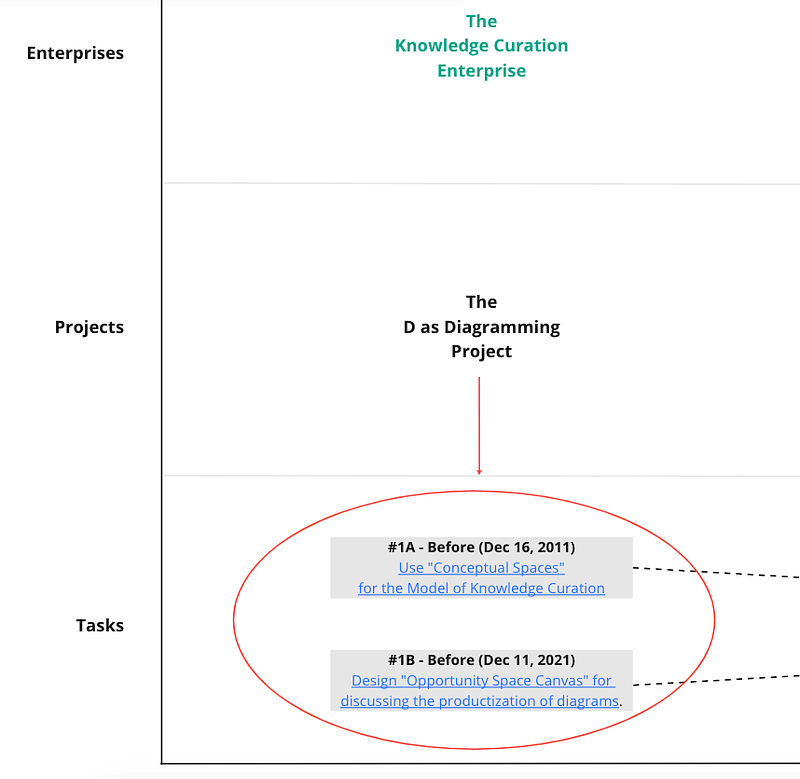
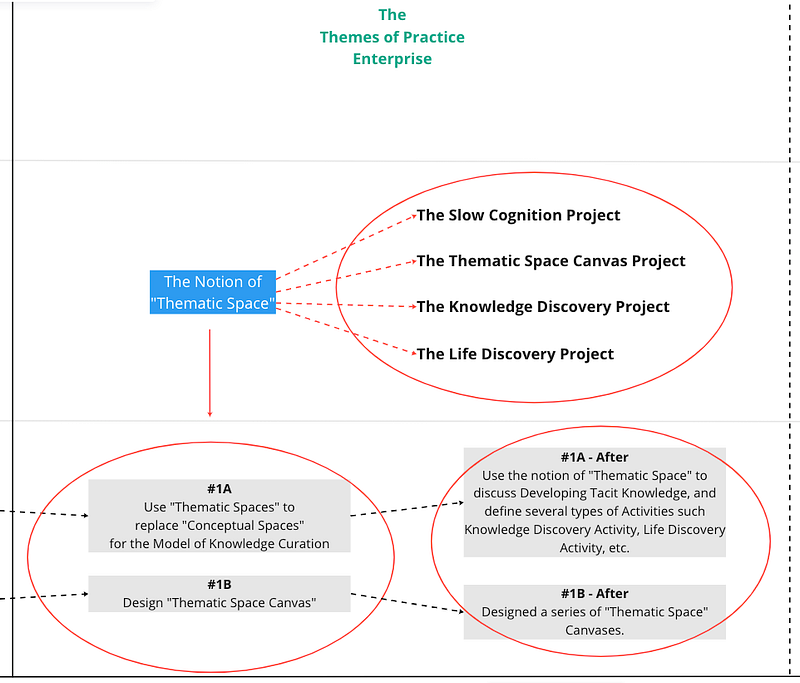
What I learned from the draft is that there are different amounts of data in four levels. The “Networks Enterprise” level and the “Enterprise” level have a few keywords while the “Project” level and the “Task” level have rich data.
I am working continuously on discovering some new models to visualize the “insight — activity” relationship.
This project is a new version 2.0 of Mapping Networks of Enterprise. The diagram below is version 1.0 of Mapping Networks of Enterprise, you can find more details here.
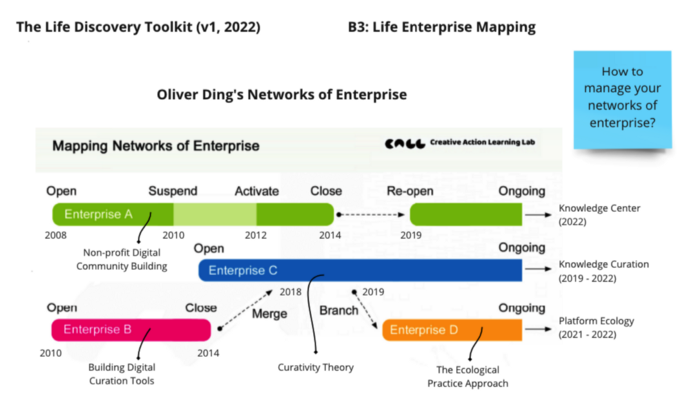
What’s the difference between version 1.0 and version 2.0 of Mapping Networks Enterprise?
Version 1.0 focuses on the “Enterprise” level and the large timescale while version 2.0 is more above the “Project” level and the small timescale.
1.3 The Notion of “Project Network”
On April 14, 2022, I wrote a short post about “Collective Network of Enterprise” and “Project Network” on Linkedin. This post shared a significant insight called “Project Network”. You can find more details here.
Howard E. Gruber’s approach has two aspects:
- 1) his resources are creators’ private notebooks, documents, and other files, and
- 2) his focus is on individual creators’ cognition development.
From Oct 2020 to Oct 2021, CALL (Creative Action Learning Lab) became a Knowledge Curation Studio that produced a set of knowledge frameworks and built an ecology of ideas. I also wrote seven books in drafts. In the past 6 months, CALL entered a new phase which could be called “Collective Network of Enterprise” or “Project Network”
The new phase of CALL has two different aspects:
- 1) CALL’s creative work is live. I shared the whole process of CALL’s creative work on the social web, and
- 2) CALL’s creative work was driven by the “Self — Other” Relevance, not the individual mind.
I started considering the Project-centered approach for CALL’s development.
On May 6, 2022, I shared the following model in CALL: How to Grow A Knowledge Enterprise.
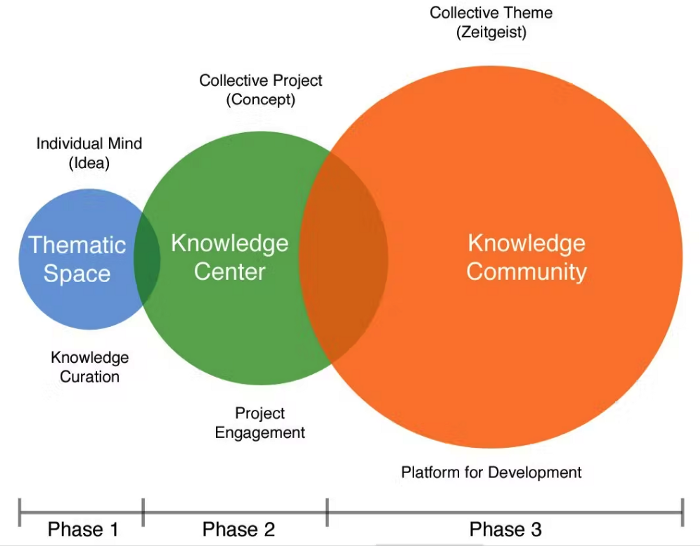
While I keep the term “Knowledge Enterprise”, the whole model goes beyond the individual creative person. It considers the developmental path of “Thematic Space > Knowledge Center > Knowledge Community” for a Knowledge Enterprise.
Howard E. Gruber’s Evolving Systems Approach to the study of Creative Work (1974,1989) is only suitable for phase 1. While Howard Gruber’s approach focuses on great creators such as Charles Darwin, the Project-centered approach aims to focus on professional workers.
The notion of “Project Network” and the above model of “Knowledge Enterprise” led to the following diagram:
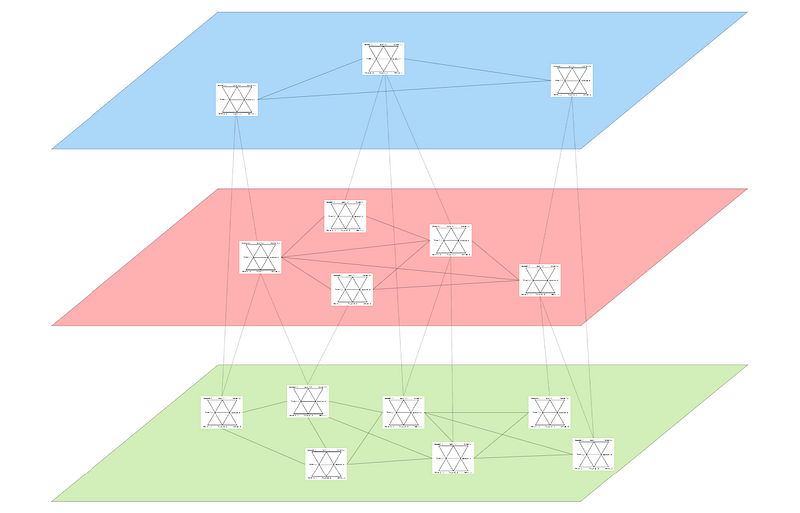
The Model of “Project Network” is for discussing the idea of “Knowledge Center”. It’s a multiple-level network, not a one-level network.
- A Network of Themes
- A Network of Knowledge Centers
- A Network of People
Each level refers to one type of Project. The “Themes” level refers to “Concept as Project”. For example, “TEDx” and “Startup Weekend” are Concepts, and the global TEDx community is a large project. The global Startup Weekend community is a large project too.
The “Knowledge Centers” level refers to “Center as Project”. For example, Each local TEDx program and each local Startup Weekend chapter are local projects.
The “People” level refers to “Engagement as Project”. For example, if a person joins a local TEDx team as a volunteer, she can consider her own experiences and actions of participating in the team as a Developmental Project for her.
These three types of Projects are also embedded in three types of networks: a network of themes, a network of centers, and a network of people.
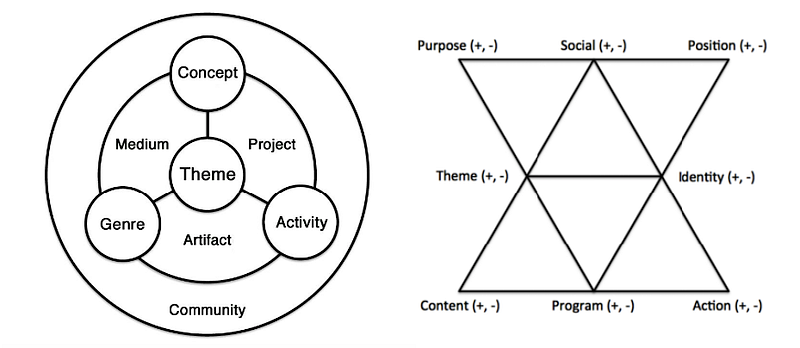
The above two diagrams are the Themes of Practice framework (left) and the model of Developmental Project (right). They can be used for understanding the “Themes” level (“Concept as Project”) and the “Center” level (“Center as Project”).
1.4 The Concept Developmental of the Ecological Practice Approach
On April 26, 2021, I reviewed the historical development of the Ecological Practice Approach.
In Oct 2020, I wrote an article titled The Ecological Practice Approach Toolkit and shared my work on a new approach for practice studies. This approach was originally called the Gibson — Lakoff — Schön approach because I adopted theoretical concepts from James J. Gibson, George Lakoff, and Donald Schön.
From Sept 2018 to March 2019, I wrote a book titled Curativity: The Ecological Approach to Curatorial Practice in order to reflect on one of my life themes: Curation. The Ecological Practice Approach was born from the process of writing Curativity.
In the past three years, I developed three versions of the Ecological Practice Approach.
- The “Toolkit” version (2019)
- The “Germ-cell” version (2020)
- The “Hierarchy” version (2021)
The 2019 version is a curated toolkit version. In 2020, I developed a new diagram to represent the germ-cell of the Ecological Practice approach.
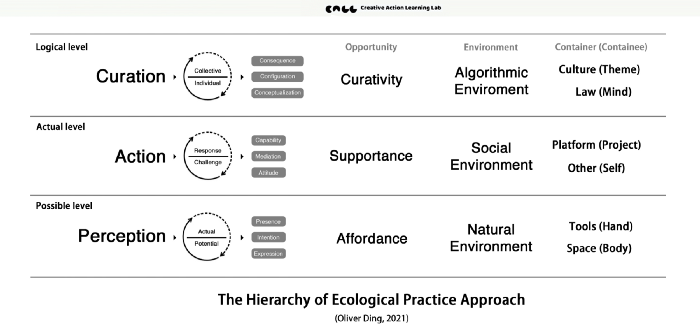
On April 2, 2021, I designed the above diagram to summarize the core concepts of the Ecological Practice Approach. It is an expansive version of the Germ-cell version.
What’s the newest development of the Ecological Practice Approach at the theoretical level from April 2021 to April 2022?
Though I did several projects about the approach, the major concept development of the approach are two ideas:
- Ecological Genidentity
- Ecological Relevance
The concept of Genidentity was introduced by Kurt Lewin for his theory about the philosophy of science. In 2017, I adopted the concept of “Genidentity” to discuss “the Life of Artifacts” in a private file titled Activity as Container which is an early version of the Ecological Practice Approach.
In 2019, I started testing the Ecological Practice Approach and applying it to study Platform-based social practice. I coined the term “Platform Genidentity” for the Platform Ecology project.
In Feb 2020, I wrote a 160-page private document titled Life Theory.
The “Life Theory” document is both a theoretical plan and a toolkit. As a theoretical plan, it describes the position and the direction of expanding the Ecological Practice approach to a social theory. As a toolkit, it curates six frameworks together. It is the beta version of the Ecological Practice approach.
The concept of “Genidentity” was planned as a core member of the Ecological Practice Approach. Since my approach to using the concept of “Genidentity” is different from Kurt Lewin’s approach. I name my notion “Ecological Genidentity”. You can find more details about “Genidentity” here. You can also find more details about the Platform Genidentity Framework here.
The concept of “Ecological Relevance” was not planned in the “Life Theory” file.
On Nov 19, 2021, I published D as Diagramming: An Integrated Framework for Studying Knowledge Diagrams (Part 2) which discussed my “Relevance” thematic space and a practical perspective “Cultural Significance”.
Why did I discuss my “Relevance” thematic space? Because I wanted to develop an integrated framework for studying knowledge diagrams in order to close the D as Diagramming project (phase I).
In the article, I reviewed Alfred Schutz’s Relevance theory. Though I personally like it, however, his phenomenological theoretical framework is complicated. Instead of adopting one particular relevance theory, I use multiple units of analysis to explore the thematic space of Relevance.
Later I used “Ecological Relevance” to name my notion of Relevance.
This is an amazing journey of concept development!
On April 24, 2022, I reviewed the historical development of the Ecological Practice Approach from the perspective of Concept Development. I roughly used the following canvas to curate Affordance-inspired ideas in my work.
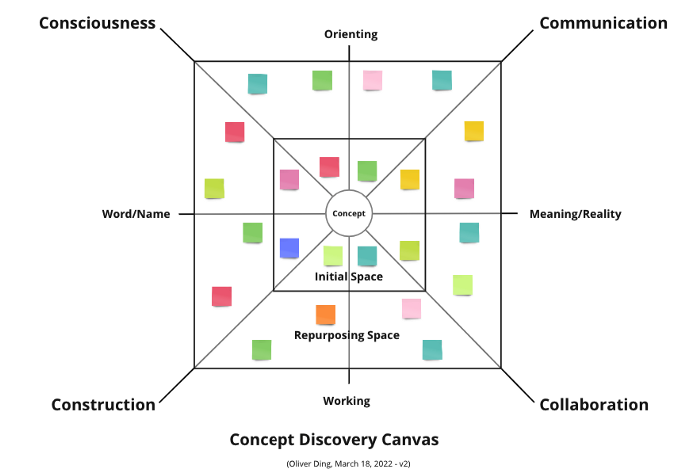
In fact, I didn’t directly use the above canvas. I removed all dimensions and words, it went back to its original version Thematic Space Canvas, and defined two spaces as Primary Concepts and Secondary Concepts.
I made a draft on a piece of paper and considered it as a new sub-project of the Slow Cognition project.
Part 2: Future
What’s the future of the Slow Cognition project (phase II)?
While Phase I of the Slow Cognition project focuses on Instruments (the Thematic Space Canvas, etc), Phase II returns to its original focus: Methods (the Historical-cognitive approach, etc).
I also found a connection between the Slow Cognition project and the Anticipatory Activity System (AAS) project because some ideas of the AAS framework are related to the Slow Cognition method.
2.1 The “Slow Cognition” Method
The above reflection indicates a cue that my current work is on the path of exploring methods.
From the perspective of Methods, I consider Phase II of the project as a dialogue between Howard E. Gruber’s Evolving Systems Approach and Activity Theory.
On May 30, 2022, I designed the diagram below.
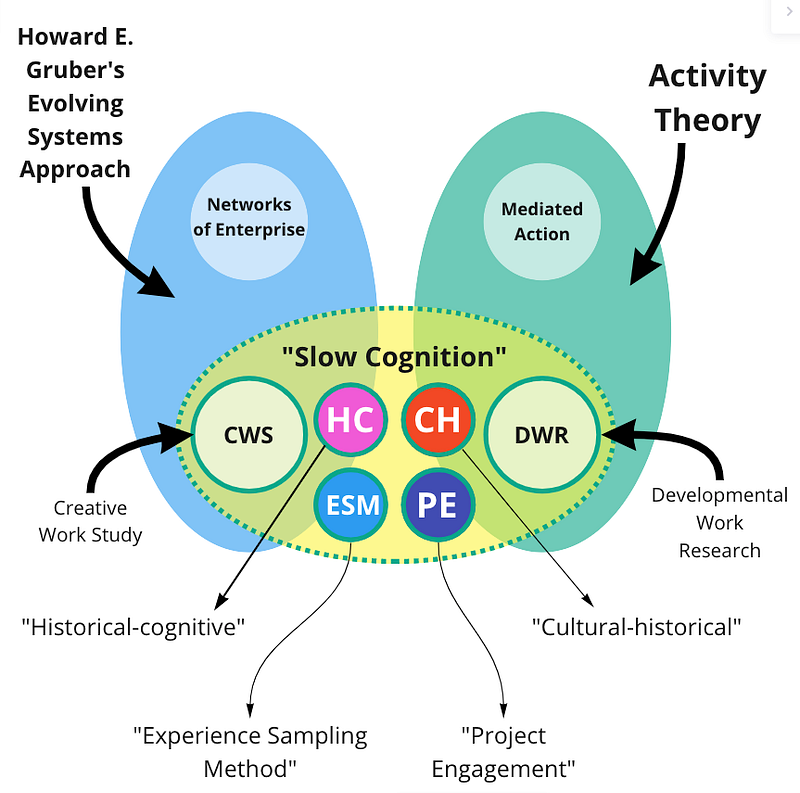
The concept of “Mediated Action” refers to Lev Vygotsky’s idea about human psychological development. Vygotsky claimed that human action and psychological functions are mediated by tools which refer to technical tools that work on objects and psychological tools that mediate the mind and environment. This concept is the foundation of Activity Theory and CHAT (Cultural-historical activity theory) in general.
The Developmental Work Research (DWR) methodology is developed by Yrjö Engeström who is the author of Learning by Expanding: An Activity-Theoretical Approach to Developmental Research (1987). The DWR is based on the Activity System model and the model of Expansive Learning. You can find more details in Activity U (IV): The Engeström’s Triangle and the Power of Diagram.
The concept of “Networks of Enterprise” refers to Howard E. Gruber’s Evolving Systems Approach. Gruber’s approach uses “Task — Project — Enterprise — Network of Enterprise” as a structure to understand a creative person’s work. It is different from Activity Theory’s “Operation — Action — Activity” hierarchy.
- Task
- Project
- Enterprise
- Networks of Enterprise
The concept of “Networks of Enterprise” refers to the pattern of work in the life of a creative individual. Gruber said, “We use the term enterprise to stand for a group of related projects and activities broadly enough defined so that (1) the enterprise may continue when the creative person finds one path blocked but another open toward the same goal and (2) when success is achieved the enterprise does not come to an end but generates new tasks and projects that continue it.” (1989, p.11)
Since Gruber’s approach focuses on creative people and their work, we can use “Creative Work Study” to describe the application of the approach.
Though these two approaches use different structures to organize work, there is a connection between Gruber’s approach and Vygotsky’s perspective on creativity. According to Seana Moran and Vera John-Steiner (2000), “For Vygotsky, creativity not only transforms objective materials into creative products, it also transforms the creator…The more differentiated his personality becomes, the better able he may be to contribute and possibly transform his or her culture…”
For Gruber, the primary focus of his approach is the uniqueness of a creative person. Gruber succinctly summarizes the dialectic of creativity and transformation: “How can I express this peculiar idea that such an [creative] individual must be a self-generating system?…The system regulates the activity and the creative acts regenerate the system” (quoted in John-Steiner, 1997, p. 78).
The Slow Cognition Method echoes the lifespan perspective and follows Vygotsky and Gruber. According to Seana Moran and Vera John-Steiner (2000), “Vygotsky’s lifespan perspective parallels that of several contemporary Western researchers. Barron (1970) focused on the creative life more than the single creative act: what a creative genius may be remembered for historically is only a small subset of the many ideas he produces in his lifetime. Helson’s (1990, 1999) longitudinal study of women found that personality development and creative achievement interact dynamically. Wallace and Gruber (1989) and Gardner (1993) both take lifelong perspectives in their studies of creative individuals, and Csikszentmihalyi et al. (1993, 1996) have studied creative work at various stages of the lifespan.”
You can find more details in D as Diagramming: The Path of Creative Life.
The Slow Cognition Method is also inspired by the following ideas:
- The Historical-cognitive method (HC)
- The Cultural-historical method (CH)
- Experience Sampling Method (ESM)
- Project Engagement method (PE)
The Historical-cognitive method combines historical research and cognitive research together. This method is developed by Gruber.
- Also, Nancy J. Nersessian used “A Cognitive-Historical approach” to name her approach to Creativity in Conceptual Change.
The Cultural-historical method refers to Activity Theorists’ methodology in general. We should notice the newest development of Activity Theory is CHAT which stands for Cultural-historical activity theory.
The Experience Sampling Method (ESM) is also called the Daily diary method, or ecological momentary assessment (EMA). It asks participants to report on their thoughts, feelings, behaviors, and/or environment on multiple occasions over time. The experience sampling method was developed by Larson and Csikszentmihalyi.
The Project Engagement method is called Cultural Projection Analysis which is inspired by Activity Theory and Ecological Psychology. You can find more details in Activity U (X): Projecting, Projectivity, and Cultural Projection.
2.2 Unfolding, Discovering, and Modeling
As mentioned above, I also found a connection between the Slow Cognition project and the Anticipatory Activity System (AAS) project because some ideas of the AAS framework are related to the Slow Cognition method.
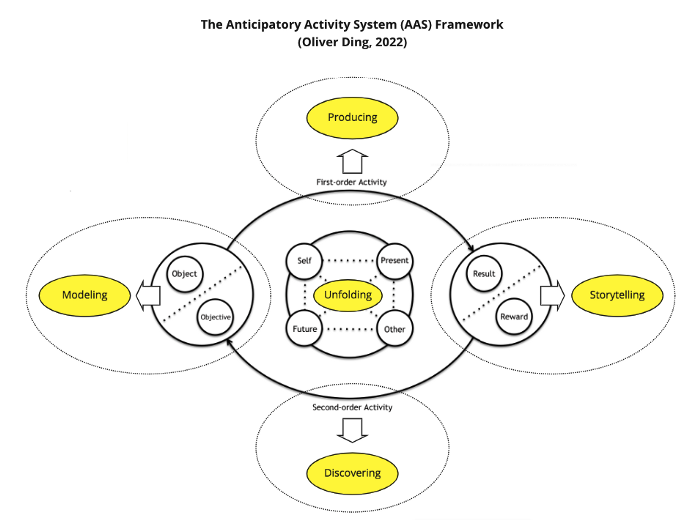
The above diagram is a simple version of the AAS framework. I added the following five movements to expand the basic model of AAS.
- Unfolding
- Discovering
- Modeling
- Producing
- Storytelling
I also developed a sub-framework for the “Modeling” movement. See the diagram below.
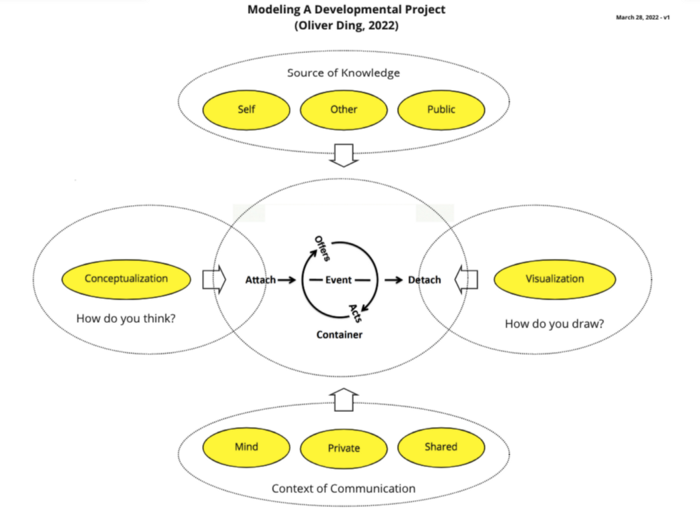
What I found from an empirical research project is that the “Modeling” movement can be studied with the Slow Cognition method.
You can find more details about the AAS framework here and the “Modeling” movement here.
2.3 Some Case Studies
In the past two months, I started using Milanote which is a digital whiteboard, and Coda which is a doc-centered collaborative platform for the Slow Cognition project (phase II).
You can find more case studies in the list below.
- Significant Insights Analysis
- Modeling A Developmental Project
- Oliver Ding: The Activity U Project (2020–2022)
- The Deep Analogy Board — Activity Theory (April 22, 2022)
- Some Milestones of the AAS project
- Oliver Ding @ 2021 and Second-order Activity
- The Development of Ecological Practice Approach
The above list is evidence that I am currently working on phase II of the Slow Cognition project.
Part 3: How to Design a Developmental Project?
I am also working on the AAS4LT 1:1 life coaching program which is designed in two parts and eight steps. You can find more details here.
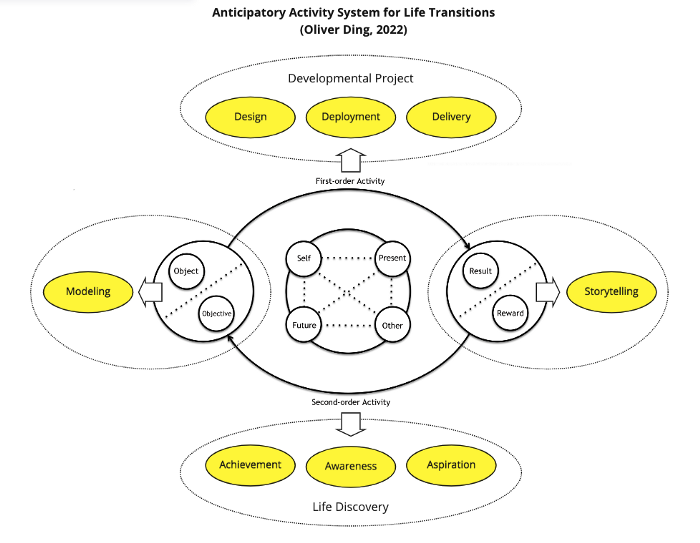
If we apply the AAS4LT framework to the Slow Cognition project (phase II), what can we learn from it?
Let’s compare the Slow Cognition project with the D as Diagramming project. I consider both two projects are my Developmental Projects.
I started the D as Diagramming project on August 10, 2021, and closed its phase I on Dec 30, 2021. Then, I didn’t start its phase II.
The Slow Cognition project was announced on Jan 5, 2022. I closed its phase I on May 19, 2022. However, I continuously worked its phase II.
Why did I make different decisions in their phase II?
If we return to the basic model of the AAS framework, we can find the starting point of the First-order Activity is about “Objective” and “Object”.
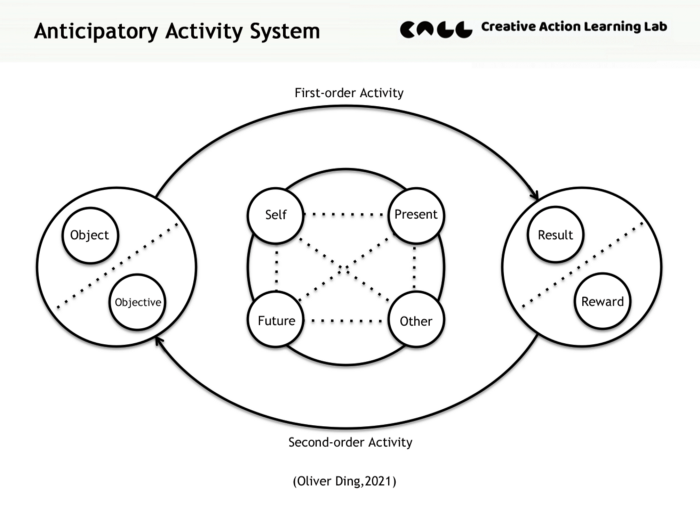
For the AAS framework, Objective (what is motive about) is about the Future while Object (what is acted on) is about the Present. These two terms adopt both Leontiev’s object (predmet) which refers to motivation and Engeström’s object which refers to ‘the raw material’ or ‘problem space’.
Moreover, Objective is related to Anticipation while Object is related to Performance. They refer to two types of complexities. See the diagram below.
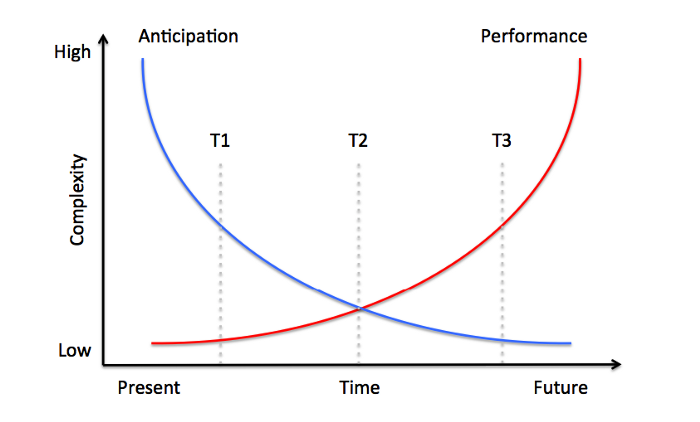
In the beginning, an Objective project our anticipation about the future and the complexity of anticipation is high because we don’t know if we can achieve the objective. At the end of an activity, the complexity of anticipation becomes low because the outcome is there.
However, the complexity of Performance on Object is a different trajectory. In the beginning, we do less work on an Object. Then, the complexity of interaction with Objects is getting higher and higher.
For the Slow Cognition project (phase II), I am currently working on several case studies on Slow Cognition. These case studies are Objects.
If I can clearly perceive 1) the changes in Objects, and 2) these changes match the Objective, then there is a real First-order Activity.
In this case, Designing a Developmental Project means making sense of the perception. This is the purpose of writing this article.
I am also working on building a new website for the Platform Ecology project. You can save the following links:
- PlatformEcology.org
- Twitter: @PlatformEcology
- Linkedin: @PlatformEcology
You are most welcome to connect via the following social platforms:
Linkedin: https://www.linkedin.com/in/oliverding Twitter: https://twitter.com/oliverding Polywork: https://www.polywork.com/oliverding Boardle: https://www.boardle.io/users/oliver-ding


