avatarOliver Ding

Summary

The Slow Cognition Project is an initiative that introduces a new cognitive framework focusing on the long-term development of thoughts, contrasting with traditional cognitive psychology's emphasis on short-term processes.

Abstract

The Slow Cognition Project, as introduced on the website, is a concept developed by Oliver Ding, who describes it in his book "The ECHO Way." This project challenges the conventional 'aha moment' creativity theory by adopting a historical-cognitive approach, emphasizing the evolution of thoughts over time. It draws inspiration from Howard E. Gruber's evolving systems approach and rejects the dichotomy of hot and cold cognition, as well as Daniel Kahneman's System 1 and System 2 framework. Instead, it aligns more closely with Keith E. Stanovich's model of the mind, which includes the Autonomous, Algorithmic, and Reflective Mind. The project's logo was created to symbolize this approach, and it connects with other concepts like the Path of Creative Life and the Life-as-Activity framework. The content is shared under the Creative Commons Attribution-NonCommercial-ShareAlike 4.0 International License.

Opinions

  • The author, Oliver Ding, prefers the term "Slow Cognition" over existing frameworks like hot and cold cognition or System 1 and System 2 thinking.
  • There is a clear preference for Keith E. Stanovich's tripartite model of the mind over Daniel Kahneman's dual-system model.
  • The Slow Cognition Project is critical of the 'aha moment' as the primary mode of creative insight, favoring a more gradual and historical perspective on cognitive development.
  • The initiative is positioned as a movement, evidenced by the creation of a logo and the invitation for others to engage with the concept through various social platforms.
  • The project is open for collaboration and connection, as indicated by the inclusion of the author's LinkedIn, Twitter, Polywork, and Boardle links.

The Slow Cognition Project

The historical-cognitive approach and the long-term development of thoughts.
On April 26, 2021, I sent an email to a friend of mine and introduced my book The ECHO Way which reflects on my journey of writing three books in six months.

I coined a new term called Slow Cognition to describe my favorite methods such as Howard E. Gruber’s the evolving systems approach to creative work.

Scholars use Hot Cognition and Cold Cognition to describe two types of cognitive studies. Cold cognition refers to pure cognitive processing of information that is independent of emotional involvement. Hot cognition considers emotional aspects.

You probably read Daniel Kahneman’s 2011 book Thinking, Fast and Slow which highlights two models of thought: System 1 and System 2.

My term Slow Cognition is related to System 2. However, I personally don’t like the System 1/System 2 framework because I adopt Keith E. Stanovich’s model of three types of mind: Autonomous mind, Algorithmic mind, and Reflective Mind.

The major difference between my term Slow Cognition and Kahneman/Stanovich’s terms are research methods. My term Slow Cognition refers to the historical-cognitive approach which is about long-term development of thoughts. Cognitive psychologists focus on short-term thoughts.

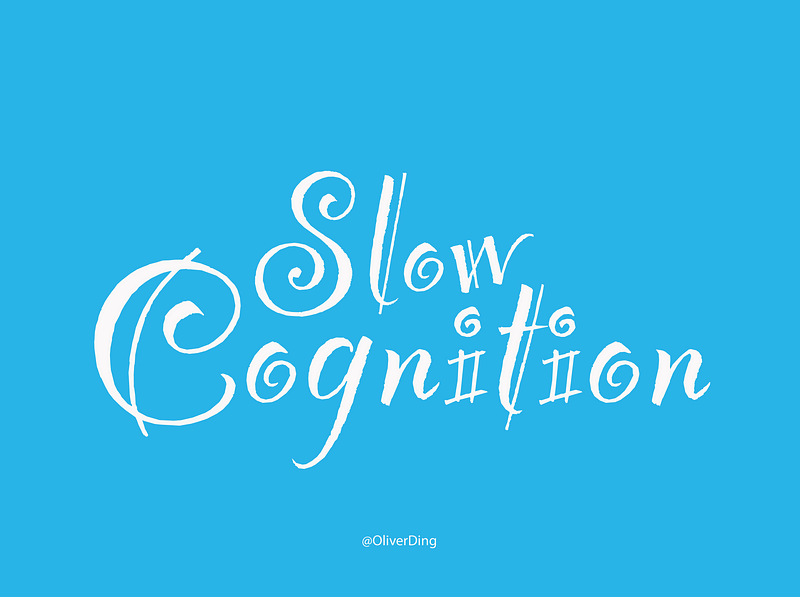
Every movement needs a logo. So I spent 30 minutes designing a logo for Slow Cognition this morning.

The Slow Cognition Project rejects the common sense of aha moment for creative cognition. Also, It refers to the metaphor of journeys, long-term activities, which echoes the Path of Creative Life and the Life-as-Activity framework.

You are most welcome to connect via the following social platforms:

Linkedin: https://www.linkedin.com/in/oliverding Twitter: https://twitter.com/oliverding Polywork: https://www.polywork.com/oliverding Boardle: https://www.boardle.io/users/oliver-ding

License

This work is licensed under the Creative Commons Attribution-NonCommercial-ShareAlike 4.0 International (CC BY-NC-SA 4.0) License. Please click on the link for details.

Cognition
Cognitive Science
Cognitive Psychology
Knowledge Management
Personal Development
Recommended from ReadMedium