a narrative of colours and forms with three dancers in each section and each act played out against a monochrome background: first yellow, followed by pink, and finally greytone.</p><p id="57bf">It’s a recognised landmark in expressive movement and dance as well as kinetic sculpture and still gets regularly referenced in contemporary fashion and pop culture. Schlemmer's theories of the dynamics of human motion in a three-dimensional stage space directly influenced the production design for Luca Guadagnino’s 2018 remake of horror classic <a href="https://readmedium.com/suspiria-2018-blu-ray-e9de9fff0bc6"><i>Suspiria</i></a><i>. The Triadic Ballet</i> also gets a specific mention in the lyrics of <i>Bauhaus Staircase</i>, the 2023 single by art-tronic duo, Orchestral Manoeuvres in the Dark (OMD).</p><p id="c05a">Sometime during the development of <i>The Triadic Ballet</i>, artistic partners <b>Lavinia Schulz</b> and <b>Walter Holdt</b> were also experimenting with costumes that served both as animated sculpture and stage set. However, their creations are forever marked with much darker ideology and associations. Lavinia Schulz had trained as a dancer and costume designer under the German theatre producer Lothar Schreyer and she met and married Walter Holdt when he was recruited, some might say ‘groomed’, straight from school by Schreyer.</p><figure id="7718"><img src="https://cdn-images-1.readmedium.com/v2/resize:fit:800/1*EiuzOMGROIA9SQyXig-UiQ.jpeg"><figcaption></figcaption></figure><figure id="3805"><img src="https://cdn-images-1.readmedium.com/v2/resize:fit:800/1*zrP3qzwos4wOfWkQKSSHzQ.jpeg"><figcaption><b>‘His’n’Hers’ variants of ‘Technik’ costume (made c.1924, photographed 1989) </b>[view license<a href="https://sammlungonline.mkg-hamburg.de/de/object/Maskenfigur-%22Technik%22-f%C3%BCr-Holdt/2000.342.AB/dc00006888?s=maskenfigur&h=0"> 1 </a>and<a href="https://sammlungonline.mkg-hamburg.de/de/object/Maskenfigur-%22Technik%22-f%C3%BCr-Schulz-klein/2000.343.AB/dc00006889?s=maskenfigur&h=0"> 2 </a>]</figcaption></figure><p id="0544">It wasn’t long before the radical attitudes and unruly behaviours of Schulz and Holdt got them expelled from the troupe and they began performing together as the duo <i>Die Maskentänzer / The Mask Dancers</i>. Made only from found materials, their costumes were an unusual mix of Dada-esque provocation and <a href="https://readmedium.com/deep-in-the-wood-trees-as-art-4b6130217c0f#5668"><i>Arte Povera</i></a><i>.</i></p><p id="c895">The iconography of forms borrowed from <a href="https://readmedium.com/driven-to-abstraction-332fb2d1e3ff">abstract</a> painting, <a href="https://readmedium.com/the-power-of-three-9016986c3cc1">Cubist</a> sculpture, early science fiction cinema, and pulp illustrations. The aesthetic of their creations fused the comedic and the grotesque and incorporated hidden elements within that affected how the ‘dancer’ moved. These included asymmetric weights and even nails and abrasive linings that would inflict injury to the wearer during certain moves. This may have been an extension of their abusive relationship that was sado-masochistic and known to involve the dynamics of hate and violence. They seemed to believe that pain and endurance were transformative in some way.</p><p id="71cb">Lavinia and Holdt would end their short, relatively fruitless career together in a murder suicide. The thirty or so performative costumes they made were thought lost until 1988, when they were rediscovered in the archives of the Museum for Art and Industry in Hamburg. They have since been conserved, displayed, and catalogued with colour photographs.</p><p id="d207">Their mentor, Lothar Schreyer, was invited to teach stagecraft at the Bauhaus in the early 1920s, where he worked alongside Oskar Schlemmer and experimented with masks and geometric costumes. By 1923, Schreyer had fallen-out with Bauhaus director Walter Gropius and Oskar Schlemmer had replaced him as Director of Stagecraft.</p><p id="0471">Schreyer would later reveal his ideology to be the antithesis of the Bauhaus. In 1933, the same year as the Nazi government of Germany closed down the last of the Bauhaus design schools, Lothar Schreyer signed the <i>Gelöbnis treuester Gefolgschaft</i> pledge of allegiance to Adolf Hitler. Ironically, when his art and design work was included in the 1937 Munich exhibition of degenerate art, <i>Die Ausstellung Entartete Kunst</i>, he was forced into a position where he had to denounce his own work and give up any artistic integrity he may have had.</p><figure id="d8d7"><img src="https://cdn-images-1.readmedium.com/v2/resize:fit:800/1*o1i7mvVbO3uBlDZmrK4dZA.jpeg"><figcaption></figcaption></figure><figure id="1987"><img src="https://cdn-images-1.readmedium.com/v2/resize:fit:800/1*Df_MwKHPYH97VBy_h-qa3Q.jpeg"><figcaption></figcaption></figure><figure id="b266"><img src="https://cdn-images-1.readmedium.com/v2/resize:fit:800/1*eEulxn-XMnViCrNj1ag-dw.jpeg"><figcaption><b>Lavinia Schulz and Walter Holdt as ‘Die Maskentänzer’ (c.1924) photographed by Minya Diéz-Dührkoop and the same costumes, ‘Toboggan Frau’ and ‘Toboggan Mann’, photographed in 1989 by conservators at Hamburg’s Museum for Art and Industry</b> [view license<a href="https://sammlungonline.mkg-hamburg.de/de/object/Tanzmasken-%22Toboggan-Frau%22-und-%22Toboggan-Mann%22-von-Lavinia-Schulz/P1994.56/mkg-e00132724?s=Lavinia+schulz&h=20"> 1 </a>and<a href="https://sammlungonline.mkg-hamburg.de/de/object/Maskenfigur-%22Toboggan-Frau%22/2000.349.AB/dc00006895?s=maskenfigur&h=0"> 2 </a>and<a href="https://sammlungonline.mkg-hamburg.de/de/object/Maskenfigur-%22Toboggan-Mann%22/1991.177.AB/dc00006911?s=maskenfigur&h=0"> 3 </a>]</figcaption></figure><p id="e0c0">So, on a lighter note but with even darker art… and skipping forward through the Modern Era to the first major Post-Modern movement, we find another couple of artists who I’m sure <i>loved</i> Halloween — the notorious, important, though relatively obscure <a href="https://readmedium.com/do-you-know-whats-really-surreal-3090c62b427">Surrealists</a>, <b>Jean Benoît</b> and <b>Mimi Parent</b>.</p><p id="20ac">The two French Canadians met while studying at Montreal’s École des Beaux-Arts and would later marry before moving to France in 1949. They were welcomed into the fervent Paris art scene and invited by André Breton, author of the Surrealist Manifesto, to participate in the the historic group exhibition he was co-curating with <a href="https://readmedium.com/bride-of-duchamp-9db845e9bd77">Marcel Duchamp</a> known as The 1959 InteRnatiOnal Exhibition of Surrealism E.R.O.S. Yes, I see that the anacronym doesn’t quite fit, already challenging accepted codes of communication, but does indicate the congruent concept of the works involved… and Jean Benoît and Mimi Parent did not disappoint on the psycho-sexual Freudian front presenting what must’ve been the most surprising and memorable experience of all the associated events.</p><p id="5e90">The whole exhibition was designed as an experiential installation where things <i>happened</i> and in this way, Paris was parallelling New York in developing ‘<a href="https://readmedium.com/when-actions-become-art-ac6d45063e45#38e5">Happenings</a>’ as a new art format. The ground-breaking work was presented by Jean Benoît at a special pre-opening ceremony and was a combination of sculpture, sound, actions, monologue, and gothic burlesque titled <i>L’Exécution du Testament du Marquis de Sade</i>. This was a premier for the work as a whole that Jean Benoît had been developing for around a decade and had spent the previous two years constructing.</p><p id="7a68">The action was presaged by recorded sounds beginning with a volcanic eruption, the noise of a crowd, and then André Breton reading a section from the last will and testament of the Marquis de Sade. In a tall headdress c
Options
onsisting of four stacked masks, and a costume of large carved panels painted in dark blue and metallic colours with some red details, Benoît entered the large room using sculptural crutches to steady himself as he laboriously dragged a large cabinet behind, representing a sarcophagus. Each measured step was accompanied by loud noises from horns under each boot. His own form was completely contained within this partially figurative sculpture, drawing upon a fusion of Cubist and tribal aesthetics with mythical or spiritual connotations. Here, we have a worn work of art that is by no means a practical garment and certainly transcends frivolous fashion in terms of concept and context. A witness described it as “a fabulous monster.”</p><figure id="0c2e"><img src="https://cdn-images-1.readmedium.com/v2/resize:fit:800/1*mfzgnMWrCrq7mjpn7qN_-Q.jpeg"><figcaption><b>‘L’Exécution du Testament du Marquis de Sade’ (1959) three stages of the costume worn by Jean Benoît</b> [<a href="https://www.wikiart.org/en/jean-benoit">view image source</a>] *</figcaption></figure><p id="3623">Finally the creature stopped its advance in a space left clear for it and there was silence. Benoît remained still as a statue. Only when uneasy mutterings began among the audience did Breton began reading a detailed list of the costume’s components along with some clues as to their symbolism — the pieces representing aspects of the modern world and the morality of ‘polite society’ that buries us alive and shackles our desires, stifling individual creativity. As each part was described, a woman dressed respectfully in funerary black removed the pieces and presented them to the viewers before mounting the parts on the wall behind. Gradually the sculpture dissembled, creating instead a prearranged parietal tableaux. The woman was Mimi Parent.</p><p id="e352">Finally Jean Benoît was revealed, painted in a similar dark colour scheme as the costume and nude except for a star of red fabric adhered over his heart and a codpiece on which was mounted a large articulated phallus that was puppeteered by means of near-invisible fishing line. A fire was then lit in a brazier or similar container to heat an ornate branding iron. After enough time to ensure it was glowing hot, Benoît, who had remained comparatively motionless and submissive throughout the ‘striptease’ was suddenly dynamic, tore away the red star from his chest and took the branding iron, pressing it to his exposed breast. The action was reflected in a large mirror and the name ‘SADE’ could be seen when the iron was lifted. Indeed, the name was branded into the artist’s flesh in mirror writing. He then turned to the viewers and spoke his first dialogue of the entire performance asking, “Who is the iron for [next]?” before returning it to the coals and making his exit.</p><p id="5e46">According to some accounts a member of the audience followed suit and, pulling open his shirt also branded ‘ƎᗡAƧ’ on his chest. It was the artist Roberto Matta, but when others seemed about to do the same, they were prevented and the fire extinguished. The whole ritual had been performed in private before an invited audience of about 100, but no recording except several eye-witness accounts survive. The performance was intended to be a decisive action that could not be reversed, revoked, or repeated. The suit itself was exhibited and Benoît had arranged for photographer Gilles Ehrmann to document the sequence of removal in an abandoned warehouse, again assisted by Mimi Parent but in the absence of an audience.</p><p id="3dfb">Parent’s profile in the subsequent exhibition was also prominent, having designed several important elements such as an artist’s multiple, <i>Boîte Alerte</i>, which was a series of 250 green letterboxes each containing 50 or so items — such as letters, pictures, and booklets — contributed by the exhibiting artists. She also designed a collaborative installation occupying one of the rooms titled <i>La Crypt du fétichisme / The Crypt of Fetishism.</i></p><figure id="6573"><img src="https://cdn-images-1.readmedium.com/v2/resize:fit:800/1*xyaHgqEK75e3RpS46_BDNA.jpeg"><figcaption></figcaption></figure><figure id="c254"><img src="https://cdn-images-1.readmedium.com/v2/resize:fit:800/1*OC5GhqIzeg07jEpsdo1D1w.jpeg"><figcaption><b>‘Masculin-Féminin’ (1959) by Mimi Parent as exhibited and as worn, photographed for the exhibition poster </b>[View license<a href="https://www.wikiart.org/en/mimi-parent/masculin-feminin-1959"> 1 </a>and image source<a href="https://www.academia.edu/44694022/L%C3%A9rotisme_%C3%A0_bout_de_souffle_du_Festin_cannibal_de_Meret_Oppenheim_1959_aux_rituels_corporels_de_Carolee_Schneemann_1964_1975_Universit%C3%A9_de_Li%C3%A8ge_D%C3%A9partement_des_Sciences_Historiques_Histoire_de_l_art_contemporain_December_11_2020"> 2 </a>] *</figcaption></figure><p id="536f">Her own works on display included <i>Masculin-Féminin — </i>theoretically a wearable piece presented as an assemblage in a box comprising the lapels from a man’s jacket and white shirt collar with a tie made from her own hair. Here, the female signifier of long blonde hair becomes an adornment for an absent man while at the same time suggesting a noose or garrotte. Her own hair, presented as the proxy for a woman in a position of dominance, would become a recurring theme. A photograph of <i>Masculin-Féminin</i> worn by a model was selected by André Breton to be the image for the exhibition poster.</p><p id="d98b">Jean Benoît would return to the sculptural costume format in later works, most notably the striking and disconcerting <i>Le Nécrophile (Dédie au Sergeant Bertrand) / The Necrophile (Dedicated to Sergeant Bertrand)</i> which he presented at the opening of the Eleventh International Exhibition of Surrealism, in 1965. The Sergeant François Bertrand referenced in the work was also known as the ‘Vampire of Montparnasse’ and is the psychiatric case for which the term <i>necrophilia</i> was coined in the mid-nineteenth-century. Clearly, Benoît was still ‘digging’ deep into the darker recesses of the Freudian psycho-sexual realm to ‘unearth’ unsettling narratives.</p><p id="608d">The cape of the costume was broad-shouldered, forming a ruff supporting a cluster of crosses, each bearing the name of a famous libertine philosopher or similarly controversial character. A garland of birds representing carrion crows ringed the shoulders. When the cape was held closed, the whole costume appeared to be a stone tower or suggest a walled cemetery. When the cape was parted, a heavy chain was revealed about Benoît’s waist on which hung knives and toy-like models of grave-digging equipment.</p><p id="84ac">A long, segmented ‘tail’ extended from the groin implying an impotent appendage that connected to the earth at the wearer’s feet, where hidden things, such as secrets and the dead, may be buried — perhaps suggesting the underworld, the ancestors, and notions of the collective subconscious. He brandished a staff topped with two figures, one grey and one white, that could be angels or demons. On the back of the worn sculpture was a motto that translates as, “Death, life is stalking you.”</p><p id="12a3">Now, that’s a helluva Halloween costume!</p><figure id="9558"><img src="https://cdn-images-1.readmedium.com/v2/resize:fit:800/1*GD6tuaKqDxxkYjuclC9JnA.jpeg"><figcaption><b>‘Le Nécrophile’ (1965) costume by Jean Benoît</b> [<a href="https://www.wikiart.org/en/jean-benoit/the-necrophile-dedicated-to-sergeant-bertrand-1965">view license</a>] </figcaption></figure><p id="9b48"><i> Signifier and the author cannot be responsible for third-party content on external sites which may contain advertising and are subject to change without notice. All images are used with license, are promotional material, or presented here for educational purposes under fair usage policy.</i></p></article></body>
Dressed-up in Art
Considering costume as concept and sculpture outside the boundaries of fashion
When does something intended to be worn transition from being simply a practical garment, transcend fashion, and become art?
It’s that time of year when even boring people will consider dressing up in weird and wonderful costumes to parade in public. It’s a Halloween tradition to wear something scary inspired by local folklore or lifted from the horror genre of mainstream media. Though, in the USA, that brief has been largely forgotten and simply wearing a statement outfit will do— outrageous, funny, sexy, surprising…
Communities the world over indulge in similar winter activities. In Mexico, the Day of the Dead festivals are much brighter and even more ostentatious events where people wear elaborate, colourful death-themed costumes, dance, celebrate their ancestors, and exchange sugar skulls. These, and similar age-old traditions, offer a degree of creative self-expression, drawing upon cultural heritage, reworking its signifiers for a contemporary context — which starts to sound like some definitions of art. Indeed, much of the related regalia certainly falls within definitions of Folk Art.
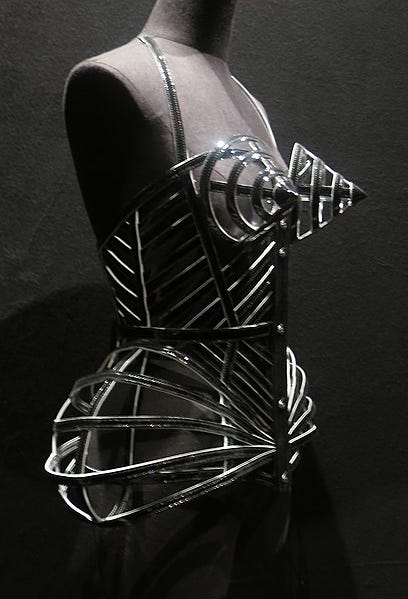
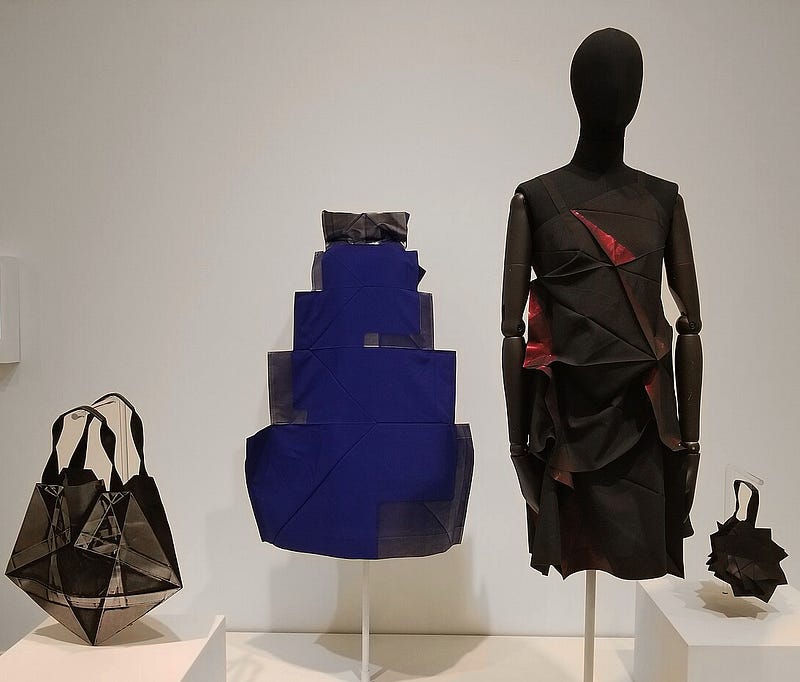
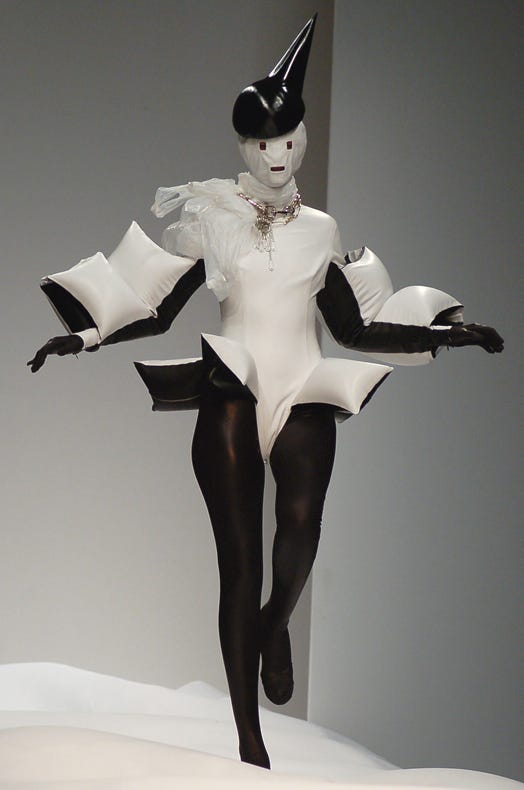
metal corsetry ‘cage’ by Jean Paul Gaultier for Madonna’s 2012 world tour, collapsible geometric folding garments for ‘Project 132 5’ (2010) by Issey Miyake, and costume with inflatable elements (2007) by Gareth Pugh [view license 1 and 2 and 3 ]
Some truly innovative fashion designers operate within the realm of art, drawing formal inspiration from sculpture, architecture, and cultural heritage as much as from their forebears in fashion and textiles. For example, Issey Miyake was directly inspired by the architectural and sculptural works of Isamu Noguchi. Miyake’s fabrics, and the clothing produced from them, were the result of concept-driven investigations into new material technologies that also produced lamp designs and interactive processes that are now preserved in the permanent collections of contemporary art museums.
Other ‘high fashion’ designers who produce work for exhibition on the catwalk often ignore the constraints of practical production or wearability in favour of grand statement pieces intended to express a concept that, in turn, may inspire haute couture labels and other fashion designers. Jean Paul Gaultier springs to mind — his costume designs for Madonna and the 1997 film, The Fifth Element were certainly sculptural and experimental in their use of materials.
Gareth Pugh is a sculptor as much as a fashion designer, and is often referred to as a performance artist. He’s become best known as a pop costumier to the stars — including Beyoncé, Lady Gaga, and Kylie Minogue — and for experimenting with the extension of the human form into inflated volumes that emphasise or conceal the wearer’s natural anatomy. Also, fashion houses like Comme des Garçons have built their reputation on outrageous, often intentionally comedic, catwalk costumes that play with sculptural volumes at the expense of the model’s comfort and ease of movement. But does merely challenging the very purpose of clothing make their wears art? Or is this simply poor design? I suppose that depends upon intent, concept, and context…
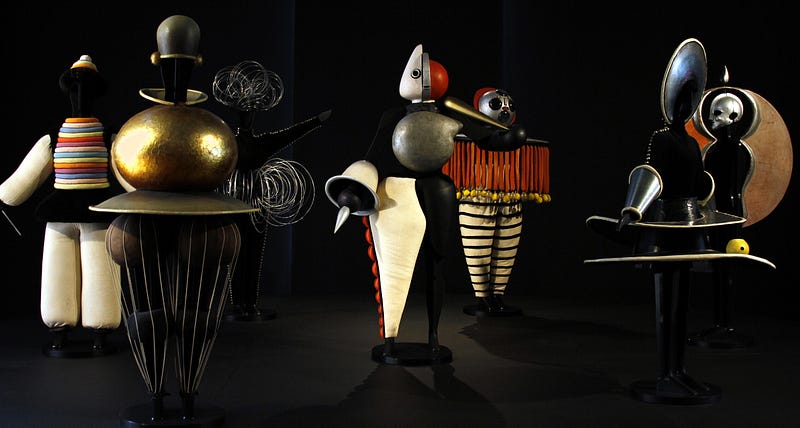
Costumes for ‘The Triadic Ballet’ (1922) by Oskar Schlemmer, photographed in 2017 by José Luiz Bernardes Ribeiro at the Stuttgart State Gallery[view license]
So, clearly, there are overlaps between the worlds of high fashion and fine art, both sharing significant antecedents. Perhaps one of the earliest examples of wearable sculpture were the costumes designed by Oskar Schlemmer for the 1922 performances of The Triadic Ballet / Triadisches Ballett. This was at a time when Modernists were very interested in art from outside the Euro-centric academic traditions and were looking to indigenous cultures, particularly those of Africa and the Americas where costumed and masked ritual performance have ancient roots.
Schlemmer was interested in a similar mode of expression that drew from the mathematics of machinery and the modern world instead of such culturally dependent and specific symbolism. His concept grew from the design principals of the Bauhaus, where he was a teacher at the time. Applying the German design school’s reductionist approach to the human figure, he treated it as a set of cylinders and spheres that, when in motion, trace arcs through space. This was the starting point for a set of experimental sculptures intended to be inhabited, and animated by the person within.
Schlemmer was approaching the body as a three-dimensional medium in the same way as a painter approaches a flat surface. As the paint covers the canvas, so his sculptures would conceal the form they were built around. However, as sculpture exists in space, he was also keen to exploit the dynamic potential of motion as choreographed geometry. Schlemmer’s underlying concept grew from an idea of the ‘natural human’ — flesh, emotions, and desires — being subsumed, contained, and concealed by the modern world around us. The implied narrative dealt with the individual regaining power over the artificial and expressing themselves through new materials and media.
The performance to show off these inhabited sculptures was a ballet based around a combination of sets of three, hence its title of Triadic Ballet. The first performances of Schlemmer’s experimental dance were choreographed as early as 1912 in collaboration with a small dance troupe led by Albert Burger and Elsa Hötzel to a score by organist Marco Enrico Bossi. After another ten years in development and with specially composed music by Paul Hindemith, Schlemmer was able to present the final choreographed and costumed version in 1922, refined into a narrative of colours and forms with three dancers in each section and each act played out against a monochrome background: first yellow, followed by pink, and finally greytone.
It’s a recognised landmark in expressive movement and dance as well as kinetic sculpture and still gets regularly referenced in contemporary fashion and pop culture. Schlemmer's theories of the dynamics of human motion in a three-dimensional stage space directly influenced the production design for Luca Guadagnino’s 2018 remake of horror classic Suspiria. The Triadic Ballet also gets a specific mention in the lyrics of Bauhaus Staircase, the 2023 single by art-tronic duo, Orchestral Manoeuvres in the Dark (OMD).
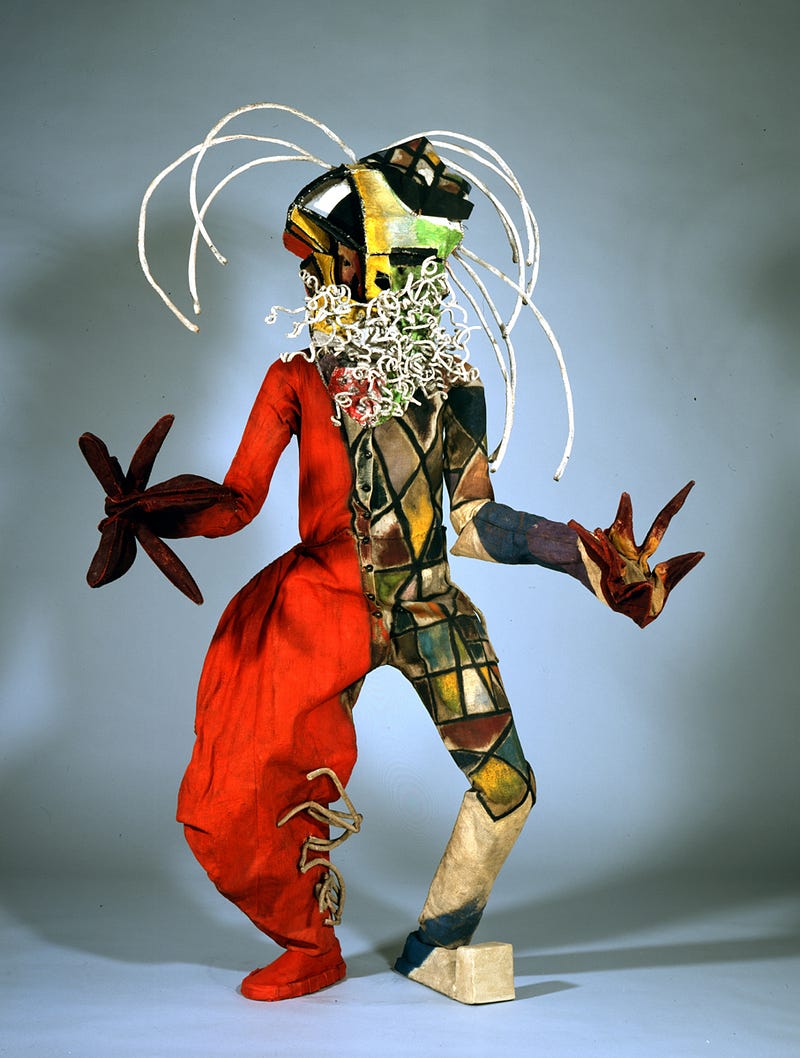
Sometime during the development of The Triadic Ballet, artistic partners Lavinia Schulz and Walter Holdt were also experimenting with costumes that served both as animated sculpture and stage set. However, their creations are forever marked with much darker ideology and associations. Lavinia Schulz had trained as a dancer and costume designer under the German theatre producer Lothar Schreyer and she met and married Walter Holdt when he was recruited, some might say ‘groomed’, straight from school by Schreyer.
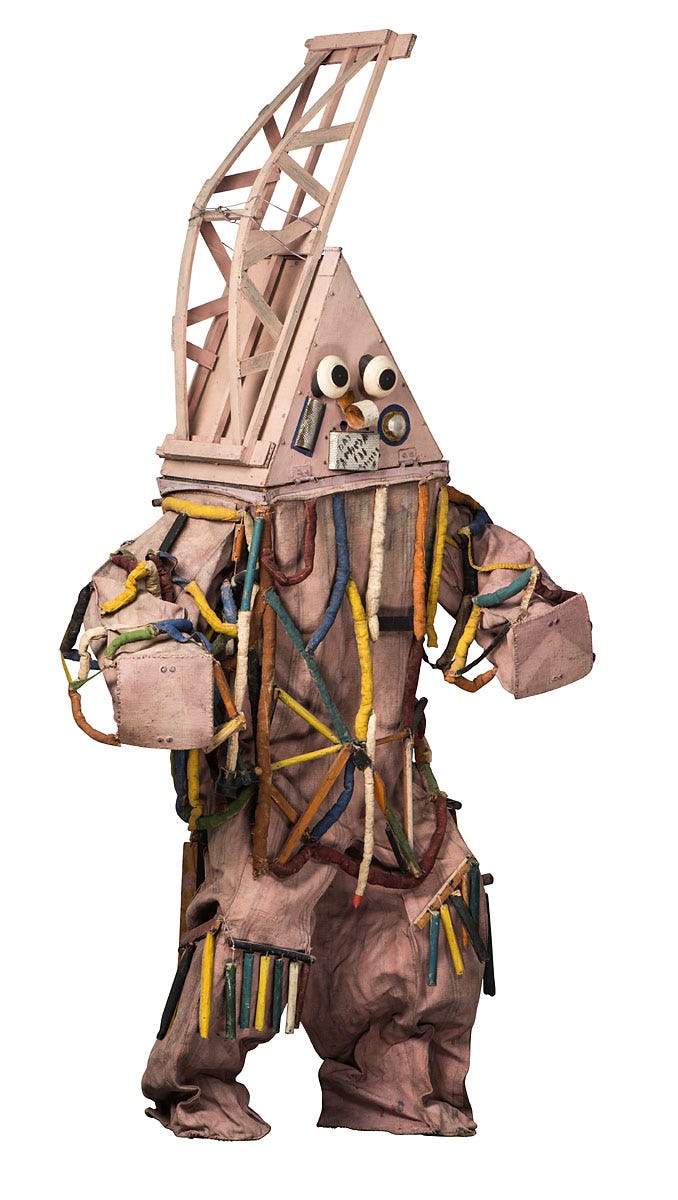
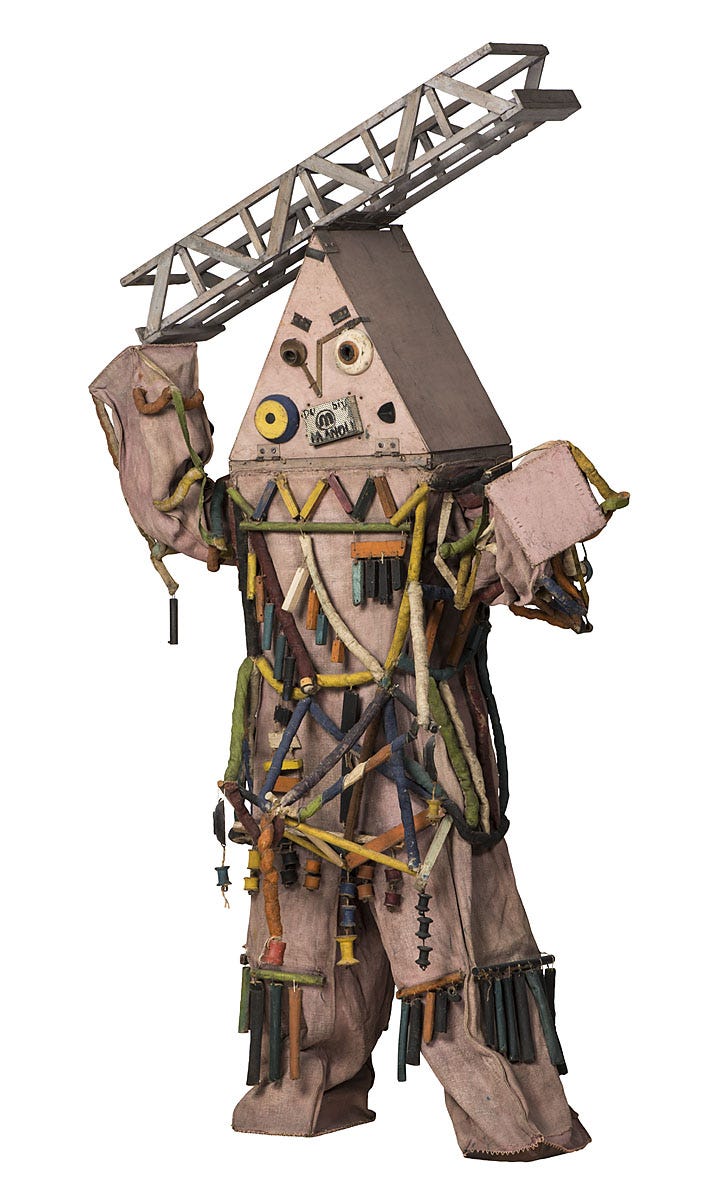
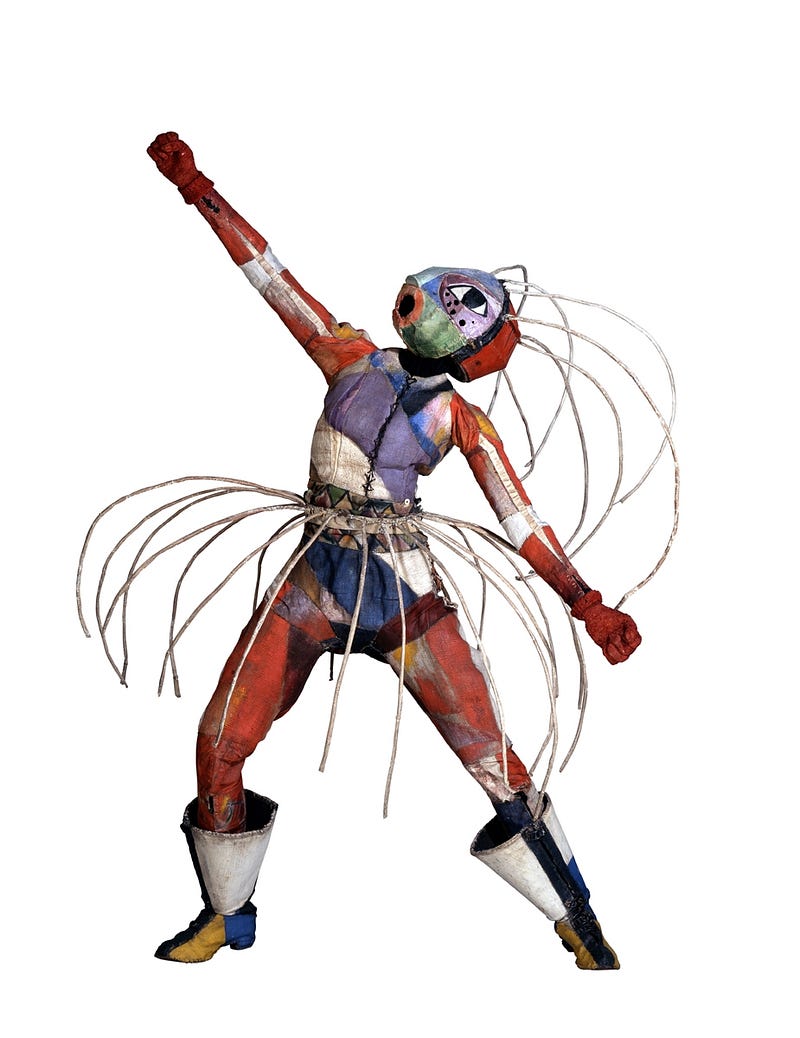
‘His’n’Hers’ variants of ‘Technik’ costume (made c.1924, photographed 1989) [view license 1 and 2 ]
It wasn’t long before the radical attitudes and unruly behaviours of Schulz and Holdt got them expelled from the troupe and they began performing together as the duo Die Maskentänzer / The Mask Dancers. Made only from found materials, their costumes were an unusual mix of Dada-esque provocation and Arte Povera.
The iconography of forms borrowed from abstract painting, Cubist sculpture, early science fiction cinema, and pulp illustrations. The aesthetic of their creations fused the comedic and the grotesque and incorporated hidden elements within that affected how the ‘dancer’ moved. These included asymmetric weights and even nails and abrasive linings that would inflict injury to the wearer during certain moves. This may have been an extension of their abusive relationship that was sado-masochistic and known to involve the dynamics of hate and violence. They seemed to believe that pain and endurance were transformative in some way.
Lavinia and Holdt would end their short, relatively fruitless career together in a murder suicide. The thirty or so performative costumes they made were thought lost until 1988, when they were rediscovered in the archives of the Museum for Art and Industry in Hamburg. They have since been conserved, displayed, and catalogued with colour photographs.
Their mentor, Lothar Schreyer, was invited to teach stagecraft at the Bauhaus in the early 1920s, where he worked alongside Oskar Schlemmer and experimented with masks and geometric costumes. By 1923, Schreyer had fallen-out with Bauhaus director Walter Gropius and Oskar Schlemmer had replaced him as Director of Stagecraft.
Schreyer would later reveal his ideology to be the antithesis of the Bauhaus. In 1933, the same year as the Nazi government of Germany closed down the last of the Bauhaus design schools, Lothar Schreyer signed the Gelöbnis treuester Gefolgschaft pledge of allegiance to Adolf Hitler. Ironically, when his art and design work was included in the 1937 Munich exhibition of degenerate art, Die Ausstellung Entartete Kunst, he was forced into a position where he had to denounce his own work and give up any artistic integrity he may have had.
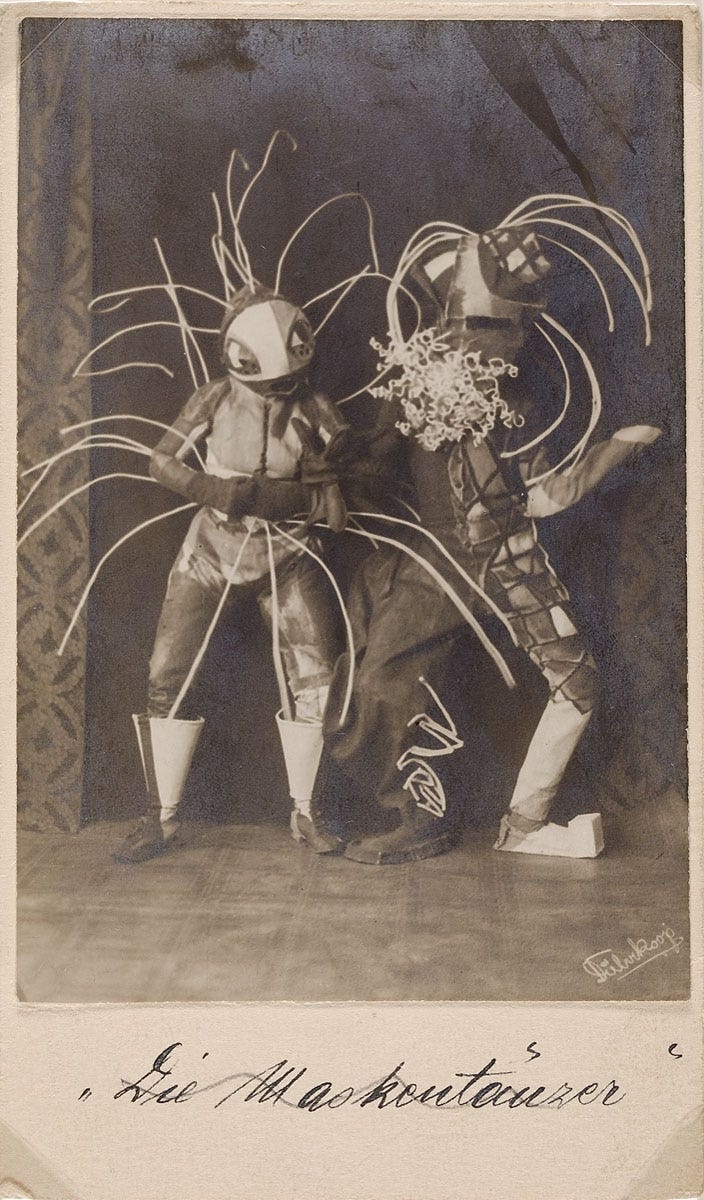
Lavinia Schulz and Walter Holdt as ‘Die Maskentänzer’ (c.1924) photographed by Minya Diéz-Dührkoop and the same costumes, ‘Toboggan Frau’ and ‘Toboggan Mann’, photographed in 1989 by conservators at Hamburg’s Museum for Art and Industry [view license 1 and 2 and 3 ]
So, on a lighter note but with even darker art… and skipping forward through the Modern Era to the first major Post-Modern movement, we find another couple of artists who I’m sure loved Halloween — the notorious, important, though relatively obscure Surrealists, Jean Benoît and Mimi Parent.
The two French Canadians met while studying at Montreal’s École des Beaux-Arts and would later marry before moving to France in 1949. They were welcomed into the fervent Paris art scene and invited by André Breton, author of the Surrealist Manifesto, to participate in the the historic group exhibition he was co-curating with Marcel Duchamp known as The 1959 InteRnatiOnal Exhibition of Surrealism E.R.O.S. Yes, I see that the anacronym doesn’t quite fit, already challenging accepted codes of communication, but does indicate the congruent concept of the works involved… and Jean Benoît and Mimi Parent did not disappoint on the psycho-sexual Freudian front presenting what must’ve been the most surprising and memorable experience of all the associated events.
The whole exhibition was designed as an experiential installation where things happened and in this way, Paris was parallelling New York in developing ‘Happenings’ as a new art format. The ground-breaking work was presented by Jean Benoît at a special pre-opening ceremony and was a combination of sculpture, sound, actions, monologue, and gothic burlesque titled L’Exécution du Testament du Marquis de Sade. This was a premier for the work as a whole that Jean Benoît had been developing for around a decade and had spent the previous two years constructing.
The action was presaged by recorded sounds beginning with a volcanic eruption, the noise of a crowd, and then André Breton reading a section from the last will and testament of the Marquis de Sade. In a tall headdress consisting of four stacked masks, and a costume of large carved panels painted in dark blue and metallic colours with some red details, Benoît entered the large room using sculptural crutches to steady himself as he laboriously dragged a large cabinet behind, representing a sarcophagus. Each measured step was accompanied by loud noises from horns under each boot. His own form was completely contained within this partially figurative sculpture, drawing upon a fusion of Cubist and tribal aesthetics with mythical or spiritual connotations. Here, we have a worn work of art that is by no means a practical garment and certainly transcends frivolous fashion in terms of concept and context. A witness described it as “a fabulous monster.”
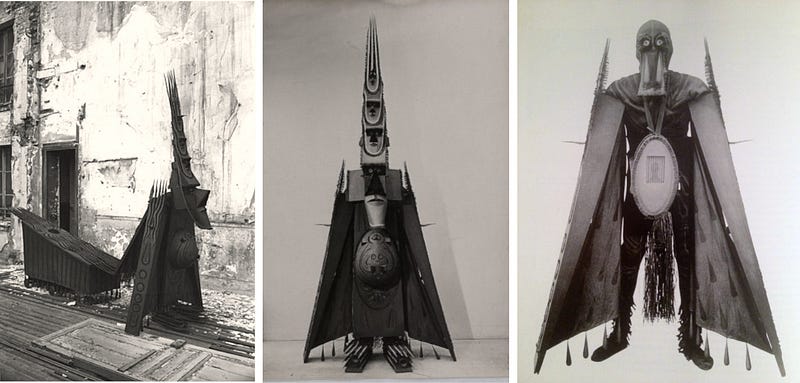
‘L’Exécution du Testament du Marquis de Sade’ (1959) three stages of the costume worn by Jean Benoît [view image source] *
Finally the creature stopped its advance in a space left clear for it and there was silence. Benoît remained still as a statue. Only when uneasy mutterings began among the audience did Breton began reading a detailed list of the costume’s components along with some clues as to their symbolism — the pieces representing aspects of the modern world and the morality of ‘polite society’ that buries us alive and shackles our desires, stifling individual creativity. As each part was described, a woman dressed respectfully in funerary black removed the pieces and presented them to the viewers before mounting the parts on the wall behind. Gradually the sculpture dissembled, creating instead a prearranged parietal tableaux. The woman was Mimi Parent.
Finally Jean Benoît was revealed, painted in a similar dark colour scheme as the costume and nude except for a star of red fabric adhered over his heart and a codpiece on which was mounted a large articulated phallus that was puppeteered by means of near-invisible fishing line. A fire was then lit in a brazier or similar container to heat an ornate branding iron. After enough time to ensure it was glowing hot, Benoît, who had remained comparatively motionless and submissive throughout the ‘striptease’ was suddenly dynamic, tore away the red star from his chest and took the branding iron, pressing it to his exposed breast. The action was reflected in a large mirror and the name ‘SADE’ could be seen when the iron was lifted. Indeed, the name was branded into the artist’s flesh in mirror writing. He then turned to the viewers and spoke his first dialogue of the entire performance asking, “Who is the iron for [next]?” before returning it to the coals and making his exit.
According to some accounts a member of the audience followed suit and, pulling open his shirt also branded ‘ƎᗡAƧ’ on his chest. It was the artist Roberto Matta, but when others seemed about to do the same, they were prevented and the fire extinguished. The whole ritual had been performed in private before an invited audience of about 100, but no recording except several eye-witness accounts survive. The performance was intended to be a decisive action that could not be reversed, revoked, or repeated. The suit itself was exhibited and Benoît had arranged for photographer Gilles Ehrmann to document the sequence of removal in an abandoned warehouse, again assisted by Mimi Parent but in the absence of an audience.
Parent’s profile in the subsequent exhibition was also prominent, having designed several important elements such as an artist’s multiple, Boîte Alerte, which was a series of 250 green letterboxes each containing 50 or so items — such as letters, pictures, and booklets — contributed by the exhibiting artists. She also designed a collaborative installation occupying one of the rooms titled La Crypt du fétichisme / The Crypt of Fetishism.
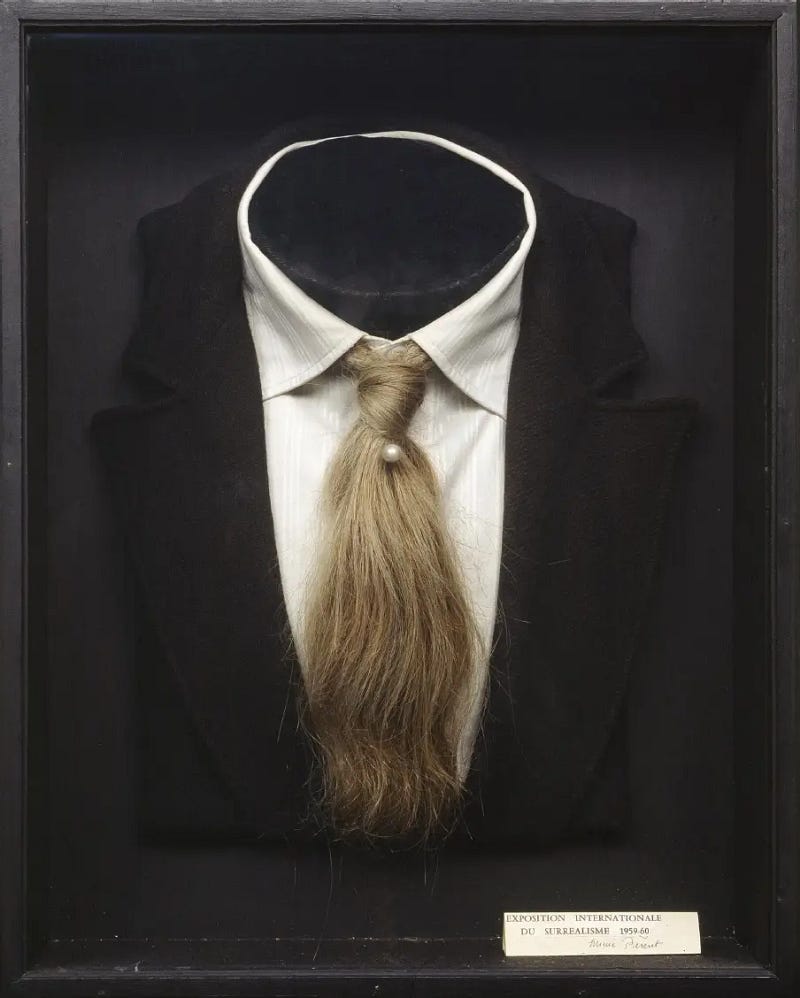
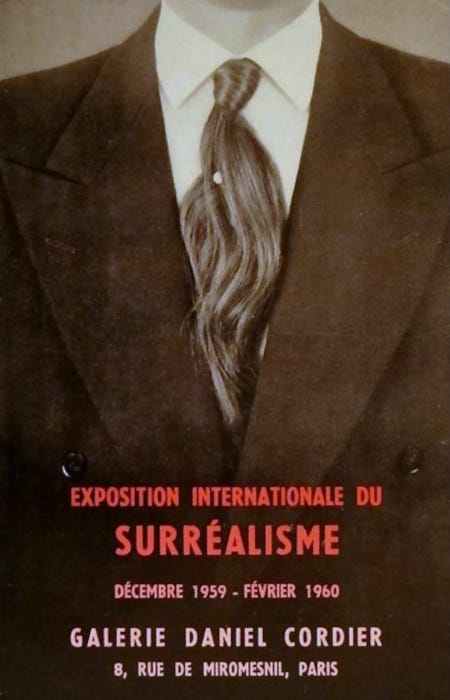
‘Masculin-Féminin’ (1959) by Mimi Parent as exhibited and as worn, photographed for the exhibition poster [View license 1 and image source 2 ] *
Her own works on display included Masculin-Féminin — theoretically a wearable piece presented as an assemblage in a box comprising the lapels from a man’s jacket and white shirt collar with a tie made from her own hair. Here, the female signifier of long blonde hair becomes an adornment for an absent man while at the same time suggesting a noose or garrotte. Her own hair, presented as the proxy for a woman in a position of dominance, would become a recurring theme. A photograph of Masculin-Féminin worn by a model was selected by André Breton to be the image for the exhibition poster.
Jean Benoît would return to the sculptural costume format in later works, most notably the striking and disconcerting Le Nécrophile (Dédie au Sergeant Bertrand) / The Necrophile (Dedicated to Sergeant Bertrand) which he presented at the opening of the Eleventh International Exhibition of Surrealism, in 1965. The Sergeant François Bertrand referenced in the work was also known as the ‘Vampire of Montparnasse’ and is the psychiatric case for which the term necrophilia was coined in the mid-nineteenth-century. Clearly, Benoît was still ‘digging’ deep into the darker recesses of the Freudian psycho-sexual realm to ‘unearth’ unsettling narratives.
The cape of the costume was broad-shouldered, forming a ruff supporting a cluster of crosses, each bearing the name of a famous libertine philosopher or similarly controversial character. A garland of birds representing carrion crows ringed the shoulders. When the cape was held closed, the whole costume appeared to be a stone tower or suggest a walled cemetery. When the cape was parted, a heavy chain was revealed about Benoît’s waist on which hung knives and toy-like models of grave-digging equipment.
A long, segmented ‘tail’ extended from the groin implying an impotent appendage that connected to the earth at the wearer’s feet, where hidden things, such as secrets and the dead, may be buried — perhaps suggesting the underworld, the ancestors, and notions of the collective subconscious. He brandished a staff topped with two figures, one grey and one white, that could be angels or demons. On the back of the worn sculpture was a motto that translates as, “Death, life is stalking you.”
Now, that’s a helluva Halloween costume!
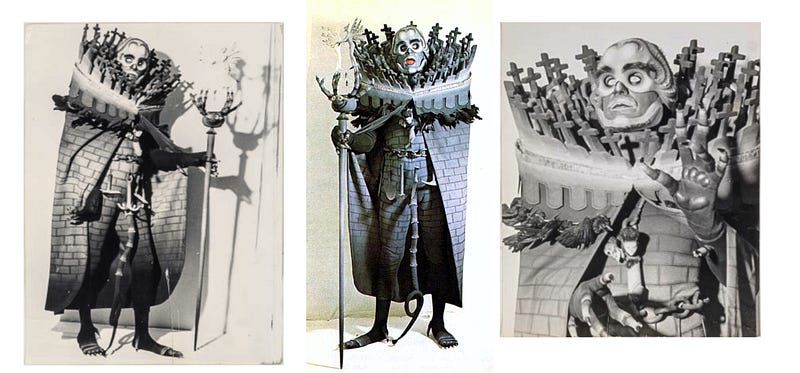
‘Le Nécrophile’ (1965) costume by Jean Benoît [view license] *
* Signifier and the author cannot be responsible for third-party content on external sites which may contain advertising and are subject to change without notice. All images are used with license, are promotional material, or presented here for educational purposes under fair usage policy.