

When Actions Become Art
Performance was an important innovation of twentieth-century Art but actions aren’t always art…
Performance Art is a difficult one to differentiate and define. Sometimes it’s easier to understand what it is, in terms of what it isn’t. It is distinct from what are known as the Performing Arts but it doesn’t fall within theatre, dance, recital, film… although, there are inevitable overlaps with these modalities.
To some degree, all art relies on an element of action… for example, a painting is a collection of marks made by the cumulative actions of the painter. So, art is always the result of an artist’s action… but in Performance Art, it is the actions themselves that are presented as the most important element of the work. In the correct context, a simple gesture can be art.
Not everyone is an artist, and not everything is art. Something done with the intention of being art, is perhaps half-way there and can become art when received as such. Art requires human agency and relies on an aspect of communication — it needs to have at least three components — a transmitter and a receiver, plus a medium connecting the two. Not all media is art, sometimes it’s simply information, or noise. Art also requires meaning. Though the artist’s intended meaning may differ from the audience’s received meanings.
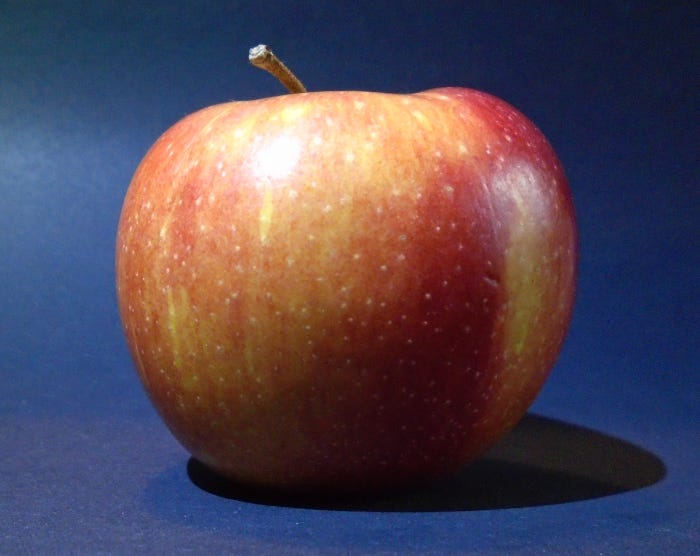
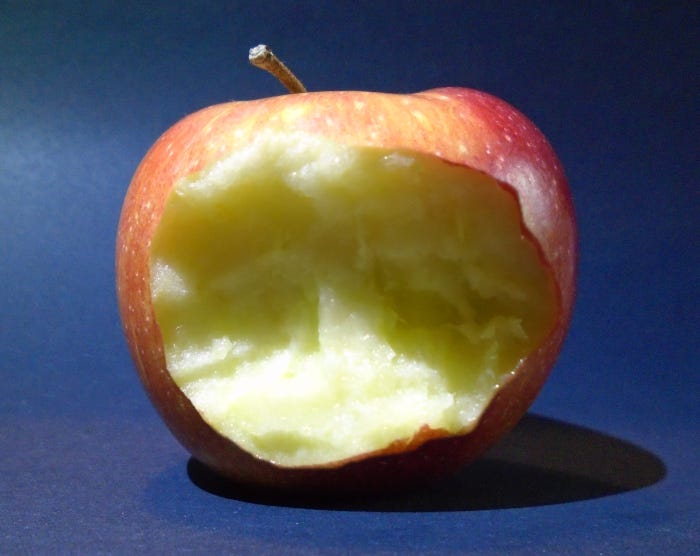
An apple isn’t food until it’s eaten. An apple isn’t art until it’s presented, painted, sculpted… or eaten by an artist during a performance. Eating an apple on stage with the crunch of each bite amplified would encourage the audience to consider the action of eating as sound rather than sustenance. Food for thought rather than digestion. Chewing would be the rhythm and when the action of eating an apple is divorced from familiar settings, we may begin to consider what additional meanings are intended. Cultural and contextual connotations may pop into the minds of those witnessing and listening, from Eve in Eden to Johnny Appleseed in America, from Newton to New York… what about computers and consumers?
Sounds don’t become music until listened to as such. If you’re trying to talk and a loud motorbike roars past, then that’s just noise. If, instead, one pauses and listens to it pass, noting the rhythm of its pistons, the doppler effect of the soundwaves compressing on approach then stretching as it departs, well then it might become music — there’s metre, structure, progression.
A similar notion of Modern machine music was postulated by the Italian Futurists who claimed that the rhythm of a machine gun could stir the human spirit more than any great symphony. The Futurists, who published their first manifesto in 1909, also saw action and movement as an artform and were one of the earliest movements to adopt performance, in itself, as a fine art medium. Particularly in the serving of food during Futurist banquettes.
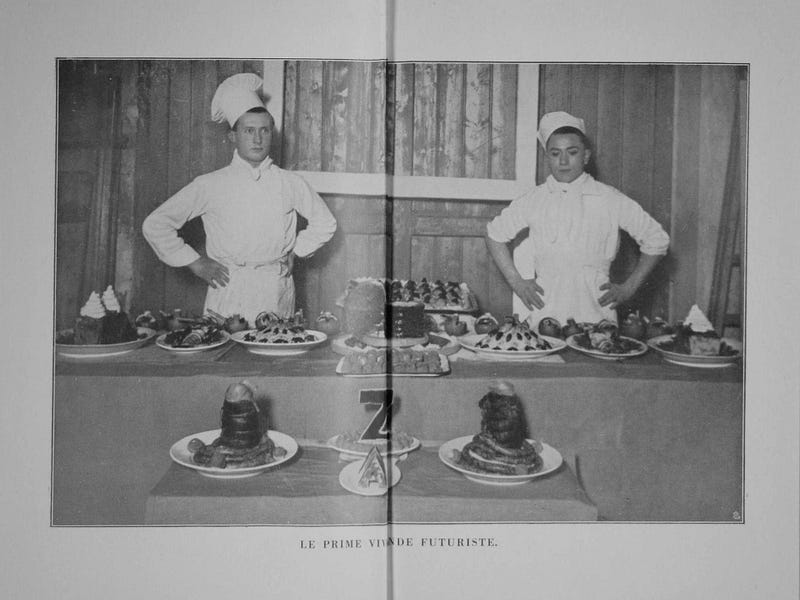
These unique events involved various aspects of performance including firing guns and revving motorcycles as part of the dining experience. The sound and smells of the food, fumes, and cordite were all a part of the art — actions that produced no lasting, tangible artefact beyond the participatory performance.
Actions were also embraced as a Modern artform by a collective of refugee artists centred around Hugo Ball’s club, Cabaret Voltaire, in Zurich during and following the First World War. This is where the seeds of Dada germinated — the movement most usually cited as the origins of Performance Art.
During 1916, a series of confrontational and provocative performances were presented at Cabaret Voltaire involving anarchic actions where pianos were destroyed with axes as they were being played, performers set their clothes alight and ran amok among the audiences or ‘attacked’ them with knives, cutting off pieces of cloth or buttons to use in impromptu assemblages and collages. Such accounts may be apocryphal or embellished but no doubt Performance Art was established as an exciting, and confrontational, new avenue for artists to explore.
During the 1920s, the Bauhaus ran a scenic studio that challenged theatrical conventions and explored relationships between body, space and movement, though the performances were close to what would become known as ‘expressive movement and dance.’ Perhaps the most well-known is Slat Dance (sometimes translated as Pole Dance) first choregraphed by Oskar Schlemmer, during the early 1920s. This work, which involves a dancer whose limbs are extended with long white slats moving against a dark backdrop, is still occasionally performed as modern ballet and was recently referenced in the 2018 remake of Suspiria.
Society ‘Dame’, Rrose Sélavy, was also pushing the boundaries of art and society during the Rroaring Twenties. She was Marcel Duchamp, in drag. Duchamp, the founding father of Dada, created hir as an alter ego and lived part of his life as Rrose, who gave entertaining after dinner talks crammed with puns, clever word play, and double entendre. S/he would later publish works of poetry.
Hir moniker was itself a play on words intended to sound like the common French toast, “Eros! c’est la vie,” which loosely translates as, “Love! such is life,” or something like, “We are all at the mercy of love’s whims.” S/he confounded the doormen of gentlemen’s clubs by emphasising the discriminatory aspects of perceived gender. Rrose was photographed as a ‘fashion icon’ by regular collaborator, Man Ray and these images are the surviving document of Duchamp’s lived performances.
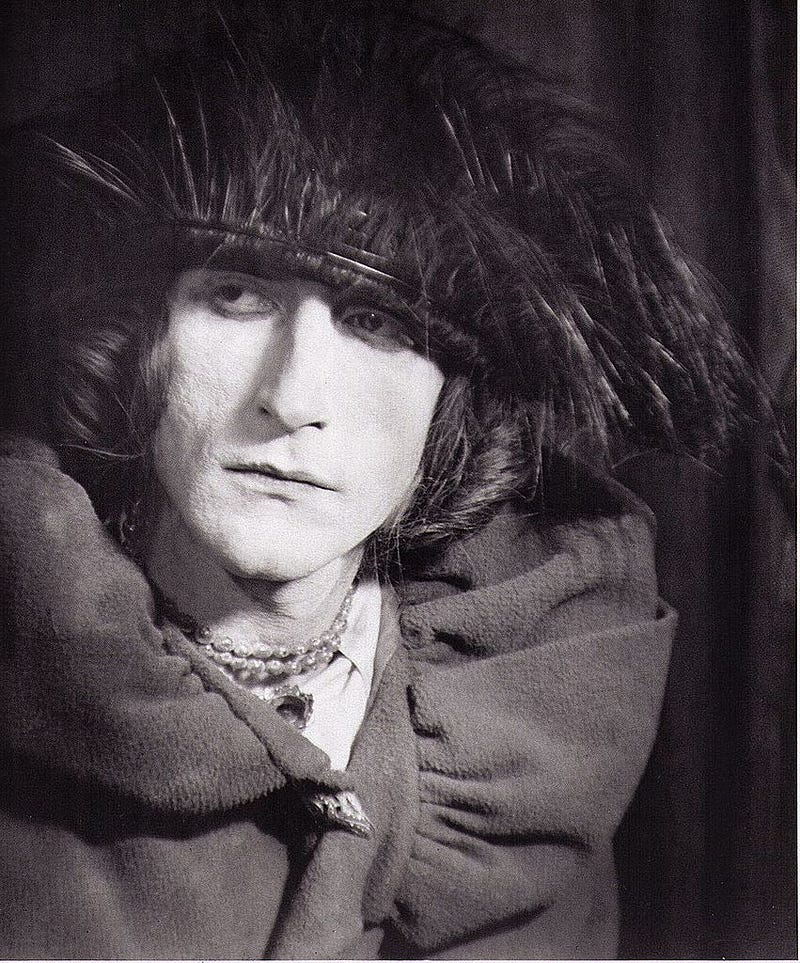
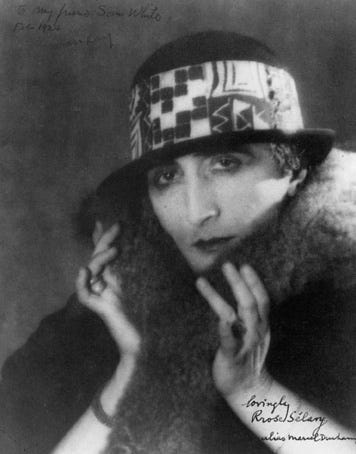


This was an ambitious and sophisticated embodiment of Performance Art. With Rrose Sélavy, Duchamp fused Invisible Theatre, where the audience is unaware that a performance is occurring, with Hype Art, which relies on word of mouth and other media to document and disseminate the work. In addition to exploring notions of identity and of self-identifying, it also broaches aspects of what Joseph Beuys would later term Social Sculpture, where the art interacts with and affects wider society, using preexisting social structures as its media.
During the late 1950s, Jim Dine was among a small group of artists, centred around his New York Judson Church Gallery, who pioneered the idea of Happenings in art. Claes Oldenburg and Marcus Ratliff were among the first artists associated with Dine’s, often improvised, actions that presented the making as part of the art itself, maybe even more so than any resultant pieces. In the early 1960s he was building assemblages in the presence of an audience who were encouraged to interact with the artist and participate in the process. Many of his sculptures combined everyday objects and retained a strong implication of the actions required to fuse them, evidencing the presence and actions of the artist even when displayed in his absence. Dine’s use of familiar, ‘everyday’ objects built on the heritage of Duchamp’s Readymades and closely associated him with Pop Art.
Performance Art really hit its stride during the 1960s and became a major movement associated with Fluxus — which had grown from Dada ideologies; Nouveau réalisme — a Paris-based European collective that would become associated with American Pop Art; and Situationist International — who pushed performance art into the wider socio-political arena.
In 1961, Yves Klein was presenting Performance Painting recitals before an invited audience, where an orchestra provided a musical score and he painted his trademark International Blue onto the naked bodies of models whom he then instructed to make prints directly onto canvas with their bodies.
By 1962, Niki de Saint Phalle, and associate of Klein, was shooting her sculptures and canvases as an art event. She also invited fellow artists, including Robert Rauschenberg, to take part in these actions of violent creativity.
Carolee Schneemann, perhaps the best known of the pioneering feminist performance artists, often made her nude self the central figure of her events. She presented this as a symbolic reclaiming of the female body which she felt had been appropriated as a cultural object and subsequently depersonalised by the wider society. In 1963, she incorporated her own form into an installation in her loft studio which featured broken mirrors, empty frames, and old umbrellas. Schneemann took on different symbolic guises by ‘dressing’ herself with grease, chalk, plastic, and other ‘unremarkable’ substances to performed her 36 Transformative Actions. These were documented in photographs by Icelandic Pop Artist, Erró, under the umbrella title of Eye Body.
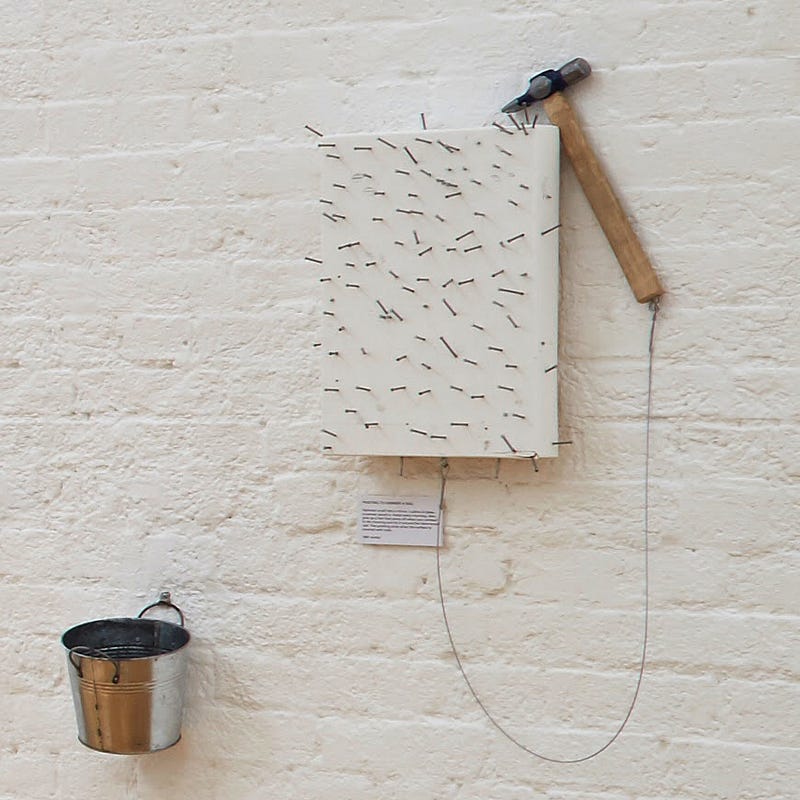
The Performance Art of Yoko Ono, who was part of the New York Judson Church circle, usually included an interactive element that relied on audience participation in the absence of the artist. She termed these Instruction Pieces with 1961's Painting to Hammer a Nail being an early example. Next to a zinc bucket of nails hangs a thick wooded board, painted white, from which a hammer is suspended by cord. The instruction is simple and visitors are invited to hammer a nail into the painting’s blank white surface. This action is as much a component of the work as the materials. Over time, the surface becomes crammed with nails until, in order to hammer more in, some must be displaced. The work comments on a society reliant on limited resources within a defined border and the noisy action feels subversive in the silence of a gallery, disrupting the relationships between artist, gallerist, and visitors.
Sometimes visitor participation in Ono’s work was unexpected, such as when John Lennon visited her 1966 exhibition in London. Lennon was a musician and songwriter in the British band, The Beatles and he found Ono’s work humorous and intriguing. One piece, Apple, comprised a fresh apple presented on a plinth, intended to rot over the course of the exhibition.
Famously, Lennon took a big bite out of the fruit before returning it to its plinth. Ono was initially furious, but not for long as she realised the connotations of a man taking a bite from an apple presented by a woman. What had been intended as a piece of Process Art had suddenly been extended into performance via an unplanned collaboration and elevated into Hype Art by the ensuing media coverage.
Perhaps the most famous of her Performative Artworks were the headline-grabbing bed-ins of 1969. These were intended as peaceful protest against the Vietnam War and were performed in collaboration with John Lennon who, by then, was her husband. These were really inactions, offered as an antithesis of aggressive military actions, relying on Mass Media to reach a wide audience in form of Hype Art that also exploited ideas of celebrity.
From 1970, Vito Acconci began using his body, and other people, in scenarios that usually involved repeated actions carried out according to some prescribed formula. With Step Piece, he stepped on and off a foot stool every morning, maintaining thirty step-ups a minute until muscle fatigue prevented him from achieving this rate. He documented these daily routines with photographs and published monthly progress reports through 1970 tracking the gradual improvement in performance.
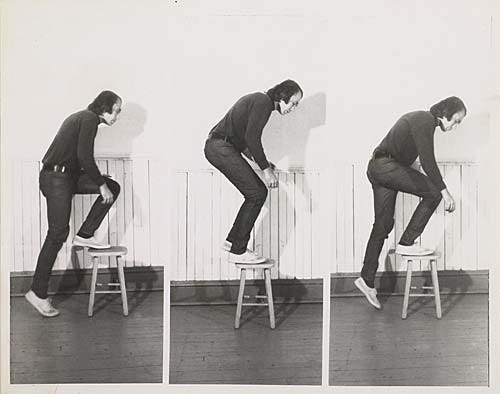
As Yoko Ono had, he also produced Instruction Pieces that didn’t directly involve the artist, the best known being Association Area staged in 1971 where two participants, both blindfolded and with their ears plugged, had been instructed to mimic each other’s mannerisms and movements for a period of one hour.
Around the same time in London, the artist duo, Gilbert and George were presenting themselves in gallery settings as a pair of living statues. Painted gold and wearing their typically British grey suits, they would stand on a plinth and sing. They wore similar suits in their everyday life, maintaining that the Performance never ended and, indeed, every aspect of their life should be considered an ongoing work of Performance Art.
Also in the early Seventies, 1973–74, Marina Abramović was performing her series of Rhythm events at various locations across Europe. These ten performances were based around actions that involved elements of ritual, compulsion, self-harm, misuse of medical drugs, and a real risk to life for the artist and those present. The final six-hour performance, Rhythm 0 (which could’ve been her final performance, ever) involved Abramović remaining entirely passive whilst visitors were invited to use anything from a selection of 72 items on her body. Among those items were DIY tools, clothing, various knives, foods (including an apple, of course), and a loaded gun. The Rhythm performances were intended to tackle themes of individual and collective responsibility and the relationship of the self within society — the personal and the political.
The Coyote process of Joseph Beuys is certainly one of the most sophisticated examples of Performance Art, manifesting from 1974–76 as “I Like America and America Likes Me” — which has been discussed previously in Signifier. The core action occurred at the René Block Gallery, in New York at the height of the No New York scene.
No New York was a punk movement centred at CBGBs in the mid-to-late-seventies. Confrontationalist artist Lydia Lunch was its primary perpetrator and her disparate Performance Art encompassed spoken word, invisible theatre, music events, direct confrontation with small audiences, and actions that occasionally included explicit sex and violence. Aspects of some such performances were later scripted and filmed, playing a seminal role in the birth of the Cinema of Transgression. She went on to exhibit sculptures and photography in more traditional gallery spaces, as well as exploring the potential of multiple music formats including, Punk, No Wave Noise, experimental Jazz, avant-garde Ambient, Progressive Rock, and raucous Blues…
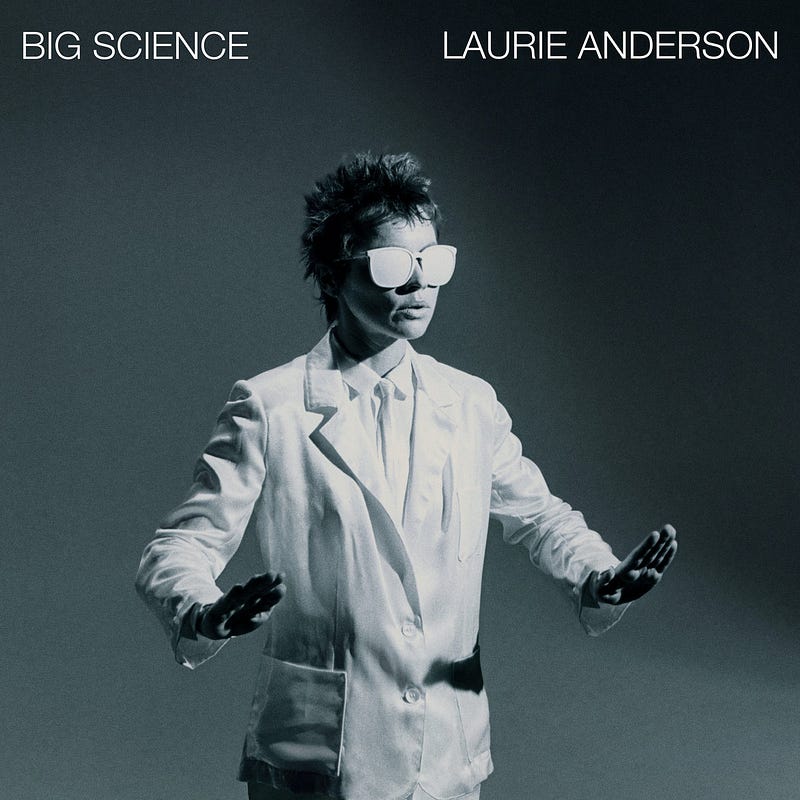
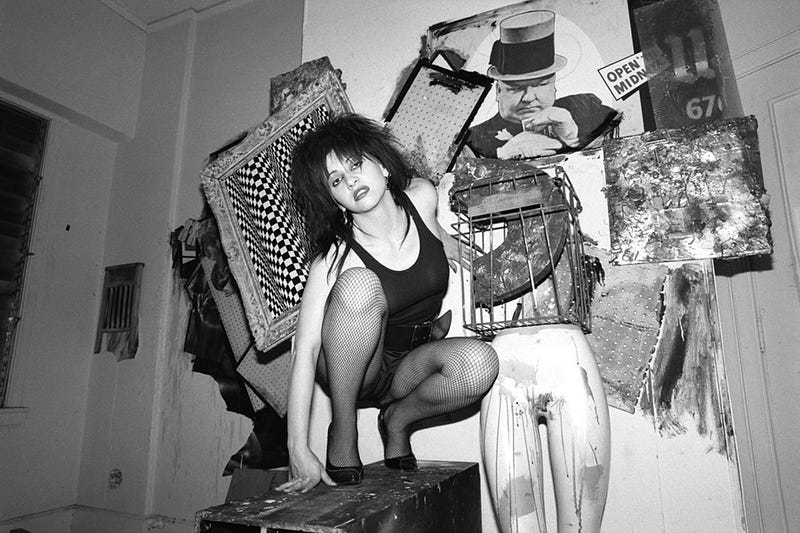

Starting out as a sculptor and installation artist, Laurie Anderson was attracted to the ‘happening’ New York art scene of the Seventies. She was also interested in melding art and actions within the format of music performance. One of her most notable early works was performed with a violin whilst wearing ice skates frozen into a block of ice. The improvisation would continue until the ice melted and freed her.
Anderson’s focus on music took her Performance back onto the mainstream stage, framing her Art as Pop music and becoming an unlikely star in the process. Her stage shows fused experimental music, poetry, actions, installation, and video. She is well-known for her breakthrough single, O Superman, which was marketed as an alternative pop song and charted in several territories, reaching number 2 in the UK during 1981. She later collaborated with author William Burroughs who, in the 1980s, had adopted Niki de Saint Phalle’s shooting-painting technique, using pistols and shotguns to rupture the pressurised canisters of aerosol paints fixed to plywood boards.
Sometimes Performance Art requires not the actions, but simply the presence of the artist, as with James Luna’s The Artifact Piece which he performed among the ethnographic displays at the San Diego Museum of Man, during 1987. Stillness and silence were at the heart of this Performance piece in which he lay in a museum display cabinet along with his favourite objects, books, records, and various legal documents he’d been issued with.
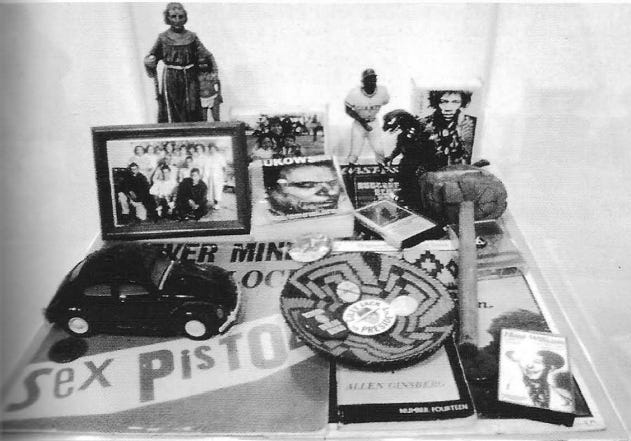
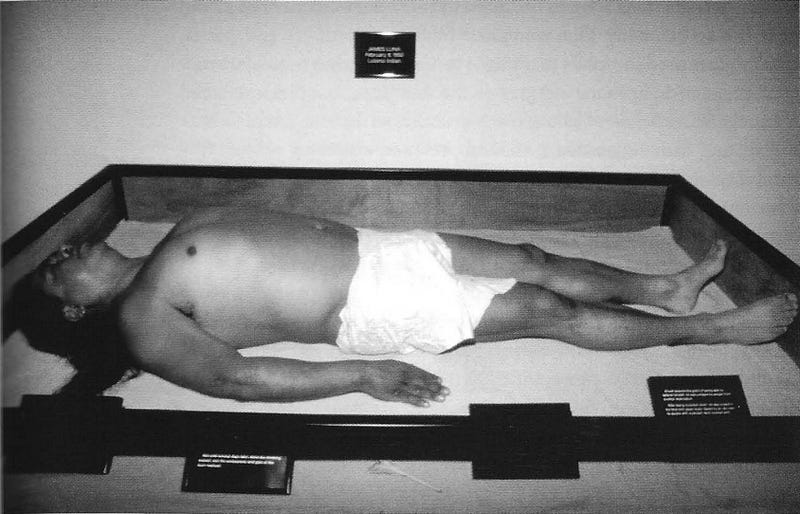
Luna presented himself naked, except for a loincloth, and the various scars on his body were labelled as if he was a scientific or historic curio. He was of Payómkawichum heritage — the original indigenous people living in Southern California when the Spanish invaders arrived. His body was a document that recorded the marks left from drunken falls, fights, or accidents, and spoke volumes about his selfhood and the wider ethnic identity of Native Americans. His life was a record of the times and brought together historical and contemporary issues while his inaction referenced the ritualistic dances and ceremonies that were the community-building Performance Art of his ancestors. Made conspicuous by absence.
…and this is by no means a compete run-down of important twentieth-century Performance Art! Hopefully there are enough clues in the brief overview to set those who are interested off on their own continuing journey of discovery. Perhaps they are encouraged to recognise the artistic potential in their own actions and those of others around them.
Now, you too can be art.
You can read Remy Dean’s interview with Lydia Lunch at the Scrawl archives.
* All images are used with permission or presented here for educational purposes under fair usage policy.