
She Had Her Gun All Ready
When Niki de Saint Phalle wore her Shooting Suit, she repurposed the phallic symbolism of the gun into a feminist tool of violent creativity…
Wearing her specially designed shooting suit, French artist Niki de Saint Phalle created a number of works that in addition to being performed ‘actions’ were also part sculpture, part collage, and part painting.
Often, the paintings were created in front of a live audience and recorded on film as they were constructed and then shot at, usually with a .22 calibre rifle though pistols were sometimes used. The transformative instant of ballistic impact was then evidenced in the resultant objet, and the process documented with film and photographs.
For such events, large assemblages of objects were coated in plaster and containers of paint were suspended in front of these large pieces or concealed within their structure. When the bullets hit these containers the pigments exploded, spattered, and dripped over the white surfaces. She called these shootings, Tirs. This was when Action Painting was en vogue, particularly in the male-dominated New York scene — the legacy of Jackson Pollock.
In 1962, for one of the signature works from this period, she made a hollow cast of the Venus de Milo in white plaster over a metal frame, and packed bags of black and red paints inside it. She then shot the statue from a distance. The bullets punctured the paint bags concealed within in the cavity and the coloured ‘blood’ then ran from the bullet holes and painted the sculpture. The Shooting Suit itself was white and figure-hugging, making the living Saint Phalle a Modern echo of the classical icon of femineity. Being a professional fashion model, Saint Phalle was well-aware of how media packaged and portrayed women.
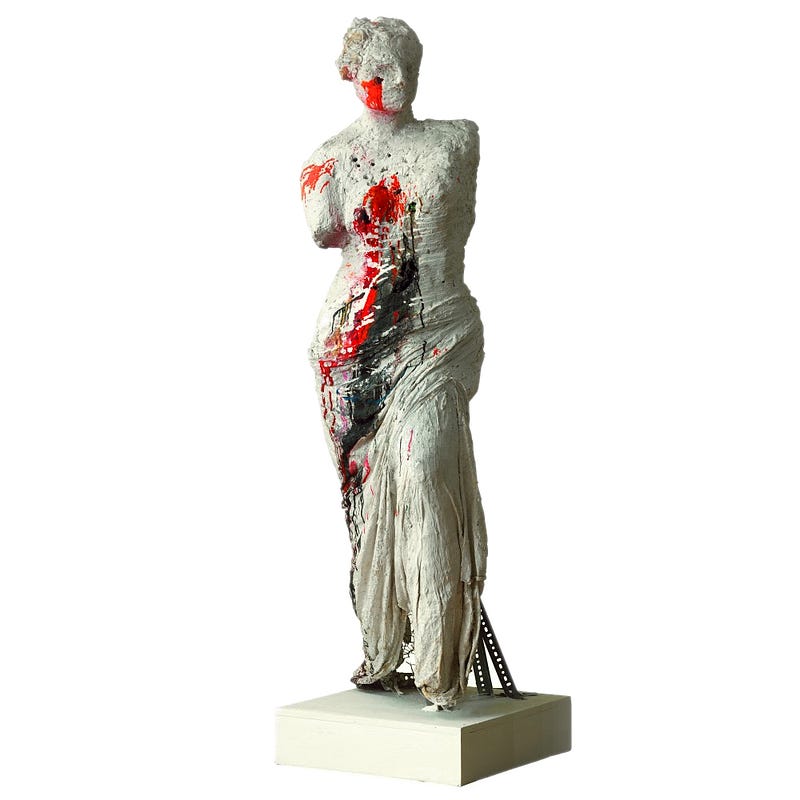
This work is almost a dictionary definition of the Post-Modern: an ‘attack’ upon a classical work that does not destroy it but extends and compliments it, bringing its meaning into a more relevant relationship with the contemporary.
In this act she re-appropriated the gun, a mechanism of death and destruction, and used it in a creative act, turning the male principles of projection and penetration into a dynamic act of feminine creativity. I am reminded of the title of Nick Zedd’s 1992 film, War is Menstrual Envy. Incidentally, I have borrowed the title, She Had Her Gun All Ready, from a 1978 seminal entry into the cinema of transgression written, directed, and starring Vivienne Dick, with Lydia Lunch and Pat Place.
In Saint Phalle’s shooting actions, the works are transformed from their potential state in a series of instants that last a fraction of a second. In other circumstances, those tiny moments could mean the difference between life and death. Saint Phalle was a good shot, yet however accurate the marks(wo)man, there was always an element of chance as a metaphor of the differential between intention and result, transmission and reception, the signifier and the signified.
Increasingly, she collaborated with others in these shootings, notably allowing Robert Rauschenberg to shoot her collaged piece titled Homage to Bob Rauschenberg (1961). In the series of Homages that were to follow, she would often invite male colleagues to fire the guns under her instruction, thereby subjugating inherent male aggression to feminine creativity.
By relinquishing control of the decisive moment, Saint Phalle was partly removing the hand of the artist from the work. It seems she intended this as the antithesis to the cult of personality that had been dominating the contemporary art scene in which collectors bought artefacts for the name attached, rather than aesthetic reasons or any specific concept embodied by a piece.
She aligned with the emergent Nouveau Réalisme movement, which had been instigated in 1960 by fellow French artist Yves Klein and the influential critic, Pierre Restany. It has often been summed-up as the French answer to Pop Art and grew out of the Dada ideologies expressed in the work of Marcel Duchamp. Other notable contributors to Nouveau Réalisme include Christo, César Baldaccini, Daniel Spoerri, Jasper Johns, Larry Rivers, and the aforementioned Robert Rauschenberg.
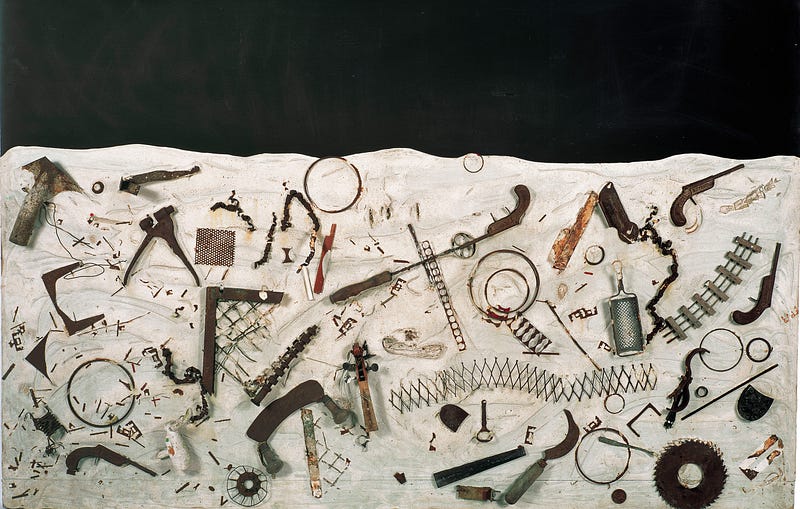
Niki de Saint Phalle had made her first shooting works early in 1961 when she shot four paintings in the back yard of her studio in front of a small audience. Though this was a radical method, it was a progression from ideas she had been exploring in her work since the mid-1950s as her paintings began to include more and more collaged elements. They had developed into assemblages of objects mounted on wooden boards or set in plaster to create sculptural panels.
These objects would often represent the domestic roles of a traditional housewife. However, when selected for their deadly potential and presented together, kitchen implements such as hefty rolling pins, tenderising mallets, and meat-cleavers took on sinister connotations. It wasn’t long before more ‘masculine’ items began to join them in her collages - circular saws, pliers, and pistols.
In a series of collages she started making in 1960, titled Saint Sébastien / Portrait of My Lover / Portrait of Myself, a paint-spattered shirt was plastered onto a board with a darts board fixed where the wearer’s head would be. Visitors to exhibitions where these were displayed were encouraged to throw the darts provided at the ‘face’…
A couple of weeks after the first, the second shooting session took place in the Impasse Ronsin, the now famous dead-end street in Paris around which many artists had their studios. So, this time it was attended by many more formative figures of the Nouveau Réalisme group. Not long after that, the work of Niki de Saint Phalle was included in the ‘blockbuster’ exhibition Movement in Art that toured several major galleries across Europe, showcasing the new trends in Kinetic Sculpture, Action Painting, and Actions. The Stedelijk Museum in Amsterdam opened the exhibition with an opportunity for attendees to shoot a set of de Phalle’s paintings suspended in trees, completing the works which would then be exhibited in the galleries.
By the time she took her Shooting Actions to the USA, Niki de Saint Phalle had a special costume made for the events — her one-piece Shooting Suit. The suit added a sculptural element, a three-dimensional form occupied and animated by the artist herself. It also marked her aside from the other artists she often invited to fire at her constructions.
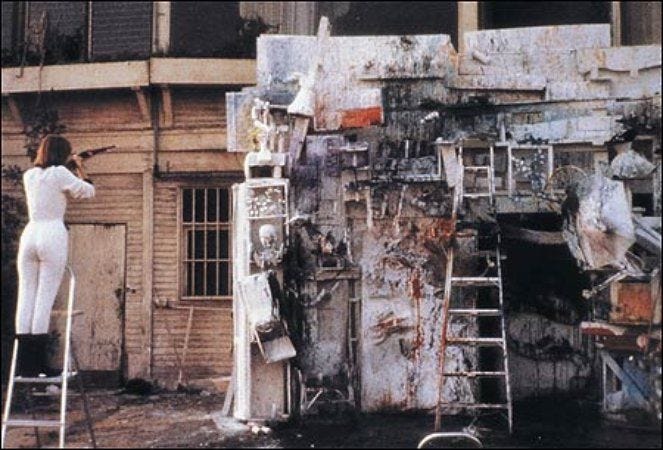
The suit itself became an artefact, part self-portrait, part relic of the events. When exhibited alongside the shot paintings and sculptures, it denoted the presence of the artist when the works came into being, and emphasised the absence of the artist in the work when displayed as material memory. Perhaps all so-called art is basically the material memory of an artist’s actions. Vital gestures. Decisive interventions. A record of transitional instants.
Niki de Saint Phalle took the concept of the absent artist further when her works were later delivered to, or assembled at, the galleries with succinct instructions of how they should be shot.
1. Lean picture against a wall. 2. Put a strong board behind it (if required, in order to protect the wall). 3. Take a .22 long rifle and load with short ammunition. 4. Shoot the colour pouches which are embedded in the plaster until they have “bled” (or until you like the picture). 5. Attention! Leave the picture in the same position until well dried. Then still be careful, as remains of colour not yet dry might run over the picture.
* All images are used with permission or presented here for educational purposes under fair usage policy.


