
Body Beautiful
A few Classical Greek statues established the western paradigms of masculine and feminine (even bovine) beauty that have persisted for millennia…
Myron of Eleutherae was respected as being one of the earliest Greek sculptors to achieve complete realism, fused with perfect aesthetic balance. He worked toward an end result cast in bronze and produced figures that, to the observers of the time, looked as if they would actually complete the movement in which they had been cast. They were anatomically accurate. Their flesh and skin texture appeared supple and mobile, despite being made of hard metal.
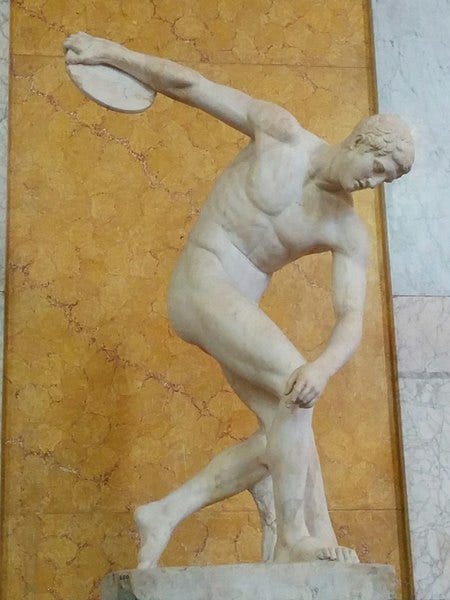
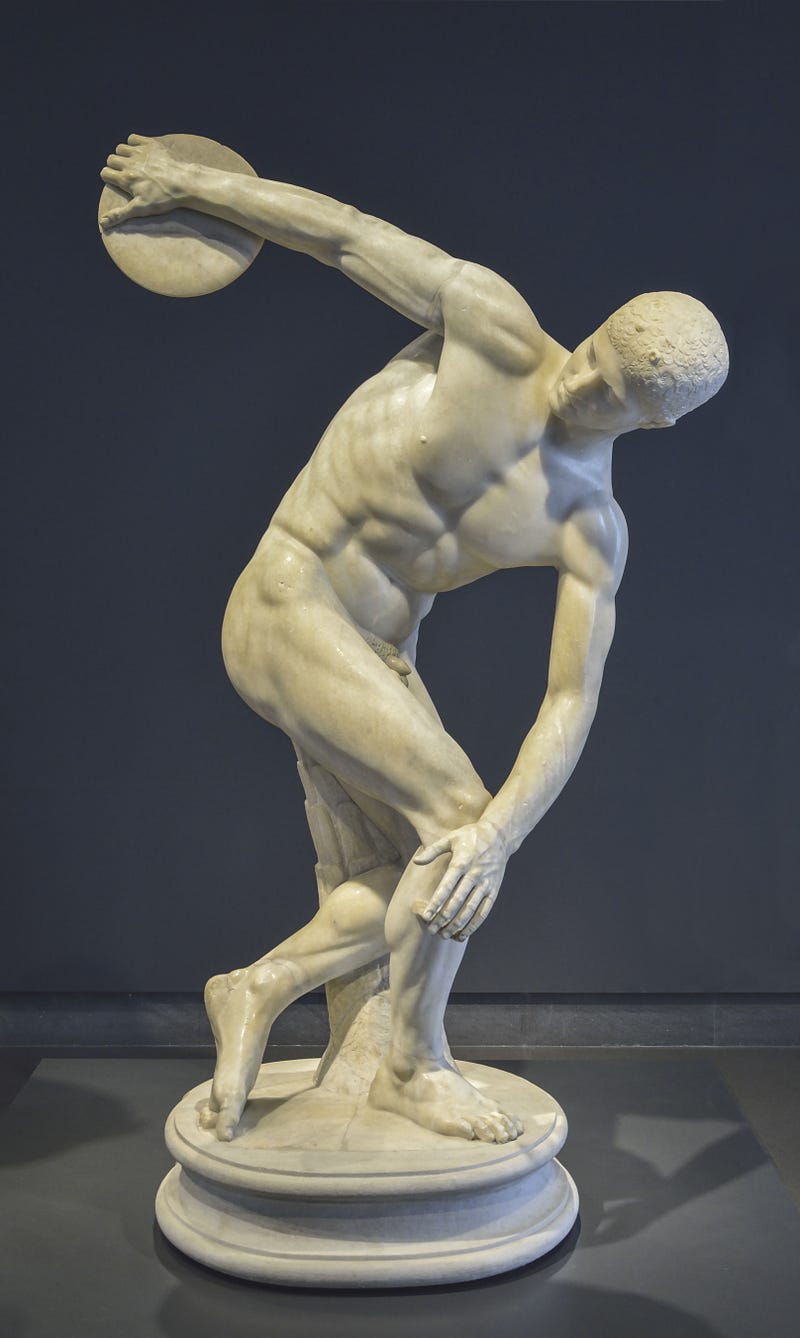
The most famous of his works is Diskobolos, an athlete in the motion of hurling a discus. It’s believed that the Roman copies we know today as The Discus Thrower were carved from direct observation of Myron’s bronzes, originally sculpted and cast in bronze circa 460 BCE, all of which have been lost. It’s believed that many were later re-smelted by the Roman Catholic Church, to be recast into religious icons or used to make cannons and no original work of Myron is known to survive.
The Discus Thrower is perfectly balanced, as an athlete would be. The body is correctly proportioned and all the mechanics of muscle and underlying skeleton are correct. Bear in mind, though, this may well be an idealised body according to established aesthetics of the time. Similar to the airbrushing of celebrity photos in the mass media of today, this body may well have had any blemishes or incongruities, ‘glossed over’.
There is some debate about the positioning of the head. An athlete in the act of throwing a discus, when at the point of motion depicted, would almost certainly be looking back toward the throwing arm. However, eighteenth- and nineteenth-century copies were mostly made with the figure facing forward, toward the ‘target’. The most famous version, now displayed in the British Museum, was restored in the 1770s from fragments for the collector Charles Townley and it seems his restorer repositioned the head in error or to make it more acceptable to taste. In general, Romans liked their statuary to seem assertive and fixed on a goal ahead of them — this meshed with their psychology of advancing the empire and looking to the future. But there are surviving Roman-period copies with the head in the more natural position. So, the face forward pose was probably an eighteenth-century invention.
Critics also have also pointed out that the face of the athlete lacks any expression of effort. Although the head of the Townley version may not be a correct match with the torso, this trait is almost certainly true to the original. Myron was working at a time during the transition from the ‘severe period’, when the faces of all Greek statuary were passive and unsmiling, to the golden age of ‘Classical Naturalism’.
Scholars credit Myron as a major innovator towards the newer style because his compositions were original, whereas many of his contemporaries copied established poses and patterns. The stances of his statues were anything but impassive and implied a dynamic continuation of movement. This expressed what it was that marks a living human apart from a statue and introduced a distinctive naturalism achieved through observation.
The Classical philosophies of Humanism were the driving force behind the increasing value of keen ‘scientific’ observation. The focus on understanding ourselves as the centre of our universe led to a belief that we can only ever understand the wider universe from that human point of view. Only by honing our perceptions can we question the nature of things and, as we only experience though human faculties, our understanding will necessarily be tied to the subjective, human experience. Therefore, it was of primary importance that we learn what it is to be ‘human’…
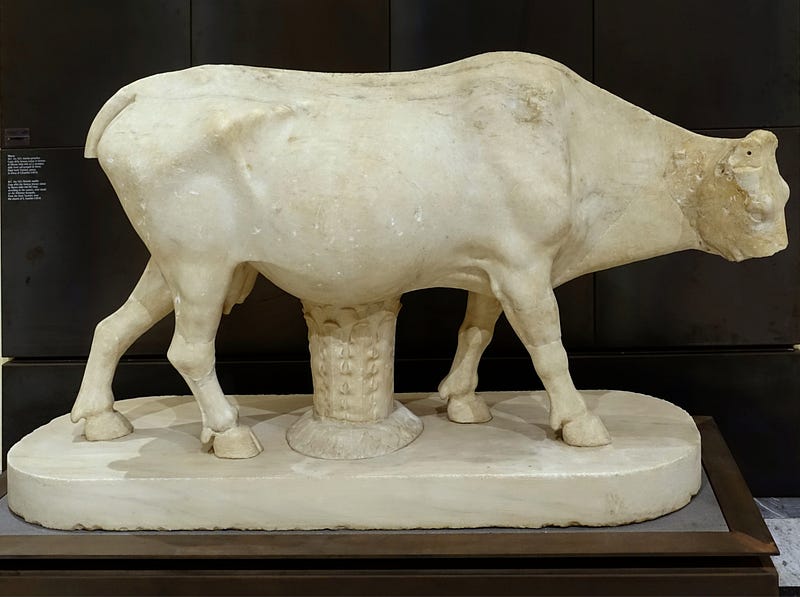
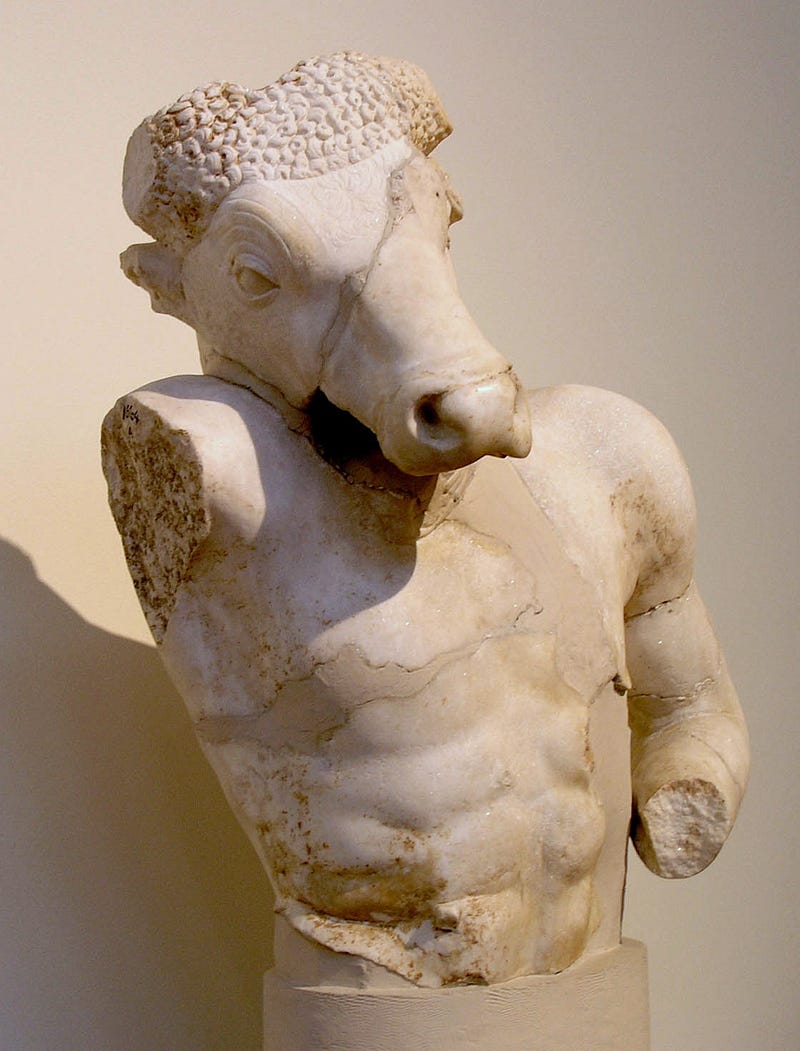
This didn’t mean that the ancient Greeks were only interested in themselves and other humans, but that they would apply their senses to the experience of all aspects of existence. Myron turned his keen observation and quest for naturalistic realism to many other things and was renowned in his day for a sculpture of a cow that people mistook to be a real heifer.
His bronze cow became a ‘tourist attraction’ and people would pat and talk to it in an attempt to coax it into life. It’s thought that Myron was the first sculptor of the Classical era to create an effigy of an animal other than a horse. Importantly, Myron also recognised the imagination as a part of the human experience and applied his method to realising mythological beings and beasts. He used his skills in sculpting the human and the bovine when he created statues of the Minotaur.
Throughout Classical Greek art we see the nude or partially nude figure. This was because the people they portray were, in reality, often nude. They performed athletics naked, for the same reasons that soldiers were often naked: speed and freedom of movement. The climate was very warm so it was more comfortable, when under exertion, to be without clothing. The Greeks also thought that the human form was beautiful and could be an expression of perfection. The gods were perfect and humans that neared physical perfection also approached the gods and could, perhaps, achieve that same state of grace.
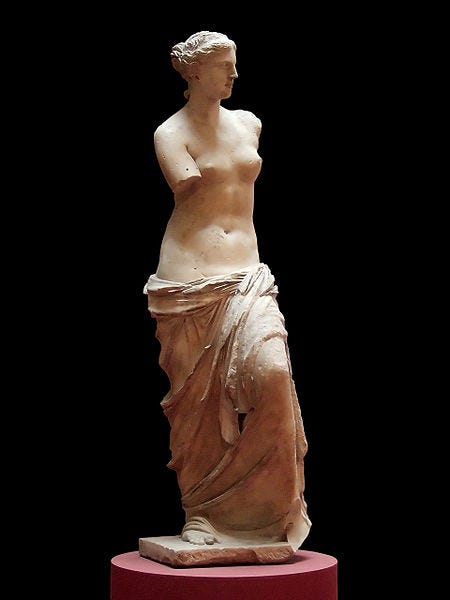
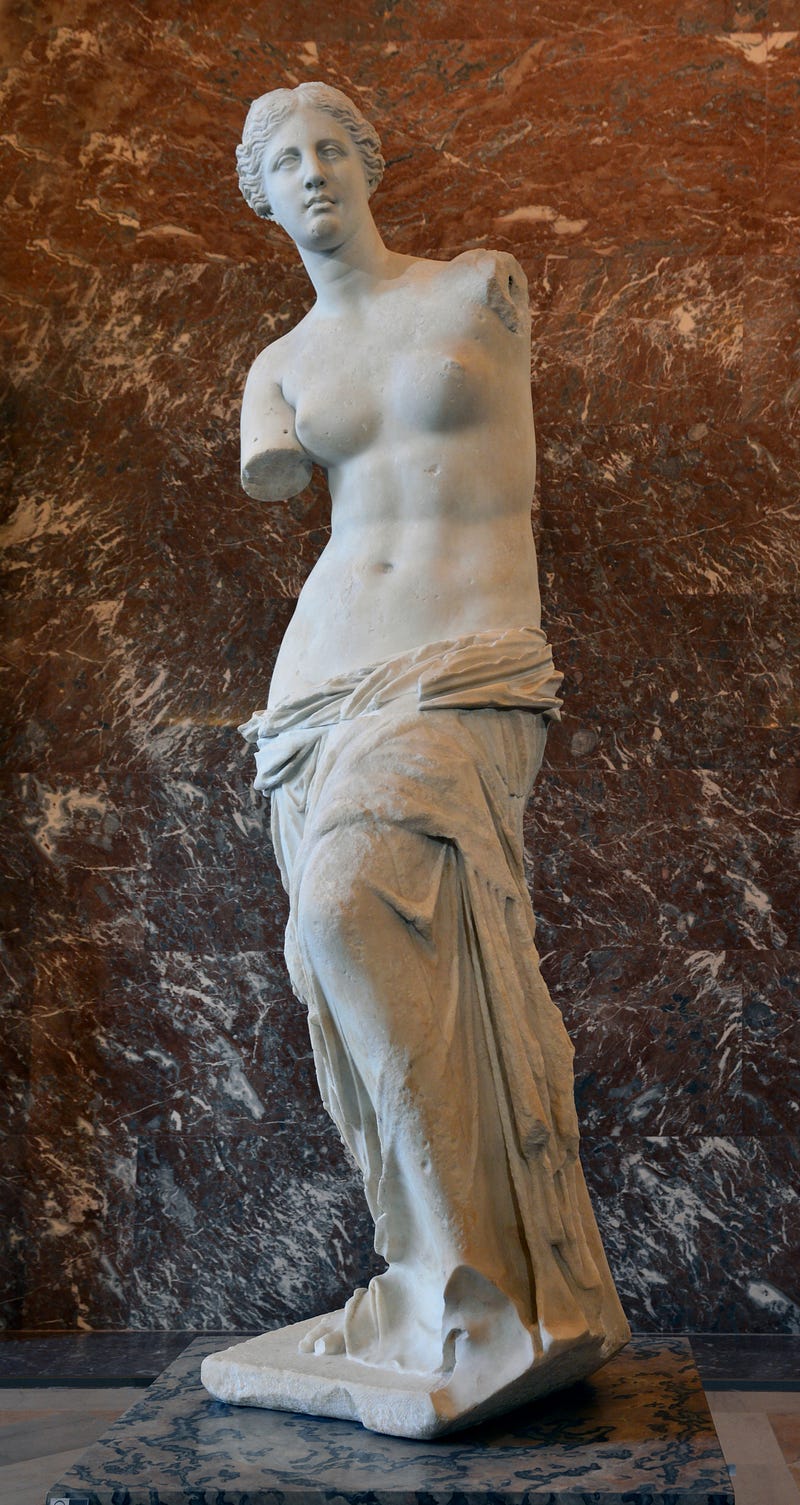
The famous statue of Aphrodite is attributed to the Classical Greek sculptor Alexandros of Antioch and was carved between 130 and 100 BCE. This larger than life marble statue defines concepts of feminine beauty that persist to this day. The Romans re-named the Greek goddess, Venus and as the statue was found on the island of Milos, it is commonly referred to as The Venus de Milo.
The statue was found in several pieces including arms and fragments of a pillar which have been lost since its discovery in 1820. One of the hands held an apple, supporting the idea that ancient depictions of Aphrodite inspired the popular image of the biblical Eve.
By the Classical Era, we no longer see femineity represented as the ‘abundant woman’. Like the discus throwers, this figure represents the belief that a beautiful body was one that worked well, one that could move efficiently in a state of youth, vitality and health.
In the Venus De Milo and many other statues, we see the human form partially covered by flowing gowns. This allowed the sculptors to demonstrate their skills in the carving of fabric so that it appeared to flow around, and mould to, the form beneath. Obviously, there was an element of eroticism, but also implied that true beauty is a natural human state and can be revealed by stripping away artifice. Classical Greek philosophers saw a strong correlation between truth and beauty. Unveiling ‘beauty’ was a metaphor for revealing ‘truth’.
Natural, human, truth.
Classical Art and the emergence of Humanism has been discussed by Remy Dean previously in Signifier.


