avatarPenny Grubb

Free AI web copilot to create summaries, insights and extended knowledge, download it at here

11668

Abstract

: url(https://miro.readmedium.com/v2/resize:fit:320/1*XDnLSPPI68qo2TsOHyhQbw.jpeg)"></div> </div> </div> </a> </div><p id="33c8">This work settles in with its surroundings, but the effect of graffiti and street art in an urban setting is often to change the context of the surroundings, not only to brighten spaces but to enlarge them, sometimes changing the proportions of the vista.</p><p id="bd13">Not all street art aims to promote tranquility. It is a medium used to convey a range of ideas from factual information through educational and environmental messages to robust protests.</p><p id="293f">Why have a boring old sign when you can paint a wall? <a href="undefined">Susan Alison</a>’s local cricket ground uses this mural to leave no one in doubt as to what goes on there:</p><div id="ee54" class="link-block"> <a href="https://readmedium.com/cricket-ground-just-down-the-road-24d175a5e05d"> <div> <div> <h2>Cricket Ground Just Down the Road</h2> <div><h3>undefined</h3></div> <div><p>undefined</p></div> </div> <div> <div style="background-image: url(https://miro.readmedium.com/v2/resize:fit:320/1*6x_44NKi0_1o1MGzpDHiqQ.png)"></div> </div> </div> </a> </div><p id="b660"><a href="undefined">Dennett</a> shows in this one an educational message in a depiction of the University of Florida’s Century Tower:</p><div id="c25b" class="link-block"> <a href="https://readmedium.com/what-education-used-to-be-d9e2c5d3e3e2"> <div> <div> <h2>What Education Used to Be</h2> <div><h3>undefined</h3></div> <div><p>undefined</p></div> </div> <div> <div style="background-image: url(https://miro.readmedium.com/v2/resize:fit:320/0*TMnioMrHILdrkJ_v)"></div> </div> </div> </a> </div><p id="2068">Graffiti and street art have also been used as powerful forms of protest against unsafe streets. Street artists painted murals in London’s Leake Street Tunnel in <a href="https://inspiringcity.com/2021/03/14/street-artists-paint-in-support-of-safer-streets-for-women/">one of many events</a> protesting the entrenched misogyny behind the kidnap and murder of Sarah Everard, snatched off the street by an off-duty police officer.</p><p id="a4cc">There have been many street art and graffiti responses to tragedies. In this one, <a href="undefined">Michelle March</a> shows artwork commissioned to “make a happy place” in New York City where the World Trade Centre once stood.</p><div id="1f8d" class="link-block"> <a href="https://readmedium.com/do-what-makes-you-happy-19473981df84"> <div> <div> <h2>Do What Makes You Happy</h2> <div><h3>undefined</h3></div> <div><p>undefined</p></div> </div> <div> <div style="background-image: url(https://miro.readmedium.com/v2/resize:fit:320/1*0mhC5EtC67e1hA-w0hThww.jpeg)"></div> </div> </div> </a> </div><p id="8617">Some inventive artists make use of the materials at the heart of their protests against environmental damage. <a href="undefined">Vidya Sury, Collecting Smiles</a> shows street art whose message is in its manner of construction — the work is created from broken ceramics:</p><div id="b359" class="link-block"> <a href="https://readmedium.com/when-man-respects-nature-31c0db14df08"> <div> <div> <h2>When Man Respects Nature</h2> <div><h3>undefined</h3></div> <div><p>undefined</p></div> </div> <div> <div style="background-image: url(https://miro.readmedium.com/v2/resize:fit:320/1*PwmAUHnOaYBgJQXjxCwJAg.jpeg)"></div> </div> </div> </a> </div><p id="2716">And in this one, <a href="undefined">Vishal Mehta</a> has captured a work created from the gum that plagues city streets the world over:</p><div id="1235" class="link-block"> <a href="https://readmedium.com/1-million-wads-of-gum-d8400ac3d412"> <div> <div> <h2>1 Million Wads of Gum</h2> <div><h3>undefined</h3></div> <div><p>undefined</p></div> </div> <div> <div style="background-image: url(https://miro.readmedium.com/v2/resize:fit:320/1*v-eiBSJg6H39UlY91MWN-g.jpeg)"></div> </div> </div> </a> </div><h1 id="3472">What’s Wrong With Walls Anyway?</h1><p id="2423">I posed a question at the start: would anyone argue the case for a blank wall over the amazing murals shown earlier? I can think of one person who might — the author <a href="https://en.wikipedia.org/wiki/Stephen_King">Stephen King</a>. He says he prefers to write facing a blank wall. However, I think even he would concede that the neighbourhoods emerging from his imagination lack the sense of safety and security most of us crave.</p><p id="1c29">Not all graffiti and street art attempts to cloak the walls that are its canvas. There are some striking examples where the underlying structures are pulled into the work without being disguised at all.</p><h2 id="5105">Retaining the vibe of the wall</h2><p id="e1fc">This work caught by <a href="undefined">Emma Tiger Lee</a> makes no attempt to masquerade as anything other than a run-down corner, though it begs some interesting questions — was the artwork there before the barricade or after … how and why were the high paintings done?</p><div id="5122" class="link-block"> <a href="https://readmedium.com/keep-people-out-or-lock-people-in-e9ec3a211c20"> <div> <div> <h2>Keep People Out or Lock People In?</h2> <div><h3>undefined</h3></div> <div><p>undefined</p></div> </div> <div> <div style="background-image: url(https://miro.readmedium.com/v2/resize:fit:320/1*3Fb0LY5tIvZOokidFaB7hw.jpeg)"></div> </div> </div> </a> </div><p id="8cf2"><a href="undefined">Rosalind Pagan</a>’s image of industrial Manchester does nothing to hide the murkiness of the building, yet it is a magnificent mural, several storeys high:</p><div id="cf00" class="link-block"> <a href="https://readmedium.com/grimy-graffiti-52224eee939f"> <div> <div> <h2>Grimy Graffiti</h2> <div><h3>undefined</h3></div> <div><p>undefined</p></div> </div> <div> <div style="background-image: url(https://miro.readmedium.com/v2/resize:fit:320/1*xT8awmMkJhiOXeppuPC0Gg.jpeg)"></div> </div> </div> </a> </div><p id="2603">Sometimes the graffiti statement sits right on the wall without seeming to be a part of it as <a href="undefined">Linda Kohler</a> captures here:</p><div id="e0ce" class="link-block"> <a href="https://readmedium.com/quite-a-spike-abddf92d00cd"> <div> <div> <h2>Quite a Spike</h2> <div><h3>undefined</h3></div> <div><p>undefined</p></div> </div> <div> <div style="background-image: url(https://miro.readmedium.com/v2/resize:fit:320/1*3sprn3yYAtkwxb2Ns21Z7Q.png)"></div> </div> </div> </a> </div><p id="f759">And at times it retains the wall’s character but also changes it as demonstrated by the image caught by <a href="undefined">Kim McKinney</a>:</p><div id="5f2a" class="link-block"> <a href="https://readmedium.com/a-few-words-to-base-your-life-upon-pick-them-all-ff11fc2fe57f"> <div> <div> <h2>A Few Words to Base Your Life Upon — Pick Them All</h2> <div><h3>undefined</h3></div> <div><p>undefined</p></div> </div> <div> <div style="background-image: url(https://miro.readmedium.com/v2/resize:fit:320/1*i_03cWpoxIobyOf3uUC9aw.jpeg)"></div> </div> </div> </a> </div><p id="d2d8">And shouldn’t all schools encourage storytelling in any way they can, including the form captured by <a href="undefined">Vidya Sury, Collecting Smiles</a>:</p><div id="d318" class="link-block"> <a href="https://readmedium.com/sour-grapes-9ed3cf83615e"> <div> <div> <h2>Sour Grapes</h2> <div><h3>undefined</h3></div> <div><p>undefined</p></div> </div> <div> <div style="background-image: url(https://miro.readmedium.com/v2/resize:fit:320/1*3f9L4jtL-NwO-1eI1UydXQ.jpeg)"></div> </div> </div> </a> </div><h1 id="d25b">Does It Matter What It’s Called?</h1><p id="53d7">To some people yes. There are those who see a gulf between street art and graffiti, equating the latter to vandalism. There are as many who applaud the creativity wherever it appears. Professor Andrew Kulman from the <a href="https://www.bcu.ac.uk/visual-communication">School of Visual Communication</a> at Birmingham City University takes the view:</p><blockquote id="d7a2"><p>“There is no bad graffiti, just graffiti, as a personal visual expression any graffiti is a valid gesture. People may argue that the choice of space or surface could be ill-considered or antisocial but the fact it exists suggests someone had an intent to create the marks.”</p></blockquote><p id="aa9f">I’m not going to try to make the distinction. It’s clear to me that separating graffiti from street art is <a href="https://scholarworks.wmich.edu/cgi/viewcontent.cgi?article=4422&amp;context=masters_theses">not that simple</a>. Objective definitions differ. Work on <a href="https://journals.sagepub.com/doi/abs/10.1177/0011392118823830">defining</a> and <a href="https://scholarworks.gsu.edu/cgi/viewcontent.cgi?article=1049&amp;context=art_design_theses">understanding</a> the area shows that, as with so many things, once you start to dig, the devil is indeed in the detail.</p><p id="9a97">A point that seems relevant to the effect of street art and graffiti on safety is the way it changes the perceptions of an area. It doesn’t have to be a rainbow spectacular to completely alter the character of a wall, as shown by this work captured by <a href="undefined">Kaori Mitsui</a></p><div id="216c" class="link-block"> <a href="https://readmedium.com/black-and-white-on-the-wall-photo-story-challenge-65c3cd38d5f4"> <div> <div> <h2>Black and White on The Wall</h2> <div><h3>undefined</h3></div> <div><p>undefined</p></div> </div> <div> <div style="background-image: url(https://miro.readmedium.com/v2/resize:fit:320/1*_T9LkDTCyc7hzXJ5uuZRxw.jpeg)"></div> </div> </div> </a> </div><p id="88aa">In the following example, captured by <a href="undefined">Randy Runtsch</a>, there’s barely a wall. It’s almost as though someone painted a few bricks around the reality of a stageplay.</p><div id="

Options

359e" class="link-block"> <a href="https://readmedium.com/when-groucho-marx-met-charlie-chaplin-by-chance-in-winnipeg-763e9508c39f"> <div> <div> <h2>When Groucho Marx Met Charlie Chaplin by Chance in Winnipeg</h2> <div><h3>undefined</h3></div> <div><p>undefined</p></div> </div> <div> <div style="background-image: url(https://miro.readmedium.com/v2/resize:fit:320/1*7GwYSEkCiE6PMaxlGhB0Ow.jpeg)"></div> </div> </div> </a> </div><h1 id="d757">Who Are The Artists?</h1><p id="2883">We’ve probably all heard of <a href="https://en.wikipedia.org/wiki/Banksy">Banksy</a>, but much graffiti and street art is anonymous — unsurprising as in many cases it is done in contravention of by-laws — but some of the contributors to <a href="undefined">Mary Chang Story Writer</a>’s graffiti series found and included information and tributes to the artists. These included pieces by <a href="undefined">Vidya Sury, Collecting Smiles</a> — who contributed a wealth of amazing artwork to the series.</p><p id="7d6e"><a href="undefined">Barb Dalton 🇺🇦</a> not only found and photographed this mural but researched it to find the identity of the man depicted in it — Mike “Wunder” Kennedy of Toronto’s street art community:</p><div id="5200" class="link-block"> <a href="https://readmedium.com/a-fitting-tribute-to-a-street-artist-6f7202d6fc99"> <div> <div> <h2>A Fitting Tribute to a Street Artist</h2> <div><h3>undefined</h3></div> <div><p>undefined</p></div> </div> <div> <div style="background-image: url(https://miro.readmedium.com/v2/resize:fit:320/1*0m4gkPf_0tlF4-CKAql3pA.jpeg)"></div> </div> </div> </a> </div><p id="9134">The following work shows a touching tribute to a street artist, ZEAL, by fellow street artists, captured by ZEAL’s great-aunt, <a href="undefined">Kim McKinney</a></p><div id="3858" class="link-block"> <a href="https://readmedium.com/the-gift-of-graffiti-d7e327604616"> <div> <div> <h2>The Gift of Graffiti</h2> <div><h3>undefined</h3></div> <div><p>undefined</p></div> </div> <div> <div style="background-image: url(https://miro.readmedium.com/v2/resize:fit:320/1*7sZPuhsVbrhfqnyZX41oAA.jpeg)"></div> </div> </div> </a> </div><h1 id="d7a0">How Far Can Graffiti & Street Art Go?</h1><p id="17c5">When researching anything, it is always a good idea to check the extremes … the margins… This is where patterns that looked secure will show their weaknesses, where rock-solid assumptions might crumble, and where the unexpected will pop up. I was tempted down the alleyway of 3D street art, but that deserves an illustrated article of its own. I will just drop in this one example, caught by <a href="undefined">Jillian Amatt — Artistic Voyages</a>.</p><div id="fbb8" class="link-block"> <a href="https://readmedium.com/not-all-street-art-is-2d-eeebe175624"> <div> <div> <h2>Not All Street Art is 2D</h2> <div><h3>undefined</h3></div> <div><p>undefined</p></div> </div> <div> <div style="background-image: url(https://miro.readmedium.com/v2/resize:fit:320/1*tJFG8b6ocFiASNAlUE0tFA.jpeg)"></div> </div> </div> </a> </div><p id="0f73">Instead, I decided to touch on the question of whether it should stop at walls and buildings. How about painting road surfaces and pavements such as this footpath photographed by <a href="undefined">Lisa McAully</a>:</p><div id="cd22" class="link-block"> <a href="https://readmedium.com/why-pavement-art-can-be-much-more-than-dusty-fun-89cc849ba560"> <div> <div> <h2>Why Pavement Art Can Be Much More Than Dusty Fun</h2> <div><h3>undefined</h3></div> <div><p>undefined</p></div> </div> <div> <div style="background-image: url(https://miro.readmedium.com/v2/resize:fit:320/1*RNyigoExirFKFEYcfMs3Lw.jpeg)"></div> </div> </div> </a> </div><p id="597e">Would painting the roads themselves make a difference? How could it not? But which way — towards safety or danger?</p><p id="9061">I find it counterintuitive that artwork on the road itself could enhance road safety — wouldn’t it be a distraction to drivers? Yet conventional road markings are road paintings that we all accept, and these are beneficial by showing where we can safely drive, cycle, or walk. But — as ever — it’s not that simple.</p><p id="63ec">London introduced <a href="https://www.bbc.co.uk/news/uk-england-london-10680560">cycle superhighways in 2010</a> — bright blue lanes for cyclists, but a spate of fatal collisions on these superhighways led to a record number of cyclists being killed, and protests against the inadequacy of blue paint on the road and a fancy title. A representative of the <a href="https://lcc.org.uk/">London Cycling Campaign</a> said:</p><blockquote id="4b68"><p>“The blue paint on Cycle Superhighways is meaningless. It’s got no status in law.”</p></blockquote><p id="3041">In addition, as many campaigners pointed out, it tended to give cyclists a false sense of security.</p><p id="974a">Away from official road markings, <a href="https://www.bicycling.com/news/a39819477/asphalt-art-study/">a study carried out in 2021</a> showed a huge decrease in accidents involving vulnerable road users (pedestrians and cyclists) following the installation of street art. A study from <a href="https://assets.bbhub.io/dotorg/sites/43/2022/04/Asphalt-Art-Safety-Study.pdf">Bloomberg Philanthropies</a> analysed 17 sites and found a 50 percent decrease in crashes involving pedestrians or other vulnerable road users. They found that “<a href="https://www.bloomberg.org/blog/new-study-shows-streets-are-safer-with-asphalt-art/">asphalt art changed driver behavior</a>” and</p><blockquote id="47c0"><p>“The result was safer streets when art projects were installed in places like crosswalks or intersections.”</p></blockquote><h2 id="6973">Does There Have To Be Any Meaning?</h2><p id="6fac">There are times the story seems written only for those in the know — the family in-joke that makes the streets neither safer nor more dangerous. The art that just is. Who knows what the story is here?</p><div id="c408" class="link-block"> <a href="https://readmedium.com/motorbike-racer-mystery-doctor-many-questions-fd9859c28160"> <div> <div> <h2>Motorbike Racer, Mystery Doctor, Many Questions</h2> <div><h3>undefined</h3></div> <div><p>undefined</p></div> </div> <div> <div style="background-image: url(https://miro.readmedium.com/v2/resize:fit:320/1*4rESdDyo0sECVS34qoeZDA.jpeg)"></div> </div> </div> </a> </div><p id="d759">No one in the crowd standing waiting for the train to go by had any convincing ideas, but it provided more than a blank wall to look at, and sparked some comments and conversations, thus generally brightening a few people’s lives.</p><h1 id="503f">Graffiti And Street Art — Good Or Bad?</h1><p id="aa81">Graffiti and street art <a href="https://www.thenatureofcities.com/2016/03/23/graffiti-and-street-art-can-be-controversial-but-can-also-be-a-medium-for-voices-of-social-change-protest-or-expressions-of-community-desire-what-how-and-where-are-examples-of-graffiti-as-a-posi/">remain controversial</a>. Views (as on most art) are largely subjective. Some approve, some don’t. Some hold firm to “knowing what they like” and looking askance at anything outside their preconceptions.</p><p id="db97">How about the paintings on the walls of a pedestrian underpass? Are they beautiful or a desecration of the concrete walls? Do they brighten the place or encourage vandalism? There are those whose judgement depends critically on <a href="https://link.springer.com/article/10.1007/s10610-015-9288-4">whether or not the artwork was officially sanctioned</a> — seeing artwork as ‘good’ only if it was created within the law of the time.</p><h1 id="ba3d">The Jury’s Out</h1><p id="16be">The jury has to remain out, as I have not conducted an exhaustive examination of all the work that has been done on this. As well as the ones referenced above, I found a mass of interesting studies including one from <a href="http://Street Art Participation in Increasing Investments in the City Center of Bucharest, a Paradox or Not?">Bucharest</a>, and treatments of <a href="https://journals.sagepub.com/doi/10.1177/0044118X95027001005">urban graffiti</a> and <a href="https://scholarworks.wmich.edu/cgi/viewcontent.cgi?article=4422&amp;context=masters_theses">the urban landscape</a>.</p><p id="f21d">Most of what I’ve seen and read — the most surprising on <a href="https://www.seniorcare2share.com/does-street-art-make-roads-safer/">the effects of asphalt art</a> — has leant towards giving me a positive view of graffiti and street art, but there are always counterexamples:</p><p id="2e8c">How about this one photographed by <a href="undefined">A. Grace</a>? No argument that it brightens the underpass, but has it changed a long dark tunnel into something safer or something more sinister? Would you walk this way on your own at night?</p><div id="70e9" class="link-block"> <a href="https://a-grace.medium.com/layers-of-art-a-walk-into-the-unknown-9cc6aa9aa29e"> <div> <div> <h2>Layers of Art: A walk into the Unknown</h2> <div><h3>undefined</h3></div> <div><p>undefined</p></div> </div> <div> <div style="background-image: url(https://miro.readmedium.com/v2/resize:fit:320/1*sTcDaroNQfpl99EehBP2jQ.jpeg)"></div> </div> </div> </a> </div><p id="54b3">And how about the safety aspects of this one captured by <a href="undefined">Will Hull</a>? Is it a useful warning or a death trap? Imagine the unwary pedestrian, wandering along, mind on other things, hearing the sound of a train. Do they look up to see an image matching the sound and instinctively step backwards into the path of a real train?</p><div id="c6ef" class="link-block"> <a href="https://readmedium.com/looking-at-art-can-be-risky-1c2bf9b80f5e"> <div> <div> <h2>Looking at Art Can Be Risky</h2> <div><h3>undefined</h3></div> <div><p>undefined</p></div> </div> <div> <div style="background-image: url(https://miro.readmedium.com/v2/resize:fit:320/1*yD6v8aAOJSNVoRI3mNzQCw.jpeg)"></div> </div> </div> </a> </div><p id="ed8e">Notwithstanding some controversial examples, the positive effects of graffiti and street art seem to outweigh the negative, from brightening dark corners to enhancing safety and fostering community spirit.</p><p id="dcbf"><a href="https://pennygrubb.medium.com/navigating-the-stories-i-write-84ccd3f2f46d">Read more from Penny Grubb</a></p></article></body>

Does Graffiti Affect Safety On Our Streets?

Art, crime, or disturbing images?
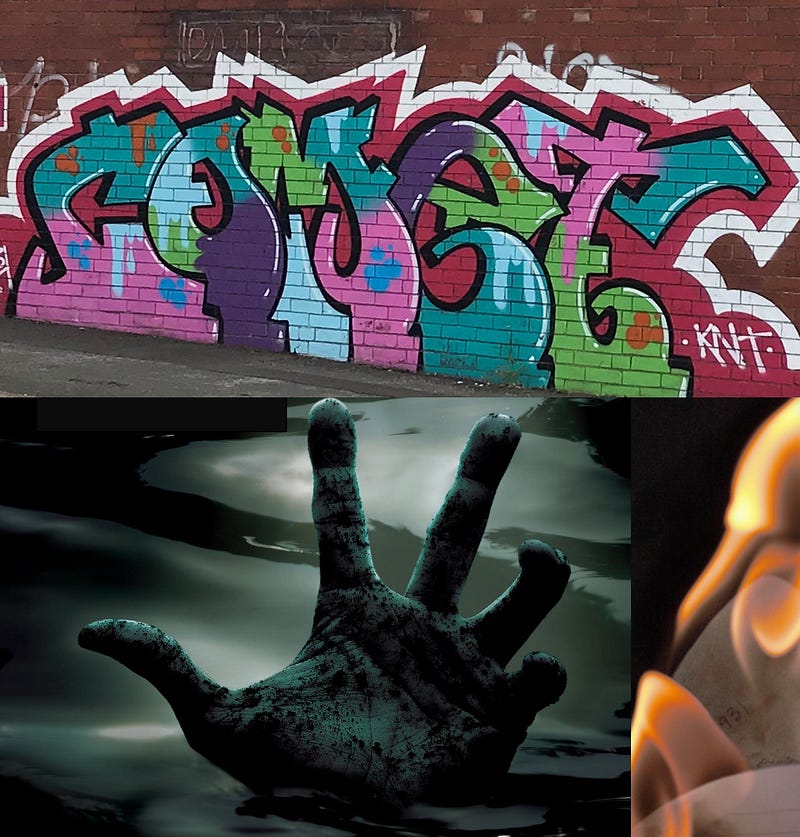
Image: Penny Grubb

The benefits of art for well-being and mental health are well documented. But does this stretch to graffiti and street art? Recently, Mary Chang Story Writer published a series of pieces showing graffiti and street art from around the world in her Six-Word Photo Story publication. Some incredible artwork has been on show and it made me wonder about the wider question.

Awesome murals hiding the banal bleakness of a blank wall surely make a street more inviting, a happier place. Does anyone argue the case for the blank wall — an expanse of concrete render or old chipped bricks — over something like this, photographed by CARMEN F MICSA?

Does Graffiti & Street Art Make An Area Safer?

To my mind, a street with busy shops, colours, lights, and people, has a friendlier vibe — and a safer one — than a badly lit street of blank, closed, shop fronts. Who wouldn’t feel safer with this artwork, photographed by Randy Runtsch, overlooking the street?

I can conclude that I personally feel safer in a lighter, busier, more colourful place, than in a darker, deserted, monochrome one, and I won’t be surprised to learn that a lot of people feel the same way, but it’s a perception, a series of anecdotes, and might not be objectively true.

The plural of anecdote is not evidence.

So I set out to see if anyone had studied the topic. And us being the inquisitive species we are — of course, I found that plenty of people have done just that.

Feeling Safe Is Fundamental To Security

Visual appeal and narratives matter!

Street Studies is a non-profit organisation established in 2012. It works in urban areas and aims to promote creativity. Steffen Gray, its chairman says

“Everybody needs to feel safe in their daily environment. It’s a very basic need, connected to atmospheres, visual impressions and to the individual conception of a neighbourhood’s reputation as either safe or dangerous. Visual appeal and narratives matter!”

A key plank in Street Studies’ work has been to tackle anti-social patterns of behaviour. They tap into the rich social history of urban arts to engage at-risk young people, providing convincing alternatives and lessening the pressures to participate in anti-social behaviour.

How safe or unsafe we feel in an area is affected both by the way we see our own neighbourhood and the way that outsiders perceive it. An area can be safe in terms of accidents, crime rates, and so on, but if seen as troubled, people will stay away. And without people to support or start new businesses, become residents, visit as holidaymakers, etc … the neighbourhood can struggle until it meets the initially inaccurate perception as undesirable and unsafe. Without active intervention, it can become a downward spiral.

Fostering The Perception That An Area Is Cared For And Safe

The buzz helps keep urban spaces safe

Revitalization of public spaces has been an important part of policies to reverse the urban decay of the latter part of the 20th century. Street Studies’ research has found evidence of public safety benefits to urban art projects. They note, too, the added benefit of a sense of community that comes from providing ‘art spaces’ — people come to look, foot traffic increases, and there is a greater sense of ownership and community.

As journalist, author, and activist, Jane Jacobs puts it:

“This buzz helps keep urban spaces safe by providing helpful eyes in the street.”

And who wouldn't get a buzz when confronted by this 4-storey high mural? Photographer, Jason Edmunds said it stopped him in his tracks. I’m not surprised. It not only transforms its surroundings, it also plays with 3D to trick the eye.

Eyes On The Street

People are less likely to commit a crime and more likely to behave well when they are being watched. No surprise there. But do the watching eyes have to be real? Would this sharp gaze, photographed by Kan Kante Hsieh, deter someone from crime?

The slightly bizarre answer is that it might.

There are studies indicating that images of eyes watching are enough to prevent petty theft or to increase compliance e.g when paying for goods via an honesty box, or to increase cash donations to charity boxes. It is called eye image compliance.

The psychology behind this seems to centre on our innate reaction to seeing eyes. We are hard-wired to take close notice of faces, it’s why we can more easily distinguish our fellow humans from each other than we can recognise individual sheep in a flock.

It should be noted that hard evidence is mixed on eye image compliance. However, evoking the sense that someone is keeping an eye on an area makes it seem better cared for. Differing levels of effectiveness of the “being watched” phenomenon might relate to the realism and directness of the gaze within the image.

Surely this all-seeing eye, photographed by Pulpo Viejo, would generate second thoughts if not total confusion in someone contemplating wrongdoing.

This partly 3D image taken by Ian Hanson combines “eyes on the street” with the transformation of the wall. Who would risk stepping out of line under that eye?

I wasn’t able to find a study of eye image compliance in cats, but I can’t help thinking that if I was a feline with malicious intent, this steely stare, captured by Susan Alison, would stop me in my tracks.

What Do We Want From Urban Street Art?

Are we looking to bring peace and tranquility to busy urban environments? In this photograph, pockett dessert captures graffiti and street art in a rural setting.

This work settles in with its surroundings, but the effect of graffiti and street art in an urban setting is often to change the context of the surroundings, not only to brighten spaces but to enlarge them, sometimes changing the proportions of the vista.

Not all street art aims to promote tranquility. It is a medium used to convey a range of ideas from factual information through educational and environmental messages to robust protests.

Why have a boring old sign when you can paint a wall? Susan Alison’s local cricket ground uses this mural to leave no one in doubt as to what goes on there:

Dennett shows in this one an educational message in a depiction of the University of Florida’s Century Tower:

Graffiti and street art have also been used as powerful forms of protest against unsafe streets. Street artists painted murals in London’s Leake Street Tunnel in one of many events protesting the entrenched misogyny behind the kidnap and murder of Sarah Everard, snatched off the street by an off-duty police officer.

There have been many street art and graffiti responses to tragedies. In this one, Michelle March shows artwork commissioned to “make a happy place” in New York City where the World Trade Centre once stood.

Some inventive artists make use of the materials at the heart of their protests against environmental damage. Vidya Sury, Collecting Smiles shows street art whose message is in its manner of construction — the work is created from broken ceramics:

And in this one, Vishal Mehta has captured a work created from the gum that plagues city streets the world over:

What’s Wrong With Walls Anyway?

I posed a question at the start: would anyone argue the case for a blank wall over the amazing murals shown earlier? I can think of one person who might — the author Stephen King. He says he prefers to write facing a blank wall. However, I think even he would concede that the neighbourhoods emerging from his imagination lack the sense of safety and security most of us crave.

Not all graffiti and street art attempts to cloak the walls that are its canvas. There are some striking examples where the underlying structures are pulled into the work without being disguised at all.

Retaining the vibe of the wall

This work caught by Emma Tiger Lee makes no attempt to masquerade as anything other than a run-down corner, though it begs some interesting questions — was the artwork there before the barricade or after … how and why were the high paintings done?

Rosalind Pagan’s image of industrial Manchester does nothing to hide the murkiness of the building, yet it is a magnificent mural, several storeys high:

Sometimes the graffiti statement sits right on the wall without seeming to be a part of it as Linda Kohler captures here:

And at times it retains the wall’s character but also changes it as demonstrated by the image caught by Kim McKinney:

And shouldn’t all schools encourage storytelling in any way they can, including the form captured by Vidya Sury, Collecting Smiles:

Does It Matter What It’s Called?

To some people yes. There are those who see a gulf between street art and graffiti, equating the latter to vandalism. There are as many who applaud the creativity wherever it appears. Professor Andrew Kulman from the School of Visual Communication at Birmingham City University takes the view:

“There is no bad graffiti, just graffiti, as a personal visual expression any graffiti is a valid gesture. People may argue that the choice of space or surface could be ill-considered or antisocial but the fact it exists suggests someone had an intent to create the marks.”

I’m not going to try to make the distinction. It’s clear to me that separating graffiti from street art is not that simple. Objective definitions differ. Work on defining and understanding the area shows that, as with so many things, once you start to dig, the devil is indeed in the detail.

A point that seems relevant to the effect of street art and graffiti on safety is the way it changes the perceptions of an area. It doesn’t have to be a rainbow spectacular to completely alter the character of a wall, as shown by this work captured by Kaori Mitsui

In the following example, captured by Randy Runtsch, there’s barely a wall. It’s almost as though someone painted a few bricks around the reality of a stageplay.

Who Are The Artists?

We’ve probably all heard of Banksy, but much graffiti and street art is anonymous — unsurprising as in many cases it is done in contravention of by-laws — but some of the contributors to Mary Chang Story Writer’s graffiti series found and included information and tributes to the artists. These included pieces by Vidya Sury, Collecting Smiles — who contributed a wealth of amazing artwork to the series.

Barb Dalton 🇺🇦 not only found and photographed this mural but researched it to find the identity of the man depicted in it — Mike “Wunder” Kennedy of Toronto’s street art community:

The following work shows a touching tribute to a street artist, ZEAL, by fellow street artists, captured by ZEAL’s great-aunt, Kim McKinney

How Far Can Graffiti & Street Art Go?

When researching anything, it is always a good idea to check the extremes … the margins… This is where patterns that looked secure will show their weaknesses, where rock-solid assumptions might crumble, and where the unexpected will pop up. I was tempted down the alleyway of 3D street art, but that deserves an illustrated article of its own. I will just drop in this one example, caught by Jillian Amatt — Artistic Voyages.

Instead, I decided to touch on the question of whether it should stop at walls and buildings. How about painting road surfaces and pavements such as this footpath photographed by Lisa McAully:

Would painting the roads themselves make a difference? How could it not? But which way — towards safety or danger?

I find it counterintuitive that artwork on the road itself could enhance road safety — wouldn’t it be a distraction to drivers? Yet conventional road markings are road paintings that we all accept, and these are beneficial by showing where we can safely drive, cycle, or walk. But — as ever — it’s not that simple.

London introduced cycle superhighways in 2010 — bright blue lanes for cyclists, but a spate of fatal collisions on these superhighways led to a record number of cyclists being killed, and protests against the inadequacy of blue paint on the road and a fancy title. A representative of the London Cycling Campaign said:

“The blue paint on Cycle Superhighways is meaningless. It’s got no status in law.”

In addition, as many campaigners pointed out, it tended to give cyclists a false sense of security.

Away from official road markings, a study carried out in 2021 showed a huge decrease in accidents involving vulnerable road users (pedestrians and cyclists) following the installation of street art. A study from Bloomberg Philanthropies analysed 17 sites and found a 50 percent decrease in crashes involving pedestrians or other vulnerable road users. They found that “asphalt art changed driver behavior” and

“The result was safer streets when art projects were installed in places like crosswalks or intersections.”

Does There Have To Be Any Meaning?

There are times the story seems written only for those in the know — the family in-joke that makes the streets neither safer nor more dangerous. The art that just is. Who knows what the story is here?

No one in the crowd standing waiting for the train to go by had any convincing ideas, but it provided more than a blank wall to look at, and sparked some comments and conversations, thus generally brightening a few people’s lives.

Graffiti And Street Art — Good Or Bad?

Graffiti and street art remain controversial. Views (as on most art) are largely subjective. Some approve, some don’t. Some hold firm to “knowing what they like” and looking askance at anything outside their preconceptions.

How about the paintings on the walls of a pedestrian underpass? Are they beautiful or a desecration of the concrete walls? Do they brighten the place or encourage vandalism? There are those whose judgement depends critically on whether or not the artwork was officially sanctioned — seeing artwork as ‘good’ only if it was created within the law of the time.

The Jury’s Out

The jury has to remain out, as I have not conducted an exhaustive examination of all the work that has been done on this. As well as the ones referenced above, I found a mass of interesting studies including one from Bucharest, and treatments of urban graffiti and the urban landscape.

Most of what I’ve seen and read — the most surprising on the effects of asphalt art — has leant towards giving me a positive view of graffiti and street art, but there are always counterexamples:

How about this one photographed by A. Grace? No argument that it brightens the underpass, but has it changed a long dark tunnel into something safer or something more sinister? Would you walk this way on your own at night?

And how about the safety aspects of this one captured by Will Hull? Is it a useful warning or a death trap? Imagine the unwary pedestrian, wandering along, mind on other things, hearing the sound of a train. Do they look up to see an image matching the sound and instinctively step backwards into the path of a real train?

Notwithstanding some controversial examples, the positive effects of graffiti and street art seem to outweigh the negative, from brightening dark corners to enhancing safety and fostering community spirit.

Read more from Penny Grubb

Graffiti
Street Art
Urban Landscapes
Road Safety
Community
Recommended from ReadMedium