
Knowledge Discovery: The “Concepts — Notions” Mapping
A typology of concepts and concept curation

This article is part of the Slow Cognition Project which focuses on Developing Tacit Knowledge with Thematic Space Canvas. The Knowledge Discovery Canvas is an application of the Thematic Space Canvas.
The Knowledge Discovery Canvas has two nested squares which divide the thematic space into two sub-spaces: inner space and outer space. For Developing Tacit Knowledge, the inner space is all about personal knowing activities while the outer space is related to social interactions.
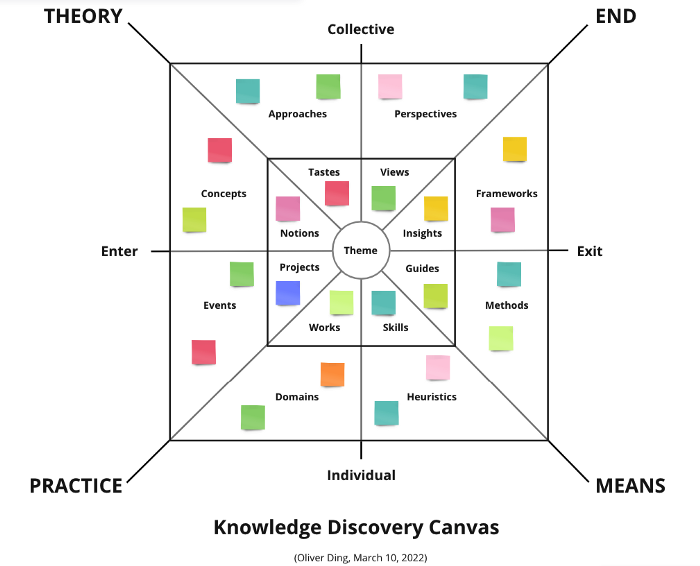
Based on the above settings, I generated a series of mapping between outer space and inner space:
- Approaches — Tastes
- Concepts — Notions
- Events — Projects
- Domains — Works
- Perspectives — Views
- Frameworks — Insights
- Methods — Guides
- Heuristics — Skills
Today I’ll focus on the Concepts — Notions mapping and develop a typology of concepts.
In April 2021, I wrote a book called The ECHO Way to reflect on the process of writing three books. In the book, I used one chapter to discuss the topic of Concept Curation. This article will also share some ideas from the chapter.
Contents
Part 1: A Typology of Concepts
1.1 Theory, Practice, and Concepts 1.2 Theoretical Concepts and Operational Concepts 1.3 Orienting Concepts and Intermediate Concepts 1.4 Technological Concepts and Sociocultural Concepts 1.5 Shared Concepts and Personal Notions
Part 2 Concept Curation
2.1 Building Knowledge Toolkits 2.2 Discovering Knowledge Niches 2.3 Developing New Concepts
Part 3: Concepts and Notions
Part 1: A Typology of Concepts
Part 1 aims to develop a new typology of Concepts for the Knowledge Discovery Activity.
1.1 Theory, Practice, and Concepts
The Knowledge Discovery Canvas is designed with four areas: the THEORY area, the PRACTICE area, the END area, and the MEANS area. The “Concepts — Notions” mapping is located in the THEORY area.
Originally, I only considered Theoretical Concepts for the Knowledge Discovery Canvas. Inspired by the MEANS — END spectrum for Frameworks, I developed the following “Theory — Practice spectrum” for Concepts. The outcome is a new typology of Concepts.
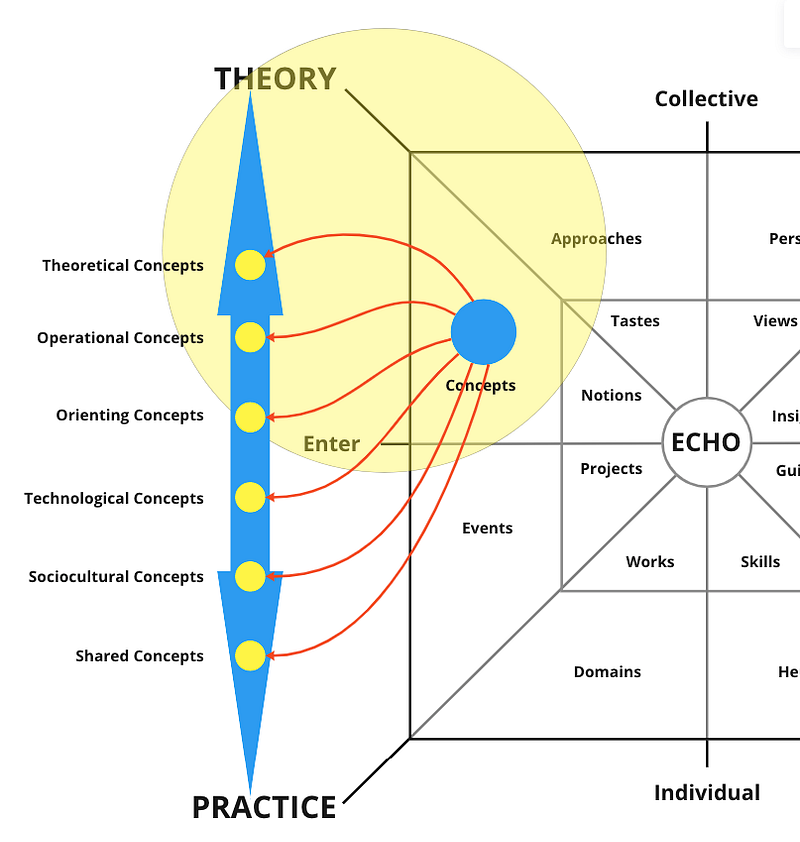
The above diagram shows six types of concepts which are divided into two groups.
The first group is related to the “THEORY” area and these concepts are about research and producing new public knowledge.
- Theoretical Concepts
- Operational Concepts
- Orienting Concepts
The second group is related to the “PRACTICE” area and these concepts are about learning, sharing, and working with knowledge for individual purposes.
- Technological Concepts
- Sociocultural Concepts
- Shared Concepts
The distinction between the “THEORY” group and the “PRACTICE” group considers the two types of motivations for dealing with concepts. One is for contributing to the development of public knowledge, the other one is for using public knowledge for private purposes. These two types of motivations lead to different attitudes toward appreciating concepts.
1.2 Theoretical Concepts and Operational Concepts
Theoretical Concepts are the foundation of theoretical approaches such as Meta-theories and Specific Theories. They can be used to develop knowledge frameworks.
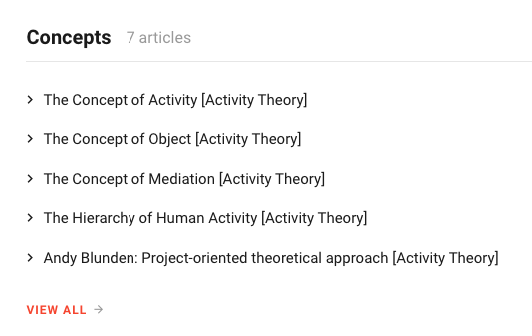
For example, the above picture is a screenshot of the homepage of Activity Analysis which is a website for sharing knowledge about Activity Theory and other social practice theories. The category of “Concepts” only publishes articles about individual concepts. For Activity Theory, “Activity”, “Object”, “Mediation”, and “Hierarchy of human activity” are primary theoretical concepts.
Operational Concepts are developed for empirical research and reflection. It can be generated from theoretical concepts or not. I use the distinction between Abstract Models and Concrete Models to emphasize the relationship between Theoretical Concepts and Knowledge Frameworks. If a framework incorporates some Theoretical Concepts, then it is an Abstract Model. If a framework only uses Operational Concepts without adopting any Theoretical Concepts, then it is a Concrete Model.
Some knowledge frameworks can directly adopt some theoretical concepts as their operational concepts. For example, Yrjö Engeström’s Activity System Model is a knowledge framework. Its diagram displays seven operational concepts.
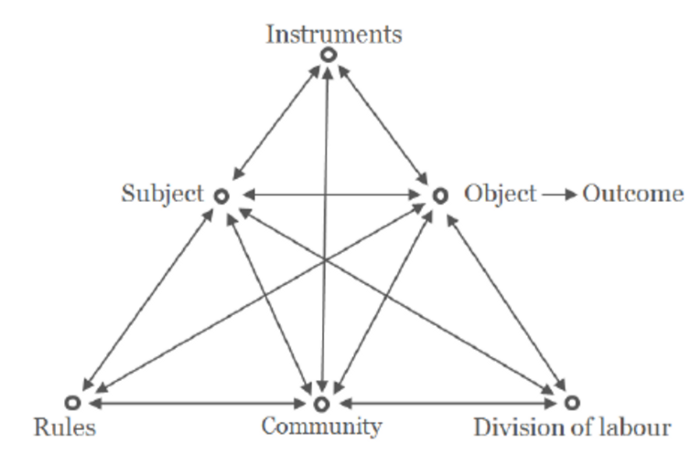
We should notice that a knowledge framework can directly adopt some theoretical concepts as its operational concepts. For example, the above diagram shows “Subject” and “Object” which are core theoretical concepts of Activity Theory. However, some researchers use “Actor” to replace “Subject” with the same diagram for their own work. The concept of “Actor” should be understood as an operational concept. For real-life research, the difference between “Subject” and “Actor” doesn’t matter since we need to see the final data which refers to a person or several people.
While Yrjö Engeström uses the word “Instruments”, other researchers use “Mediating Tool” or similar words. For example, Maral Babapour, Antonio Cobaleda-Cordero, and Marianne Karlsson adopt Activity Theory to develop a framework for understanding the interrelations between users and workplace design. They use the word “Mediating Tool”.
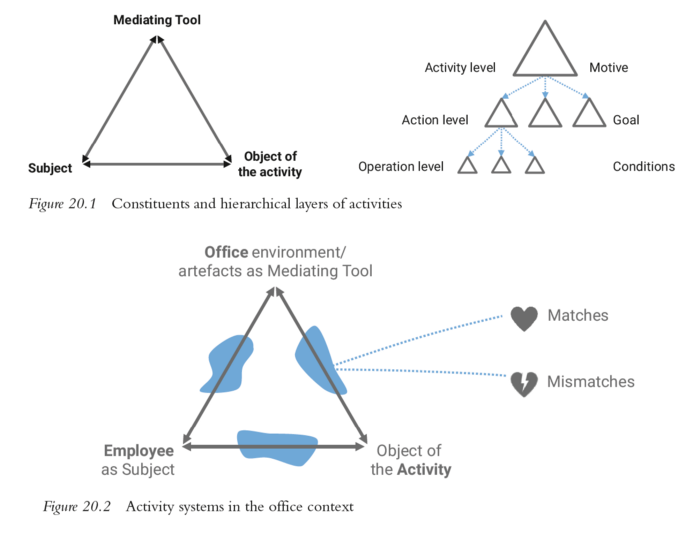
Both theoretical concepts and operational concepts can be defined precisely or vaguely. For example, the scope of the concept of “Instruments/Mediating Tool” is very broad in Activity Theory. The above diagram shows an example, the authors understand “Office Environment” as a “Mediating Tool” from the perspective of Activity Theory. Since Activity Theory doesn’t have a theoretical concept of “Environment,” researchers tend to use the concept of “Instruments/Mediating Tool” to understand “Environment”.
We also should notice that a knowledge framework’s diagram may not display some key theoretical concepts. In fact, we don’t have to display theoretical concepts in a diagram because we can discuss them with words in a research report. For example, the concept of “Mediation” is a foundational theoretical concept of Activity Theory. In fact, Yrjö Engeström’s Activity System Model was developed with double mediations. However, the Activity System Model doesn’t display the word “Mediation” in its diagram.
1.3 Orienting Concepts and Intermediate Concepts
Both Orienting Concepts and Intermediate Concepts are only useful for knowledge creators. The term “Orienting Concepts” is coined by the sociologist and social theorist Derek Layder.
Derek Layder suggests using Orienting Concepts as the starting point to guide research, “Two important features of orienting concepts are their ‘two-sided’ nature and their reference to social processes. The Two-sided nature of orienting concepts concerns their dual reference to objective and subjective aspects of social life. A concern with social processes focuses on their ability to trace social activity and events over time and space.” (1998, p.101)
A great example of orienting concepts is “Career”, Layder pointed out, “The twin virtues of the concept of career stem from its theoretical relevance and the breadth of its empirical applicability. The empirical scope of the concept derives from its use outside as well as inside the context of work and occupations…the concept of career is potentially capable of addressing certain problems in social analysis. In particular, it could help to overcome certain divisions such as that between macro and micro analysis and between interpretive and institutional analysis (‘interactionist’ or ‘structural’ sociology). This is because, as I have said, the concept of career is capable of reaching into both objective and subjective aspects of social life. In these senses, the concept uniquely expresses the intertwining of individual experience and the collective forces that constitute what we generally mean by the term ‘society’. Thus, career is a step towards overcoming the false distinction implicit in the old argument about the ‘individual versus society’.”(1993, pp.131–132)
In 2020, I followed Layder’s suggestion and used “Project” as an Orienting Concept for the book Project-oriented Activity Theory.
I also use “Intermediate Concepts” for developing new ideas. You can find more details in Knowledge Discovery: The “Middleware” Strategy. I don’t add “Intermediate Concepts” into the above typology because it only refers to a specific strategy.
1.4 Technological Concepts and Sociocultural Concepts
The distinction between Technological Concepts and Sociocultural Concepts was made in the Concept-fit framework for Platform Innovation.
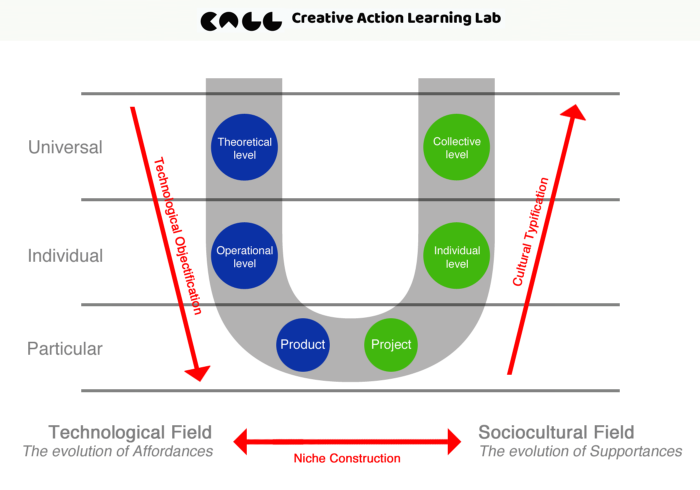
I classify such terms as Sociocultural Concepts because they refer to social behaviors and social phenomena. The value of Sociocultural Concepts is for ordinary communication and professional practices. By sharing such terms, we can exchange our insights on emerging social needs and changes in society.
By contrast, Technological Concepts refer to scientific theoretical knowledge and operational techniques. For example, “Search Engine,” “Ubiquitous Computing,” “5G,” “Virtual Reality,” “Blockchain,” “Responsive Web Design,” and “Markdown”. The value of Technological Concepts is for scientific discovery, academic research, and their industrial applications. It helps scientists, theorists, researchers, engineers, teachers, and designers on producing new knowledge and transform abstract knowledge into concrete practice.
It’s hard to make a simple and accurate typology. My goal is to distinguish Concepts into Sociocultural types and Technological types. The above definitions may not be accurate, however, the distinction is already described by the terms “sociocultural” and “technological”. In fact, some concepts are both sociocultural concepts and technological concepts. For instance, “SEO,” “Blog,” “Social Media,” “Open Access,” “MOOC,” etc. In order to keep a simple starting point, let’s remain this rough distinction.
I also developed sub-categories of Technological Concepts and Sociocultural Concepts for the Concept-fit framework. You can find more details here.
1.5 Shared Concepts and Personal Notions
While Technological Concepts and Sociocultural Concepts focus on public knowledge for learning and use, the term “Shared Concepts” and “Personal Notions” consider the social contexts of using these concepts.
Shared Concepts refer to personal communication contexts, team working environments, community discussions, social media discussions, non-academic public events, etc.
The issue of “Shared Concepts” leads to the challenge of balancing academic knowledge and practical situations. Let’s look at two examples, the first one is humor I found in Daniel Newman’s tweets.
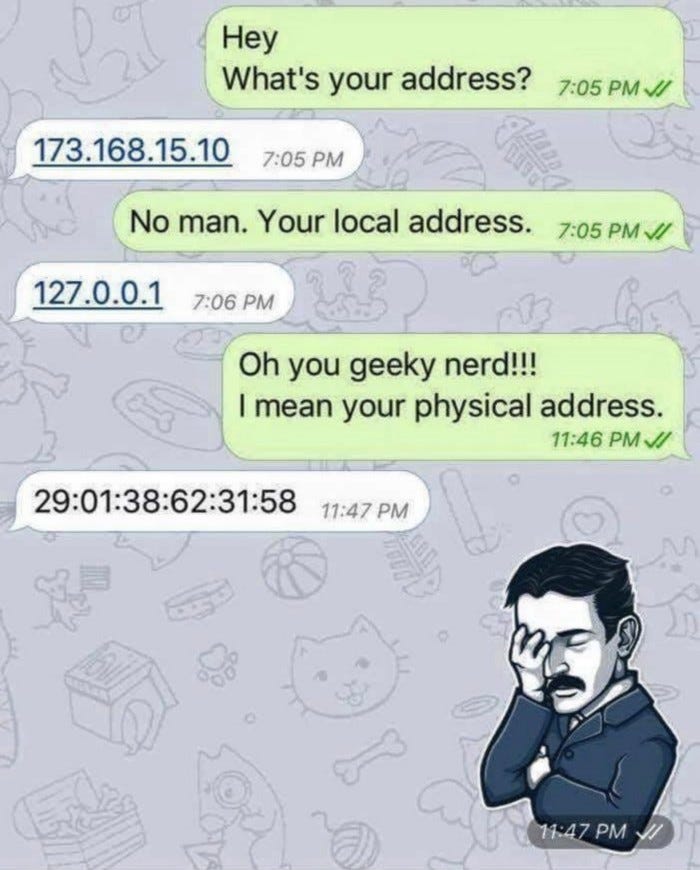
Obviously, we know this is a joke about language and daily communication. Human communication is highly contextualized, if a person doesn’t pay attention to the background of the conversation, he won’t get a great benefit from talking with others.
The second one is a litter harder than the above humor. The TEDx talk below is about “Comfort Zone”. Does the speaker use the concept as a normal word or an academic concept? Not all TEDx/TED ideas are worth spreading. Sometimes, we need to press the pause button and keep the idea for tweaking for a while.
In the age of ideas overload, we have to identify the context of ideas and determine their value for our knowing activity. One effective way of avoiding the curse of concept is searching for a concept on Google Scholar. For example, if you type “Comfort zone” on Google Scholar, the first search result is Mike Brown’s paper “Comfort zone: Model or metaphor?”. I read the paper and highlight a key piece below:
The term ‘comfort zone’ is not only readily referred to in the literature but it is also prevalent in the discourse of adventure education practitioners. But what is a comfort zone? How do you know if it is growing? Is there one ‘universal’ comfort zone that defines or limits my behaviour across all activities or are comfort zones task/context specific? Do my actions indicate that my comfort zone has increased or am I merely performing to complete the task so I can ‘get out of here’? Can my comfort zone shrink?…Searches in main educational and psychological journal databases make no reference to the ‘comfort zone’ as a theory or model. The term appears as a metaphor in the title in a number of publications (for example, see Eccelstone, 2004) but it does not appear as an educational theory, as for example, experiential learning does.(Mike Brown, 2008)
For daily communication, it is fine to use ‘comfort zone’ as a metaphor. However, if you want to adopt it as a conceptual tool for your knowing and guide your learning and personal development, I suggest you read Mike Brown’s paper.
Another example is the concept of “Mediation” which is a core idea of Activity Theory. I found Jonte Bernhard’s paper Thinking and Learning through Technology — Mediating Tools in Science and Engineering Education very helpful for me.
Thinking is hard work, meaningful concepts help us think effectively. However, as Sonke Ahrens mentioned in his book How to Take Smart Notes, “A scientific term or concept only becomes meaningful within the context of a theory — otherwise, it would just be a word.”(pp.117–118)
I don’t add “Personal Notion” to the above typology because it is located in the inner space of the Knowledge Discovery Canvas.
Part 2 Concept Curation
In April 2021, I wrote a book called The ECHO Way to reflect on the process of writing three books. In the book, I used one chapter to discuss the topic of Concept Curation.
I used the term Concept Curation to describe several actions of curating a set of concepts for developing new frameworks or toolkits. The chapter shares three examples of Concept Curation and each example refers to a specific purpose.
2.1 Building Knowledge Toolkits
From Sept 2018 to March 2019, I wrote a book titled Curativity: The Ecological Approach to Curatorial Practice in order to reflect on one of my life themes: Curation. The Ecological Practice Approach was born from the process of writing Curativity. This approach was originally called the Gibson — Lakoff — Schön approach because I adopted theoretical concepts from James J. Gibson, George Lakoff, and Donald Schön.
This 2019 version of the Ecological Practice Approach is a curated toolkit version. In a broad sense, the Ecological Practice approach has its philosophical roots in traditional Pragmatism and contemporary embodied cognitive science. Inspired by practice studies theorist Davide Nicolini (2013)’s “tool-kit approach” which curates various concepts from different theoretical accounts based on a family relationship, allowing a network of dissimilarities and similarities, I consider the Ecological Practice approach a toolkit.
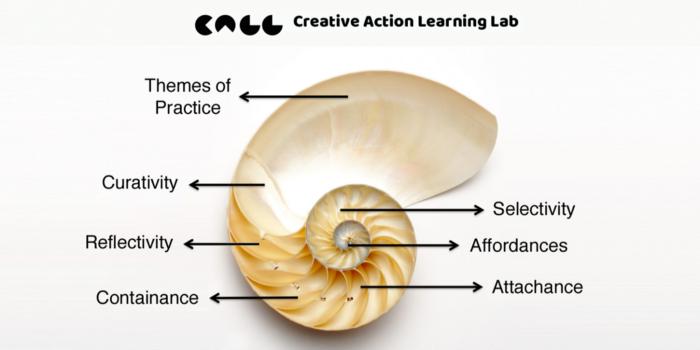
The above diagram shows several theoretical concepts. Some concepts are adopted from theoretical resources. The concept of Selectivity is adopted from William James’ Radical Empiricism. The concept of Affordance is adopted from Ecological psychologist James J. Gibson. The concept of Reflectivity is adopted from Donald Schön. I also developed several original concepts such as Attachance, Containance, Curativity, and Themes of Practice.
Later I used other methods to develop new versions of the approach. You can find more details in The Developmental of Ecological Practice Approach.
2.2 Discovering Knowledge Niches
In Feb 2021, I worked on the Platform for Development Framework (v2.0). I defined a new concept called Developmental Platform for interdisciplinary developmental study.
As an interdisciplinary concept, the term Developmental Platform refers to a social environment that could strongly support adult development in various ways. There are three keywords in this definition:
- social environment
- strongly support
- adult development
The term “social environment” is a rough term. It can refer to traditional social structures such as organization and community. I also consider emergent social contexts such as digital platforms as social environments.
The term “strongly support” divides social environments into two groups from the perspective of strongness. Any social environment could support people, however, there are only a few social environments that could strongly support people. Thus, we can consider some strong social environments as platforms.
The term “adult development” is a solid term in developmental science. According to Wikipedia, “Adult development encompasses the changes that occur in biological and psychological domains of human life from the end of adolescence until the end of one’s life. These changes may be gradual or rapid and can reflect positive, negative, or no change from previous levels of functioning.” Thus, the Developmental Platform highlights the perspective of developmental science.
Do we need such a new concept? Let’s use the following Venn diagram to find a creative space for the Developmental Platform.
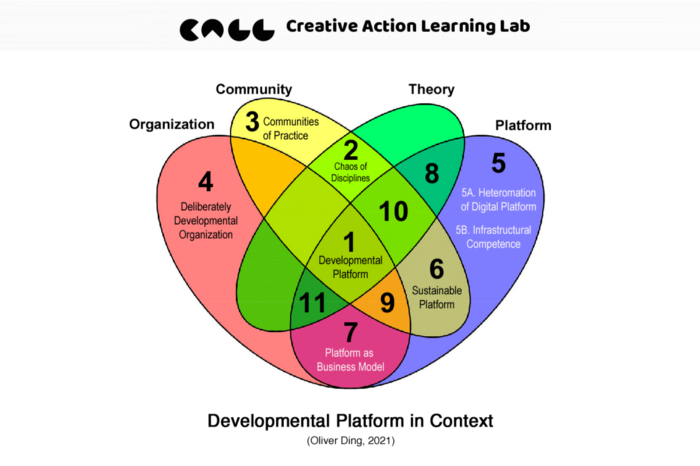
The above diagram is a four-set Venn diagram. Four sets are Organization, Community, Theory, and Platform. How to read this diagram?
- First, let’s focus on the shared developmental part which is located in the #1 area. This space is what I called Developmental Platform.
- Second, let’s look around other areas and place related theoretical ideas in some spaces.
- Third, let’s compare the #1 area with other areas. In this way, we can find the real need for the concept of Developmental Platform.
In this way, I compared the concept of Developmental Platform with other related ideas and found its knowledge niche. You can find more details here.
2.3 Developing New Concepts
In Jan 2021, I worked on the book Project-oriented Activity Theory. In order to understand the internal structure and dynamics of Projects, I propose the concept of Zone of Project.
As an important step in expanding the approach of Project-oriented Activity Theory, the concept of “Zone of Project” is an outcome of a conceptual curation that is inspired by the Ecological ZONE framework and Project-oriented Activity Theory. The theoretical resources of these two frameworks are the ecological approach and the cultural-historical approach. Thus, it is a challenge to achieve this goal.
I focused on the thread of “Vygotsky-Cole-Barker”. The following diagram represents my strategy for this complex conceptual curation.
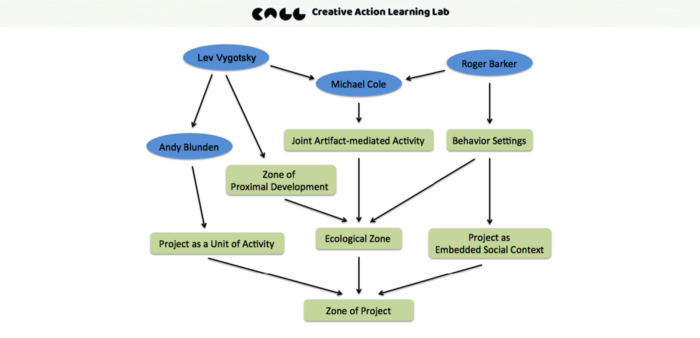
Position and Process are two useful concepts for discussing the internal structure and dynamics of Projects. In addition, I also add Themes as an important concept for this discussion.
In particular, I use a unique way to explain these three concepts by curating “Project as a Unit of Activity”, “Ecological Zone” and “Project as Embedded Social Context”. The final outcome is the new concept of “Zone of Project”.
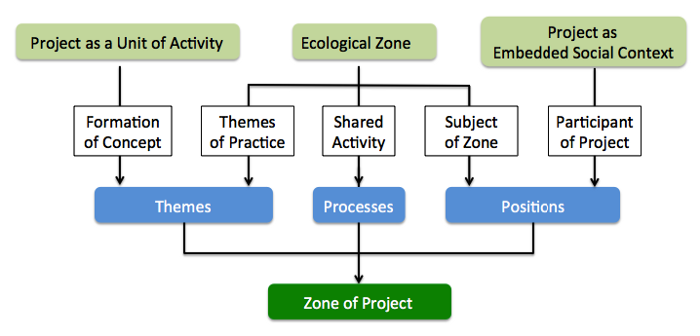
The above diagram represents the structure of this conceptual curation.
The Shared Activity of the Ecological Zone refers to the Processes of projects. Each zone of a project has several processes as its shared activity.
One of the theoretical statements of the Ecological Zone framework is “Themes of Practice”. In order to curate various experiences of daily interactions, I adopted the concept of Themes of Practice from Curativity Theory for ZONE. A Theme of Practice refers to a set of interactions that share a common issue, an agenda, or a theme. Since Theme is a particular concept, I can adopt Blunden’s proposal — the “Hegel-Marx-Vygotsky” account of “Concept” — as a theoretical foundation to support the concept of “Themes of Practice”. Also, the notion of “Formation of Concept” is the foundation of Blunden’s Project-oriented Activity Theory.
The result is a new concept “Themes of Project”. I also emphasized that “Themes of Project” expands Blunden’s “Concept of Project”.
Finally, we see “subject” in the Ecological Zone framework. It is also easy to understand that there are “participants” within the embedded social context. This leads to the idea of Positions.
Part 3: Concepts and Notions
For the Knowledge Discovery Canvas, Notions are located in the inner space which is about personal knowing and thoughts. It means Notions are about personal ideas.
I also designed an OS card for Knowledge Discovery Activity. The name “OS” stands for Objective — Subjective. For example, the picture below is an OS card for the “Concepts — Notions” mapping.
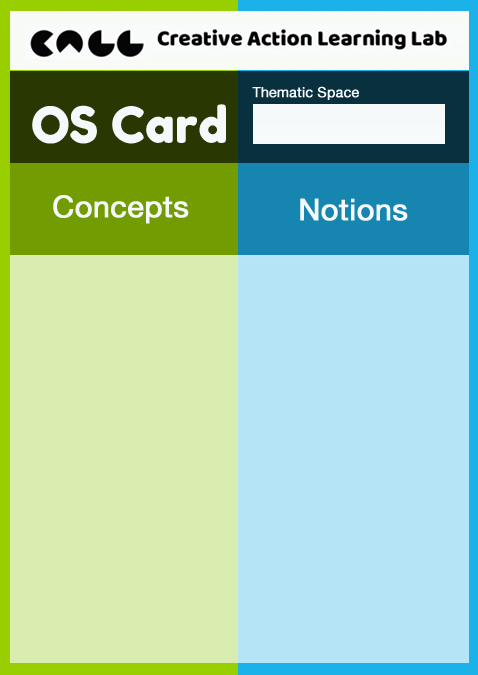
Each OS Card only records one mapping clue. The picture below is an example of a mapping clue.
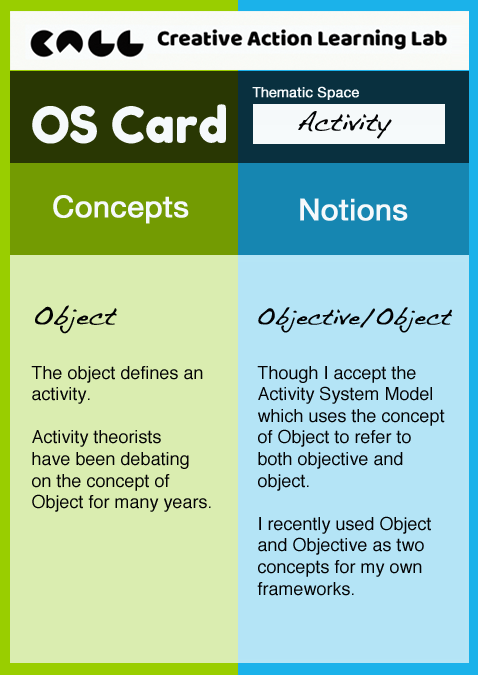
A mapping clue is a connection between a fact inside outer space and a fact inside inner space. The connection could be strong or weak. The above example “Object — Objective/Object” is a really strong connection.
You can find more details in Mapping Thematic Spaces #1: OS Card and Mapping Clues.
I also discussed the difference between Concepts and Notions in Knowledge Discovery: Concepts, Notions, and the Concept Dynamics Framework.
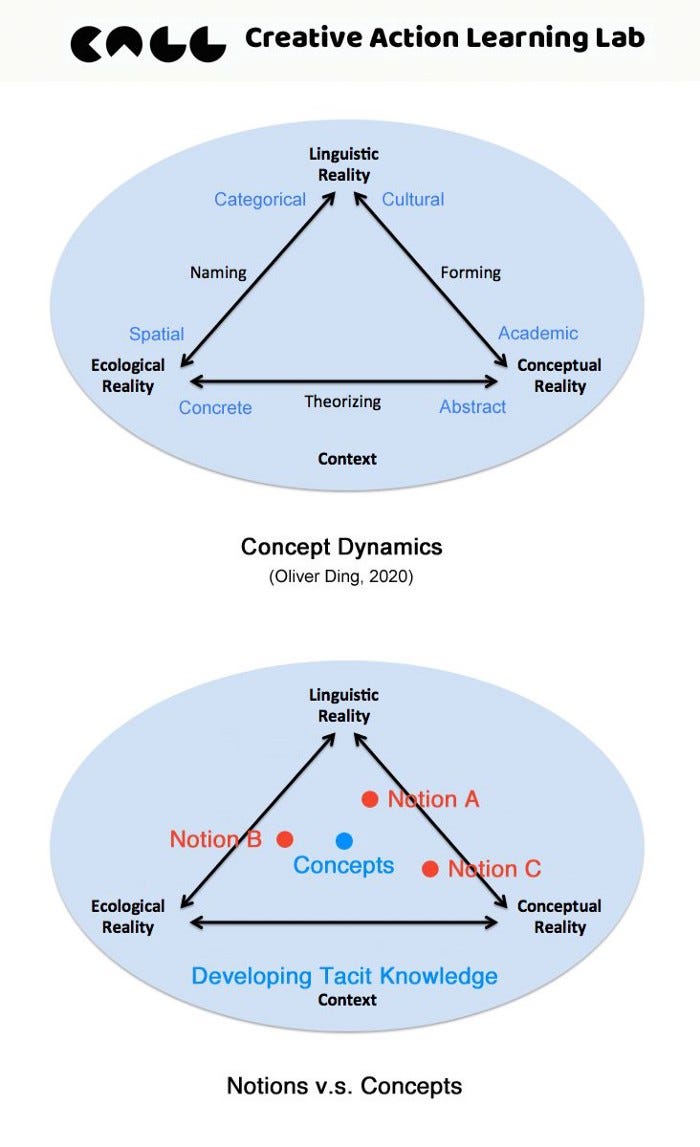
The article used the Concept Dynamics Framework to discuss Concepts and Notions. The above diagram shows the difference between Ideal Knowledge Concepts and Real World Notions.
- Ideal Knowledge Concepts: it is placed at the center which means a perfect match of three aspects.
- Real-World Notions: It might appear at different places on the map.
Notion A: high linguistic reality, middle conceptual reality, and low ecological reality.
Notion B: middle linguistic reality, middle ecological reality, and low conceptual reality.
Notion C: high conceptual reality, low linguistic reality, and low ecological reality.
So, one strategy for developing tacit knowledge is turning Real World Notions into Ideal Knowledge Concepts.
Related Articles
- The Slow Cognition Project
- Slow Cognition: A Meta-canvas for Developing Tacit Knowledge
- Knowledge Discovery: Concepts, Notions, and the Concept Dynamics Framework
- Knowledge Discovery: The “Approaches — Tastes” Mapping
- Knowledge Discovery: The “Perspectives — Views” Mapping
- Knowledge Discovery: The “Frameworks — Insights” Mapping
- Knowledge Discovery: The “Events — Projects” Mapping
- Knowledge Discovery: The “Domains — Works” Mapping
- Knowledge Discovery: The “Heuristics — Skills” Mapping
- Knowledge Discovery: The “Methods — Guides” Mapping
- Knowledge Discovery: The HERO U Canvas
- Knowledge Discovery: The Concept Dynamics Framework
- Knowledge Discovery: The “Double Theme” Strategy
- Knowledge Discovery: The “Middleware” Strategy
- Project-oriented Activity Theory (Book)
- D as Diagramming: The Mind as Play Metaphor
- D as Diagramming: An Integrated Framework for Studying Knowledge Diagrams (Part 1)
- Themes of Practice (2019–2021)
- The Career Theme Canvas
I am also working on building a new website for the Platform Ecology project. You can save the following links:
- PlatformEcology.org
- Twitter: @PlatformEcology
- Linkedin: @PlatformEcology
You are most welcome to connect via the following social platforms:
Linkedin: https://www.linkedin.com/in/oliverding Twitter: https://twitter.com/oliverding Polywork: https://www.polywork.com/oliverding Boardle: https://www.boardle.io/users/oliver-ding


