
Coding Sins: Hilarious Developer Confessions
How ‘whiteboarding’ got mocked

In the year 2017, David Heinemeier Hansson, a well-known programmer and the creator of the popular Ruby on Rails coding framework, started a Developer Confessions thread on Twitter with this post:
In no time, it went viral. He ranted about interview practices in large companies — kicked off a number of tweets across many technical professions.
Some of the other best Series —
Data Science and Machine Learning Research ( papers) Simplified **
100 days : Your Data Science and Machine Learning Degree Series with projects
Complete Data Visualization and Pre-processing Series with projects
Exceptional Github Repos — Part 1
Exceptional Github Repos — Part 2
Tech Newsletter —
If you are interested, you can join my newsletter through which I send tech interview tips, techniques, patterns, hacks — Software Development, ML, Data Science, Startups and Technology projects to more than 30K readers. You can subscribe to Tech Brew :
Github —
Projects Videos —
All the projects, data structures, SQL, algorithms, system design, Data Science and ML , Data Analytics, Data Engineering, , Implemented Data Science and ML projects, Implemented Data Engineering Projects, Implemented Deep Learning Projects, Implemented Machine Learning Ops Projects, Implemented Time Series Analysis and Forecasting Projects, Implemented Applied Machine Learning Projects, Implemented Tensorflow and Keras Projects, Implemented PyTorch Projects, Implemented Scikit Learn Projects, Implemented Big Data Projects, Implemented Cloud Machine Learning Projects, Implemented Neural Networks Projects, Implemented OpenCV Projects,Complete ML Research Papers Summarized, Implemented Data Analytics projects, Implemented Data Visualization Projects, Implemented Data Mining Projects, Implemented Natural Leaning Processing Projects, MLOps and Deep Learning, Applied Machine Learning with Projects Series, PyTorch with Projects Series, Tensorflow and Keras with Projects Series, Scikit Learn Series with Projects, Time Series Analysis and Forecasting with Projects Series, ML System Design Case Studies Series videos will be published on our youtube channel ( just launched).
Subscribe today!
Consensus being:
Riddles are bullshit, whiteboard challenges are not relevant to our actual skills and day-to-day work.
Being a software engineer myself, to some extent I concur with David.
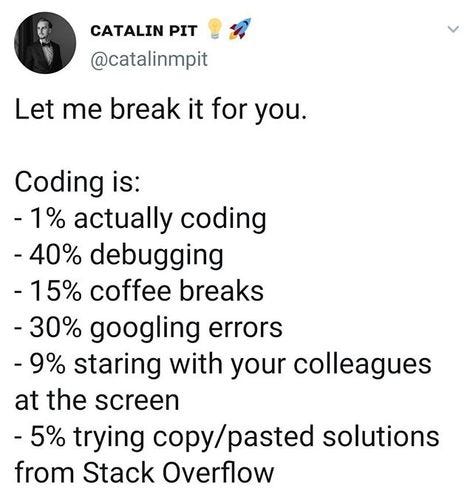
Famous coding instructor Quincy Larson wrote in a blog post:
“The only world where you would actually need to be able to recall an algorithm would be a post-apocalyptic one, where the hard drives of all the computers connected to the internet were fried, and all copies of foundational academic papers and computer science textbooks had been reduced to ashes”
In this post, I’m going to cover the hilarious confessions of the programmers as tweets.
Tim Dierks, a Lead at Google wrote this:
While the veracity of whiteboard interviews is still debatable — people think that whiteboard interviewing is a discrete skill, much like being able to remember Pi to a thousand decimal places, Aline Lerner, the Founder of interviewing.io once said — “After drawing on data from thousands of technical interviews, it’s become clear to us that technical interviewing is a process whose results are nondeterministic and often arbitrary”.
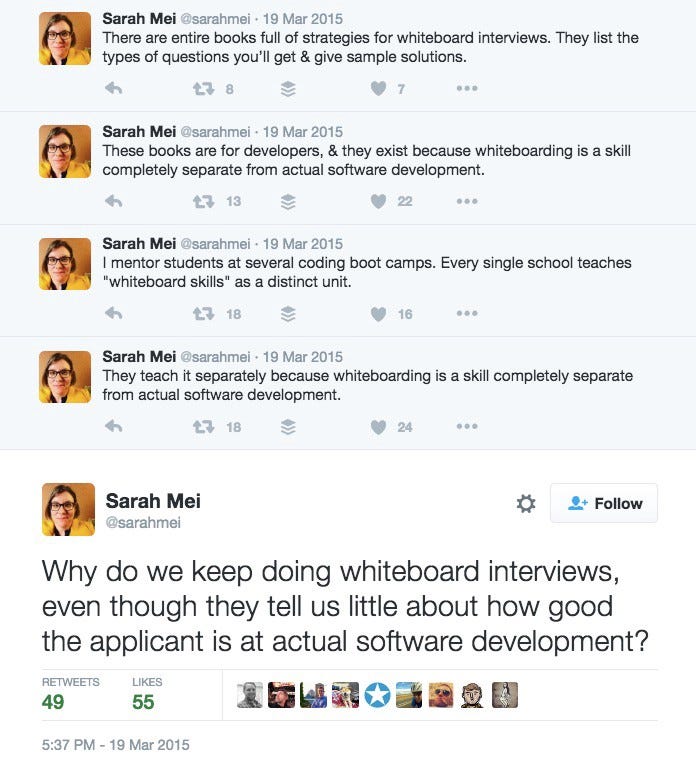
Sarah Mei posted a series of tweets:
Four Square has publicly ditched whiteboard interviews in favor of take-home assignments.
We were concerned that [the whiteboard interview] process filtered out many other great engineers for reasons other than their abilities. Some possible reasons include variation between interviewers, candidate nervousness, or the unnaturalness of whiteboard coding generally.
As a result, Four Square has gotten rid of the random false negatives that can result from the “algorithm question lottery.
To conclude, most of the companies now rely on the pair-programming-centric interview to weed out bad candidates. Well, that makes sense. Isn’t it?
Thanks for reading. Keep Learning and coding!


