
The Art of Situational Note-taking: Be Careful of Using Buzzwords
A case study: From “Ecological Complexity (2020)” to “Creative Social Cognition (2023)”
This post is part of the “Art of Situational Note-taking” project.
My approach to note-taking is represented in the diagram below.
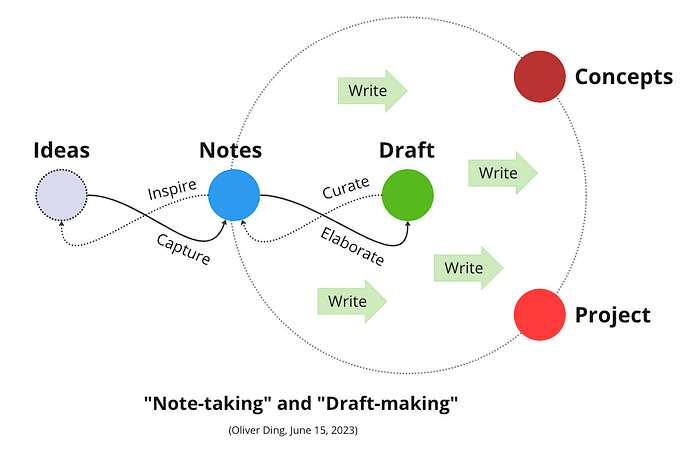
My model is more about developing a concept system for a project than producing a book. You can find more details in Situational Note-taking: Capture Significant Insights Outside the Room.
Today I’d like to share one of my habits: Be Careful of Using Buzzwords.
This article only shares a case study. From 2020 to 2023, I focused on a set of primary concept of my ecological approach. I didn’t use “Ecological Complexity” as a primary concept for my approach.
If you are building a concept system for your knowledge creations or a mental platform to support your product innovation, you should be careful of using buzzwords.
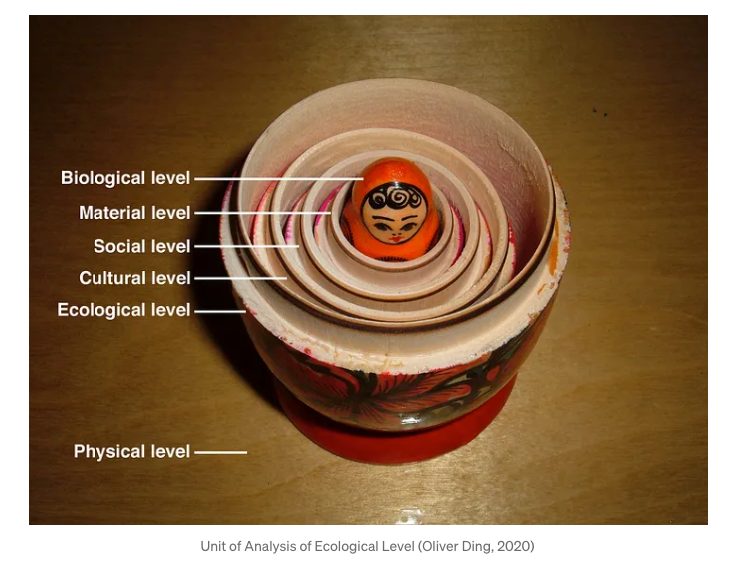
The above picture is the Unit of Analysis of Ecological Interaction which is a method I developed in July 2020. The ecology view focuses on the “organism—environment” relationship. It suggests every living organism has its specific surrounding medium of environment called niche. An organism is also part of other organisms’ environment. Following this general view, I consider “ecological interaction” as “people interacting with their surrounding context” and see “social interaction” as a subset of “ecological interaction” because we can consider other people as social context.
You can find more details in the articles below:
- Curativity Theory: The Ecological Approach to General Curation Practice — April 1, 2020
- #SocialPxD — ReEngagement with Twitterville: An Introduction to Ecological Physics Method — June 19, 2020
- Frame Analysis in Context: An Example of Quasi-social Interaction and Ecological Interaction Analysis — July 21, 2020
- Hammer, Hammering, and Affordance: The Materiality Turn and Artifact-centered Interaction — July 31, 2020
- Mapping Thematic Space #7: The Center of the “Ecological Interaction” Thematic Space— Feb 25, 2022
Why did I use the theme “Ecological Complexity” to frame my knowledge enterprise?
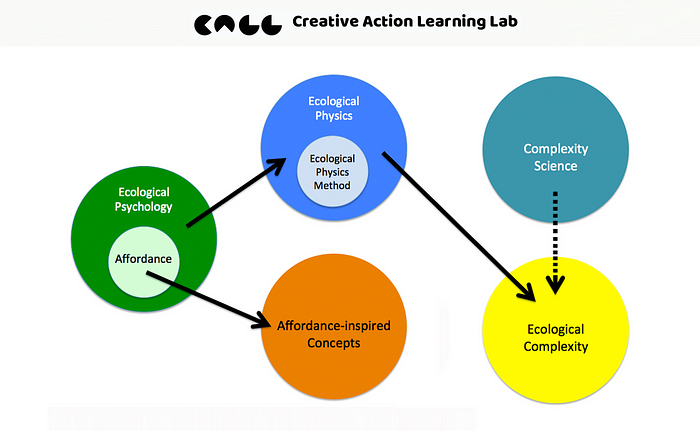
On April 1, 2020, I published an article titled Curativity Theory: The Ecological Approach to General Curation Practice. The article introduces the basic ideas of Curativity Theory. In order to offer a background about the “ecological practice” approach, I wrote the section with a diagram. At that time, I wanted to use the term of “ecological complexity” to highlight a path of my ecological approach.
What I want to explore is not re-defining the concept of Affordance which is a primary theoretical concept of James J. Gibson’s Ecological Psychology, but adopting Gibson’s philosophical stance to understand the relationship between the dynamics of human actions and the structure of human environments.
One year later, I published an article to review the historical development of the Ecological Practice approach on April 26, 2021. This article doesn’t mention the term “ecological complexity” since I was not sure if I should adopt complexity science for my ecological approach.
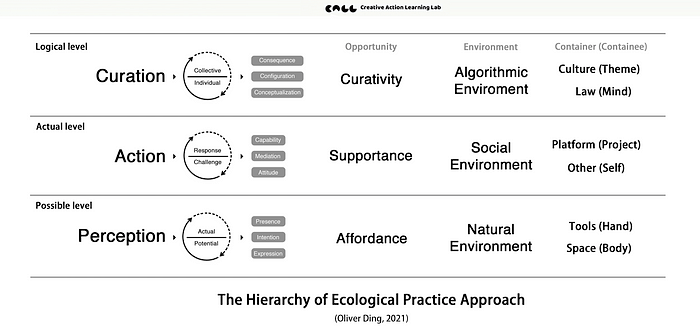
On April 29, 2021, I wrote a short note about the theme of “Ecological Complexity”:
However, I think we can still use the term of “ecological complexity” to refer to the complex relationship between the dynamics of human actions and the structure of human environments without introducing new ideas from complexity science.
Later, I didn’t use the term “ecological complexity” for my ecological practice approach.
The term “Complexity” was very popular around 2020. Many authors talked about it. My strategy was to keep my ecological approach simple.
I focused on developing a set of primary theoretical concepts for my ecological approach.
The canvas below represents the landscape of the Ecological Practice approach.
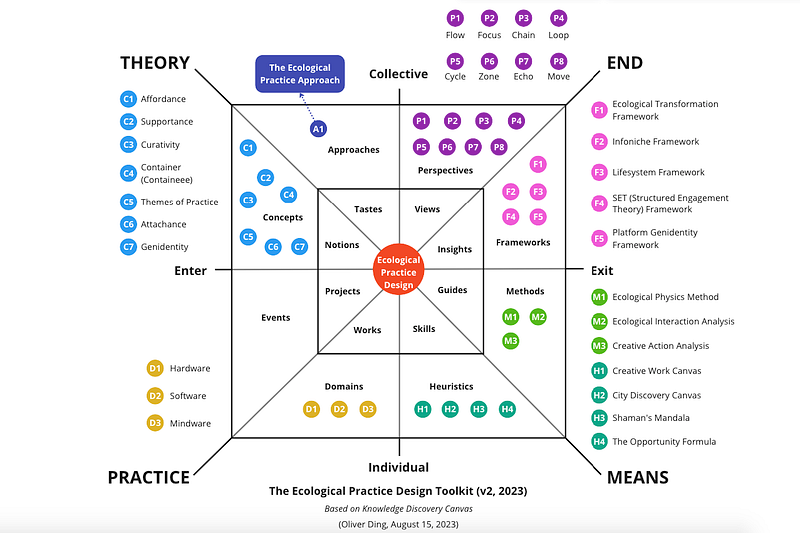
I only selected seven primary concepts:
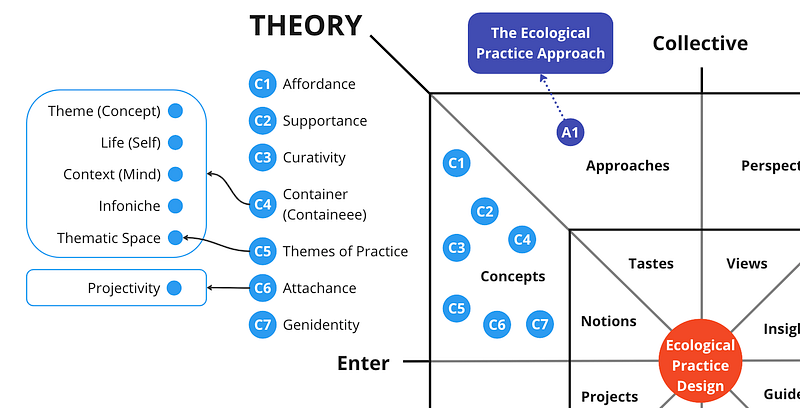
- Affordance
- Supportance
- Curativity
- Container (Containee)
- Themes of Practice
- Attachance
- Genidentity
These primary concepts also led to secondary concepts and related knowledge projects. For example, the concept of “Thematic Space”.
The concept of “Thematic Space” combines Thematic Thinking and Spatial Thinking.
If we make a list, then it refers to Thematic Thinking.
- Name
- Website
The above tiny list only contains four items which are four categories. Thematic Thinking sees things in differences and similarities.
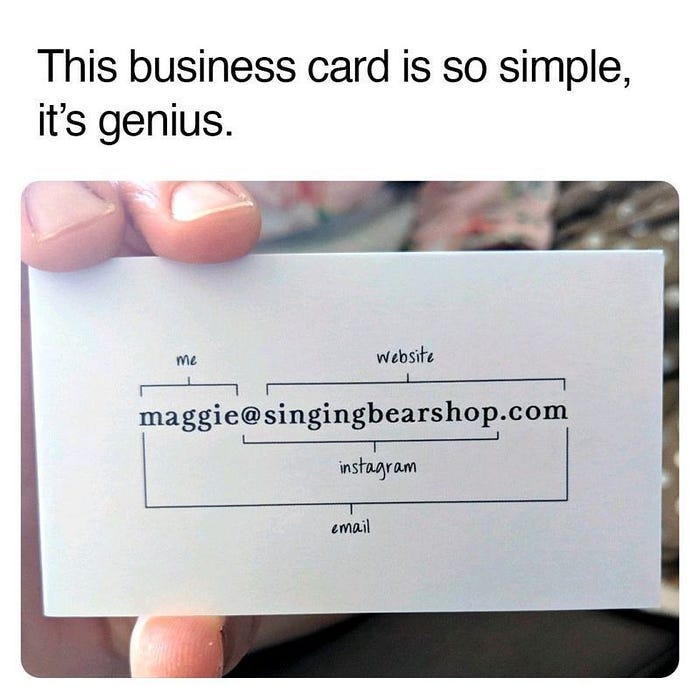
In contrast, Spatial Thinking cares about the meaning and value of spatial structures of environments without considering categories.
- {
[@(singingbearshop].com)} - {email}
- [Instagram]
- (Website)
Thematic Thinking and Spatial Thinking follow two different logics.
You can find more details in #TalkThree 14: What’s “Thematic Space”?
In July 2023, I finished the “Mental Moves” knowledge project and edited a possible book titled Mental Moves: The Attachance Approach to Ecological Creative Cognition.
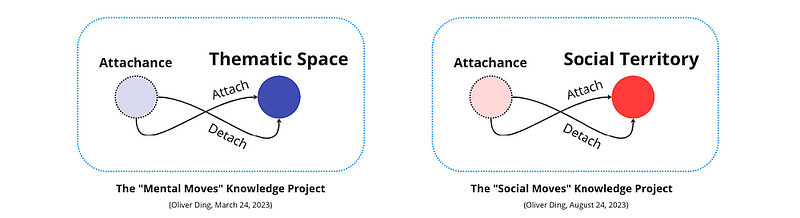
On August 24, 2023, I started the “Social Moves” knowledge project which uses “Social Territory” as the primary concept.
For the Mental Moves project, the concept of “Thematic Space” is associated with knowledge models/knowledge frameworks.
For the Social Moves project, I need to find a way to connect “Thematic Space” and “Social Territory”.
This challenge encouraged me to develop an integrated ecological approach to social cognition in Dec 2023. See the diagram below.
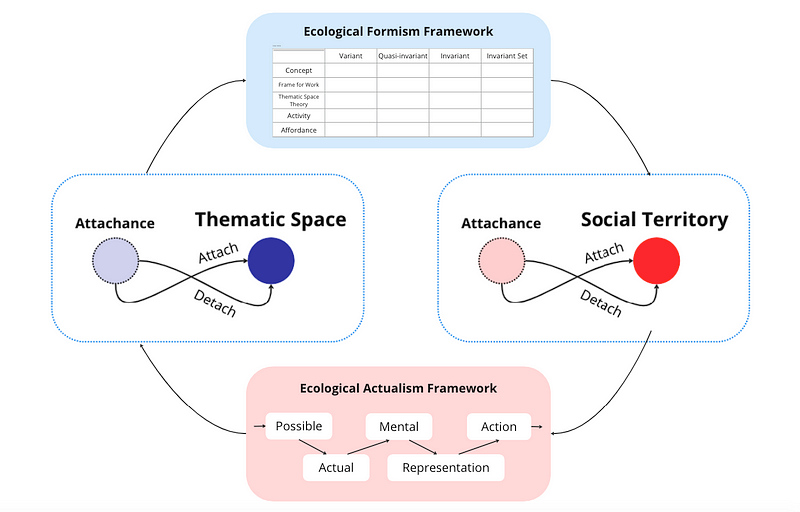
If we put “Mental Moves” and “Social Moves” together, we see a new unit of analysis of Social Cognition. While “Social Moves” are about Social Actions, “Mental Moves” are about related Mental Activities.
Social Cognition = Social Moves (Mental Moves)
Both “Mental Moves” and “Social Moves” shared the concept of “Thematic Space”.
The primary focus of the Mental Moves project is “Knowledge” while the primary focus of the Social Moves project is “Activity”.
These two focuses echo the two dimensions of the Universal Reference of Knowledge Engagement which was developed on Nov 11, 2022.
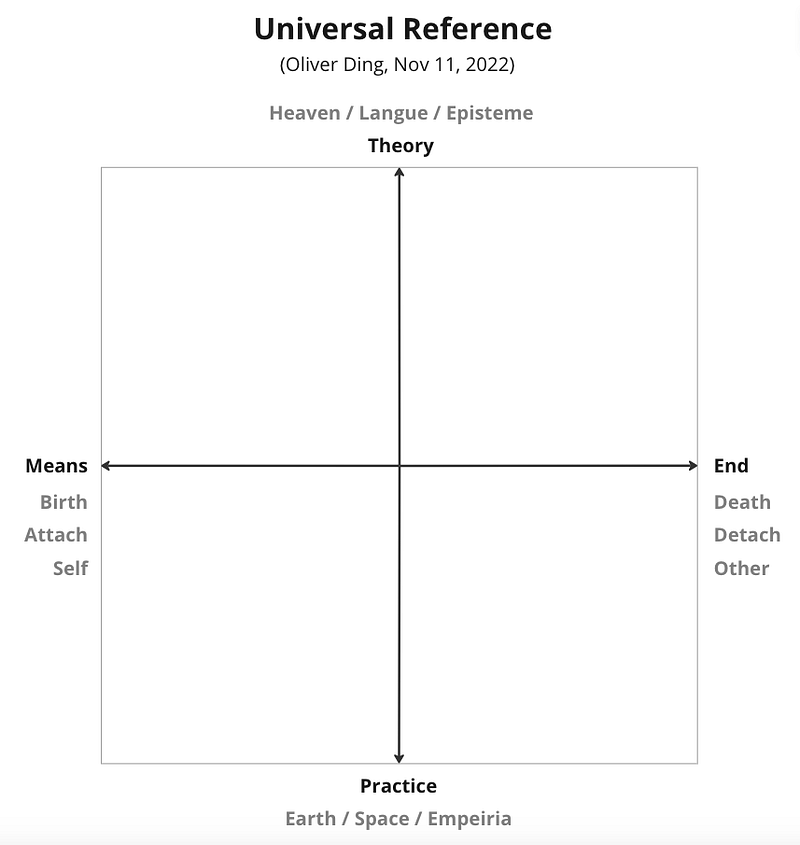
The above diagram uses multiple dimensions to define a canvas.
The Vertical group refers to the Degrees of Abstraction of “Knowledge”.
The “Theory — Practice” dimension is shared with the following pairs of concepts:
- The “Heaven — Earth” dimension
- The “Langue — Space” dimension
- The “Episteme — Empeiria” dimension
The Horizontal group refers to the Situations of Activity of “Engagement”.
The “Means — End” dimension is shared with the following pairs of concepts:
- The “Birth — Death” dimension
- The “Attach — Detach” dimension
- The “Self — Other” dimension
You can find more details in Diagram: A Universal Reference for Knowledge Engagement.
On Nov 18, 2022, I used “World of Activity” to define this social space for knowledge creators. You can find more details in Lifescope: The World of Activity for Creative Life Curation.
From Nov 2022 to Dec 2023, I discovered some new insights about the concept of “World of Activity”. See the two diagrams below:
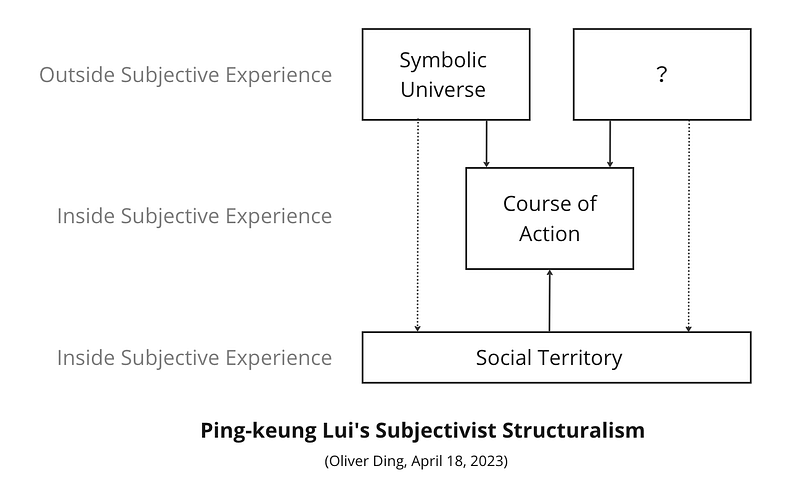
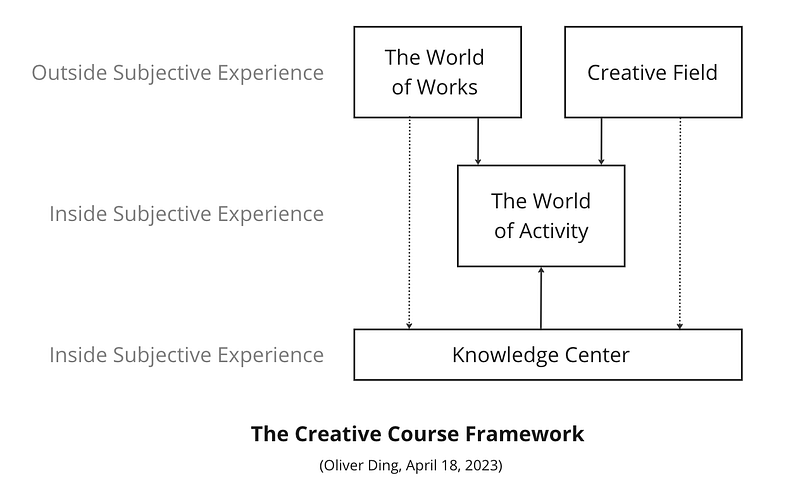
The Creative Course Framework (right) was inspired by Lui’s Subjectivist Structuralism (left) which is part of his theoretical sociology.
- Course of Action → World of Activity
- Social Territory → Knowledge Center
I use the “World of Activity” to refer to the course of action of creators. The term was inspired by social phenomenologist Alfred Schutz’s term “The World of Working”.
In order to distinguish the covert performances of mere thinking from those overt requiring bodily movements, Schutz called the latter Working. According to Schutz, Working refers to action in the outer world.
The World of Working is one sub-world of the World of Daily Life or the Life-world. There are other sub-worlds in the Life-world. For example, the worlds of fantasy and dream.
In order to research creative life, I think it is important to consider the worlds of fantasy and dreams since they are significant sources of creative inspiration. Thus, I coined the term “World of Activity” in order to make a distinction between Schutz’s idea and my idea.
You can find more details in Knowledge Engagement: The Creative Course Framework.
The Ecological Formism Framework offers a solution to connect the concept of “Thematic Space” with the concept of “Social Territory”. See the diagram below.
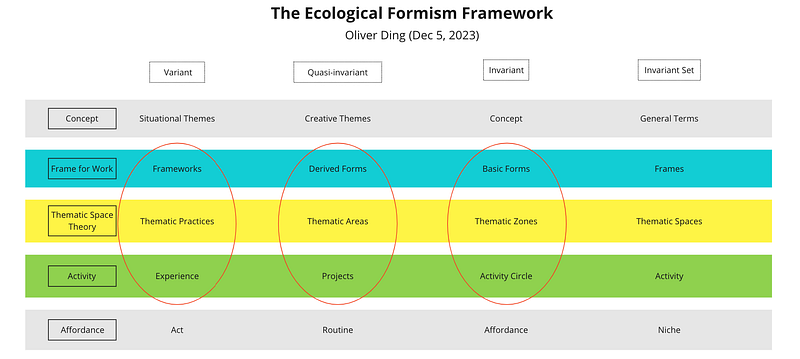
The above diagram highlights the connection between three units of analysis:
- The “Activity” level
- The “Thematic Space Theory (TST)” level
- The “Frame for Work (Knowledge Framework)” level
We also can see three cross-level connections:
- Variant: Experience — Thematic Practices — Frameworks
- Quasi-invariant: Projects — Thematic Areas — Derived Forms
- Invariant: Activity Circle — Thematic Zones — Basic Forms
The five units of analysis refer to the Horizontal group of World of Activity: the Situations of Activity of “Engagement”.
The four types of knowing refer to the Vertical group of World of Activity: the Degrees of Abstraction of “Knowledge”.
In this way, the Ecological Formism Framework offers an operational framework to understand the relationship between “Social Territory” and “Course of Actions”.
You can find more details in Social Moves: An Integrated Ecological Approach to Social Cognition and Social Moves: Thematic Zones, Thematic Areas, and Social Territory,
From 2020 to 2023, I focused on a set of primary concept of my ecological approach. I didn’t use “Ecological Complexity” as a primary concept for my approach.
If you are building a concept system for your knowledge creations or a mental platform to support your product innovation, you should be careful of using buzzwords.
Related books (Drafts)
- Creative Life Theory: Building A Knowledge Enterprise
- Mental Moves: The Attachance Approach to Ecological Creative Cognition
- Knowledge Discovery: Developing Tacit Knowledge with Thematic Space Canvas
- Knowledge Curation: Turning Pieces into A Meaningful Whole
- Life Discovery: Biography, Journey, Program
- Perspectives on Product Engagement
- Diagramming as Practice
- Diagram Blending: Building Diagram Networks
- Creative Life Curation: Discover Thematic Spaces of Creative Life


