avatarNaina Chaturvedi

Free AI web copilot to create summaries, insights and extended knowledge, download it at here

9888

Abstract

/i></b> <a href="https://amzn.to/3a12MwV">https://amzn.to/3a12MwV</a></p><h1 id="9a21">2. The Elements of Statistical Learning: Data Mining, Inference, and Prediction</h1><p id="4f51">If you are love statistics and want to learn ML from the statistics perspective then this book is a valuable resource. This book emphasizes mathematical derivations to explain the underlying concepts of a machine learning algorithm. The pre-requisite for this book is a thorough understanding of statistics and linear algebra.</p><figure id="8980"><img src="https://cdn-images-1.readmedium.com/v2/resize:fit:800/0*LhH8H_mYLtiKeGjb.jpg"><figcaption><a href="https://amzn.to/3b3JWXf">The Elements of Statistical Learning: Data Mining, Inference, and Prediction</a> (Image source and Credit: Amazon books)</figcaption></figure><p id="daaa"><b>Authors — </b>Trevor Hastie, Robert Tibshirani, and Jerome Friedman</p><p id="81ed"><b>Who can read this book: </b>Experience ML engineers.</p><p id="d0ee"><b>Topics covered —</b></p><p id="adca">Supervised learning and unsupervised learning.</p><p id="2cba">Neural networks, support vector machines, classification trees and boosting</p><p id="4230">Graphical models, random forests, ensemble methods, least angle regression and path algorithms for the lasso, non-negative matrix factorization, and spectral clustering.</p><p id="9273"><b>About the authors —</b></p><p id="270e">Trevor Hastie, Robert Tibshirani, and Jerome Friedman are professors of statistics at Stanford University. Hastie and Tibshirani developed generalized additive models and wrote a popular book of that title. Hastie co-developed much of the statistical modeling software and the environment in R/S-PLUS and invented principal curves and surfaces. Tibshirani proposed the lasso and is co-author of the very successful An Introduction to the Bootstrap. Friedman is the co-inventor of many data-mining tools including CART, MARS, projection pursuit and gradient boosting. <i>(Source: Springer)</i></p><p id="1258"><b><i>Get it here: <a href="https://amzn.to/3b3JWXf"></a></i></b><a href="https://amzn.to/3b3JWXf">https://amzn.to/3b3JWXf</a></p><div id="fd50" class="link-block"> <a href="https://naina0412.medium.com/10-silicon-valley-liners-puns-that-are-so-funny-apt-relatable-to-the-tech-world-a2ee797f7949"> <div> <div> <h2>10 “Silicon Valley” Liners/Puns that are So Funny, Apt & Relatable to the Tech World</h2> <div><h3>Hilarious as they sound…</h3></div> <div><p>naina0412.medium.com</p></div> </div> <div> <div style="background-image: url(https://miro.readmedium.com/v2/resize:fit:320/0*3Qz3nDDiuLroFeHs.gif)"></div> </div> </div> </a> </div><h1 id="2d8e">3. Hands-on Machine Learning Scikit-Learn, Keras & TensorFlow</h1><p id="95b6">Hands-on exercises and implementations are as important as a thorough understanding of the concepts. This book makes sure that you play around with codes, examples and build your own neural nets by offering a detailed theory with hands-on on neural nets. The breadth of information covered is quite wide and the writing is extremely clear, easy to read, written in impeccable English. This book assumes that you are an absolute beginner who knows close to nothing about Machine Learning and want to learn the intricacies of Machine Learning.</p><figure id="69e3"><img src="https://cdn-images-1.readmedium.com/v2/resize:fit:800/0*sMPQ4fe-x5Nkzf5N.jpg"><figcaption><a href="https://amzn.to/2yNC7Xt">Hands-on Machine Learning Scikit-Learn, Keras & TensorFlow</a> (Image source and Credit: Amazon books)</figcaption></figure><p id="3dbd"><b>Authors — </b>Aurélien Géron</p><p id="3854"><b>Who can read this book: </b>Beginner ML Enthusiast/Engineers</p><p id="4703"><b>Topics covered —</b></p><p id="34fd">Machine-learning project end-to-end using Scikit-learn</p><p id="d2f3">Deep dive into neural net architectures, including convolutional nets, recurrent nets, and deep reinforcement learning</p><p id="339e">Explore in detail the neural nets, techniques for training and scaling deep neural nets</p><p id="e522">Explore support vector machines, decision trees, random forests, and ensemble methods</p><p id="724a">How to use the TensorFlow library to build and train neural nets</p><p id="3207"><b>About the author —</b></p><p id="aed6">Aurélien Géron is a machine learning consultant and trainer. A former Googler, he was the product manager for YouTube’s video classification team.. He was also a founder and CTO of Wifirst and a founder and CTO of two consulting firms — Polyconseil (telecom, media, and strategy) and Kiwisoft (machine learning and data privacy).</p><p id="a69c"><b><i>Author’s Github</i></b><a href="https://github.com/ageron">https://github.com/ageron</a></p><p id="16bf"><b><i>Get it here:</i></b> <a href="https://amzn.to/2yNC7Xt">https://amzn.to/2yNC7Xt</a></p><h1 id="a1af">4. Python Machine Learning: Machine Learning and Deep Learning with Python, scikit-learn, and TensorFlow</h1><p id="05ec">This was the first book I purchased when I started out with Machine Learning and I don’t regret it at all. The beauty of this book is that it focusses heavily on practical code examples. If you know some Python and you want to use machine learning and deep learning then pick up this book. This book is written for developers and data scientists who want to build practical machine learning and deep learning codes and for anyone who wants to teach the computer how to learn from data. The authors of the book Raschka and Mirjalili break difficult concepts down into language that a layperson can easily understand while building and learning these codes/examples within real-world contexts.</p><figure id="4ad8"><img src="https://cdn-images-1.readmedium.com/v2/resize:fit:800/0*tjm1mOvVjwcO7jya.jpg"><figcaption><a href="https://amzn.to/2xhutV8">Python Machine Learning: Machine Learning and Deep Learning with Python, scikit-learn, and TensorFlow</a> (Image source and Credit: Amazon books)</figcaption></figure><p id="45c7"><b>Authors — </b>Sebastian Raschka and Vahid Mirjalili</p><p id="d234"><b>Who can read this book: </b>Beginner ML Enthusiast/Engineers</p><p id="36c3"><b>Topics covered —</b></p><p id="2fcb">Learn how to apply machine learning to image classification, sentiment analysis, intelligent web applications, etc</p><p id="cdb6">Master the frameworks, models, and techniques that enable machines to learn from data and predict continuous target outcomes using regression analysis</p><p id="7242">Use Scikit-learn for machine learning and TensorFlow for deep learning and learn the best practices for evaluating and tuning models</p><p id="12af"><b><i>Build and train neural networks, GANs etc</i></b></p><p id="12f9">Learn how to use social media data for sentiment analysis</p><p id="ad21"><b>About the author —</b></p><p id="9d0e">Sebastian Raschka is an Assistant Professor of Statistics at the University of Wisconsin-Madison focusing on machine learning and deep learning research. Some of his recent research methods have been applied to solving problems in the field of biometrics for imparting privacy to face images. His research focus areas include the development of methods related to model evaluation in machine learning, deep learning for ordinal targets, and applications of machine learning to computational biology.</p><p id="53ae"><b><i>Author’s GitHub</i></b><i><a href="https://github.com/rasbt"></a></i><a href="https://github.com/rasbt">https://github.com/rasbt</a></p><p id="9497">Vahid Mirjalili obtained his Ph.D. in mechanical engineering working on novel methods for large-scale, computational simulations of molecular structures. Currently, he is focusing his research efforts on applications of machine learning in various computer vision projects at the Department of Computer Science and Engineering at Michigan State University. He recently joined 3M Company as a research scientist, where he uses his expertise and applies state-of-the-art machine learning and deep learning techniques to solve real-world problems in various applications to make life better.</p><p id="59b3"><b><i>Author’s Github —</i></b> <a href="https://github.com/vmirly">https://github.com/vmirly</a></p><p id="1672"><b><i>Get it here : <a href="https://amzn.to/2xhutV8"></a></i></b><a href="https://amzn.to/2xhutV8">https://amzn.to/2xhutV8</a></p><h2 id="4678">5.Machine Learning: The Art and Science of Algorithms that Make Sense of Data</h2><p id="9cba">This book is hard to read but in the end, it’s worth it. The author of the book uses the example-based approach that begins by discussing how a spam filter works, which gives an immediate introduction to machine learning in action without giving a lot of importance to the technicalities. This book has a lot of mathematical jargon and requires a thorough understanding of linear Algebra.</p><figure id="0f0f"><img src="https://cdn-images-1.readmedium.com/v2/resize:fit:800/0*8MqJUpB644lx46hM.jpg"><figcaption><a href="https://amzn.to/3cekezu"><b>Machine Learning: The Art and Science of Algorithms that Make Sense of Data</b></a><b> (</b>Image source and Credit: Amazon books<b>)</b></figcaption></figure><p id="d41e"><b>Authors — </b>Peter Flach</p><p id="6571"><b>Who can read this book — </b>Beginner to Experienced Machine Learning Engineers</p><p id="da43"><b>Topics covered —</b></p><p id="b30b">The main focus is given on covering a Wide range of logical, geometric and statistical models and state-of-the-art topics such as matrix factorization and ROC analysis.</p><p id="349d"><b>About the author —</b></p><p id="2bd3">Peter Flach is a Professor of Artificial Intelligence at the University of Bristol. His main research area is — mining h

Options

ighly-structured data and the evaluation and improvement of machine learning models using ROC analysis. He is also Editor-in-Chief of the Machine Learning journal.</p><p id="f488"><b><i>Get it here :</i></b> <a href="https://amzn.to/3cekezu">https://amzn.to/3cekezu</a></p><h2 id="a72f">6. Probabilistic Graphical Models: Principles and Techniques (Adaptive Computation and Machine Learning series)</h2><p id="b551">I love this book for this book unifies the many different types of probabilistic models used in artificial intelligence. This book covers a variety of models, ranging from Bayesian networks, undirected Markov networks, discrete and continuous models, and extensions to deal with dynamical systems and relational data. Probabilistic graphical models are a powerful framework for representing complex domains using probability distributions, with numerous applications in machine learning, computer vision, natural language processing, and computational biology.</p><figure id="ee8e"><img src="https://cdn-images-1.readmedium.com/v2/resize:fit:800/0*UGPsQWscWCwFxIc8"><figcaption><a href="https://amzn.to/2VnGCQd"><b>Probabilistic Graphical Models: Principles and Techniques (Adaptive Computation and Machine Learning series)</b></a><b> (</b>Image source and Credit: Amazon books<b>)</b></figcaption></figure><p id="6b5f"><b>Authors — </b>Daphne Koller and Nir Friedman</p><p id="2151"><b>Who can read this book — </b>Experienced Machine Learning Engineers</p><p id="265b"><b>Topics covered —</b></p><p id="1aba">Bayesian networks, undirected Markov networks, discrete and continuous models</p><p id="c0bf">Probabilistic graphical models</p><p id="4c0d"><b>About the authors —</b></p><p id="2e2a">Daphne Koller is a Professor in the Department of Computer Science at Stanford University. Her main research focus is on using probabilistic models and machine learning to understand complex domains that involve large amounts of uncertainty. <i>(Source: Stanford AI Lab)</i></p><p id="d635">Nir Friedman is a Professor in the Department of Computer Science and Engineering at Hebrew University. His areas of interest are — Inference and learning in probabilistic models which involve work on representation, inference, and learning with Bayesian networks and related representations, with applications to concept learning, data mining. Computational Biology which focusses on applying probabilistic models to understand biological systems and to analyze data collected from biological sources, such as protein and DNA sequences. <i>(Source: Stanford AI Lab)</i></p><p id="5e2d"><b><i>Get it here:</i></b> <a href="https://amzn.to/2VnGCQd">https://amzn.to/2VnGCQd</a></p><p id="9b84"><i>Note: This story post contains affiliate links.</i></p><h1 id="4001">Want to read programmers humor?</h1><div id="fd28" class="link-block"> <a href="https://readmedium.com/programming-humor-part-2-f92cf5a26f2b"> <div> <div> <h2>Programming Humor Part 2</h2> <div><h3>Keep laughing because it’s hilarious ….</h3></div> <div><p>medium.com</p></div> </div> <div> <div style="background-image: url(https://miro.readmedium.com/v2/resize:fit:320/0*xkCXqHz7vIXjmjD_.png)"></div> </div> </div> </a> </div><div id="1e2f" class="link-block"> <a href="https://readmedium.com/the-most-hilarious-code-comments-ever-bae3cb1030b5"> <div> <div> <h2>The Most Hilarious Code Comments Ever</h2> <div><h3>Programmer Humor: Yes, coders actually wrote them!</h3></div> <div><p>medium.com</p></div> </div> <div> <div style="background-image: url(https://miro.readmedium.com/v2/resize:fit:320/0*C-cPP9D2MIyeexAT.gif)"></div> </div> </div> </a> </div><div id="93a8" class="link-block"> <a href="https://readmedium.com/coding-sins-hilarious-developer-confessions-f55eb342454e"> <div> <div> <h2>Coding Sins: Hilarious Developer Confessions</h2> <div><h3>How ‘whiteboarding’ got mocked</h3></div> <div><p>medium.com</p></div> </div> <div> <div style="background-image: url(https://miro.readmedium.com/v2/resize:fit:320/0*JceCvoRHEHRXyHnb.jpeg)"></div> </div> </div> </a> </div><div id="052b" class="link-block"> <a href="https://readmedium.com/10-witty-programming-jokes-that-will-make-you-go-rofl-a53fbfb91943"> <div> <div> <h2>10 Witty Programming Jokes That Will Make You Go ROFL</h2> <div><h3>These are hilarious ….</h3></div> <div><p>medium.com</p></div> </div> <div> <div style="background-image: url(https://miro.readmedium.com/v2/resize:fit:320/0*c6MUlOF-1Z2Su0-E)"></div> </div> </div> </a> </div><h1 id="3c65">Recommended Articles -</h1><div id="f7a3" class="link-block"> <a href="https://readmedium.com/python-iterators-generators-and-decorators-made-easy-659cae26054f"> <div> <div> <h2>Python Iterators, Generators And Decorators Made Easy</h2> <div><h3>A Quick Implementation Guide</h3></div> <div><p>medium.com</p></div> </div> <div> <div style="background-image: url(https://miro.readmedium.com/v2/resize:fit:320/0*XtVnWXUTVVE13f3-.jpeg)"></div> </div> </div> </a> </div><div id="70ed" class="link-block"> <a href="https://readmedium.com/23-data-science-techniques-you-should-know-61bc2c9d1b3a"> <div> <div> <h2>23 Data Science Techniques You Should Know!</h2> <div><h3>Save your precious time by using these hacks</h3></div> <div><p>medium.com</p></div> </div> <div> <div style="background-image: url(https://miro.readmedium.com/v2/resize:fit:320/1*222j6BFuGGqZxksgOHa4kg.png)"></div> </div> </div> </a> </div><div id="b8f3" class="link-block"> <a href="https://readmedium.com/coding-sins-hilarious-developer-confessions-f55eb342454e"> <div> <div> <h2>Coding Sins: Hilarious Developer Confessions</h2> <div><h3>How ‘whiteboarding’ got mocked</h3></div> <div><p>medium.com</p></div> </div> <div> <div style="background-image: url(https://miro.readmedium.com/v2/resize:fit:320/0*JceCvoRHEHRXyHnb.jpeg)"></div> </div> </div> </a> </div><div id="c55e" class="link-block"> <a href="https://readmedium.com/5-cool-advanced-pandas-techniques-for-data-scientists-c5a59ae0625d"> <div> <div> <h2>5 Cool Advanced Pandas Techniques for Data Scientists</h2> <div><h3>Use these techniques …</h3></div> <div><p>medium.com</p></div> </div> <div> <div style="background-image: url(https://miro.readmedium.com/v2/resize:fit:320/0*nd1WG4uRgLzMQr8P.jpeg)"></div> </div> </div> </a> </div><div id="bbb9" class="link-block"> <a href="https://readmedium.com/stack-overflow-analyzed-data-from-60-000-software-developers-hours-they-work-languages-they-476ac6ca0197"> <div> <div> <h2>Stack Overflow Analyzed Data from 60,000+ Software Developers — Hours They Work, Languages They…</h2> <div><h3>Here is what they found…</h3></div> <div><p>medium.com</p></div> </div> <div> <div style="background-image: url(https://miro.readmedium.com/v2/resize:fit:320/0*LWGz2247yyjKfW6g.png)"></div> </div> </div> </a> </div><div id="4965" class="link-block"> <a href="https://readmedium.com/advanced-python-made-easy-part-4-a4996ba9fe19"> <div> <div> <h2>Advanced Python Made Easy — Part 4</h2> <div><h3>Use these hacks and techniques…</h3></div> <div><p>medium.com</p></div> </div> <div> <div style="background-image: url(https://miro.readmedium.com/v2/resize:fit:320/0*nd1WG4uRgLzMQr8P.jpeg)"></div> </div> </div> </a> </div><div id="1938" class="link-block"> <a href="https://readmedium.com/advanced-python-made-easy-part-1-ce1e2f17431e"> <div> <div> <h2>Advanced Python Made Easy — Part 1</h2> <div><h3>Use these hacks and techniques…</h3></div> <div><p>medium.com</p></div> </div> <div> <div style="background-image: url(https://miro.readmedium.com/v2/resize:fit:320/0*nd1WG4uRgLzMQr8P.jpeg)"></div> </div> </div> </a> </div><h1 id="d281">If you like this post don’t forget to clap below —</h1><figure id="58a6"><img src="https://cdn-images-1.readmedium.com/v2/resize:fit:800/0*Gcp3rC5-_pKzHS1V.gif"><figcaption></figcaption></figure><p id="184c"><b><i>Thanks for reading. Keep learning !!</i></b></p><p id="8327"><b>Gain Access to Expert View — <a href="https://datadriveninvestor.com/ddi-intel">Subscribe to DDI Intel</a></b></p></article></body>

6 Books Machine Learning Engineers Should Read

Master the important concepts of ML with hands-on exercises…

Gif (Source and credits: Giphy)

Well, truth be told — ML and AI can be very intimidating for the beginners. As a prerequisite, you should be able to write a little bit of code either in python or R, have some mathematical background and should be able to understand some basic ML jargon. But what’s most important is to be guided by the right Machine Learning book.

Projects Videos —

All the projects, data structures, SQL, algorithms, system design, Data Science and ML , Data Analytics, Data Engineering, , Implemented Data Science and ML projects, Implemented Data Engineering Projects, Implemented Deep Learning Projects, Implemented Machine Learning Ops Projects, Implemented Time Series Analysis and Forecasting Projects, Implemented Applied Machine Learning Projects, Implemented Tensorflow and Keras Projects, Implemented PyTorch Projects, Implemented Scikit Learn Projects, Implemented Big Data Projects, Implemented Cloud Machine Learning Projects, Implemented Neural Networks Projects, Implemented OpenCV Projects,Complete ML Research Papers Summarized, Implemented Data Analytics projects, Implemented Data Visualization Projects, Implemented Data Mining Projects, Implemented Natural Leaning Processing Projects, MLOps and Deep Learning, Applied Machine Learning with Projects Series, PyTorch with Projects Series, Tensorflow and Keras with Projects Series, Scikit Learn Series with Projects, Time Series Analysis and Forecasting with Projects Series, ML System Design Case Studies Series videos will be published on our youtube channel ( just launched).

Subscribe today!

Below is the list of my favorite books —

1. The Hundred-Page Machine Learning Book

I absolutely love this book. This is the book you need to grok and master machine learning concepts. It explains various machine learning topics in 100 pages in detail and is very academic in its approach. It’s endorsed by reputed leaders — the Director of Research at Google, Peter Norvig and Sujeet Varakhedi, Head of Engineering at eBay.
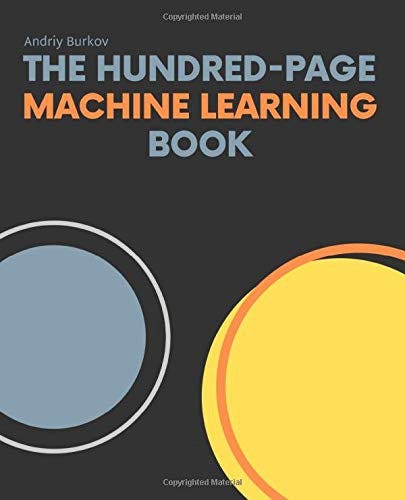
The Hundred-Page Machine Learning Book (Image source and Credit: Amazon books)

Who can read this book: Budding to experienced ML engineers

Topics covered —

Supervised and unsupervised learning

Support vector machines

Neural networks, ensemble methods, gradient descent, cluster analysis, and dimensionality reduction, autoencoders, and transfer learning

Feature engineering and hyperparameter tuning

Author — Andriy Burkov

About the author —

Andriy is a dad of two and a machine learning expert based in Quebec City, Canada. He has a Ph.D. in Artificial Intelligence and he has been leading a team of machine learning developers at Gartner.

His specialty is natural language processing and conversational interfaces. His team works on building state-of-the-art multilingual text extraction and normalization systems for production, using both shallow and deep learning technologies.

Authors Github: https://github.com/aburkov

Get it here: https://amzn.to/3a12MwV

2. The Elements of Statistical Learning: Data Mining, Inference, and Prediction

If you are love statistics and want to learn ML from the statistics perspective then this book is a valuable resource. This book emphasizes mathematical derivations to explain the underlying concepts of a machine learning algorithm. The pre-requisite for this book is a thorough understanding of statistics and linear algebra.
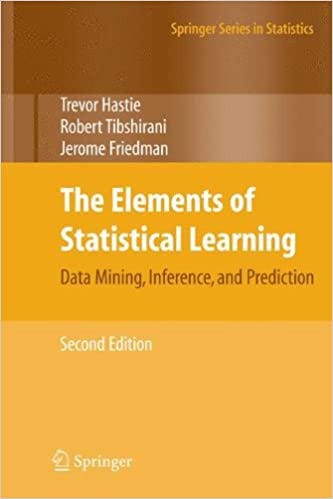
The Elements of Statistical Learning: Data Mining, Inference, and Prediction (Image source and Credit: Amazon books)

Authors — Trevor Hastie, Robert Tibshirani, and Jerome Friedman

Who can read this book: Experience ML engineers.

Topics covered —

Supervised learning and unsupervised learning.

Neural networks, support vector machines, classification trees and boosting

Graphical models, random forests, ensemble methods, least angle regression and path algorithms for the lasso, non-negative matrix factorization, and spectral clustering.

About the authors —

Trevor Hastie, Robert Tibshirani, and Jerome Friedman are professors of statistics at Stanford University. Hastie and Tibshirani developed generalized additive models and wrote a popular book of that title. Hastie co-developed much of the statistical modeling software and the environment in R/S-PLUS and invented principal curves and surfaces. Tibshirani proposed the lasso and is co-author of the very successful An Introduction to the Bootstrap. Friedman is the co-inventor of many data-mining tools including CART, MARS, projection pursuit and gradient boosting. (Source: Springer)

Get it here: https://amzn.to/3b3JWXf

3. Hands-on Machine Learning Scikit-Learn, Keras & TensorFlow

Hands-on exercises and implementations are as important as a thorough understanding of the concepts. This book makes sure that you play around with codes, examples and build your own neural nets by offering a detailed theory with hands-on on neural nets. The breadth of information covered is quite wide and the writing is extremely clear, easy to read, written in impeccable English. This book assumes that you are an absolute beginner who knows close to nothing about Machine Learning and want to learn the intricacies of Machine Learning.
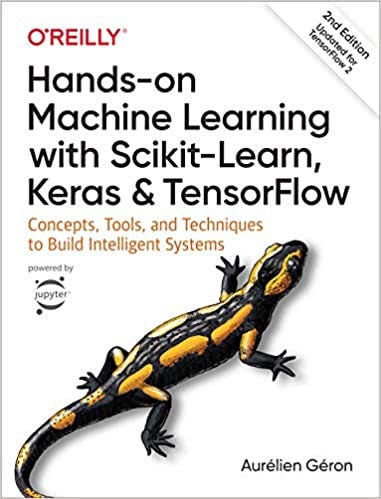
Hands-on Machine Learning Scikit-Learn, Keras & TensorFlow (Image source and Credit: Amazon books)

Authors — Aurélien Géron

Who can read this book: Beginner ML Enthusiast/Engineers

Topics covered —

Machine-learning project end-to-end using Scikit-learn

Deep dive into neural net architectures, including convolutional nets, recurrent nets, and deep reinforcement learning

Explore in detail the neural nets, techniques for training and scaling deep neural nets

Explore support vector machines, decision trees, random forests, and ensemble methods

How to use the TensorFlow library to build and train neural nets

About the author —

Aurélien Géron is a machine learning consultant and trainer. A former Googler, he was the product manager for YouTube’s video classification team.. He was also a founder and CTO of Wifirst and a founder and CTO of two consulting firms — Polyconseil (telecom, media, and strategy) and Kiwisoft (machine learning and data privacy).

Author’s Githubhttps://github.com/ageron

Get it here: https://amzn.to/2yNC7Xt

4. Python Machine Learning: Machine Learning and Deep Learning with Python, scikit-learn, and TensorFlow

This was the first book I purchased when I started out with Machine Learning and I don’t regret it at all. The beauty of this book is that it focusses heavily on practical code examples. If you know some Python and you want to use machine learning and deep learning then pick up this book. This book is written for developers and data scientists who want to build practical machine learning and deep learning codes and for anyone who wants to teach the computer how to learn from data. The authors of the book Raschka and Mirjalili break difficult concepts down into language that a layperson can easily understand while building and learning these codes/examples within real-world contexts.
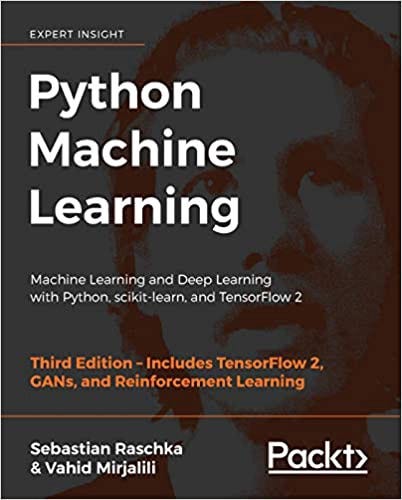
Python Machine Learning: Machine Learning and Deep Learning with Python, scikit-learn, and TensorFlow (Image source and Credit: Amazon books)

Authors — Sebastian Raschka and Vahid Mirjalili

Who can read this book: Beginner ML Enthusiast/Engineers

Topics covered —

Learn how to apply machine learning to image classification, sentiment analysis, intelligent web applications, etc

Master the frameworks, models, and techniques that enable machines to learn from data and predict continuous target outcomes using regression analysis

Use Scikit-learn for machine learning and TensorFlow for deep learning and learn the best practices for evaluating and tuning models

Build and train neural networks, GANs etc

Learn how to use social media data for sentiment analysis

About the author —

Sebastian Raschka is an Assistant Professor of Statistics at the University of Wisconsin-Madison focusing on machine learning and deep learning research. Some of his recent research methods have been applied to solving problems in the field of biometrics for imparting privacy to face images. His research focus areas include the development of methods related to model evaluation in machine learning, deep learning for ordinal targets, and applications of machine learning to computational biology.

Author’s GitHubhttps://github.com/rasbt

Vahid Mirjalili obtained his Ph.D. in mechanical engineering working on novel methods for large-scale, computational simulations of molecular structures. Currently, he is focusing his research efforts on applications of machine learning in various computer vision projects at the Department of Computer Science and Engineering at Michigan State University. He recently joined 3M Company as a research scientist, where he uses his expertise and applies state-of-the-art machine learning and deep learning techniques to solve real-world problems in various applications to make life better.

Author’s Github — https://github.com/vmirly

Get it here : https://amzn.to/2xhutV8

5.Machine Learning: The Art and Science of Algorithms that Make Sense of Data

This book is hard to read but in the end, it’s worth it. The author of the book uses the example-based approach that begins by discussing how a spam filter works, which gives an immediate introduction to machine learning in action without giving a lot of importance to the technicalities. This book has a lot of mathematical jargon and requires a thorough understanding of linear Algebra.
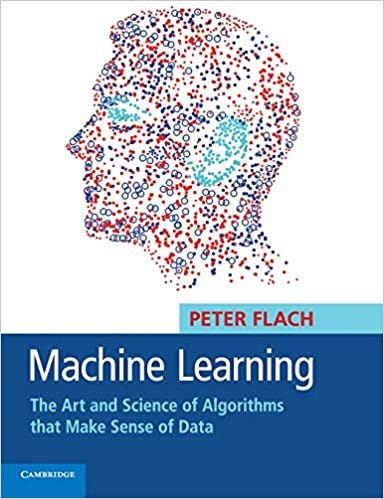
Machine Learning: The Art and Science of Algorithms that Make Sense of Data (Image source and Credit: Amazon books)

Authors — Peter Flach

Who can read this book — Beginner to Experienced Machine Learning Engineers

Topics covered —

The main focus is given on covering a Wide range of logical, geometric and statistical models and state-of-the-art topics such as matrix factorization and ROC analysis.

About the author —

Peter Flach is a Professor of Artificial Intelligence at the University of Bristol. His main research area is — mining highly-structured data and the evaluation and improvement of machine learning models using ROC analysis. He is also Editor-in-Chief of the Machine Learning journal.

Get it here : https://amzn.to/3cekezu

6. Probabilistic Graphical Models: Principles and Techniques (Adaptive Computation and Machine Learning series)

I love this book for this book unifies the many different types of probabilistic models used in artificial intelligence. This book covers a variety of models, ranging from Bayesian networks, undirected Markov networks, discrete and continuous models, and extensions to deal with dynamical systems and relational data. Probabilistic graphical models are a powerful framework for representing complex domains using probability distributions, with numerous applications in machine learning, computer vision, natural language processing, and computational biology.
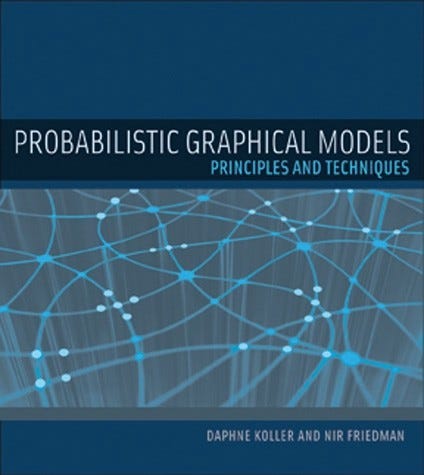
Probabilistic Graphical Models: Principles and Techniques (Adaptive Computation and Machine Learning series) (Image source and Credit: Amazon books)

Authors — Daphne Koller and Nir Friedman

Who can read this book — Experienced Machine Learning Engineers

Topics covered —

Bayesian networks, undirected Markov networks, discrete and continuous models

Probabilistic graphical models

About the authors —

Daphne Koller is a Professor in the Department of Computer Science at Stanford University. Her main research focus is on using probabilistic models and machine learning to understand complex domains that involve large amounts of uncertainty. (Source: Stanford AI Lab)

Nir Friedman is a Professor in the Department of Computer Science and Engineering at Hebrew University. His areas of interest are — Inference and learning in probabilistic models which involve work on representation, inference, and learning with Bayesian networks and related representations, with applications to concept learning, data mining. Computational Biology which focusses on applying probabilistic models to understand biological systems and to analyze data collected from biological sources, such as protein and DNA sequences. (Source: Stanford AI Lab)

Get it here: https://amzn.to/2VnGCQd

Note: This story post contains affiliate links.

Want to read programmers humor?

Recommended Articles -

If you like this post don’t forget to clap below —

Thanks for reading. Keep learning !!

Gain Access to Expert View — Subscribe to DDI Intel

Machine Learning
Books
Programming
Tech
Python
Recommended from ReadMedium