
Life Discovery: Biography, Journey, Program (and a possible book, Part 2)
A Possible Book for the Life-as-Project Approach
This is Part 2 of Life Discovery: Biography, Journey, Program (and a possible book).
Part 1 of the article introduces three metaphors for reflecting on the Life Discovery Project. You can find more details from the following link.
Part 3 collects articles and links as references.
Part 2 will use three metaphors to organize a possible book about the Life-as-Project approach.
Part 1: Life as Project
Part 1 focuses on the historical development of the Project-centered approach and the Life-as-Project framework. In fact, it is part of the Life-as-Activity project.
Originally, I wrote a long article titled Life as Activity (v0.3) and developed a framework for adult life development from the perspective of Activity Theory on Nov 29, 2020.
On Sept 10, 2021, I wrote a short note about the Life-as-Activity Framework (v2.0).
On Feb 7, 2022, I developed a toolkit called Life Discovery Toolkit (v1.0).
On the other side, I used “Project Engagement” as the name of Part 3 of the book Project-oriented Activity Theory and it refers to a set of my own ideas for expanding Andy Blunden’s original approach about “Project as a Unit of Analysis of Activity” and “Activity as Formation of Concept”.
On Jan 18, 2022, I created the new version of the Project Engagement Toolkit (2022) which is a project-oriented toolkit for theory-based reflection and study.
On Feb 12, 2022, I adopted the Project Engagement approach to reflect on the Life Discovery Toolkit (v1.0) and created the following diagram.
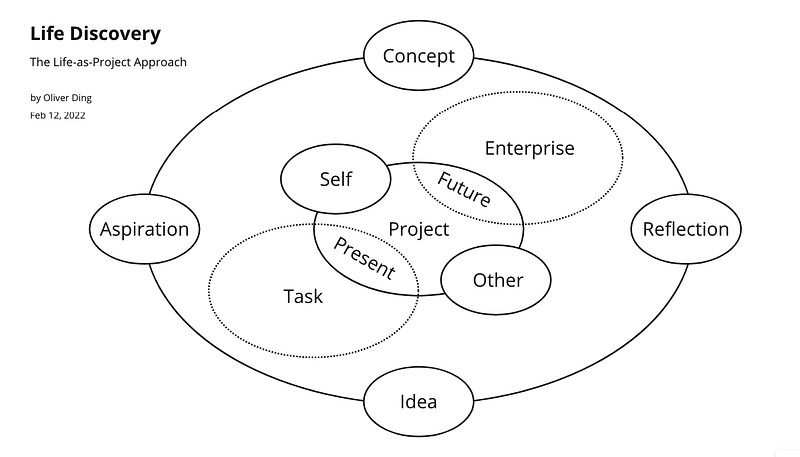
The above diagram is the starting point of the Life-as-Project approach.
If we put the Life-as-Project approach and the Life Discovery Toolkit (v1.0) together, then one is an Integrated Framework and the other one is an Operational Heuristics.
- Integrated Framework: The Life-as-Project approach
- Operational Heuristics: The Life Discovery Toolkit (v1.0)
While the Life Discovery Toolkit (v1.0) wants to curate many frameworks together, the Life-as-Project approach aims to establish a Project-centered approach.
If we consider Project as A Multiple Dimension Concept, then a new focus is established: Building A Project-centered Approach. This focus creates a new “Center” in my mind. The “Project” thematic space becomes an independent creative space.
We can see the difference between Project-oriented Activity Theory and the Project-centered Approach from their diagrams.
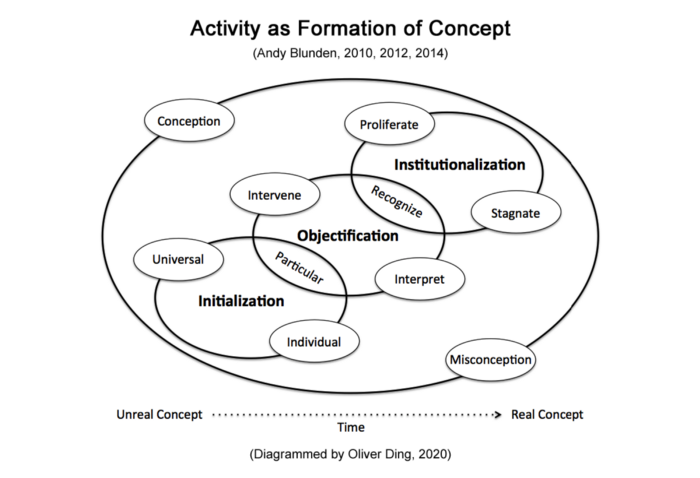
The above diagram “Activity as Formation of Concept” is the core idea of Project-oriented Activity Theory. There is a spatial logic behind the above diagram. I repeat the spatial logic of the Dialectic Room meta-Diagram at two levels. The zoom-in level and the zoom-out level. At the zoom-in level, I use the Dialectic Room meta-diagram three times in order to represent three phases of the process of “Activity as Formation of Concept”.
However, the diagram of the Life-as-Project Approach changes the spatial logic. It adopts the “CENTER-PERIPHERY” spatial logic. I just placed several pairs of concepts around the center “Project” in order to develop the “Project-centered” approach.
On Feb 26, 2022, I designed a canvas called Life Discovery Canvas (v1.0) which is based on Thematic Space Canvas. The basic form of the canvas represents the “CENTER-PERIPHERY” spatial logic. It echoes the name “Project-centered Approach”. See the diagram below.
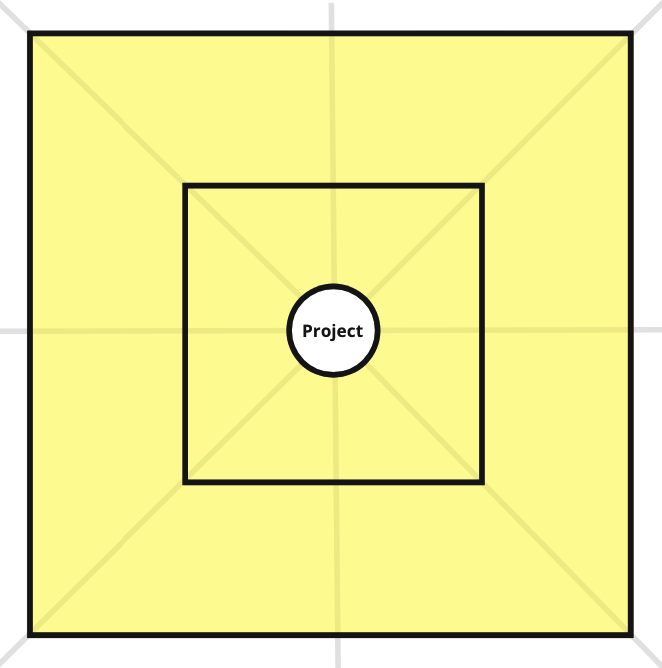
The new canvas offers new Graphical Space Affordances because it can represent more dimensions of the Project-centered approach.
The philosophical roots of the Project-centered approach are Activity Theory and Ecological Psychology. At the general philosophical level, both ecological psychology and activity theory share the same view of the inseparability of human beings and the world.
While Activity Theorist emphasizes the mind and self are developed within Activity, Ecological Psychologists focus on the mutual relationship between organism and environment. I personally use the metaphor “Container” to describe both activities and environments.
The Project-centered approach is also inspired by other theoretical resources such as Anticipatory Systems Theory and Curativity Theory. I defined the following six basic principles for developing the approach.
- Being by Doing
- Engagement as Method
- End as Means
- Discovery as Development
- Performance as Experiment
- Curativity as Creativity
The above six principles are also applied to the Life Discovery Project. The outcome is the Life-as-Project approach.
Part 2: Life Discovery
As mentioned above, my journey over the six months can be understood with three metaphors: Biography, Journey, and Program.
Part 2 adopts these three metaphors to reflect on my journey over the six months.
I also consider the journey as a case of the Slow Cognition Project which aims to explore the long-term development of thoughts. I also use the diagram below to discuss “Developing Tacit Knowledge” which is similar to “long-term development of thoughts”.
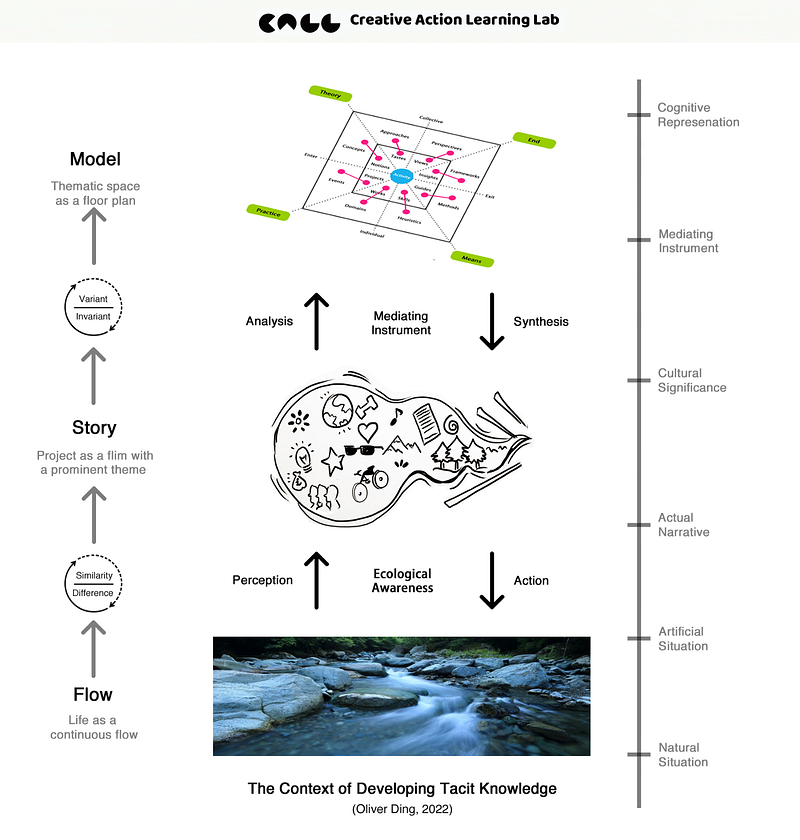
Part 2 aims to turn my life as a continuous Flow into Story with several significant Themes.
This Story also connects to the Model which refers to the Life-as-Project approach, the Life Discovery Toolkit, the Life Discovery Canvas, and the AAS Framework.
While I moved from Flow to Model, I also moved back from Model to Flow.
In the past six months, I publicly shared my journey on social media platforms such as Medium, Linkedin, Twitter, etc. These activities are considered Storytelling. In this way, I returned from Model to Story.
Finally, I launched the AAS4LT framework and hosted the AAS Board 1:1 life coaching program. My models become real Flow in some people’s real life.
From the perspective of the Slow Cognition project, Life Discovery is a particular type of Knowledge Discovery and the primary theme of Life Discovery is “My Life”.
The objective of the Life Discovery Activity is to Develop Tacit Knowledge about “My Life” and turn Tacit Knowledge into resources for actions.
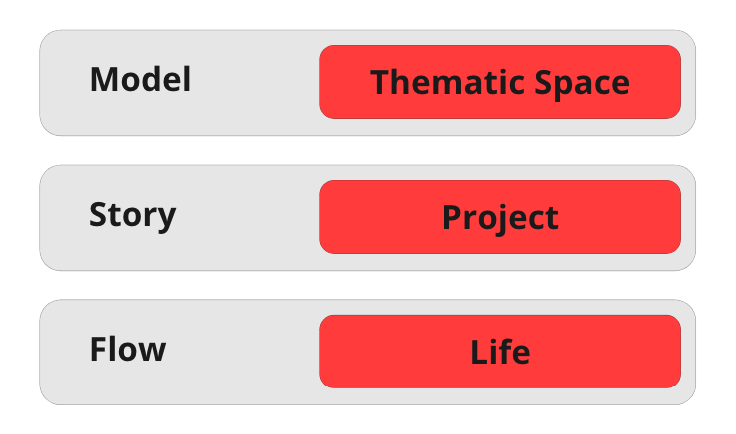
By connecting the Project-centered Approach and the concept of “Thematic Space” together, we can find the following connection:
Life = Project = Thematic Space
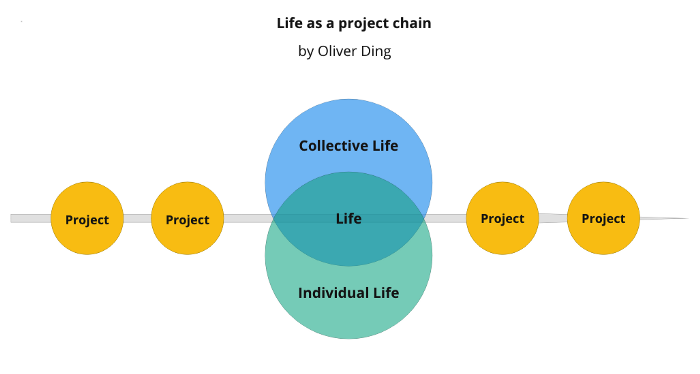
While Life is a chain of projects, it can be understood as a journey of moving between various thematic spaces.
Each project has its primary themes and other secondary themes. By joining projects and leaving projects, we are practicing our significant Life Themes. Thus, these projects are Thematic Spaces too.
This insight also echoes the model “Flow — Story — Model”. We can also find more details in Thematic Space: Project as Story.
In this way, I develop the 7th basic principle of the Life-as-Project approach: “Project as Thematic Space”.
Part 3: The Biography
Part 3 uses the “Biography” metaphor to introduce the first group of modules of the Life Discovery Program.
As mentioned above, the “Biography” metaphor refers to the “Text — Life” mapping which considers our “Biography” as “Text” and our life course as “Life”.
We are both the readers and the author of our “Biography”. In this way, our “Life” is a “Read/Write” Life. While we are reading our life as a book, we are writing it too. If you invite other people to join the Life Discovery Program, then you have more books to read.
Now the Read/Write Life is a Super Project. Under this Super Project, there are many sub-projects that are normal projects.
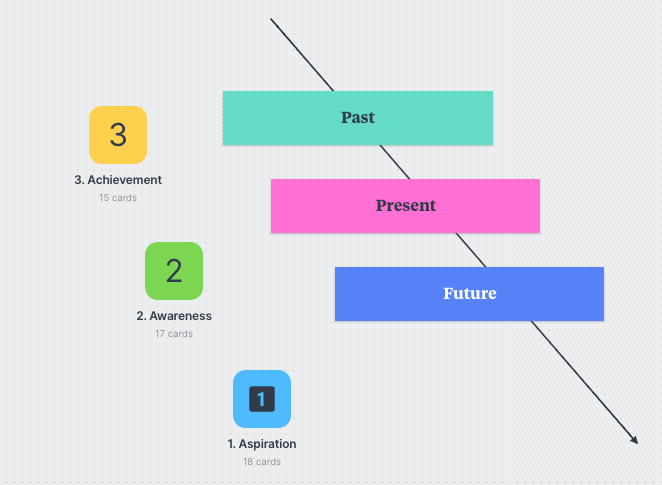
Usually, we use the “Past — Present — Future” schema to think about the structure of the life course. However, the Life Discovery Program uses “Future — Present — Past” to organize three modules.
- Life Aspiration Orientation: Future
- Life Process Awareness: Present
- Life Achievement: Past
The starting point of the Life Discovery Program is Future and Life Aspiration. It means we consider the “Future — Present — Past” as a “Biography” which refers to a meaning whole. We ask you to imagine yourself as a creative writer and you need to imagine your future life course which represents your Life Aspiration.
Step 2 returns to Present which refers to Life Process Awareness. Since We only consider knowledge creators as target audiences, we ask you to select one primary life project to practice this step. Life Projects are projects you initiated or joined in your life. It can be a work project, a family project, a non-profit community project, a personal learning project, a blog project, etc. You have to choose a Significant Life Project as the primary life project for this step.
The Life Process Awareness module uses the “Anticipation — Performance” Complexity framework to analyze your primary life project. We pay attention to how you are actually writing your Biography and what you are writing about in the Present chapter.
Step 3 moves back to Past for Life Achievement Reflection. At this point, we become readers of our Biography. Since we have written some chapters of our Biography, we can review these chapters. You are going to select one or more particular life themes and reflect on the achievement of these themes.
The module uses the “Themes of Practice” framework to guide the reflection. We pay attention to the “Practice” part of “Themes of Practice” and use the process to understand your skills, knowledge, and resources.
Moreover, one Significant Goal of Life Discovery Activity is to discover Potential Life Themes for further development. I used the Thematic Analysis method for the AAS Board program. This method is related to biographical research, narrative psychology, and Hermeneutics.
Part 4: The Journey
Part 4 uses the “Journey” metaphor to refer to the challenges, complexities, and unfoldness of life development.
I also use the “Life as Sailing” metaphor for the Life Discovery Project and Life Development in general.

- Life: it is a journey such as sailing at sea.
- Boat: social container such as family, team, group, project, company, community, etc.
- Sea: social context and social environment.
This metaphor refers to everyday life situational challenges, complexities, and opportunities.
For Life Discovery Program, I use “Now” as Project Network to design the second group modules of the program. While the first group modules focus on a single project, the second group modules move to multiple projects.
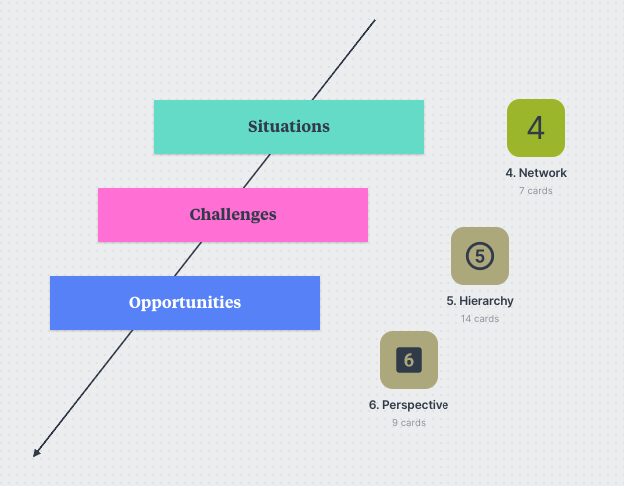
Step 4 Network considers a person’s “Now” as a connected project network that can be understood from three levels: the network of themes, the network of projects, and the network of people. You are going to list significant themes, projects, and people for this step and use the visualization technique to analyze them.
Step 5 Hierarchy used the Hierarchy perspective to understand a set of challenges. The program also uses a three-level framework to discuss life challenges.
Step 6 Perspectives aims to discover potential opportunities for different perspectives. The primary module of the step is the Formula of Opportunity model.
Part 5: The Program
Part 5 considers The Life Discovery Activity from the perspective of Service Design.
I consider two types of Life Discovery activities:
- Self-guided Program
- Host-guided Program
For Self-guided Program, the Service Design process focuses on designing mediating instruments such as the following three tools:
- Life Discovery Toolkit (v1.0)
- Life Discovery Canvas (v1.0)
- Life Discovery Board (v2.0)
Host-guided Program can be a 1:1 life coaching program or a cohort learning program. It can be offline, online, or hybrid. The Service Design process focuses on the user experience of the whole program.
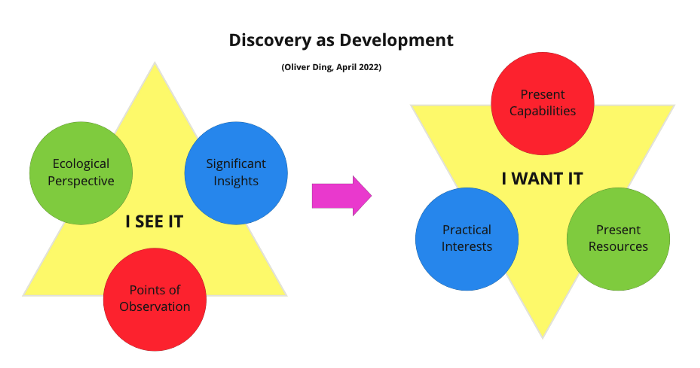
Both Self-guided programs and Host-guided programs share the following basic structure:
- The Life Discovery Program is a sub-program of the Life Strategy Program.
- The Outcome of the Life Discovery Program is Significant Insights.
- The Outcome should be presented as a Life Discovery Reflection Report.
- The Report should point to several possible directions for the following actions: Running Developmental Projects.
I consider Life Discovery Project as a sub-project of the Life Strategy Project. which is also guided by the Anpicatory Activity System framework.
Epilogue: Life, History, and Multiverse
The newest development of the Project-centered approach is the above diagram about “Life, History, and Multiverse”. I will consider applying it for the next version of the Life Discovery Program since it offers a zoom-out view for the Life-as-Project approach.
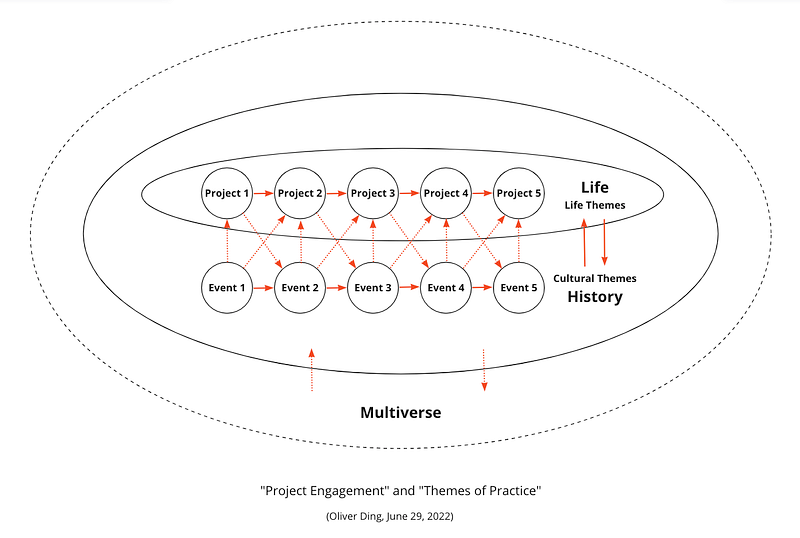
On June 29, 2022, I adopted the perspective of sociology to reflect on the notion of “Activity as Project Engagement”, I realized that while we can understand Life as a chain of Projects, we can understand History as a chain of Events. Thus, we connect “Event — Project”, “Life — History”, and “Life Themes — Cultural Themes” together.
This notion echoes my idea about “Event — Project” in Life as Activity (v0.3).
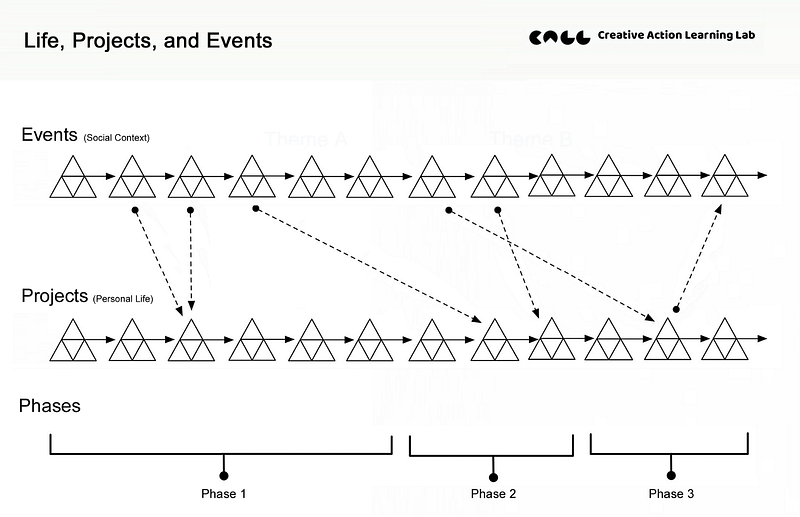
The Life-as-Project approach uses “events” and “projects” to present social context and individual biography. The difference between “events” and “projects” are individual involvement. If the person directly gets involved in an activity — it means she is the subject of the activity or part of the community of the activity — then the activity is a project of her biography. If the person doesn’t directly get involved in the activity, then the activity is an event of her biography.
The newest insight of “Life as moving between Thematic Space” also connects the Project Engagement approach and the Themes of Practice framework.
Finally, we see a simple model of the development of life and history:
Life = Projects = Thematic Spaces = Events = History
In this way, the Life-as-Project approach echoes Andy Blunden’s notion of “a project is a concept of both psychology and sociology” (2014,p.15).
Related articles
- Life Discovery: The AAS Framework
- CALL for LIFE: Anticipatory Activity System for Life Transitions
- CALL for LIFE: Modeling A Developmental Project
- The Project Engagement Toolkit (2022)
- Life Discovery: The Life-as-Project Approach
- The Life Discovery Toolkit (v1)
- The Life Discovery Canvas (v1.0) — Part 1: Theoretical Background
- The Life Discovery Canvas (v1.0) — Part 2: Spatial Structure
- The Life Discovery Canvas (v1.0) — Part 3A: Concepts (THINK and LEARN)
- The Life Discovery Canvas (v1.0) — Part 3B: Concepts (SAY and DO)
- The Life Discovery Canvas (v1.0) — Part 4: Inspirations
- Life Discovery: The “Being by Doing” Principle
- Life Discovery: The “Performance as Experiment” Principle
- Life Discovery: The “Engagement as Projection” Principle
- Life Discovery: The “Discovery as Development” Principle
- CALL for LIFE: Oliver Ding @ 2021 and Second-order Activity
- Life Discovery: Twelve Significant Insights from Four Months
- Life Discovery: “Points of Observation” and “Significant Insights”
- Life Discovery: Significant Insights Analysis
- Life Discovery: The “Tacit” Type of Second-order Activity
- Life Discovery: The Unfoldness of Activity
- Life Discovery: Running A Developmental Project
I am also working on building a new website for the Platform Ecology project. You can save the following links:
- PlatformEcology.org
- Twitter: @PlatformEcology
- Linkedin: @PlatformEcology
You are most welcome to connect via the following social platforms:
Linkedin: https://www.linkedin.com/in/oliverding Twitter: https://twitter.com/oliverding Polywork: https://www.polywork.com/oliverding Boardle: https://www.boardle.io/users/oliver-ding


