The Complete Guide to Becoming a Renaissance Person
Three big ideas you can use to build a personal system of creativity and productivity

In the last 25 years, we have witnessed the start of a new renaissance era powered by cutting edge digital technologies. Today’s innovations have become more ubiquitous and accelerated as we are surrounded by a fusion of technologies blurring the lines between the physical, digital, and biological spheres.
Almost five billion people are connected to the Internet today and enjoying unprecedented access to knowledge, processing power, connectivity, and storage capacity.
May you live in exponential times
Human knowledge now doubles every year. We will witness crazy times where human knowledge will double every few months. This implies a tsunami of disruptive innovation. We seem to experience breakthrough innovation almost every month now — just look at GPT-3 and Neuralink demo over the past few weeks.
Although our minds are wired to think linearly, we need to learn to think exponentially about the future of technology. Exponential changes are hard to grasp, and our biological minds are not well equipped to deal with such changes. That is why we have a hard time understanding how compounding works over time. Technology breakthroughs in the fields of artificial intelligence, the Internet of Things, self-driving vehicles, 3-D printing, nano-bio, quantum computing, robotics, and blockchain will converge and amplify each other.
As we enter a disruptive age of innovation unleashed by the upcoming artificial intelligence revolution, the qualities that make us uniquely human are becoming more valuable than ever.
What makes us human?
As robots take over blue-collar jobs and machines take over white-collar jobs, we need to nourish our creativity and imagination as these are what differentiates us from machines.
The best parts of human nature including our hearts, souls, creativity, imaginative capacity, empathy, compassion, and stewardship will be even more significant.
We humans are not machines of productivity — we are organisms of curiosity. We are not optimized for efficiency and productivity; therefore we should probably leave these goals for artificial intelligence. Machines, robots, and algorithms can crunch numbers, analyze problems, and carry out repetitive tasks. We need to flourish what is uniquely human in our lives, such as:
- following our hearts, desires, interests, and curiosity,
- using our imagination to bring new and fresh things to the world,
- spending time for learning, experimenting, playing, and exploring,
- finding our own voice and expressing our emotions to the world,
- building sustainable relationships and empathy with other people,
- sharing our creative passions and excitement, and
- sharing our unique stories and experiences with the world.
Creativity has now become mainstream
Creative talent will be the most critical factor of production and growth in this new economy. If you have a laptop, a cell phone, and an Internet connection, you can instantly become an entrepreneur and build your own company.
Creativity has already become the main engine of world economies. Entrepreneurs, artists, scientists, engineers, and technologists who pursue a creative vision against all the odds and risk factors are respected worldwide. We have entered a new golden age for dreamers, inventors, creators, makers, designers, builders, programmers, and content creators.
Curiosity is the engine that powers innovation
Curiosity is now the engine powering multidisciplinary innovation across industries. That is why today is the perfect time to become a renaissance person once again. When you are a renaissance person like Elon Musk, your interests range from colonizing Mars to digging tunnels, from batteries to cybertrucks, and from electric cars to solar roofs.
The world needs your creativity
The world needs more renaissance people like Bill Gates or Elon Musk who pursue innovation with bold ambition, an insane focus, and a broad cross-disciplinary mindset.
The world needs your creativity, imagination, and curiosity. You can create breakthrough value by:
- creating new worlds and universes,
- acting like a super-hero and amplifying your unique strengths into super-powers,
- creating your own adventures and games you wish to play,
- pursuing pure-play and fantasy,
- cultivating fierce and fearless imagination,
- finding and expressing your own quirkiness, weirdness, and originality,
- connecting unlikely fields and domains,
- using your imagination to create your own creative assets (blogs, books, music, fashion, videos, podcasts, online courses, etc.) and sharing them with the world,
- using your imagination to bring things that are fresh and exciting to the world,
- creating your own brands, products, services, and even avatars, and
- reclaiming your childhood creativity.

In this article, I will share the top 3 habits of renaissance people. If you spot yourself exhibiting some of these, you are on your way to becoming a renaissance person. Do not ever give up on your vision and remember that your journey is a marathon. It is the perfect time for you to accelerate and amplify these habits to design the life that brings you joy. Think about how you can nurture and apply these habits through small steps in your everyday life.
1. Conduct small experiments in your field every day.
Start small and make it practical. Fail early and fail often — give yourself hundreds of opportunities for failure and experimentation.
If you want to be a renaissance person, you need to continuously learn, adapt, take risks, do a lot of experiments, and provide yourself lots of opportunities for failure.
Sir James Dyson tried 5126 times and he failed each time — until he invented Dyson’s bagless vacuum cleaners.
Conducting 10,000 experiments in a field is now hailed as the new recipe for innovative success. Renaissance people and inventors thrive by doing 10,000 experiments.
Whatever your passion is, you need to create a huge body of work to make a big contribution, and this means creating thousands of pieces of your work. Joe Rogan created 4000 episodes of podcasts which were downloaded almost 200 million times. Creating this huge library made him the king of podcasting and Spotify paid Joe Rogan $100m to license his contents.
Adam Grant states in his book that “Originals” maximize their odds of creating a masterpiece by coming up with a very large number of ideas. Creative geniuses are not qualitatively better in their fields than their peers; they simply produce a greater volume of work. The sheer volume of ideas and experiments gives them more variation and a higher chance of originality:
“It’s widely assumed that there’s a tradeoff between quantity and quality — if you want to do better work, you have to do less of it — but this turns out to be false. In fact, when it comes to idea generation, quantity is the most predictable path to quality. “Original thinkers,” Stanford professor Robert Sutton notes, “will come up with many ideas that are strange mutations, dead ends, and utter failures. The cost is worthwhile because they also generate a larger pool of ideas — especially novel ideas.”
You also need to be very flexible and let your strategy emerge as you go. Detailed plans never work, especially in high-velocity industries where innovation is fast and emergent. That is why letting 1000 flowers bloom is a better strategy than sticking to one flower. You take two steps forward and one step back — in order to gather feedback, incorporate suggestions, pivot, sidetrack, adapt, rework, and improve.
70% of successful new startups end up with a strategy different from the one they initially started with. If you want to be wildly successful and innovative, follow Elon Musk’s example. Conduct hundreds of experiments and keep learning. Give yourself hundreds of opportunities for failure.
From Leonardo da Vinci to Mozart, from Edison to Einstein, prolific inventors and geniuses allowed themselves to do thousands of experiments. Einstein had 2332 patents on his name. Einstein published more than 300 papers. Leonardo started every day with a list of things to learn that day — from geology to optics.
Companies such as Facebook, Zara, Google, P&G, or Amazon are known to conduct hundreds of experiments each month. The great majority of these experiments result in failure, yet they continue experimenting every day. They all know that experimentation is the only way to go forward.
This formula applies to you as an individual as well. How many experiments are you conducting every day? How many opportunities do you give yourself to fail every day? How many new, fresh, and exciting things are you learning every day? These are the true measure of innovativeness and success in today’s world. You need to continue experimenting until you reach 10,000 experiments in the field(s) that you want to contribute to.
Do not get discouraged if you fail. You need to give yourself a lot of opportunities to fail, learn, and reiterate. Elon Musk has had more than a decade of crashing and burning rockets under his belt. These failures were important because they provided critical feedback points for later experiments and iterations.
One of the defining qualities of world-class entrepreneurs is their persistence and resilience in the face of all failures they have had. I use the “How We Made Our Millions” program by Peter Jones in my courses to teach entrepreneurship. In the episode below, you will find the entrepreneurial success stories of Richard Reed (of Innocent smoothies) and Michelle Mone (of Ultimo lingerie). One of the few similarities between these two entrepreneurs is how they never give up on their visions when they face enormous challenges:
So, what is the key lesson here? Fail early and fail often. Analyze your results, draw your conclusions, keep learning, and apply your learning to your next iteration. Build a personal system of creativity and productivity. Repeat your experiments consistently, get better each time, keep learning, and keep creating assets over a long period of time. This is the only sustainable way to innovation.
Imagine where you would be in just 6 months if you wrote one page every day, you created one visual, and you spoke one minute on video:
- You would have 180 pages written on your Medium.
- You would have 180 visuals/pictures on your Instagram.
- You would have 180 videos uploaded on your YouTube channel.
This would make you a totally different person.
I am a living example and proof of this! I have aspired to write practitioner articles for the last 15 years, but I have always procrastinated this. “One day, I will start writing a book,” I said, and that day never came. I felt like an utter failure and gave up hope.
The Coronavirus lockdown has enabled me to make a radical decision: I would write regularly on Medium during the lockdown period. I would try to write and publish a minimum of 1 article every 2 days — however small, messy, crap, and insignificant that article might be. During the last six months, I have written 150 articles on Medium.
I would have NEVER guessed that I could write so many articles.
I have come across a diary entry from last year where I told myself to write one article every month! This goal was not inspiring, so I ended up not writing for several months. When I decided to pursue ‘an impossibly high’ goal of publishing 150 articles in 6 months, I felt more intrigued and took this as a serious game to challenge myself. It worked really well. Each article was a different experiment and I failed in most of the experiments. However, I have learned tremendously. I feel that I am on track to become a serious writer, thinker, and experimenter.
If you really want to make a lasting contribution in your field, you need to give yourself a decade’s worth of inventing, experimenting, creating, inventing, innovating, creating assets, and disrupting yourself. Start with a challenging goal you can achieve in 6 months. Start small and give yourself hundreds of chances for failure. This is the best recipe for achieving sustainable innovation and personal growth.
2. Read and learn beyond your discipline.
Expand your interests, be curious, and become a polymath. Compound your learning and knowledge for the long term. Develop multidisciplinary mental models.
From Einstein to Feynman, from Darwin to Tesla, and from Leonardo Da Vinci and Marie Curie renaissance people pursue a wide variety of interests. They are polymaths who have built unlikely combinations of skills and knowledge across diverse fields.
Elon Musk combines multidisciplinary knowledge from engineering, software, physics, astronomy, design, neurology, business, manufacturing, and finance to transform industries and create breakthrough innovation. His curiosity, learning, and inventiveness have no boundaries. Elon knows about creating electric cars, improving batteries, digging tunnels, designing reusable rockets, implanting neural laces to the brain, terraforming Mars, and creating starships. He performs at the highest level because he can transcend beyond disciplines and domains. Elon Musk grew up reading two books a day — he reads widely and wildly.
To become a polymath, you need to expand your horizons and read books from diverse disciplines. A polymath is an individual whose knowledge spans a significant number of subjects, known to draw on complex bodies of knowledge to solve specific problems.
To develop your polymath side, be greedy about your learning, and read widely and diversely beyond disciplines. Read at least 100 books every year (which means 2 books per week).
The world’s best leaders and investors read widely. Warren Buffett spends about six hours every day reading books, newspapers, and corporate reports. Bill Gates is known to read at least 50 books per year. His interests are extremely wide and range from sewage systems to vaccines, and from biological growth to artificial intelligence.
Provide yourself more opportunities for pure-play, exploration, and adventure. Similar to Bill Gates’ think weeks, schedule time in your calendar for learning and exploring new things. Time for learning, playing, or exploring is not wasted time.
To solve the wicked problems of the 21st century, you need to think beyond borders and disciplines. One way to develop multidisciplinary knowledge and perspectives is to master the mental models of different fields and use them to develop a holistic perspective and make better decisions in your life. Cross boundaries — there are no borders. Play the long term game and imagine that you are running a marathon. Below is the new success equation:
Ask Right Questions + Follow Your Interests + Intense Curiosity + Continuous Learning + Imagination + Passion
Steven Johnson in his book titled “Where Good Ideas Come From” mentions the significance of coffee houses, open networks, fresh connections, multidisciplinary interactions, happy accidents, and sparks of brilliance in creating breakthrough innovation:
Scott Adams combines dry humor, corporate culture, and drawing skills to create his Dilbert comic strips. He states:
Everyone has at least a few areas in which they could be in the top 25% with some effort. In my case, I can draw better than most people, but I’m hardly an artist. And I’m not any funnier than the average standup comedian who never makes it big, but I’m funnier than most people. The magic is that few people can draw well and write jokes. It’s the combination of the two that makes what I do so rare. And when you add in my business background, suddenly I had a topic that few cartoonists could hope to understand without living it.
In order to develop polymath skills, you need to hunt for the most interesting stuff. Spend time every day for learning new things that excite and surprise you. Surprise yourself by challenging yourself to write in domains that you are curious about, but do not feel qualified.
For example, I have started writing about transdisciplinary topics outside my comfort zone including Mars, neural laces, doors, a squash, GPT-3, singularity, BTS, panarchy, entrepreneurship, and corporate spiritual responsibility. When I look back at these stories, I am deeply surprised. I did not think that I would be writing articles covering imagination, futuristic visions, technologies, or innovations. I did not think I had the confidence or expertise to write on these topics. I surprised myself and my brain through the power of curiosity. So, it pays to be a hunter and learner of the most interesting things. You need to become a relentless learning machine and develop your own mental models to strengthen your perspectives.
When you are curious, you become a relentless learning machine. You get excited and want to explore the topics in more depth. As you read more, you get momentum and want to learn even more. Your super-power then becomes sharing your excitement with your readers. You can best teach through sharing your curiosity adventures and new discoveries that excite you. People do not read you because you are smart and you know it all. They read you because you are curious and passionate about the topics that you want to explore. Readers want your story, your independent thinking, your unique perspective, your packaging, and your take on the issues.
Rewire your brain to become a polymath. Your brain has amazing capabilities of limitless learning and neuroplasticity. You can change your definition of yourself. You can rewire your brain to learn fast and achieve fascinating things. That is what I have experienced over the next few weeks. I have re-invented myself as a futurist technology writer despite my lack of technical expertise. This is the power of neuroplasticity — you can re-wire your brain and tremendously amplify your learning skills. It all starts with changing your inner conversations with yourself.
Arrival was one of the most mind-opening films I have ever watched and I still cannot forget the originality of the big vision presented in the movie. It is a movie that rewires your brain and opens up fresh possibilities about our species and civilization in the universe. The reason this movie triumphs is that it combines multidisciplinary perspectives from diverse fields such as linguistics, science fiction, communication, emotional intelligence, anthropology, and space.
I felt a similar sensation when I watched the documentary series titled “Abstract: The Art of Design”. I loved the impossibly big aspirations bridging arts, sciences, design, business, emotions, culture, and philosophy:
One of the most interesting episodes featured Neri Oxman who worked at the intersection of synthetic biology, additive manufacturing, computational design, and materials engineering. Oxman pursues interdisciplinary projects that explore “the ability to design living matter as the built environment, rather than for it”. This implies a radical shift from consuming nature as a geological resource to editing it as a biological one. For example, Oxman uses silkworms to construct the Silk Pavilion at MIT Media Lab. Her team is pioneering a new age of symbiosis between microorganisms, our bodies, our products, and our buildings. This transdisciplinary effort to bridge science, engineering, design, and art is inspiring and beautiful:
This is the golden era for people who value self-directed learning and interdisciplinary perspectives. Information is abundant and free. You have access to all the world’s knowledge at your fingertips. YouTube gives you the chance to learn from world-class scientists, artists, and entrepreneurs. You can stand on the shoulders of giants and teach yourself anything that you want. As you learn and experiment with new things, you can share your progress with the world. You can pursue your passions and curiosities to build up fresh and exciting things.
As the number of academic and professional fields increases exponentially, there are now thousands of disciplines and skills. Creativity is about combining unrelated things together, and there are more possibilities of combination than ever. This creates hundreds of new job titles every year. Today’s most popular jobs (such as digital marketing specialist, podcast creator, or driverless car designer) did not even exist a decade ago. Polymaths can better adapt to this rapidly changing world since they can combine diverse skills and master new fields much faster than specialists. As specialist fields quickly become obsolete, we will need to have a dozen careers in our lives to survive and thrive.
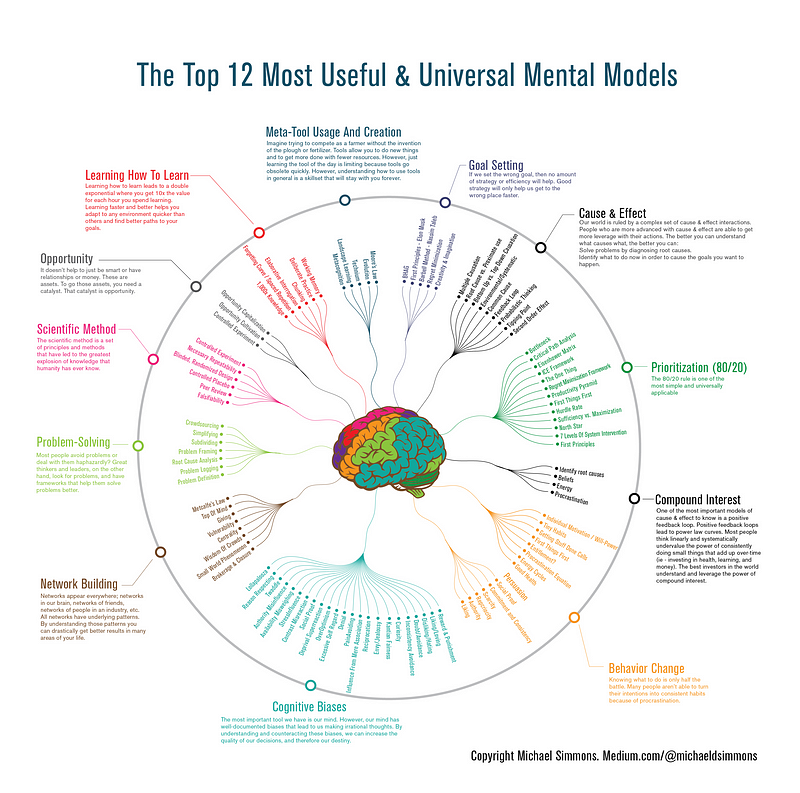
How do we cope with ever-increasing complexity? How do we get the big picture? How do we develop transdisciplinary perspectives? Best-selling author and entrepreneur Michael Simmons recommends that we develop skills and proficiency in using universal mental models that transcend disciplines. Michael Simmons is a renaissance person who has tracked more than 650 mental models used by world-leading investors, entrepreneurs, consultants, and creatives. He created this fascinating infographic that presents the 12 most useful and universal mental models. You can analyze the infographic and think about how you can develop these mental models in your life.
3. Develop a personal system of creativity and wellbeing.
Astonish and amaze yourself every day. Schedule some time for creative activities and use your wildest imagination. Develop your own system of creativity and asset creation.
The most valuable asset that you have in this life is your boundless imagination. Imagination is a real game-changer in your life. If you want to level up your game, you need to imagine and create wildly. In order to create the habit of imagination, you can carry out a series of creative challenges and imagination experiments.
If you want to live a happy, productive, and fulfilled life, you need to provide yourself more opportunities for:
- Imagination and creativity
- Curiosity, play, fun, and entertainment
- Problem solving and idea creation
- Reflection, note-taking, diary-keeping, and
- Asset Creation activities
In other words, you need to scare yourself and challenge yourself each day. Every day is an adventure. You can perhaps start a small creative project that you have always wanted to do, but you were terrified. You can start composing music, drawing, singing, dancing, or creating your own fashion line. What does your heart desire? Go for it. Your portfolio of creative work will be one of the greatest assets you have in your life. Therefore, it should always be your top priority.
A fresh way to think about this is imagining that you have a secret gift: Imagine that you are given the 8th day every week. However, this cannot be just another day. You have to do something unusual or remarkable on this day. Please design this day as your ideal day. How would you make these 8th days memorable, creative, and full of adventure? You can write or draw or doodle on this as you wish.
This will also be a day where you have an artist’s date with yourself (See Julia Cameron’s “The Artist’s Way” to learn more about this method). Fill your day with lots of inspiration. Get inspiration from lots of sources. What could be some of these sources? Brainstorm below. You can consider places, people, films, books, museums, travel, hobbies, theatre, cafes, rivers, or woods.
Remember that your creativity is shy and gentle. You need to provide your inner child and creativity ample opportunities and space to thrive. You need to be gentle, generous, and patient with it. Like plants, your creativity needs time to grow up. How dare you expect it to emerge, develop, and grow suddenly? You can trick yourself into imagination. In order to do it, you need to refrain from listening to your inner voice that is constantly criticizing everything you are in the process of creating. The best art is created when you are feeling that it is sort of scary and ridiculous, but you want to try it anyway. You are essentially creating an ideal job or project that does not exist but works perfectly for your creative soul.
In order to develop creativity as an everyday habit, you need to start improvising. You can use improvisation to increase adventure and quality in your life. To start improvising, you can use automated writing, doodling, drawing, ideating, imagining, and creating techniques. For example, practice automatic drawing and doodling by closing your eyes, holding your pencil, and moving it randomly on the paper. Just let your hand do the job. Do not worry about the end product. Attend to the creative process and just trust this process.
Design your life by surprise. Leave more room for flexibility, serendipity, exploration, and adventure. It is not easy to scare yourself and set yourself new challenges and adventures. In order to do this, you must get out of your comfort zone. You must set sail to new horizons and explore your own blue oceans. Embrace the chaos and the unknown — they are your friend. Losing yourself is one of the best ways to get more creative.
After completion of your creative project, you should share it with the world, so that everyone will see your work and enjoy it. Consider this creative video CV, for example.
It is such a showcase of creative talent, humor, and personal branding that you instantly start admiring and loving the creator. As creators, we should aspire to create and build a lot of stuff that will guide, amaze, delight, and astonish people.
Another showcase of creative talent that fascinates me each time is Meryl Streep. I think she is the best actress alive in our times; evident in her track record of 21 Oscar and 32 Golden Globe nominations. She is so versatile and talented that she can start acting right away with any given prompt:
Creating new artwork and sharing your talents with the world is not easy of course. You might feel anxious and stressed out about potential criticisms or mistakes. Still, it is a good idea to share your creations with the world. It is very satisfying to share your passions and artwork, to put them out there for enjoyment and benefit of others. Your creations will add tremendous value to your life and career.
Keep creating artwork you are proud of and keep compounding yourself and your creative assets. You will be surprised how much you will achieve in just a decade. Tap into the power of exponential returns over the long term. Although your mind is wired to think linearly about the future, you need to learn to think exponentially about the value of your creations. Exponential changes are hard to grasp, and our biological minds are not well equipped to deal with such changes. That is why we have a hard time understanding how compounding works over time. It is also the same reason how our minds cannot grasp the wealth of Jeff Bezos explained through the metaphor of rice:
This is called the power of compounding and it illustrates the power of exponential change. For example, a penny doubling every day for 31 days will become $10,737,418.24. Similar principles apply when you start incorporating positive habits in your life. James Clear explains this beautifully through the power of maths:
“Here’s how the math works out: if you can get 1 percent better each day for one year, you’ll end up thirty-seven times better by the time you’re done. Conversely, if you get 1 percent worse each day for one year, you’ll decline nearly down to zero. What starts as a small win or a minor setback accumulates into something much more.
Habits are the compound interest of self-improvement. The same way that money multiplies through compound interest, the effects of your habits multiply as you repeat them. They seem to make little difference on any given day and yet the impact they deliver over the months and years can be enormous. It is only when looking back two, five, or perhaps ten years later that the value of good habits and the cost of bad ones becomes strikingly apparent.”
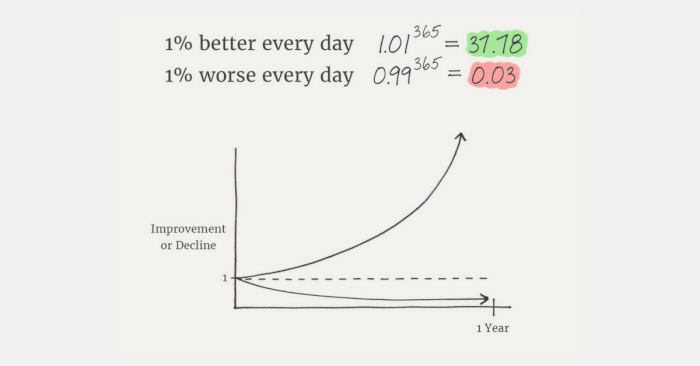
What is obvious here is that you can kickstart your own creative journey through very small actions that you can easily implement in your life. These positive habits, however small they are, will compound over time. The processes of life and nature are not linear — they are non-linear. Creativity is also non-linear, so you need to be wild in your radical learning, experimentation, and creativity.
See yourself as a work of art — always in progress. Reinvent yourself so that you can tap into endless opportunities in learning, growth, experimentation, and creativity. Set small and realistic goals you can achieve every day — just 15 minutes of creative work is fine. Practice every day, and do not break the chain — no matter what.
David Baldacci is one of the most inspiring people in scheduling creative time in his calendar. He is a full-time lawyer, but he writes his mystery novels every night between 22.00 and 02.00. He does not skip a night and keeps writing every night. He has been able to write and publish 40 novels using this crazy method!
Creativity involves shifting your mindset from scarcity to abundance. You need to shift away from a mindset of fear and limitations and embrace a life rich with new and fresh possibilities.
Beliefs are very powerful as they turn into reality. Each moment, you are creating your own assumptions and reality. Make sure it is a positive one. Create a positive story for yourself based on hope, courage, abundance, and self-confidence.
Move away from excuses, negativity, and negative friends. Move towards creative and optimistic people who challenge you and help you to be better.
Move towards people whom you admire and respect. Surround yourself with great people —remember you are influenced by the five people you spend the most time with.
Develop small positive habits and do them consistently every day. If you want to write a book, write one page every day. You will have your book ready in less than one year. I have done this myself. I doodled every day for one year, and this journey enabled me to create an inspiration book based on doodle exercises to increase self-awareness and creativity. If I had started with an ambitious goal of writing a book, I would have never achieved finishing this book. However, I tricked myself into creating consistently and moving with very small steps.
The secret is in one line. One sentence at a time. One doodle at a time. One drawing at a time. One small step at a time.
You can be more creative if you focus on the present moment you are living in. Creativity is about presence -take a deep breath and take it one slice at a time.
Do not think about the past or the future — think about what you need to do right now and in the next few minutes. Even if you are facing an enormous challenge or you are working on a very difficult project, you can break it down into small pieces. Focus on what you can do right now and start by tackling the smallest task in front of you. After you start, focus on the critical few tasks that really matter.
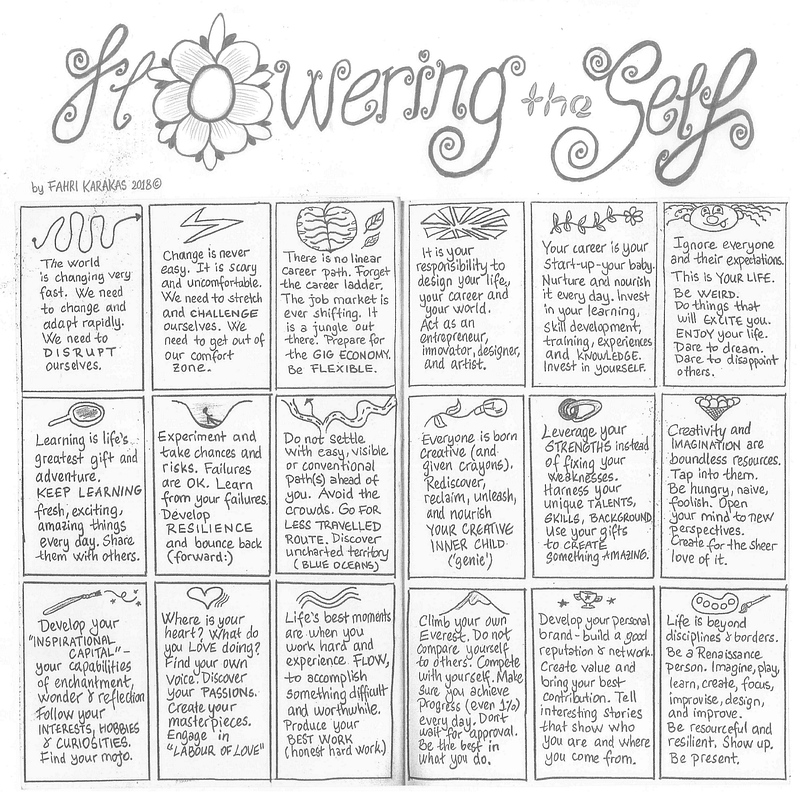
If you focus on the long term and apply moonshot thinking to create new ideas, you will be wildly creative and successful in the long term. The book titled “Bold: How to Go Big, Create Wealth and Impact the World” by Peter Diamandis focuses on mindsets you can use to unleash your creativity and create breakthrough innovation. When you are setting your long term goals, always leave an open room for X objectives(unknown goals). X objectives are goals that you cannot see right now. They will emerge as you navigate uncharted territories.
How can you compound your skills and assets for the long term? Go where no one goes. Invent your market. Create your own field. Pursue growth in a new market rather than an established one. Avoid the crowds and the competition. You should be the only one who does what you do.
You can establish and own your own game. It is all based on your imagination. There are fascinating things that only you can bring to the world. Fresh, exciting, and original things. What are they? How can you take a small action now towards making these happen? How can you continue taking small steps every day? How can you continue your adventure every day without quitting and without breaking the chain (of creating)? What will you bring to the world out there?
Take-aways
After reading this article, your task now is to identify the actions, challenges, and experiments you can apply in your life.
Michelangelo painted the Sistine Chapel ceiling in four years (be my guest for a minute and have a virtual tour below):
How will you build your own masterpiece(s) in the four years ahead of you? What is your big vision and contribution? What will you be creating?
How will you go forward? How will you create your own personal renaissance in the next four years?
How can you be a marathon runner and invest in yourself every day for the next four years? How do you make sure that you become wildly successful, rich, creative, and productive?
How can you ensure that you maintain a long term perspective and compound yourself, your knowledge, your skills, your perspectives, your creativity, and your assets in the next four years? How do you establish and play your own game where you create breakthrough value?
Where do you really start? Here is an initial roadmap for you so that you can access these resources and formulate your own strategies for going forward:
- Become a polymath (renaissance person) who learns and innovates beyond borders.
- Learn to think differently by learning across disciplines, applying mental models, and focusing on the long term.
- Develop new capabilities for dealing with FONKU — the fear of not keeping up.
- Focus on using your own imagination every day.
- Take care of your brain and improve your learning habits.
- Forget the career ladder and start creating your own assets.
- Make a commitment to create your own creative assets and invest in your own creativity.
- Develop your inspirational capital by being curious and passionate.
- Develop positive habits, systems, and assets to take control of your own future.
- Develop your antifragility and preparedness for black swans.
Conclusion and Recap
In this article, I have introduced three super-habits of renaissance people:
- They conduct hundreds of small experiments. They are entrepreneurial and biased towards action. They act and experiment fearlessly and they give themselves hundreds of opportunities for failure and experimentation. Even if they fail thousands of times, they rebound, keep learning, keep experimenting, and continue their marathon.
- They read and learn wildly beyond their own disciplines. They are extremely curious and they have a very wide range of interests. They are polymaths who continuously build unlikely combinations of skills and knowledge across diverse fields. They develop multidisciplinary mental models and compound their learning and knowledge for the long term. This gives them enormous leverage over the long term and makes them indispensable; since they can be wildly creative through connecting seemingly unrelated fields.
- They develop a personal system of creativity and wellbeing that works really well for them. They are deeply self-aware of their unique strengths and tap into them to make their best contribution. They schedule ample time for creative activities to develop their own system of asset creation. Since they know that imagination is their most valuable asset and a real game-changer in their lives, they unleash their own creative talents and use their imagination to bring new, fresh, and exciting things to the world. This means they imagine and create wildly to build a huge portfolio of creative work. They go to unique places no one has ever dreamed of before, so they do not have any competition in these blue oceans.
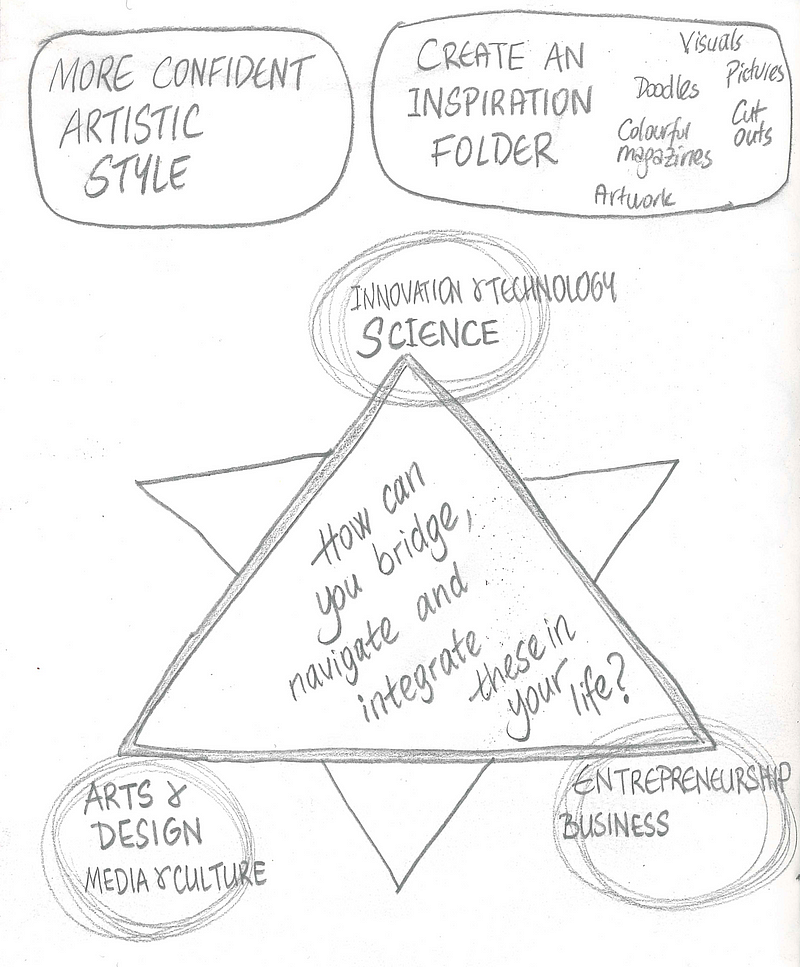
The Golden Triangle of Becoming a Renaissance Person
These three super-habits underline the three pillars of a great life. A great life is:
- Entrepreneurial, resourceful, and resilient; where you rely on massive action experimenting with new things, creating, building, disrupting and reinventing the self, failing, and trying again.
- Intellectually satisfying and exciting; where you are continuously asking questions, learning, reading, thinking, and developing knowledge across multiple disciplines and fields.
- Creatively and emotionally fulfilling; where you explore your unique strengths, find your own voice, use unlimited imagination, unleash your creative talents, build creative assets, and share them with the world.
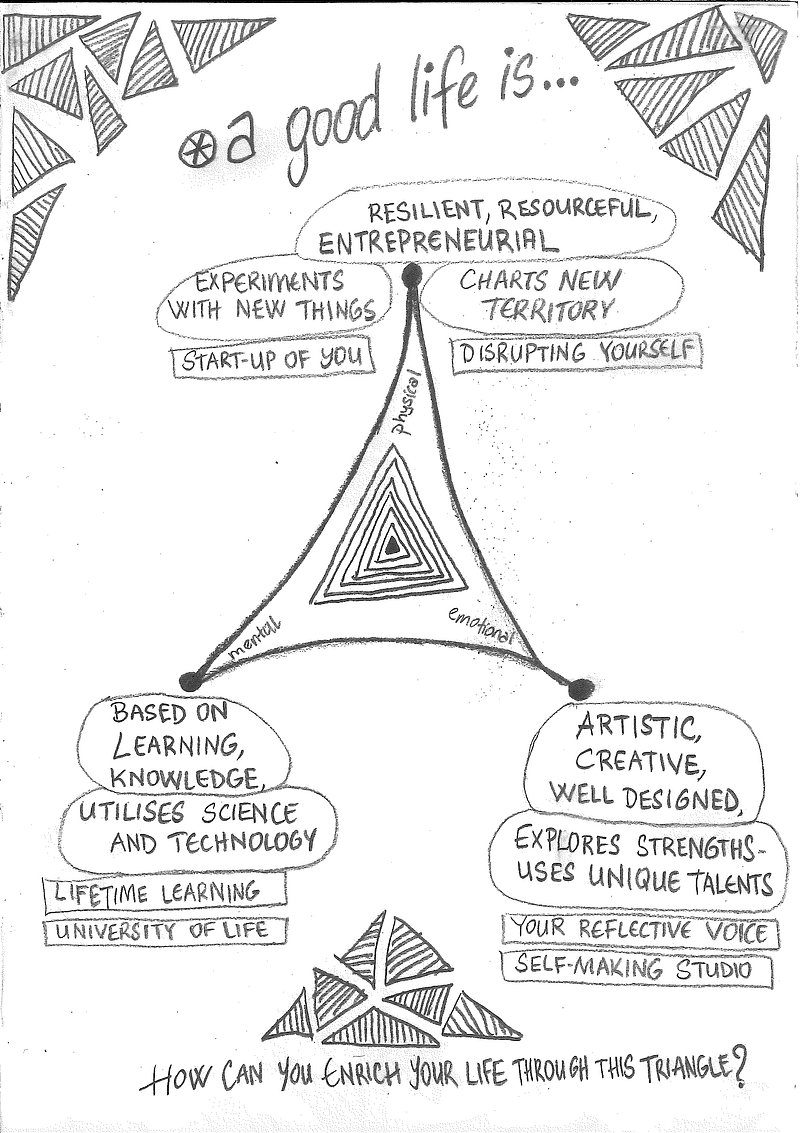
Final Exercise: Bridging Arts, Sciences, and Entrepreneurship in Your Life
Before we finish, please identify and write down some practical action points to enrich your life through bridging and nurturing these three fields:
- DOING (taking massive action, kickstarting your enterprise, implementing, experimenting, failing, pivoting, taking entrepreneurial actions, establishing your business systems, improving…)
- THINKING (learning and reading beyond borders and disciplines, deepening your understanding and perspectives, developing multidisciplinary mental models…)
- FEELING (discovering yourself, unleashing your creative talents, tapping into your emotions, finding your own voice, expressing your feelings, sharing your stories/art/emotions with the world…)
- Write down your ideas on fostering your entrepreneurial life where you try out wild experimentation:
2. Write down your ideas on crafting a life of boundless learning and knowledge across multiple disciplines:
3. Write down your ideas on designing your creative and artistic life, unleashing your creative talents, and using your imagination:
4. Combine your ideas here:
5. Dump your brain — write down your stream of consciousness (write down whatever comes to you — in no particular order):


