Panarchy Model can help you track and explain the changes you go through
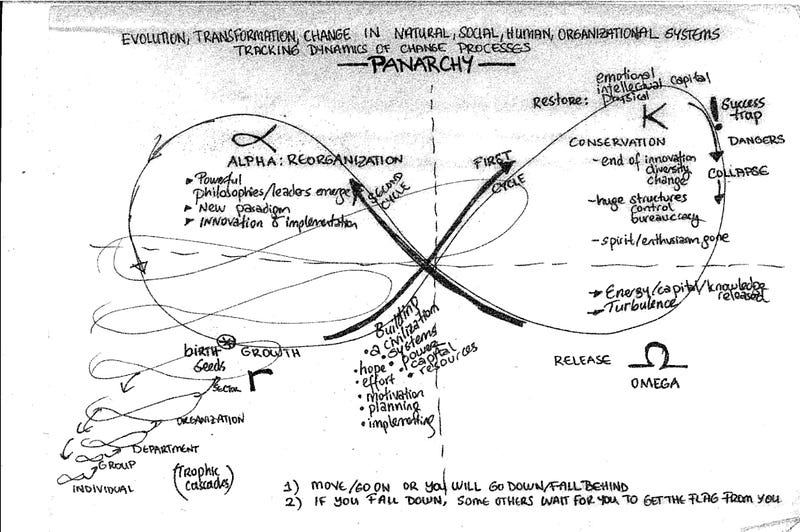
Panarchy model is an interdisciplinary social science model used to capture dynamics of complex adaptive systems.
Panarchy model is used to explain dynamics of transformation and change in human systems, organisational systems, and natural systems.
Panarchy model was proposed by Gunderson and Holling (2003) in their book titled “Panarchy: Understanding Transformations in Systems of Humans and Nature”.
Panarchy is part of systems theories which focus on developing an interdisciplinary field of science that studies the nature, dynamics, and processes of complex systems of the physical and social sciences.
Panarchy describes evolving hierarchical systems with multiple interrelated elements.
Panarchy is used to explain dynamics of changes in human systems, organizations, as well as natural systems.
In panarchy, the phases of natural systems (e.g., forests) or human systems (e.g., companies) are explained through continual adaptive cycles of growth, accumulation, restructuring, and renewal.
Panarchy is a cross-scale, interdisciplinary, and dynamic theory.
Its power is shedding light into the paradoxical interplay between change and persistence, status quo and renewal, and the predictable and the unpredictable.
Four Stages of the Panarchy Model
There are 4 phases in the Panarchy model:
R phase is the growth phase, which is characterised by accumulation of various resources and capital.
If we apply it to organisations, for example, R phase represents the startup and growth stages (early stages) in a company. The organisation is growing fast as it accumulates capital, human resources, machines, natural resources, knowledge resources, technology etc.
K phase comes next. It is the conservation phase, where growth slows down and resources are stored for system maintenance. This phase is characterised by high stability, low flexibility, and low resilience.
Let’s apply K phase to organisations: Think of very large, dominant, and bureaucratic organisations which focus on control and maintenance of status quo. The organisation loses its innovative edge and flexibility when it reaches this phase. The systems become too interconnected and too fragile. As such, they are susceptible to collapse, crisis, or breakdown.
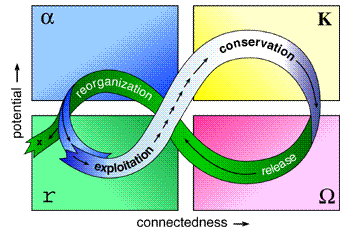
Omega phase comes next. This is the creative destruction or release phase. The system experiences a chaotic collapse and breakdown in this phase. There is often a release of accumulated capital. This is a time of great uncertainty, crisis, chaos, and failure.
Let’s apply Omega phase to organisations: Think of the phase an organisation experiences stark failures and existential risk. Nothing seems to work and most people are too scared to act constructively. There are hundreds of voices and the organisation still tries to repress these voices, without any luck or hope. The organisation loses its power and control. There is great entropy and disorganisation; and change of power structures will follow.
Alpha is the next phase. It is called the reorganisation phase. This is a time of innovation and restructuring in a system. The system experiences deep transformation. This is also a time of great uncertainty and crisis; however this is accompanied by systemic change and re-building efforts. This is also a time of innovation, renewal, and transformation.
Let’s apply Alpha phase to organisations: Think of the phase an organisation completely questions itself and its methods. It is dedicated to re-inventing itself. Perhaps leadership changes. New power dynamics, re-structuring, and changing organisational norms come along with it.
Applying Panarchy model to understand your organisation will provide you new insights into the dynamics of change in your organisation.
You can use these insights to manage and lead change in your organisation.
In each phase, leaders need to take a set of actions to successfully navigate their organisation in the midst of waves of change.
For example, if your organisation at the K phase, you can incorporate pockets of innovation in your organisation. You need to shuffle the organisation and create your own chaos and creativity initiatives in order to prevent worse collapse later. You also need to question assumptions of supremacy (‘we are the best, forget the rest’ mentality), disrupt the status quo, and challenge those who have extreme power. All of these initiatives require radical innovative thinking and action.
Applying Panarchy at the Individual Level
Although Panarchy model is mostly used to understand dynamics in larger natural or human systems, you can also use it to track and understand your own dynamics, behaviours, as well as mental and emotional swings.
I have adapted the model to explain the emotional dynamics in an individual’s life (please see the individual panarchy model and its implications below).
As individuals, we go through positive and negative emotional/mental cycles and changes all the time.
Panarchy model can give us insights to better understand, interpret, and navigate these shifts and cycles.
One of the implications of the model is that humans are incredibly complex adaptive systems.
We are very dynamic, and at some times, rather chaotic systems.
We still grasp very little of how our mind operates and how we experience different moods and emotions.
We understand our subconscious even less. There are millions of subtle cues, operations, calculations, hunches we go through every day.
We are unable to track, let alone understand, these dynamics.
When I applied Panarchy model to understand the phases I go through as an individual, I have gained valuable insights.
I hope you can also apply the model to your life and develop your own insights.
Individual Panarchy Model: Exercise
Please study the poster below.
Think about the key words in each phase.
Think about your own experiences as an individual.
How do you experience these different phases as an individual?
Here is your puzzle:
Apply Panarchy model to your life.
Reflect on your own experiences by tracking positive and negative phases/emotions in your life.
Is this model helpful in explaining some of the dynamics?
How do you cope with these different phases in your life?
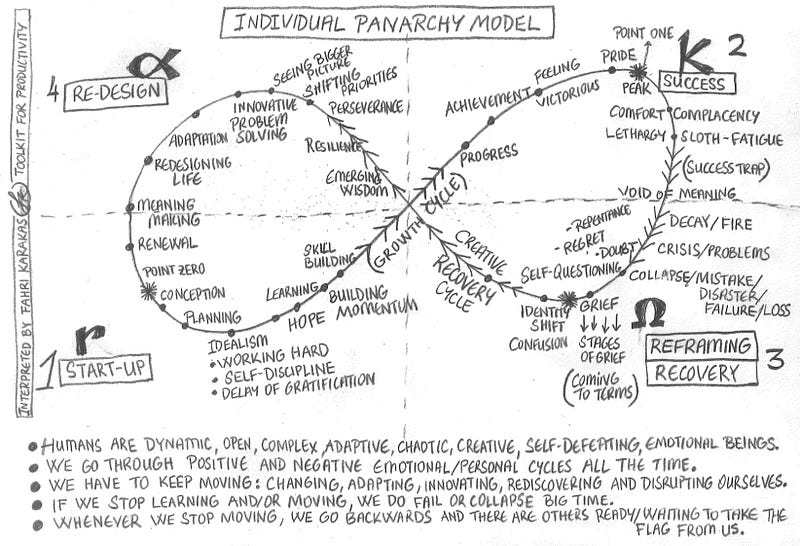
If you could not really apply these four phases and you are having some difficulties in imagining or applying these stages in your life, I would like to provide you some guidance and examples next:
How do you experience R phase? (Think about the processes of growth you experience including building your own mental, physical, or emotional capital, developing your learning, building new skills etc.)
How do you experience K stage? (Imagine that you are successful and you have achieved something significant. However, you might fall into new traps such as complacency, void, fatigue, or vanity. What could be your traps?)
How do you experience Omega stage? (Imagine you have made some grave mistakes or you have experienced some significant failures. You face cold reality. You face confusion and ambiguity. You are tested, you are tired and you might want to give up. You feel that you have lost. How do you cope with such individual collapses or disappointments? How do you develop more resilience?)
How do you experience Alpha stage? (Imagine you have already gone through failures or disappointments. You have learned and recovered from those experiences. How do you now go forward with your newfound wisdom and resilience? How do you renew yourself and start again? What are you doing differently this time?)
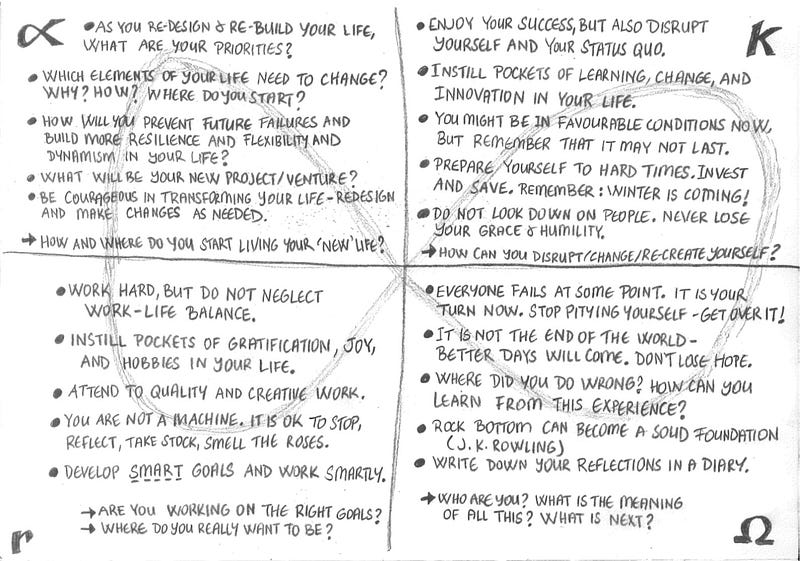
Now, I would like to invite you to the next doodle poster below.
This poster poses you a set of reflective questions about each stage.
If you feel that you are experiencing one of the stages below, please read the questions, suggestions, and advice in your quadrant.
Read them and think about how you might apply these suggestions in your life.
Ask yourself the questions posed to you.
Reflect on what you might do better.
Write down your reflections and action points.
One implication of the Panarchy model is that we cannot stop moving.
We need to be very alert, dynamic, agile, and adaptive as we move through these phases all the time.
We need to keep moving, learning, changing, innovating, adapting, disrupting, and reinventing ourselves.
We cannot stop.
If we stop learning or if we stop moving, we will lose big time.
If we lose our hope, we lose big time.
If we adopt a negative mindset, we will lose.
We need to constantly grow, learn, improve, strive, and be better.
Then, we will experience a positive cycle and spiral.
What do you think about this model?
Did it provide you a new way of thinking?
Please feel free to add your own comments, experiences, or suggestions below.
Thank you.
Sincerely;
Fahri
Fahri
Fahri Karakas is the author of Self-making Studio. You can explore more here.


