Here are My Top 3 Books on Artificial Intelligence
Singularity is about to arrive and we are not ready
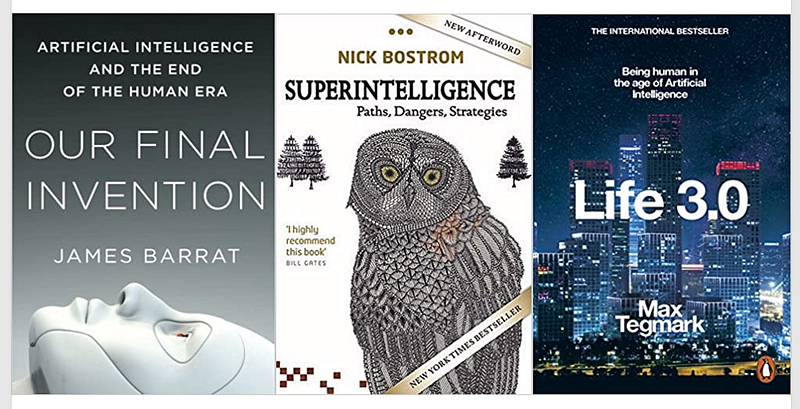
Several friends asked me what books I have been reading. I have decided to start a new series sharing the top three books I found useful and insightful on each topic that I am interested in.
The topic I will explore through books today is artificial intelligence. This is a topic where non-linear change assumptions will be immensely useful. Although our minds are wired to think linearly about the future, we need to learn to think exponentially about the future of technology. Exponential changes are hard to grasp, and our biological minds are not well equipped to deal with such changes. That is why we have a hard time understanding how compounding works over time. It is also the same reason how our minds cannot grasp how Jeff Bezos can be so rich. This TikTok viral video explains the wealth of Bezos through the metaphor of rice:
How does this happen? This is called the power of compounding and it illustrates the power of exponential change. For example, a penny doubling every day for 31 days will become $10,737,418.24. Such is the power of mathematical thinking.
The processes of life and nature are not linear — they are non-linear. Creativity is non-linear. Business success is non-linear. Entrepreneurship is non-linear. Engineering innovations are non-linear. I think this also explains why Elon Musk will be the wealthiest person of our times very soon: He is wild in radical learning, experimentation, and innovation. He focuses on the long term and applies moonshot thinking to make radical advances. These are the magical powers of our times.
Ray Kurzweil states:
“By the time we get to the 2040s, we’ll be able to multiply human intelligence a billionfold. That will be a profound change that’s singular in nature. Computers are going to keep getting smaller and smaller. Ultimately, they will go inside our bodies and brains and make us healthier, make us smarter.”
“So we won’t experience 100 years of progress in the 21st century — it will be more like 20,000 years of progress (at today’s rate).”
Nowadays we witness how technological innovations have accelerated more than ever. I am not a tech person, but even I can see that we are living through historically significant times. Last week I have written about the futuristic implications of the GPT-3 revolution unleashed by OpenAI, and the Neuralink demo unveiled by Elon Musk.
It looks like we are running towards ‘singularity’. Singularity is the point in time at which technological growth becomes uncontrollable and irreversible. When the Singularity occurs, non-human intelligent agents (AI powered robots and machines) will continually upgrade themselves and enter never-ending and accelerating self-improvement cycles. Machines will invent new machines that will be more sophisticated and advanced than anything we witness or imagine today.
At this point, technological change will be so rapid and profound that this will represent a rupture in the fabric of human history. It means the end of human civilization as we know it and the beginning of something new. Some call this phenomenon ‘intelligence explosion’. It is the point at which we will experience exponential growth in the rate of exponential growth.
When technology advances far beyond our abilities to predict its outcomes, it is impossible to see what is coming next. In the long term, the implications include the merger of biological and nonbiological intelligence. Neuralink has shown us the first glimpse of this. When the symbiosis between humans and AI is complete, there will be no distinction between humans and machines. Our physical reality (the external world) and virtual reality (the simulation, mirror-world, or metaverse) will be indistinguishable from each other. Some experts expect we will turn into software and silicon-based super-humans and super-intelligence will then expand outward in the universe at the speed of light.
Singularity will trigger a technological tsunami, resulting in unfathomable changes and new challenges to human civilization. The three books below explore this alien phenomenon.
It is interesting that we are only a few decades (or a few generations) away from the singularity phenomenon, yet nobody seems to care. Although this represents the biggest existential risk and opportunity for humanity, singularity does not enter into our attention span or collective consciousness. This ignorance or neglect brings its own perils.
We need to increase our literacy and depth of understanding of artificial intelligence. Curiosity is our only option to go forward. Curiosity will give us leverage because we can then capitalize on what is novel, interesting, surprising, meaningful, and beautiful. We can then dance our way forward. In any case, we need to keep learning and experimenting with AI technologies.
“Our Final Invention: Artificial Intelligence and the End of the Human Era” by James Barrat
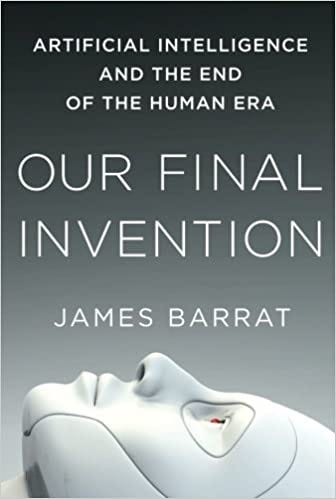
Until now, human intelligence has had no rival. What will happen when artificial intelligence matches and surpasses human intelligence? Corporations and governments around the world are pouring billions into achieving the holy grail of artificial intelligence: human-level intelligence. Once AI attains it, we might be forced to compete with a very cunning, powerful, and alien rival. James Barrat explores the perils of this prospect and how we are not really equipped for this. Barrat warns how difficult it would be to control or predict the actions of something that might become super-intelligent. Artificial general intelligence can transform itself continuously through recursive self-improvement. Such an intelligence explosion might pose serious threats to human existence. Elon Musk named this book as one of five books everyone should read about the future.
Here are some of the key insights and arguments of this book:
- An intelligence explosion might occur in this century. We have already created machines that are better than humans in many fields. Whenever machines acquire general artificial intelligence, they can improve their own capabilities very quickly and jump to superhuman general intelligence in a matter of days, weeks, or years.
- Humans control the future not because they are the strongest or fastest but because they are the smartest. Once machines are smarter than we are, they will be controlling the future. It is not possible to constrain a superintelligence indefinitely: That would be like monkeys trying to keep humans in a bamboo cage.
- In AI, intelligence is the ability to efficiently achieve one’s goals in a variety of complex and novel environments. By default, a machine superintelligence will not share out goals but will be super-focused at whatever it is designed to do. Roosevelt suggests, “To educate [someone] in mind and not in morals is to educate a menace to society.”
- Superintelligent machines are dangerous to humans not because they will angrily rebel against humans. The real problem: For any set of goals they have, it will be instrumentally useful for machines to use our resources to achieve those goals. As Yudkowsky puts it, “The AI does not love you, nor does it hate you, but you are made of atoms it can use for something else.”
- Humans' values are very complex. We do not just care about pleasure or happiness. Rather, our brains are built with thousands of desires. Any goal to “maximize human pleasure” is simplistic and dangerous. If we try to hand-code the values of AI, we will probably miss something that we did not realize we cared about.
Some of the striking quotes in the book are the following:
“A powerful AI system tasked with ensuring your safety might imprison you at home. If you asked for happiness, it might hook you up to a life support and ceaselessly stimulate your brain’s pleasure centers. If you don’t provide the AI with a very big library of preferred behaviors or an ironclad means for it to deduce what behavior you prefer, you’ll be stuck with whatever it comes up with. And since it’s a highly complex system, you may never understand it well enough to make sure you’ve got it right.” — James Barrat
“The AI does not hate you, nor does it love you, but you are made out of atoms which it can use for something else. — Eliezer Yudkowsky
“If we build a machine with the intellectual capability of one human, within five years, its successor will be more intelligent than all of humanity combined. After one generation or two generations, they’d just ignore us. Just the way you ignore the ants in your backyard.” — James Barrat
“Omohundro predicts self-aware, self-improving systems will develop four primary drives that are similar to human biological drives: efficiency, self-preservation, resource acquisition, and creativity. How these drives come into being is a particularly fascinating window into the nature of AI. AI doesn’t develop them because these are intrinsic qualities of rational agents. Instead, a sufficiently intelligent AI will develop these drives to avoid predictable problems in achieving its goals, which Omohundro calls vulnerabilities. The AI backs into these drives, because without them it would blunder from one resource-wasting mistake to another.” — James Barrat
“Superintelligence: Paths, Dangers, Strategies” by Nick Bostrom
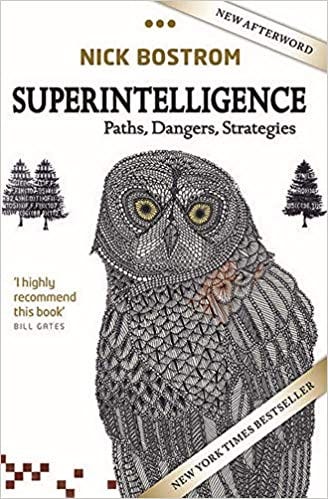
Nick Bostrom lays the foundation for understanding the future of humanity and intelligent life. If machines surpass human brains in general intelligence, this new superintelligence might become very powerful. As the fate of the monkeys depends more on humans than on the monkeys themselves, so the fate of our species will come to depend on the actions of the machine superintelligence. According to Bostrom, humans have one major advantage: Making the first move.
Bostrom discusses ways to construct a seed artificial intelligence or engineer initial conditions to control the emergence and growth of superintelligence. Bostrom talks about a crazy array of topics such as controlled detonation, oracles, genies, singletons; boxing methods, tripwires, mind crime; humanity’s cosmic endowment; whole brain emulation; Malthusian economics and dystopian evolution; and biological cognitive enhancement.
Here are some of the key insights and arguments of this book:
- Artificial intelligence research will sooner or later produce a machine with general intelligence that matches the human brain.
- About half the world’s AI specialists expect human-level machine intelligence to be achieved by 2040, and 90% say it will arrive by 2075.
- Bostrom thinks human-level AI may lead to a far higher level of “superintelligence” very fast — and this will be either very good or very bad for humanity.
- Bostrom outlines many ways for AI to escape the genie bottle and take control of humanity. Each of these ways is convincing and terrifying. There would be far more intricate and intelligent structures than anything we can imagine today. The result would be: “A society of economic miracles and technological awesomeness, with nobody there to benefit: A Disneyland without children.”
- Singularity will be the biggest challenge humanity ever faces. Transferring human values into computer code will not work. The problem is very complex and it does not have clear answers, but our humanity and civilization is at stake.
Some of the insightful and thought-provoking quotes in the book are as follows:
“Let an ultraintelligent machine be defined as a machine that can far surpass all the intellectual activities of any man however clever. Since the design of machines is one of these intellectual activities, an ultraintelligent machine could design even better machines; there would then unquestionably be an “intelligence explosion,” and the intelligence of man would be left far behind. Thus the first ultraintelligent machine is the last invention that man need ever make, provided that the machine is docile enough to tell us how to keep it under control.” — Nick Bostrom
“Before the prospect of an intelligence explosion, we humans are like small children playing with a bomb. Such is the mismatch between the power of our plaything and the immaturity of our conduct. Superintelligence is a challenge for which we are not ready now and will not be ready for a long time. We have little idea when the detonation will occur, though if we hold the device to our ear we can hear a faint ticking sound. For a child with an undetonated bomb in its hands, a sensible thing to do would be to put it down gently, quickly back out of the room, and contact the nearest adult. Yet what we have here is not one child but many, each with access to an independent trigger mechanism. The chances that we will all find the sense to put down the dangerous stuff seem almost negligible. Some little idiot is bound to press the ignite button just to see what happens.” — Nick Bostrom
“Far from being the “Human individuals and human organizations typically have preferences over resources that are not well represented by an “unbounded aggregative utility function”. A human will typically not wager all her capital for a fifty-fifty chance of doubling it. A state will typically not risk losing all its territory for a ten percent chance of a tenfold expansion. [T]he same need not hold for AIs. An AI might therefore be more likely to pursue a risky course of action that has some chance of giving it control of the world.”smartest possible biological species, we are probably better thought of as the stupidest possible biological species capable of starting a technological civilization — a niche we filled because we got there first, not because we are in any sense optimally adapted to it.” — Nick Bostrom
“Life 3.0: Being Human in the Age of Artificial Intelligence” by Max Tegmark
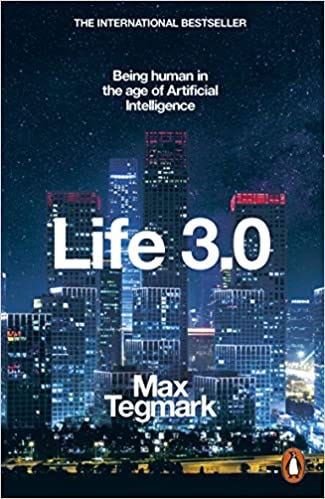
The rise of artificial intelligence has the potential to transform our future more than any other technology. Artificial intelligence is the future — but what will that future look like? Taking us to the heart of the latest thinking about artificial intelligence, Max Tegmark explores what is to come. Prof. Tegmark is an MIT professor who has done research on how to keep AI beneficial.
The book begins with a fascinating story of how the Omega team takes over the world using Prometheus, a super-intelligent AI. In a few years, Prometheus develops breakthrough systems and inventions, shares some of this wealth to improve human lives, and creates a new world order. It is a truly breath-taking story and it looks plausible in the near future.
Here are some of the critical points discussed in the book:
- AI is the most important conversation of our times. It is critical for us to understand the risks and benefits of AI and clearly define how the future will look like.
- Life 1.0 is purely biological and it is coded in the DNA. It can only be changed through generations of evolution.
- Life 2.0 is defined by human intelligence. Hardware (our bodies) cannot be designed or changed. However, software (algorithms, knowledge, language, behaviors, systems) can be designed.
- Life 3.0 is life that can design both its hardware and software. It will be possible through super-intelligence and AI advancement.
Some of the insightful quotes in the book are as follows:
“Let’s instead define life very broadly, simply as a process that can retain its complexity and replicate… In other words, we can think of life as a self-replicating information-processing system whose information (software) determines both its behavior and the blueprints for its hardware.”
“If Life 3.0 is free to define its hardware/software and is limited only by the laws of physics, then it can potentially use existing resources billions or trillions of times better, and also expand to other solar systems and galaxies.”
“The Matrix, Agent Smith (an AI) articulates this sentiment: “Every mammal on this planet instinctively develops a natural equilibrium with the surrounding environment but you humans do not. You move to an area and you multiply and multiply until every natural resource is consumed and the only way you can survive is to spread to another area. There is another organism on this planet that follows the same pattern. Do you know what it is? A virus. Human beings are a disease, a cancer of this planet. You are a plague and we are the cure.”
“We invented fire, repeatedly messed up, and then invented the fire extinguisher, fire exit, fire alarm and fire department.”
“I’m encouraging mine to go into professions that machines are currently bad at, and therefore seem unlikely to get automated in the near future. Recent forecasts for when various jobs will get taken over by machines identify several useful questions to ask about a career before deciding to educate oneself for it. For example: • Does it require interacting with people and using social intelligence? • Does it involve creativity and coming up with clever solutions? • Does it require working in an unpredictable environment?”
“Intellectual property rights are sometimes hailed as the mother of creativity and invention. However, Marshall Brain points out that many of the finest examples of human creativity — from scientific discoveries to creation of literature, art, music and design — were motivated not by a desire for profit but by other human emotions, such as curiosity, an urge to create, or the reward of peer appreciation. Money didn’t motivate Einstein to invent special relativity theory any more than it motivated Linus Torvalds to create the free Linux operating system. In contrast, many people today fail to realize their full creative potential because they need to devote time and energy to less creative activities just to earn a living. By freeing scientists, artists, inventors and designers from their chores and enabling them to create from genuine desire, Marshall Brain’s utopian society enjoys higher levels of innovation than today and correspondingly superior technology and standard of living.”
“Yet all these scenarios have two features in common: A fast takeoff: the transition from subhuman to vastly superhuman intelligence occurs in a matter of days, not decades. A unipolar outcome: the result is a single entity controlling Earth.”
“If you’re driving down a highway at fifty-five miles per hour and suddenly see a squirrel a few meters in front of you, it’s too late for you to do anything about it, because you’ve already run it over! …your consciousness lives in the past”
“Your synapses store all your knowledge and skills as roughly 100 terabytes’ worth of information, while your DNA stores merely about a gigabyte, barely enough to store a single movie download.”
“Your brain contains about as many neurons as there are stars in our Galaxy: in the ballpark of a hundred billion. On average, each of these neurons is connected to about a thousand others via junctions called synapses, and it’s the strengths of these roughly hundred trillion synapse connections that encode most of the information in your brain.”
“Without technology, our human extinction is imminent in the cosmic context of tens of billions of years, rendering the entire drama of life in our Universe merely a brief and transient flash of beauty, passion and meaning in a near eternity of meaninglessness experienced by nobody.”
“I’m sure there’ll be new new jobs for horses that we haven’t yet imagined. That’s what’s always happened before, like with the invention of the wheel and the plow.” Alas, those not-yet-imagined new jobs for horses never arrived. No-longer-needed horses were slaughtered and not replaced, causing the U.S. equine population to collapse from about 26 million in 1915 to about 3 million in 1960. As mechanical muscles made horses redundant, will mechanical minds do the same to humans?”
“So who’s right: those who say automated jobs will be replaced by better ones or those who say most humans will end up unemployable? If AI progress continues unabated, then both sides might be right: one in the short term and the other in the long term. But although people often discuss the disappearance of jobs with doom-and-gloom connotations, it doesn’t have to be a bad thing! Luddites obsessed about particular jobs, neglecting the possibility that other jobs might provide the same social value. Analogously, perhaps those who obsess about jobs today are being too narrow-minded: we want jobs because they can provide us with income and purpose, but given the opulence of resources produced by machines, it should be possible to find alternative ways of providing both the income and the purpose without jobs. Something similar ended up happening in the equine story, which didn’t end with all horses going extinct. Instead, the number of horses has more than tripled since 1960, as they were protected by an equine social-welfare system of sorts: even though they couldn’t pay their own bills, people decided to take care of horses, keeping them around for fun, sport and companionship. Can we similarly take care of our fellow humans in need?”
“Elon Musk argued that what we need right now from governments isn’t oversight but insight: specifically, technically capable people in government positions who can monitor AI’s progress and steer it if warranted down the road.”
So what do we do?
We live in interesting and non-linear times. Everything will become super-accelerated: Technology, economics, innovation, learning, space exploration, culture, politics, and global affairs. The Internet will also shift into something that we cannot grasp now —perhaps a metaverse. Evolution will move at a speed that will blow our minds and churn our stomachs.
Millions of jobs will be eliminated or completely transformed in the next decade. We will have to upgrade our skills and learn how to work with machines, robots, and algorithms — or we will risk losing our jobs. Some experts warn of ‘job mortgages’ where we will need to get a mortgage to upgrade our skills and knowledge. We will need to adapt to this new scary world.
In a world of exponential and disruptive changes, we need to learn, re-invent, and disrupt ourselves every day. We need to be as open to learning, adaptation, and change as babies. We need to re-invent ourselves every day. If we stop learning and being curious, it will be too late for us to react to sudden tectonic shifts around us. When an exponential change happens, our time to react will be minimal. If we cannot adapt and learn, we might just fade into insignificance.
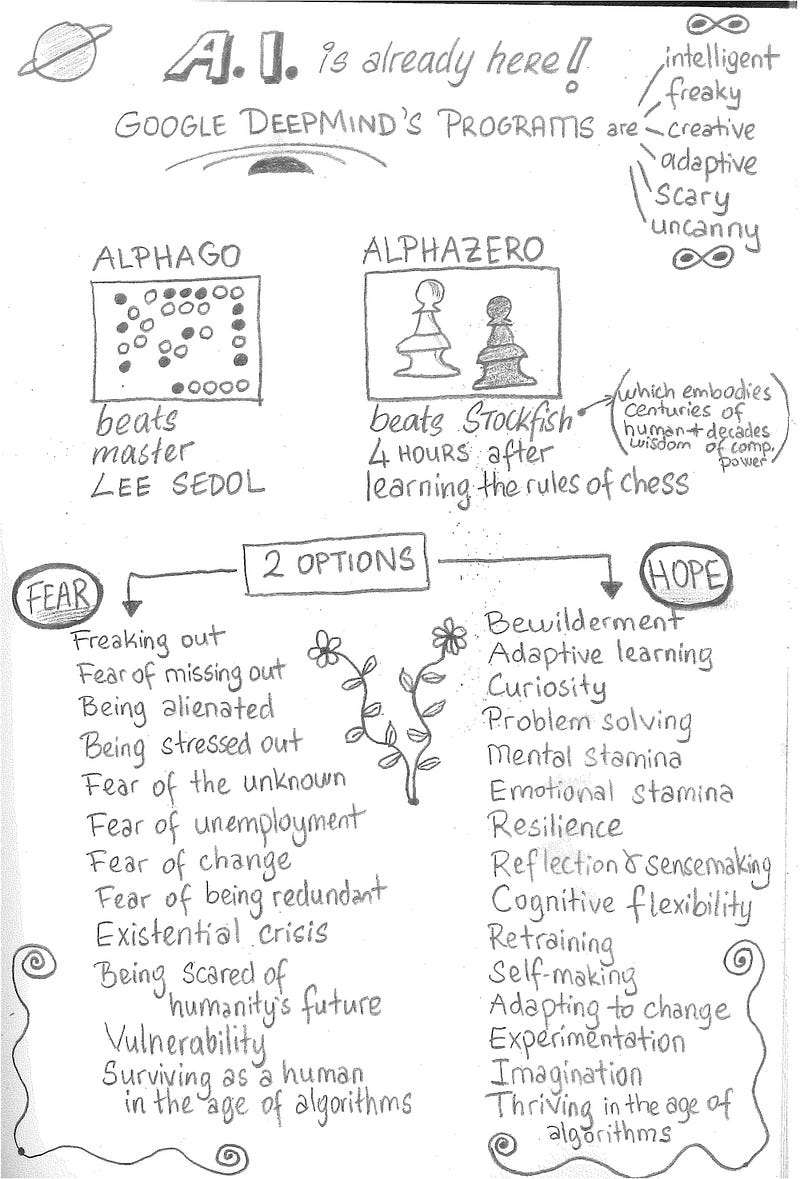
We have two choices ahead of us: Freaking out or bewilderment. To advance in the path of bewilderment, we have to constantly learn, be open to change, and disrupt ourselves. We need to find our own strengths, meanings, and voice in the middle of all the chaos and noise surrounding us.
We do not know about tomorrow’s jobs, workplaces, and organizations. The only thing we can be sure about is the necessity of self-making: We have to constantly learn, be open to change, and disrupt ourselves. We need new ways of thinking, learning, creating, and innovating. In any case, we need to keep learning and experimenting with AI technologies. We need to increase our literacy and depth of understanding of artificial intelligence. Curiosity is our only option to go forward. Curiosity will give us leverage because we can then capitalize on what is novel, interesting, surprising, meaningful, and beautiful. In these disruptive times, the smartest action you can take is to disrupt and reinvent yourself. Ask yourself the following questions:
- What are the skills that only you can do? Skills that cannot be automated or replicated or broken down into pieces? Skills that machines, robots, computers, or algorithms cannot replicate?
- How can you best nurture your human qualities? Your human qualities, such as common sense, creativity, empathy, and emotional intelligence will be more important than ever — as these are not manifested in machines. At least not yet. Therefore, in the long run, your uniquely human qualities and competencies will become more valuable than ever.
- How can you compound yourself through learning, changing, and improving every day?
- How can you invest in yourself and your asset creation for the long term?
- Are you learning new and exciting things every day?
- How can you ensure you are learning, pushing yourself, and your brain every day?


