What I wish I had known about Black Swans
Why you need to be Anti-fragile to be prepared for Black Swans
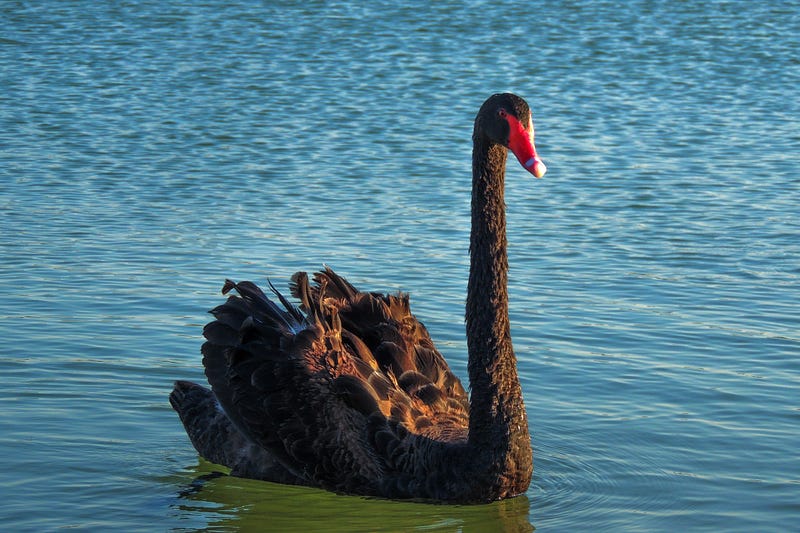
As we are living through one of the worst pandemics and economic crises of this century, I wish I had known about more about black swans and anti-fragility. Then I would have been more prepared, resilient, and robust.
If you want to understand the zeitgeist of our times, you need to understand black swans.
The best way to understand something is to write about it and to teach it. This article is my attempt to understand black swans better.
The black swan was once considered to be non-existent for centuries because there were no such things as black swans in Europe. They were spotted in 1697 by Dutch explorers in Australia for the first time. Until that time, people considered swans were white because they had never seen a black one.
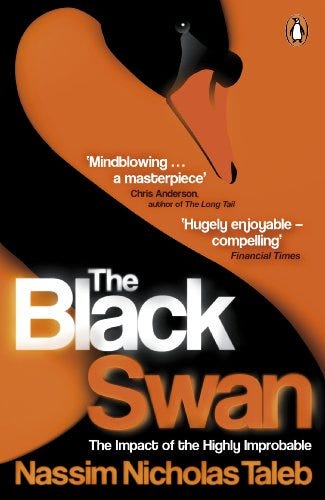
In the book titled “The Black Swan,” Nassim Nicolas Taleb analyzes the influence of highly improbable events on our lives. In this book, Taleb analyzes the disproportionate role of high-profile, hard-to-predict, and rare events that are beyond the realm of normal expectations in different fields such as history, science, finance, and technology. Black Swan book was written in 2007, just one year before the financial crash. It focuses on the extreme impact of rare and unpredictable outlier events on our lives.
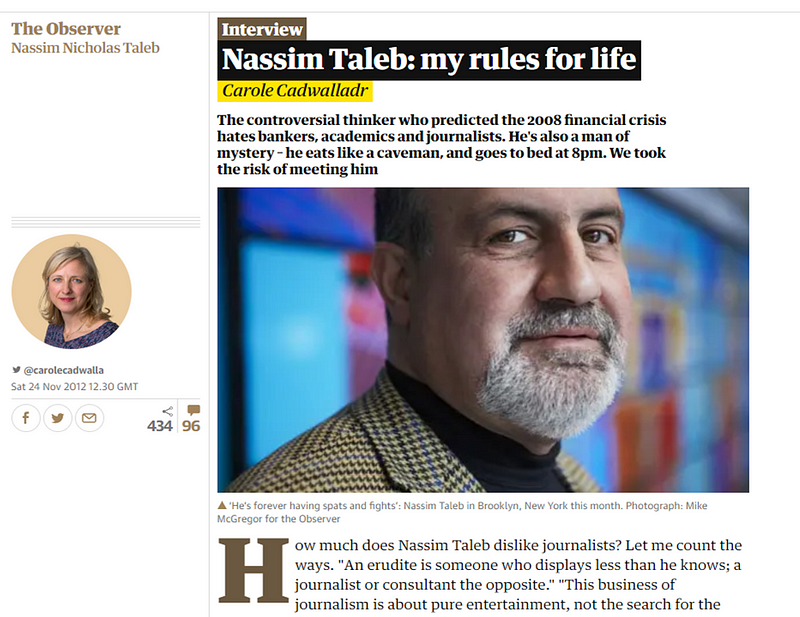
After his predictions turned out to be highly relevant and insightful, Nassim Taleb has become a celebrity known for his contrarian views. He hates bankers, academics, and journalists:)
Taleb says black swan events have had a dominant role throughout history. The black swan is a metaphor that describes an event that:
- comes as a surprise,
- has a major impact, and
- is inappropriately rationalized after it occurs with the benefit of hindsight.
We tend to ignore the possibility of black swan events until they occur. We rely too much on past events to deduce what will happen in the future. In that sense, we are like Christmas turkeys. The Christmas turkey is fed and treated well every day and expects the same thing will happen every day. Yet, on December 23rd, it will be killed for food. We need to be better prepared for unpredictable events in our lives.
We cannot foresee black swans, but we can learn to live with them.
What are the implications of black swans? How do we prepare for black swans?
Worldly wisdom quotes from Taleb and his ‘black swan’ thinking
Here are some insightful quotes from Taleb:
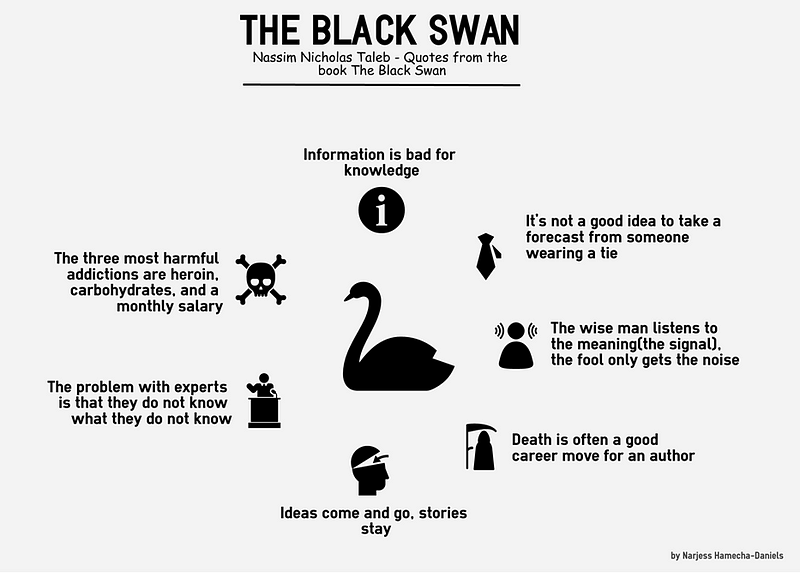
- “The three most harmful addictions are heroin, carbohydrates, and a monthly salary.”
- “Remember that you are a Black Swan…We are quick to forget that just being alive is an extraordinary piece of good luck, a remote event, a chance occurrence of monstrous proportions.”
- “If you survive until tomorrow, it could mean that either a) you are more likely to be immortal or b) that you are closer to death.”
- “You need a story to displace a story. Metaphors and stories are far more potent (alas) than ideas; they are also easier to remember and more fun to read. If I have to go after what I call the narrative disciplines, my best tool is a narrative. Ideas come and go, stories stay.”
- “Prediction, not narration, is the real test of our understanding of the world.”
- “The problem with experts is that they do not know what they do not know.”
- “If you hear a “prominent” economist using the word ‘equilibrium,’ or ‘normal distribution,’ do not argue with him; just ignore him, or try to put a rat down his shirt.”
- “The inability to predict outliers implies the inability to predict the course of history.”
- “It has been more profitable for us to bind together in the wrong direction than to be alone in the right one. Those who have followed the assertive idiot rather than the introspective wise person have passed us some of their genes. This is apparent from a social pathology: psychopaths rally followers.”
- “If you want to get an idea of a friend’s temperament, ethics, and personal elegance, you need to look at him under the tests of severe circumstances, not under the regular rosy glow of daily life.”
- “The strategy for the discoverers and entrepreneurs is to rely less on top-down planning and focus on maximum tinkering and recognizing opportunities when they present themselves. So I disagree with the followers of Marx and those of Adam Smith: the reason free markets work is because they allow people to be lucky, thanks to aggressive trial and error, not by giving rewards or “incentives” for skill. The strategy is, then, to tinker as much as possible and try to collect as many Black Swan opportunities as you can.”
- “The writer Umberto Eco belongs to that small class of scholars who are encyclopedic, insightful, and nondull. He is the owner of a large personal library (containing thirty thousand books), and separates visitors into two categories: those who react with “Wow! Signore, professore dottore Eco, what a library you have ! How many of these books have you read?” and the others — a very small minority — who get the point that a private library is not an ego-boosting appendage but a research tool. Read books are far less valuable than unread ones. The library should contain as much of what you don’t know as your financial means, mortgage rates and the currently tight real-estate market allows you to put there. You will accumulate more knowledge and more books as you grow older, and the growing number of unread books on the shelves will look at you menancingly. Indeed, the more you know, the larger the rows of unread books. Let us call this collection of unread books an antilibrary.”
- “I don’t run for trains. Snub your destiny. I have taught myself to resist running to keep on schedule. This may seem a very small piece of advice, but it registered. In refusing to run to catch trains, I have felt the true value of elegance and aesthetics in behavior, a sense of being in control of my time, my schedule, and my life. Missing a train is only painful if you run after it! Likewise, not matching the idea of success others expect from you is only painful if that’s what you are seeking. You stand above the rat race and the pecking order, not outside of it, if you do so by choice.”
- “Pasteur said, like all great discoverers, he knew something about accidental discoveries. The best way to get maximal exposure is to keep researching. Collect opportunities.”
- “We grossly overestimate the length of the effect of misfortune on our lives. You think that the loss of your fortune or current position will be devastating, but you are probably wrong. More likely, you will adapt to anything, as you probably did after past misfortunes.”
- “I know that history is going to be dominated by an improbable event, I just don’t know what that event will be.”
- “You have to avoid debt because debt makes the system more fragile. You have to increase redundancies in some spaces. You have to avoid optimization. That is quite critical for someone who is doing finance to understand because it goes counter to everything you learn in portfolio theory. … I have always been very skeptical of any form of optimization. In the black swan world, optimization isn’t possible. The best you can achieve is a reduction in fragility and greater robustness.”
- “Complex systems are weakened, even killed, when deprived of stressors.”
- “Living on our planet, today, requires a lot more imagination than we are made to have. We lack imagination and repress it in others.”
So, what should we do to better prepare for black swan events?
- We must get better at understanding exponential growth, complexity, randomness, probabilities, and chaos.
- We must read more widely across multiple domains, including history, science, engineering, finance, and sociology.
- We must get better at preparing for high frequency, high impact events. We must be resilient. We must think and act like entrepreneurs.
- A salaried job destroys your chances of building wealth if you are addicted to it. You cannot scale as an employee and your income is determined by the hours you are actively working. You are trading hours and there is a finite amount of hours that you can do. In order to build wealth, you need to start, grow, and scale your business and assets.
- We must understand that we are all connected. In a globally connected world, we are all linked by chains of influence and acquaintance. Each part of the system influences another part.
Becoming anti-fragile is our best option to navigate the future
We are currently dealing with a deadly pandemic and the worst economic crisis since the global depression of the 1930s. It is obvious that we are living in a world of black swans and there is more to come. Scientists expect the impact of climate change to be dramatic in the next decades, for example.
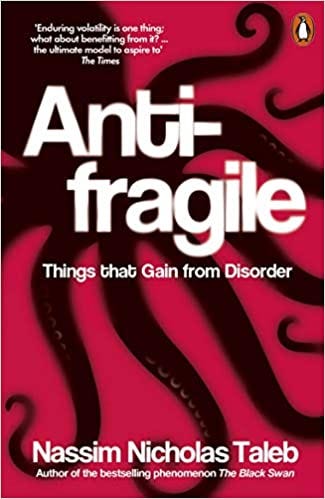
So, we need to think seriously about black swans and how we can take precautions to be more anti-fragile. Luckily, Taleb has just written about that as well.
In his new book, “Anti-fragile”, Taleb says we do need to go beyond resilient and be more anti-fragile: Just as human bones get stronger when subjected to stress and tension, many things in life benefit from stress, disorder, volatility, and turmoil. Antifragile are things that not only gain from chaos but need it in order to survive and flourish. Antifragile is a blueprint for living in a Black Swan world.
Antifragile is the antidote to Black Swans
Insightful Quotes from Anti-fragile
“Some things benefit from shocks; they thrive and grow when exposed to volatility, randomness, disorder, and stressors and love adventure , risk, and uncertainty. Yet, in spite of the ubiquity of the phenomenon, there is no word for the exact opposite of fragile. Let us call it antifragile. Antifragility is beyond resilience or robustness. The resilient resists shocks and stays the same; the antifragile gets better. This property is behind everything that has changed with time: evolution, culture, ideas, revolutions, political systems, technological innovation, cultural and economic success, corporate survival, good recipes (say, chicken soup or steak tartare with a drop of cognac), the rise of cities, cultures, legal systems, equatorial forests, bacterial resistance … even our own existence as a species on this planet. And antifragility determines the boundary between what is living and organic (or complex), say, the human body, and what is inert, say, a physical object like the stapler on your desk.”
“The antifragile loves randomness and uncertainty, which also means — crucially — a love of errors, a certain class of errors. Antifragility has a singular property of allowing us to deal with the unknown, to do things without understanding them — and do them well. Let me be more aggressive: we are largely better at doing than we are at thinking, thanks to antifragility. I’d rather be dumb and antifragile than extremely smart and fragile, any time.”
“It is easy to see things around us that like a measure of stressors and volatility: economic systems , your body, your nutrition (diabetes and many similar modern ailments seem to be associated with a lack of randomness in feeding and the absence of the stressor of occasional starvation), your psyche. There are even financial contracts that are antifragile: they are explicitly designed to benefit from market volatility.”
“Antifragility makes us understand fragility better. Just as we cannot improve health without reducing disease, or increase wealth without first decreasing losses, antifragility and fragility are degrees on a spectrum.”
“Crucially, if antifragility is the property of all those natural (and complex) systems that have survived, depriving these systems of volatility, randomness, and stressors will harm them. They will weaken, die, or blow up. We have been fragilizing the economy, our health, political life, education, almost everything … by suppressing randomness and volatility. … stressors. Much of our modern, structured, world has been harming us with top-down policies and contraptions (dubbed “Soviet-Harvard delusions” in the book) which do precisely this: an insult to the antifragility of systems. This is the tragedy of modernity: as with neurotically overprotective parents, those trying to help are often hurting us the most.”
“… Black Swans hijack our brains, making us feel we “sort of” or “almost” predicted them, because they are retrospectively explainable. We don’t realize the role of these Swans in life because of this illusion of predictability. Life is more, a lot more, labyrinthine than shown in our memory — our minds are in the business of turning history into something smooth and linear, which makes us underestimate randomness. But when we see it, we fear it and overreact. Because of this fear and thirst for order, some human systems, by disrupting the invisible or not so visible logic of things, tend to be exposed to harm from Black Swans and almost never get any benefit. You get pseudo-order when you seek order; you only get a measure of order and control when you embrace randomness.”
“Complex systems are full of interdependencies — hard to detect — and nonlinear responses. “Nonlinear” means that when you double the dose of, say, a medication, or when you double the number of employees in a factory, you don’t get twice the initial effect, but rather a lot more or a lot less. Two weekends in Philadelphia are not twice as pleasant as a single one — I’ve tried. When the response is plotted on a graph, it does not show as a straight line (“linear”), rather as a curve. In such environments, simple causal associations are misplaced; it is hard to see how things work by looking at single parts.”
“Man-made complex systems tend to develop cascades and runaway chains of reactions that decrease, even eliminate, predictability and cause outsized events. So the modern world may be increasing in technological knowledge, but, paradoxically, it is making things a lot more unpredictable.”
“An annoying aspect of the Black Swan problem — in fact the central, and largely missed , point — is that the odds of rare events are simply not computable.”
“Consider that Mother Nature is not just “safe.” It is aggressive in destroying and replacing, in selecting and reshuffling . When it comes to random events, “robust” is certainly not good enough. In the long run everything with the most minute vulnerability breaks, given the ruthlessness of time — yet our planet has been around for perhaps four billion years and, convincingly, robustness can’t just be it: you need perfect robustness for a crack not to end up crashing the system. Given the unattainability of perfect robustness, we need a mechanism by which the system regenerates itself continuously by using, rather than suffering from, random events, unpredictable shocks, stressors, and volatility.”
Nassim Taleb
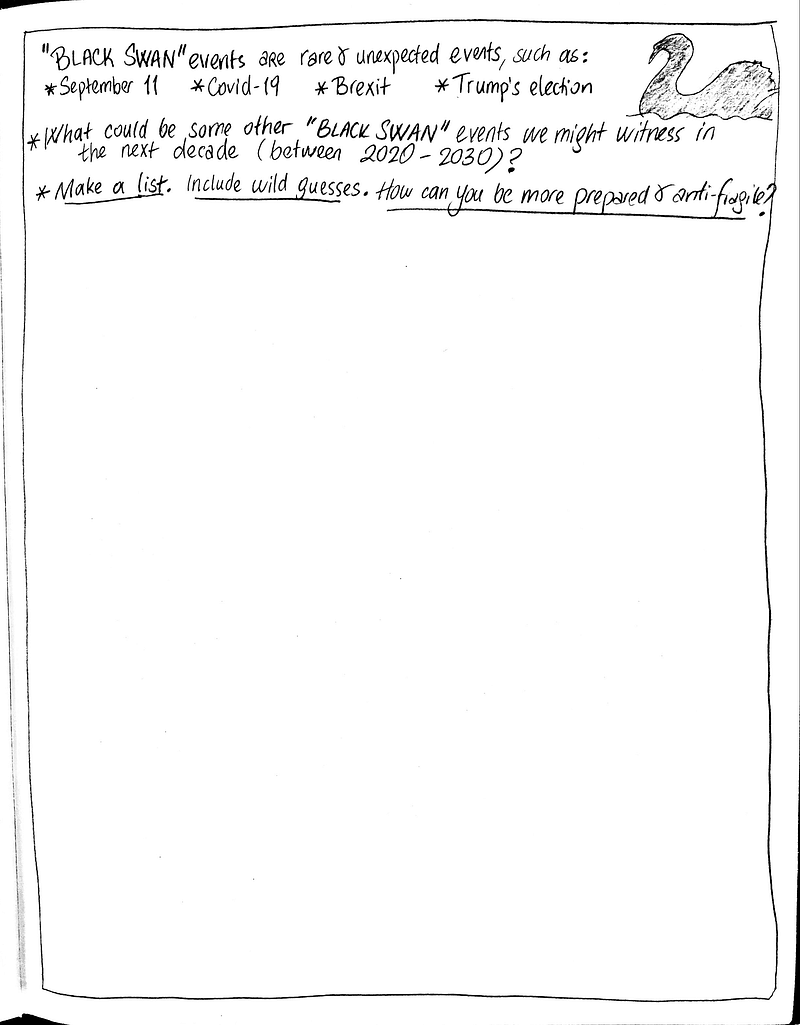
Exercise: What could be Black Swans of the next decade?
In this exercise, you will think about the next 10 years ahead of us.
- What could be some black swan events of the next decade?
- How can be better prepared for these events?
- How can we be anti-fragile in our lives and our work?
Please brainstorm and take notes. Include wide guesses.
- Write down the personal systems and principles that will make you stronger in the next decade.
- Think about practical actions you can take to be more anti-fragile. Write these down.
- Think about how you will increase your prediction skills and knowledge through reading and learning beyond disciplines.
- Create a personal manifesto and system for navigating uncharted territories and managing wild uncertainty.
- Think about the actions you can take to be economically and psychologically less vulnerable.
Fahri Karakas is the author of the Self-making Studio. You can explore more here.
Gain Access to Expert View — Subscribe to DDI Intel


