Here are My Top 3 Books on Starting Your Own Business
These best-sellers will provide you inspiration and tools for your entrepreneurial journey
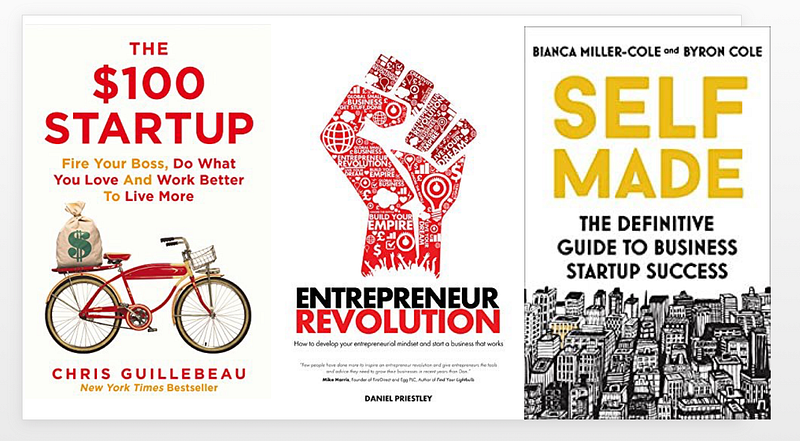
Several friends asked me what books I have been reading. I have decided to start a book review series sharing the top three books I found useful and insightful on each topic that I am interested in.
Today, I will focus on three books that will help you start your own business. We are living in times where everyone should consider themselves as an entrepreneur. Starting your own business has never been easier. You only need a laptop, a cell phone, and an Internet connection. You can create enormous value if you build a system and help other people solve their problems.
Your starting point is perhaps your passions, curiosities, and interests. Or you might tap into your natural talents and strengths. You share your art, craft, or practice with the world and start building your audience. You start creating your own creative assets such as a book, a portfolio of art work, a podcast, a YouTube channel, a portfolio of Medium articles, an online course, or else.
We live in disruptive times where an active income is not sufficient as salary addiction makes you fragile and risk-averse in the long term. To be anti-fragile and financially flexible in the long term, you need to diversify your streams of income. This means establishing multiple sources of passive income such as royalties, investing, book sales, real estate, webinars, online courses, or e-commerce. Building your own business allows you to establish a sustainable system of wealth generation that will continue to accrue income, reputation, and rewards.
One of the mistakes we fall into when we consider entrepreneurship is that we view it as a heroic, monumental, and high risk act. However, entrepreneurship does not have to be grand — you can start with small experiments, break your big vision into small everyday steps, and establish your own game through incremental and gradual actions. For example, writing on Medium is an entrepreneurial experiment. Each article is a small exercise in asset creation. You business then involves a series of acts in writing and content creation.
This is all about establishing your own game where you will excel. It also means you need to create your own category where you can be a monopoly. Ask yourself: What are the fresh, exciting, and original things only you can bring to the world? Ideally, you should focus on these things to amplify your contribution and impact.
It is important that you start very small and make this practical for yourself. Even if you are a student or a full time employee, you can build a small operation as a side hustle. You can view this as an experiment and an investment you will build over time. Spending a few hours in the evenings or in the weekends is all you need to do.
Entrepreneurship involves building a sustainable system of creating value by leveraging your unique skills and knowledge. You can get the ball rolling when you spot opportunities to solve problems out there to make money. You can start small and take easy actions to create a minimum viable digital product or service. You iterate, keep learning, and experiment with a series of strategies and behaviors. You get better in your art and craft every day. You improve and improvise constantly until you have a secret sauce that cannot be duplicated.
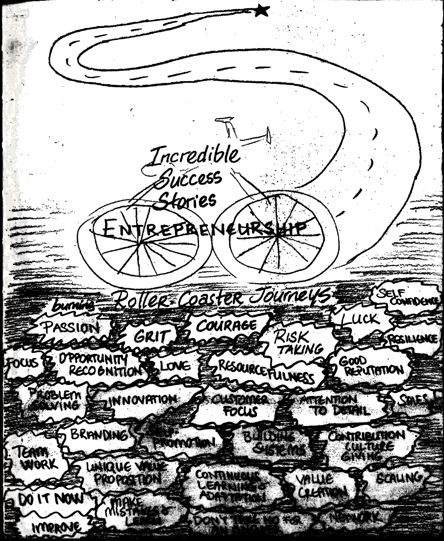
You will encounter a lot of challenges in your entrepreneurial journey for sure. However, these challenges will help you learn, grow, and get better in what you do.
Our minds are wired to think linearly about entrepreneurial success, yet, success is almost never linear. You will experience a valley of disappointment where you will deal with a ton of challenges. You will make a lot of mistakes, encounter difficulties, and you will want to quit. Yet, you need to hang in there and focus on the long term. Your success will compound over time. Your results will grow exponentially. A penny doubling every day for 31 days will become $10,737,418.24. Such is the power of exponential thinking. Remember that entrepreneurial success is non-linear. Be hungry in your learning, be relentless in your experimentation, and be bold in creating innovation. Apply moonshot thinking to make radical advances. This will be an adventure of a lifetime and you are the hero. Start your journey right here!
The $100 Dollar Startup: Fire Your Boss, Do What You Love, and Work Better to Live More, by Chris Guillebeau
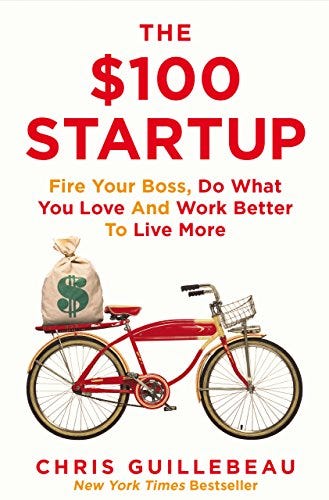
The $100 Startup is a very practical guide to kickstart your entrepreneurial journey. It shows you how to break free from the shackles of a 9 to 5 job and pursue your ambitions by combining your passion and skills. The author, Chris Guillebeau, visited almost every country in the world while he worked as an entrepreneur. Chris has an excellent blog titled The Art of Non-Conformity where he shares a lot of practical tips on lifestyle design, entrepreneurial success, and rule-breaking.
Chris identified 1500 entrepreneurs many of whom used $100 or less to build their own businesses. These individuals now make $50,000 or more a year by investing in their personal passions and strengths. The book shares case studies of entrepreneurs who were able to restructure their lives in ways that gave them freedom and fulfilment.
The book is very inspirational and practical. You do not need any degree, business plan or employees to succeed. You just need to develop a product or service that springs from what you love to do anyway. If people are willing to pay for it and you figure out a way to get paid, voila. This is the simple secret to success.
In the battle between planning and action, action always wins. So, you need to start now and start small. Your goal is to earn a good living on your own terms, when and where you want. You can do this by achieving that perfect blend of passion and income to make work something you love. The premise of this book is to show you how to do this through practical examples and insights. Some of the sections sounded a bit simplistic, but they are still useful if you are just at the start of your entrepreneurial journey.
Here are some of the key insights and arguments of this book:
- Not all passions are businesses. Your interests can be turned into viable money-making ideas if only you can find customers who are willing to pay for your products or services.
- You need to give the customer what they want, not what you think they should have. It is not your job to teach your customers how to fish, it is your job to give them fish. Customers just want easy solutions to get their problem fixed.
- Get your first sale as soon as you can. You can then test the market, get feedback, and incorporate it to make your offering more compelling. Be frugal in your spending, minimize your costs, and maximize your cash flow.
Some of the striking quotes in the book are the following:
“The new reality is that working at a job may be the far riskier choice.”
“As you begin to think like an entrepreneur, you’ll notice that business ideas can come from anywhere.”“If you make your business about helping others, you’ll always have plenty of work.”
“Value means helping people. If you’re trying to build a microbusiness and you begin your efforts by helping people, you’re on the right track. When you get stuck, ask yourself: How can I give more value? Or more simply: How can I help my customers more?”
“Value is created when a person makes something useful and shares it with the world.”
“For fifteen years, John and Barbara Varian were furniture builders, living on a ranch in Parkfield, California…The idea for a side business came about by accident after a group of horseback riding enthusiasts asked if they could pay a fee to ride on the ranch. They would need to eat, too — could John and Barbara do something about that? Yes, they could. In the fall of 2006, a devastating fire burned down most of their inventory, causing them to reevaluate the whole operation. Instead of rebuilding the furniture business, they decided to change course. “We had always loved horses,” Barbara said, “so we decided to see about having more groups pay to come to the ranch.” They built a bunkhouse and upgraded other buildings, putting together specific packages for riding groups that included all meals and activities. John and Barbara reopened as the V6 Ranch, situated on 20,000 acres exactly halfway between Los Angeles and San Francisco. Barbara’s story stood out to me because of something she said. I always ask business owners what they sell and why their customers buy from them, and the answers are often insightful in more ways than one. Many people answer the question directly — “We sell widgets, and people buy them because they need a widget” — but once in a while, I hear a more astute response. “We’re not selling horse rides,” Barbara said emphatically. “We’re offering freedom. Our work helps our guests escape, even if just for a moment in time, and be someone they may have never even considered before.” The difference is crucial. Most people who visit the V6 Ranch have day jobs and a limited number of vacation days. Why do they choose to visit a working ranch in a tiny town instead of jetting off to lie on a beach in Hawaii? The answer lies in the story and messaging behind John and Barbara’s offer. Helping their clients “escape and be someone else” is far more valuable than offering horse rides. Above all else, the V6 Ranch is selling happiness.”
“Scott Adams, the creator of the Dilbert comic series, explains his success this way: I succeeded as a cartoonist with negligible art talent, some basic writing skills, an ordinary sense of humor and a bit of experience in the business world. The “Dilbert” comic is a combination of all four skills. The world has plenty of better artists, smarter writers, funnier humorists and more experienced business people. The rare part is that each of those modest skills is collected in one person. That’s how value is created.”
“In the future, marketing will be like sex: Only the losers pay for it.”
“To succeed in a business project, especially one you’re excited about, it helps to think carefully about all the skills you have that could be helpful to others and particularly about the combination of those skills.”
“Getting started doesn’t have to cost a lot, and you can be more creative than you’d think (ever considered taking out a car loan to fund your start-up?)But instead of dreaming of it they took action and now they are on their way to achieve their dreams. You don’t need to have a special talent, you probably already have it. You don’t need to have a lot of money to get started. You don’t need to have an MBA. No! All you need is to take action, by making something useful and sharing it with the world.”
Entrepreneur Revolution: How to Develop Your Entrepreneurial Mindset and Start a Business That Works, by Chris Guillebeau
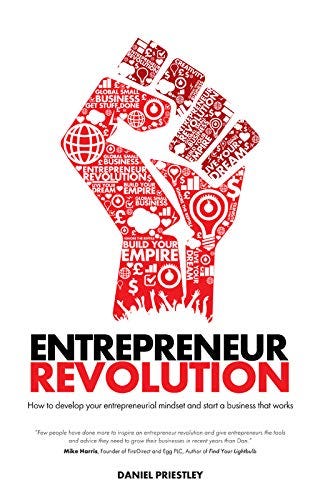
According to Daniel Priestley, we are living through an entrepreneurial revolution. This revolution is as significant and far-reaching as the Industrial Revolution. Technological changes and the Internet allow very small businesses to compete with large corporations. Priestley provides a great guide for you if you want to do something that you love, something that you’re good at, and something that will make you money (the ideal sweet spot among these three things is where entrepreneurship thrives).
Daniel Priestley is the author of four best-selling books: Key Person of Influence, Entrepreneur Revolution, Oversubscribed, and 24 Assets. Priestley built and sold businesses in Australia, Singapore, and the UK. He is one of the founders of Dent Global, a great business accelerator for entrepreneurs to stand out and scale up. He is named in the Top 10 Business Advisors in the UK by Enterprise Nation
The book guides you on how to break free from the industrial revolution economy, how to find your own place in the entrepreneur revolution, and how to live the entrepreneur revolution dream.
Here are some of the key discussions in this book:
- The world is embarking on a new age and the days of the industrial age are over. It is time to break free from the industrial revolution mindset, quit working so hard, follow your dream and make a fortune along the way.
- The industrial system is designed to keep people performing like well-trained monkeys, who can perform mind-numbing, repetitive tasks for years on end. This system is set up to prevent people from spending time in their higher mind — the empire-building part.
- Masses are kept under control by two things: First, they are convinced that they are able to survive. They do not feel threatened so that they do not turn savage and behave like reptiles. Second, they are always kept occupied with consumption and entertainment while they are not working so that they do not have a chance to access their higher mind. In this way, they will be wonderful consumers and they will not challenge the status quo. Masses are treated like this for centuries. The traditional mainstream media ensures that people are kept in their monkey brains. Advertising, entertainment, and consumption will bombard and distract the masses at all times.
- You need to transcend your monkey brain and signal out all the noise. This will give you a chance to access your inner empire builder. You can then tap into new ideas that will help people, start innovating and creating new things, and discover vast resources that you barely know exist. Convince yourself: You do not need entertainment, distraction, or consumption. You are whole and complete in this moment and your survival is not threatened in any way. Do not overstimulate yourself through emotional highs and lows. Start building a personal system of creativity and productivity.
One of the best contributions of this book is the ten challenges it provides readers. If you apply these challenges, you will learn how to think and act like an entrepreneur. You will escape the industrial era mentality and open your brain to a whole set of new possibilities and opportunities. Here are some of these challenges:
- Make three calls. You have access to all the resources that exist on this planet. Ask for these resources when you need them. Learn to have the right conversation to get them. Learn and practice: Pick up the phone, send emails, and arrange meetings. Begin the conversation without knowing where it will lead you.
- Save at least 10% of your income. Set up a new bank account and put 10% into that account. This account will calm your monkey brain and help you to feel OK about taking risks. Do not touch this money. It will be part of your wealth for the long term. You will take care of your future by saving and investing.
- Stop spending time with negative people who bring you down. Make friends with people who inspire you to achieve your best self. Spend more time having conversations with people who bring out the best in you. Make a list of people you currently spend time with, and decide who will stay and who will go. Remember: You are the average of five people that you most spend time with. These people shape your perspectives, expand your network, help you access resources, and make you notice new opportunities.
- Carry $1,000 on you at all times. You can change the amount, but the idea is to carry the amount of cash that will make you uncomfortable and that you would live to earn in one day. When you carry so much cash, you will not surrender to your monkey or reptilian brain. You will not be worried about immediate survival issues and your brain will open up to the idea of abundance. Your subconscious should be accustomed to the idea of abundance, assets, and opportunities (instead of scarcity, austerity, and risks).
- Do not have a lunch alone. Buy a mininum of two lunches every week for people you do not yet know. Build a good network of people who are not customers, clients, or old friends. Invite other entrepreneurs, business leaders, investors, artists, or people you can learn from. Get good advice and fresh ideas. Listen to their stories and learn from their life experiences. Develop connections with people, so that you can start introducing people to each other. Having a good network builds your net worth more than other factors.
- Tune out from the news. Give up on TV, papers, traditional media and news. Do not think that you are missing out on something. Your time and energy are very precious — do not waste them on the news. You will be shocked at how much energy you spent entertaining your monkey brain. Use this time and energy to learn and create your assets. Instead of getting worried about news, you will stay inspired and excited. You will get a momentum. You will then start achieving things that are newsworthy yourself.
- Keep a journal where you reflect. Make a list of your priorities, high-value tasks, goals, ideas, and dreams. Keep track of your projects and mark down your milestones. Make progress on your plans and targets. Capture all your ideas. Take note of opportunities around you. Make calculations, explore resources, map out your ideas, create diagrams, and solve problems. Write about what you are most grateful about, what you want to achieve in the next three months, and which are the most promising business ideas or investments.
- Plan your vacations first. Most people plan their vacations around their work and hope that there will be some spare time and money for vacations. But, your time is limited, and you need proper holiday. Block out 8 to 12 weeks of vacation time. Work out where you want to travel, visualize your holiday, decide on your budget and itinerary. Reverse-engineer your work to serve the lifestyle you want to live. Then, your brain will relax about “getting some downtime” because it will know that vacations are coming. This will allow you to be more productive and creative. Your family and friends will also appreciate this. Vacations are also think weeks where you revitalize, get new ideas, read, write, learn, keep a journal, and spot new opportunities. You will get your best ideas when you are away from work, because you will be more creative and you will see the big picture.
- Get your entrepreneurial team in place. Successful people are surrounded by a brilliant team of people. Build a team of great people around you who can help you achieve your goals.
The book offers a lot of practical suggestions and exercises like the ones above. I have found them immensely useful and inspiring. At first you might feel a bit uncomfortable when you apply these ideas, but they are totally worth it.
Self Made: The Definitive Guide to Business Startup Success, by Bianca Miller-Cole and Byron Cole
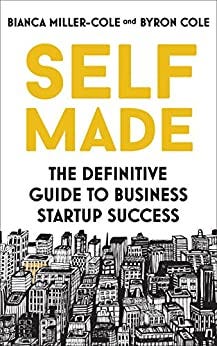
This is a very practical and useful toolkit for anyone who wants to run their own business. It features interviews with well known entrepreneurs, leaders, and experts who share valuable advice and experiences. The book covers every stage of the entrepreneurial process, from start-up to maturity, and discusses strategies to convert a fresh idea into a commercially viable proposition. Here are some of the contents that stand out:
- Authors present four steps for entrepreneurs: Vision, Action, Reaction and Evolution. They cover modern technology and social media issues that are crucial for the new generation of entrepreneurs.’
- The book covers all aspects of business from dreaming up an idea to bringing the vision to fruition. It includes valuable advice and suggestions on how to start up with an alternative to a business plan, how to find information that really matters, how to form a company, how to create a website on a budget, how to stand out from the crowd, how to build a personal brand, how to negotiate and network, how to convert social media into revenue, and how to value and sell the business on.
Here are some insightful quotes from the book:
“A clear vision of where you are heading on your business journey is the first and most vital imperative.You can’t plan your route if you don’t know where you are going, so your dreamed destination as you see it in your mind’s eye, is critical. Every successful self-made person has a vision of what they are striving to achieve.
From Bill Gates’ dream to ‘put a computer on every desk’, and Sergey Brin and Larry Page’s vision ‘to organize the Internet,’ to Jason Vale’s goal to ‘juice the world’: they all started with the end in mind. Your own long-term objectives are what will drive you when the going gets tough and are what will help shape your business decisions. Your vision is your ‘why’ — it’s your ultimate reason for doing this. Yes, you probably want to be self made because you want the flexibility that being self-employed affords you; you want to remove the earnings ceiling that being employed creates, and you want to be your own boss, but you should also have a vision of what you hope to do, and what problem you wish to solve.”
“Work harder on yourself than you do on your job… .. Why? Well because your job will benefit as a result and so will your life. You are a worthy investment. What you become is more important than what you get.”
So what do we do?
We are living in one of the most interesting times in history. If you have a laptop, a cell phone, and an Internet connection, you can instantly become an entrepreneur and build your own company.
Information is abundant and free. You have access to all the world’s knowledge at your fingertips. You can teach yourself anything that you want. You can master and teach any field. As you learn new things, you can share your passions, curiosities, and creations with the world.
We live in a world where ideas can change people’s lives. This means all of us can create our own game and become an entrepreneur. Indeed, creating your own game has never been so crucial. You can now design games, create our own blogs or podcasts or YouTube channel, or raise funds on Kickstarter. You can write a book and share your voice with the world. You can create your own lifestyle brands on wellness, health, productivity, or creativity. You can create fresh and exciting digital products (training, courses, experiences etc.). You can use crowdfunding to kickstart your ideas and projects.
You do not need to quit your job or have capital to become an entrepreneur. You can use imagination to create your own creative assets and share them with the world. You can use your imagination to bring things that are fresh and exciting to the world. In today’s world, your curiosity and imagination are the biggest tools and weapons.
We live in a world where attention matters the most. Attention is the new gold — it is the most critical, cherished, and sought after thing. As an entrepreneur, you need to learn how you can capture attention and manufacture curiosity, surprise, and virality for your business. You will need to tell your own stories, create your own personal brand, and connect with your own fans and tribe.
The world needs your creativity, imagination, and curiosity. You can create your own adventures and games you wish to play as an entrepreneur. You can cultivate a fierce and fearless imagination. You can experiment wildly to create innovation and connect unlikely fields. You can create your own brands, products, services, and even avatars. You can reclaim your childhood creativity.
The best startups go to where the future is. They innovate and create the future. They are the ones who disrupt before they are disrupted. You need to see where you are going, make sense of how the outside world is changing, identifying new trends and challenges, and work on creating new opportunities and possibilities for your enterprise.
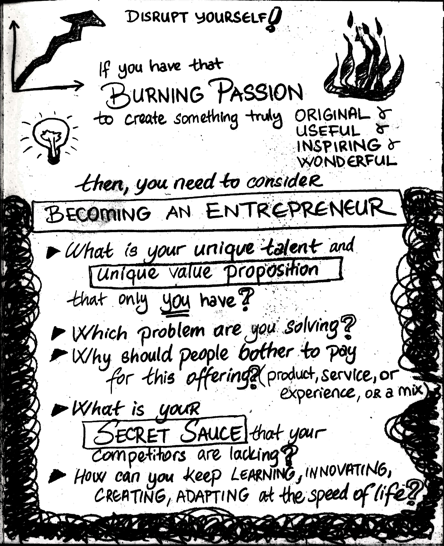
As an entrepreneur, you need to learn, re-invent, and disrupt yourself every day. If you cannot adapt and learn, your business might just fade into insignificance. You do not know about tomorrow’s opportunities. However, you will need new ways of thinking, learning, creating, and innovating. Curiosity will give you leverage because you can then capitalize on what is novel, surprising, and impactful.
- How can you compound yourself through learning, changing, and improving every day?
- How can you invest in yourself and your asset creation for the long term?
- Are you learning new and exciting things every day? Are you applying them for your business?
- How can you ensure you are learning, pushing yourself, and your brain every day?
If you want to get lucky in the long term, you need to provide yourself a lot of opportunities for failure. Failures are merely stopping points along the bigger journey. You need to celebrate your failures and use them as learning opportunities. Develop grit and resilience to get back up after a failure. Even if the whole world is turning itself against on your ideas, you need to hang in there and be patient. J. K. Rowling was rejected by a dozen of publishers before she was able to publish Harry Potter. Star Wars was rejected by many major studies until it became a household brand worth 70 billion dollars.
When you are setting your long term goals for your business, always leave an open room for X objectives(unknown goals). X objectives are goals that you cannot see right now. They will emerge as you navigate uncharted territories.
Your entrepreneurial journey is not a sprint — it is a marathon. Play the long game. Compound yourself, your business, your skills, your assets, and your networks for the long term.