avatarRemy Dean

Free AI web copilot to create summaries, insights and extended knowledge, download it at here

5906

Abstract

n many Modern painters including <a href="https://readmedium.com/the-latter-days-of-vincent-dbe90d9d1a86">Vincent Van Gogh</a>, <a href="https://readmedium.com/choco-lart-dc9e75449ca#c64a">Henri de Toulouse-Lautrec</a>, and <a href="https://readmedium.com/wild-beast-of-art-27b407cb1d26">Henri Matisse</a>, to name but a few.</p><p id="f6f8">Later, the Surrealists would become fascinated by many aspects of international folklore, including yōkai. Whatever one calls it — a world of spirits, the realm of imagination, the collective subconscious — the idea of another reality that exists parallel to, or overlays, our shared perception of the world was at the core of <a href="https://readmedium.com/do-you-know-whats-really-surreal-3090c62b427">Surrealism</a>.</p><p id="30ba">What helped me better understand the nature of yōkai was my prior, albeit rudimentary, study of First Nation lore of North America. I won’t presume to offer a definition here but, in my understanding, the Manitou concept encompasses the spirit of an entire species or any individual representative. Also, inanimate objects and places accrue their own Manitou over time. Even a manufactured item is imbued by those who handled and fashioned it, and by its continued use and appreciation. At one time or another, most of us have experienced an emotional attachment to a favourite pen, or hat. Have you ever given your bicycle or car a name? Do you still have fond memories of an imaginary friend or plushie pal from childhood?</p><p id="17a5">Many yōkai are associated with specific sites, what we may call a <i>genius loci</i>. Folklore has it that old household utensils can become yōkai, after a century or so of use, and the way they are cared for will affect their personality. Domestic and wild animals may also transition into their yōkai form when they reach an unusually old age. Cats, badgers, and tanuki feature in many supernatural stories and are pretty much guaranteed to be yōkai, their magical powers increasing as they grow. One of the most formidable of the ancient yōkai in Japan’s mythology is Tamamo no Mae, the white faced, golden furred, K<i>yūbi-no-Kitsunean</i> — a magical, nine-tailed fox, or <i>kitsune. </i>It eventually took sorcery and an army of 80,000 warriors to defeat her.</p><figure id="c6de"><img src="https://cdn-images-1.readmedium.com/v2/resize:fit:800/1*YcFQGfa6xuk-ne2FwKl96A.jpeg"><figcaption></figcaption></figure><figure id="a730"><img src="https://cdn-images-1.readmedium.com/v2/resize:fit:800/1*xyEDcP3Sj7bl2of7uqg9tA.jpeg"><figcaption><b>woodblock illustrations for ‘The Tongue-Cut Sparrow’ (1886) </b>and<b> ‘The Old Man & The Devils’ (c.1910) </b>from<b> Hasegawa’s ‘Japanese Fairy Tales Series’ </b>[<a href="https://publicdomainreview.org/essay/woodblocks-in-wonderland-the-japanese-fairy-tale-series">view license</a>]</figcaption></figure><p id="121b">Takejiro Hasegawa published twenty volumes of his <i>Japanese Fairy Tales Series</i>, from 1885 to 1922, first in English and then a half-dozen more languages exporting the volumes across Europe and Russia. Japan had been an isolationist, ‘locked country’ into the mid-1850s, only opening up to international trade after 1868, marking the end of the Edo Period. To much of the world, Japan seemed mysterious and exotic so the books stimulated widespread interest in the untapped folklore of this strange land.</p><p id="26f0">For a period at the close of the nineteenth-century London became a favoured foreign destination for the fashionable elite of Japan and some families began sending their sons to England for part of their education. Being able to read familiar fairy tales in English was a useful learning tool and the books became popular in the domestic market, their richly illustrated pages fixing what yōkai looked like in the popular imagination.</p><p id="65ed">Hasegawa brought together some of the best woodblock artists of his day to illustrate his books and consulted the great folklorist and storyteller, Lafcadio Hearn who also contributed tales for the series. Hearn was a westerner who settled and married in Japan, becoming a citizen and establishing himself as the leading authority on the nation’s customs and folklore. He was responsible for documenting and translating many traditional tales.</p><figure id="347b"><img src="https://cdn-images-1.readmedium.com/v2/resize:fit:800/1*v_1QM2qCsUuMqYxQy903Ng.jpeg"><figcaption></figcaption></figure><figure id="cfdc"><img src="https://cdn-images-1.readmedium.com/v2/resize:fit:800/1*sDpchaC51Dgz_xPEHywlNg.jpeg"><figcaption></figcaption></figure><figure id="c45a"><img src="https://cdn-images-1.readmedium.com/v2/resize:fit:800/1*KcZC2IwogDEiYmGcjiWJwA.jpeg"><figcaption><b>cover and illustrations for Lafcadio Hearn’s story of ‘The Goblin Spider’ (c.1910)</b> *</figcaption></figure><p id="6a57">The translated works of Hearn and the Fairy Tale books of Hasegawa helped to preserve an aspect of cultural identity during a time of dreadful turmoil as Imperialist Japan failed to adapt to internationalism and resorted to military aggression and war.</p><p id="3cce">Before the war that ended Imperialism in Japan, the young Mizuki Shigeru had grown up listening to the old folk tales of the supernatural and, inspired by illustrations in popular books like Hasegawa’s Japanese Fairy Tales Series, became an artist of great promise. However, in 1942, he was drafted and fought in Papua New Guinea where the horrors of war left deep physical and mental scars. After an ill-fated battle, he found himself the sole survivor of his military unit and, as such, was expected to commit suicide. He determined not to do so. If he was to survive, he saw his duty to bear witness and do his best to publicise his profoundly pacifist beliefs in the hope of averting further wars.</p><p id="4039">He was left-handed and his injuries led to the amputation of h

Options

is left arm. He would spend years retraining himself to draw with his other hand and his first manga comic book, <i>Rocketman</i>, was published in 1957. During the 1960s his long-running manga series featuring yōkai — <i>Hakaba Kitarō</i>, <i>Kappa no Sanpei</i>, and <i>GeGeGe no Kitarō</i> — became hugely popular. They brought the traditional characters back to the fore of the Japanese imagination, though he’d added his own unique twist.</p><p id="8f75">Generally, his yōkai were mischievous, fun-loving characters that only wanted peace and parties, though some still retained their more macabre, ghoulish aspects for narrative purposes. His graphic novel of 1972, <i>Nonnonba</i> was an homage to his nanny who’d first enlivened his imagination with supernatural folktales and, in 1974, he published the first in a series of his own yōkai encyclopaedias.</p><figure id="7f82"><img src="https://cdn-images-1.readmedium.com/v2/resize:fit:800/1*WAM_jQqvWS-oc3L9zwrFXw.jpeg"><figcaption></figcaption></figure><figure id="0b71"><img src="https://cdn-images-1.readmedium.com/v2/resize:fit:800/1*S0hC_5cDYgADjgRcx4Nw2w.jpeg"><figcaption></figcaption></figure><figure id="ab97"><img src="https://cdn-images-1.readmedium.com/v2/resize:fit:800/1*Rc-Ms11vntiSLihWoKb0dw.jpeg"><figcaption></figcaption></figure><figure id="a82a"><img src="https://cdn-images-1.readmedium.com/v2/resize:fit:800/1*6fJ_59WPcwpGbK4sGEGlpA.jpeg"><figcaption><b>illustrations of <i>Umibōzu</i>, Kappa, Kobokunokai, and Ōnyūdō</b> <b>by Mizuki Shigeru from his Yōkai Encyclopaedias</b> </figcaption></figure><p id="e97d">His anti-war, pro-love message pervaded all his stories. It was welcomed by the post-war peace movement and a nation needing to reassess its traditional heritage as it moved forward to a brighter future. Mizuki Shigeru continues to have a massive influence on Japanese culture and is honoured with a museum dedicated to his life and works in Sakaiminato City, situated in the coastal region where he grew up.</p><p id="4b74">Satoshi Tajiri grew up with Mizuki’s manga and yōkai were the driving factor behind his designs for Pokémon in the mid-1990s, which became a popular franchise and is now an international multi-media phenomenon. Yōkai proliferate in the works of the animator Hayao Miyazaki and his popular Studio Ghibli productions. The story of a romance between a cute kitsune and her human partner has been unfolding in a long-running series of mainstream adverts, for Nissin’s Donbei noodles. In 2018, J-pop artist <a href="https://readmedium.com/take-a-bow-the-power-of-kyary-pamyu-pamyu-1fc84cc7cf42">Kyary Pamyu Pamyu</a> toured the lavish yōkai-themed concert show, <i>The Spooky Obakeyashiki</i>. And is it just me, or is there a definite poetic parallel with the world of <i>The Moomins,</i> created in the late 1940s by Finnish author and illustrator Tove Jansson?</p><p id="d186">Mizuki Shigeru’s take on yōkai was the main inspiration for <i>The Daiei Trilogy</i> of films directed by Kimiyoshi Yasuda — which is quite fitting as a film is, basically, a <i>very long</i> picture scroll! They were recently restored and released as <i>The Yōkai Monsters</i> box set, consisting of <i>100 Monsters</i>, <i>Spook Warfare</i>, and <i>Along with Ghosts</i>, originally made back-to-back during 1968. They are presented with Takashi Miike’s 2005 movie <i>The Great Yōkai War</i>, in which Mizuki Shigeru makes a brief cameo to reiterate his anti war message during the finale.</p><p id="36cc"><a href="https://medium.com/framerated/y%C5%8Dkai-monsters-collection-1968-2005-blu-ray-arrow-video-219c83408cff">You can read my extended four-film review of the <i>Yōkai Monsters</i> box set at Frame Rated.</a></p><figure id="f46c"><img src="https://cdn-images-1.readmedium.com/v2/resize:fit:800/1*cDJCze3dwIzD-Uck57JhDA.jpeg"><figcaption></figcaption></figure><figure id="9f7e"><img src="https://cdn-images-1.readmedium.com/v2/resize:fit:800/1*HxA-2yRqqOSkyXUnVzc4UA.jpeg"><figcaption><b>Mizuki Shigeru appears as the face of the Great <i>Yōkai</i> in ‘The Great <i>Yōkai </i>War’ (2005) and Ryûnosuke Kamiki, as the film’s protagonist, Tadashi, visits the Mizuki Museum in another scene from the film — the cute yōkai riding on his head is a Sunekosuri </b>[<a href="https://medium.com/framerated/y%C5%8Dkai-monsters-collection-1968-2005-blu-ray-arrow-video-219c83408cff">courtesy Arrow Video</a>]</figcaption></figure><p id="60a5"> <i>All images are used with permission or are in the public domain, and presented here for educational purposes under fair usage policy.</i></p><div id="29bf" class="link-block"> <a href="https://remydean.medium.com/membership"> <div> <div> <h2>Join Medium with my referral link - Remy Dean</h2> <div><h3>Please consider subscribing via this referral link to support more writing by Remy Dean. A portion of your membership…</h3></div> <div><p>remydean.medium.com</p></div> </div> <div> <div style="background-image: url(https://miro.readmedium.com/v2/resize:fit:320/0*-PvPDQc-BgOnJokN)"></div> </div> </div> </a> </div><div id="e09e" class="link-block"> <a href="https://readmedium.com/nine-dragons-in-a-handscroll-fedcb6063b58"> <div> <div> <h2>Nine Dragons in a Handscroll</h2> <div><h3>Chen Rong’s masterpiece of calligraphic brushwork, innovative painting technique, storytelling, and magic… all rolled…</h3></div> <div><p>medium.com</p></div> </div> <div> <div style="background-image: url(https://miro.readmedium.com/v2/resize:fit:320/1*AaRk-jJz5-a0MaNC5EgbgQ.jpeg)"></div> </div> </div> </a> </div></article></body>

Supernatural Scrolls

Exploring the spooky Japanese art that has recorded the surreal world of yōkai for centuries, from woodblock to celluloid…

Most children in the west know what fairies and goblins — even vampires and werewolves — are. They’ll even have a general idea of what they look like and how they may behave. There’s little need for detailed descriptions and explanations. Well, that’s how it is for Japanese children and yōkai. Indeed, fairies, goblins, vampires, and werewolves would all come under the umbrella term… as would umbrellas!
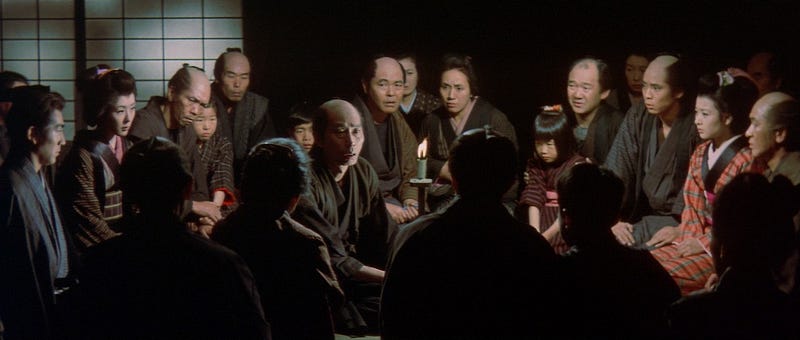
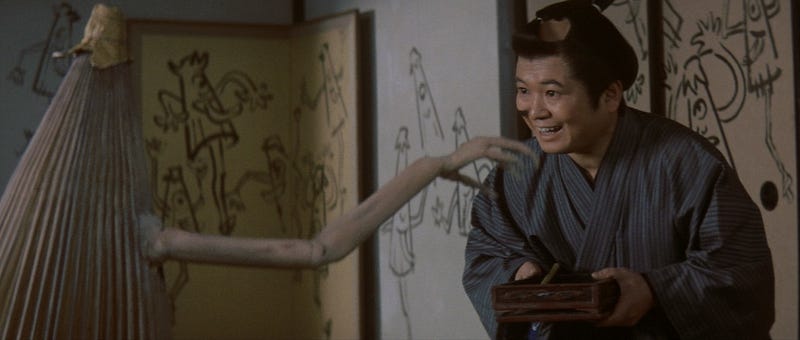
gathering of 100 supernatural tales, a scene from the 1968 Daiei film ‘100 Monsters’ and the appearance of a Karakasa-Kozo, an umbrella yōkai [courtesy Arrow Video]

Just as with fairies, there’s an immense variety of yōkai and their tales are inextricably woven into the cultural history of Japan just as Grimm’s fairy tales, regional folklore, and ghost stories are in Europe’s heritage. So, that’s a good way into the general concept — a starting point from which to explore the more intricate subtleties.

The origins of yōkai folklore are lost in the mists of time and draw together threads from across Asia, but it was during the Edo Period that telling tales of yōkai became an increasingly popular pastime among the cultured elite. They would hold ‘gatherings of 100 supernatural tales’ (hyakumonogatari kaidankai) to exchange spooky stories. These events — perfectly suited for a Halloween party — involved the lighting of many candles. It didn’t have to be 100, but required at least one for each guest.

Those present would then take turns to tell a scary story as if they had experienced it themselves. The tales would draw upon the folklore of their home town or where they grew up, so such gatherings were often performed for visitors from other regions as a form of cultural exchange. The stories always featured yōkai and yūrei. (The term yūrei includes ghosts but, confusingly, yōkai can become ghosts and vice versa.)

Each guest would mark the end of their story by extinguishing a candle and eventually only one flickering flame would remain. It’s said that when that final flame was blown out, a spirit from one of the evening’s tales would appear in the room! So, there were prayers to be said before it went out, or if bravadoes had been fortified by drinking enough sake, they wouldn’t bother with that and see what manifested… or not.
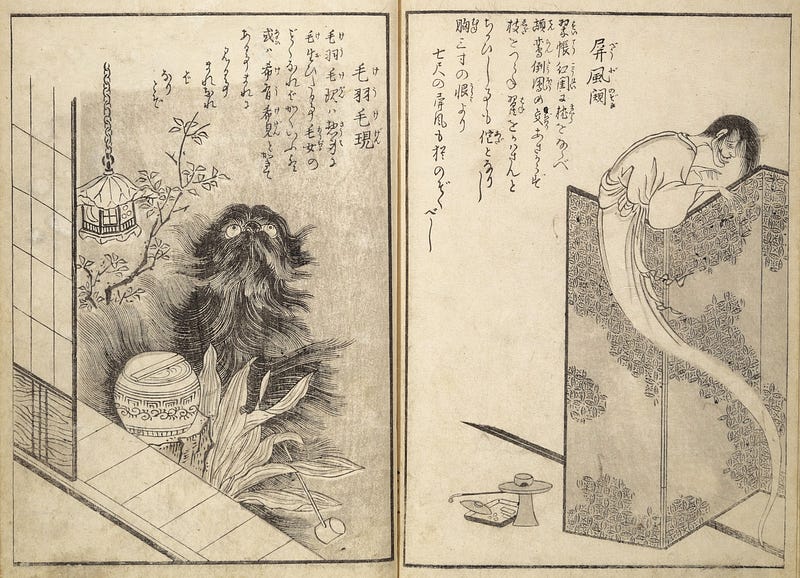
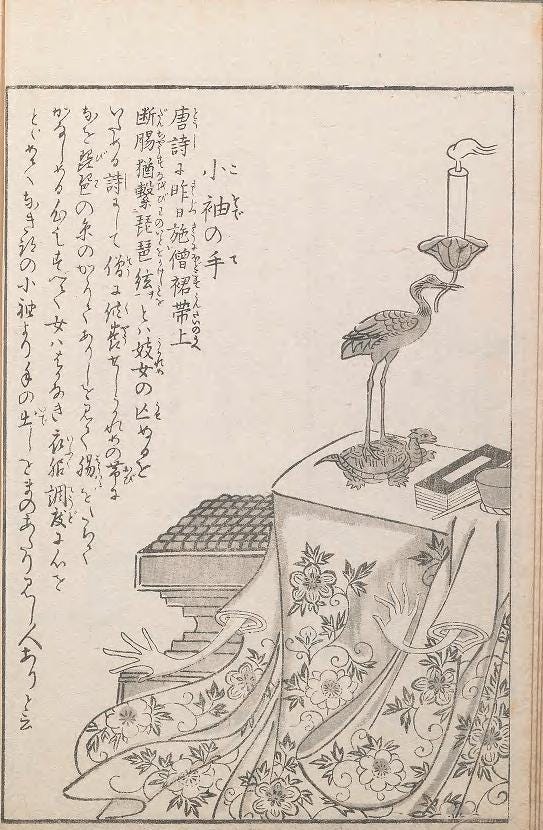
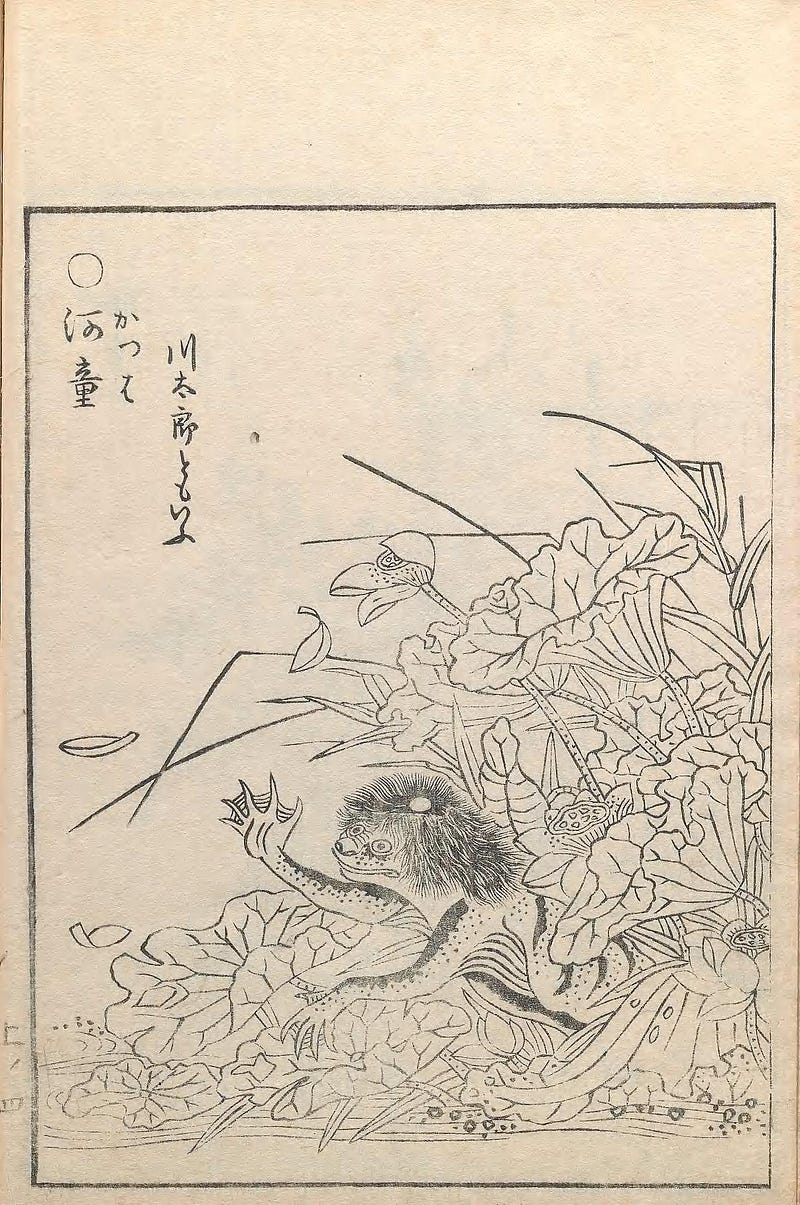
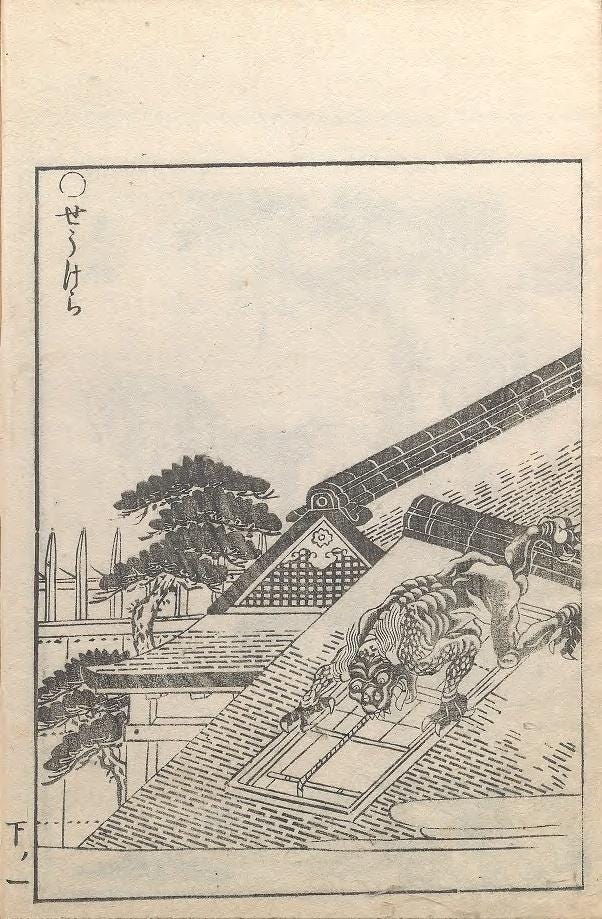
eighteenth-century prints by Toriyama Sekien from his definitive ‘Yōkai Dictionaries’ depicting the yōkai of Keukegen, Byōbunozoki, Kosodenote, Kappa and Shōkera *

These gatherings caught-on among the wider public and there was a huge market for picture scrolls featuring the various whimsical creatures and terrifying monsters. The artist and scholar, Toriyama Sekien began cataloguing yōkai and by 1776 had published the seminal Gazu Hyakki Yagyō / Illustrated Night Parade of a Hundred Demons. By the 1780s, he was compiling ‘best of’ collections with evocative titles such as, Bag of One Hundred Random Demons, or A Horde of Haunted Housewares. Sekien’s collected illustrations became the definitive dictionaries of yōkai that influenced how they would be perceived to this day.

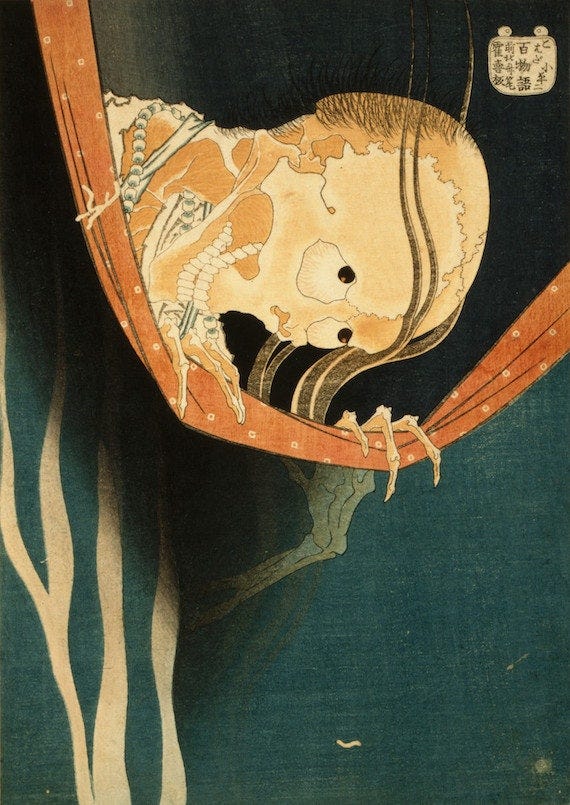
Katsushika Hokusai, the great woodblock artist of the late Edo, also set out to publish his own illustrated collection of Hyaku Monogatari / One Hundred Ghost Stories. Though, by 1830, he’d only produced five before abandoning the project. No one’s sure why he never finished his yōkai opus. Perhaps there’s a tale of terror and imagination yet to be told?
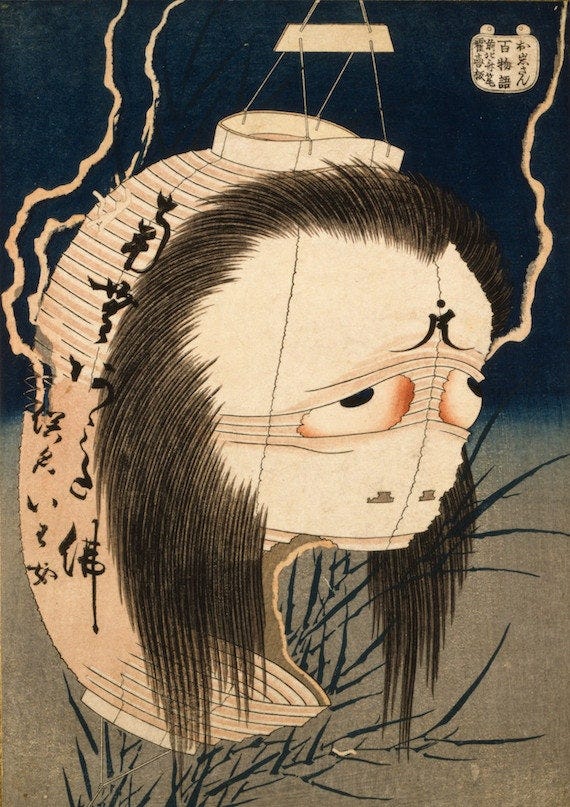
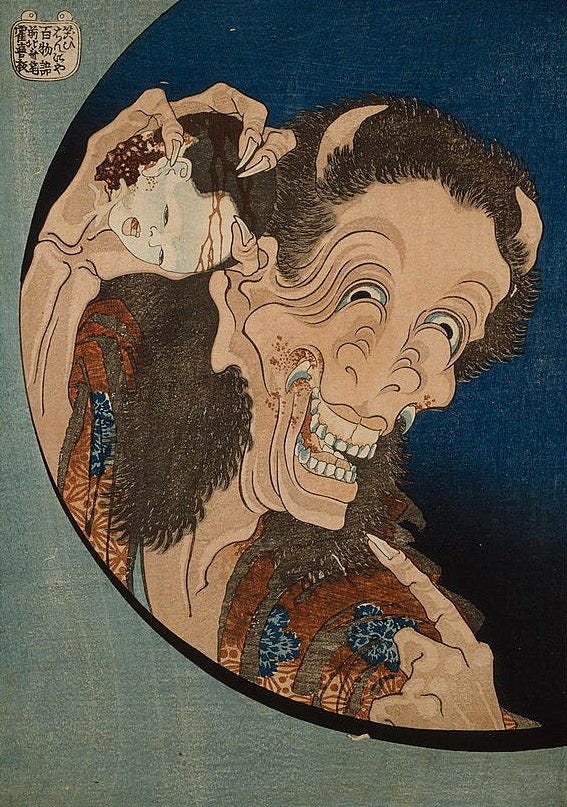
three illustrations by Katsushika Hokusai — of Oiwa, Hannya, and Kohada-Koheiji — for ‘Hyaku Monogatari / One Hundred Ghost Stories’ (c.1830) [view license 1 and 2 and 3 ]

Japanese woodblock prints, particularly those of Hokusai, became popular among collectors in the west and exerted an indelible influence upon many Modern painters including Vincent Van Gogh, Henri de Toulouse-Lautrec, and Henri Matisse, to name but a few.

Later, the Surrealists would become fascinated by many aspects of international folklore, including yōkai. Whatever one calls it — a world of spirits, the realm of imagination, the collective subconscious — the idea of another reality that exists parallel to, or overlays, our shared perception of the world was at the core of Surrealism.

What helped me better understand the nature of yōkai was my prior, albeit rudimentary, study of First Nation lore of North America. I won’t presume to offer a definition here but, in my understanding, the Manitou concept encompasses the spirit of an entire species or any individual representative. Also, inanimate objects and places accrue their own Manitou over time. Even a manufactured item is imbued by those who handled and fashioned it, and by its continued use and appreciation. At one time or another, most of us have experienced an emotional attachment to a favourite pen, or hat. Have you ever given your bicycle or car a name? Do you still have fond memories of an imaginary friend or plushie pal from childhood?

Many yōkai are associated with specific sites, what we may call a genius loci. Folklore has it that old household utensils can become yōkai, after a century or so of use, and the way they are cared for will affect their personality. Domestic and wild animals may also transition into their yōkai form when they reach an unusually old age. Cats, badgers, and tanuki feature in many supernatural stories and are pretty much guaranteed to be yōkai, their magical powers increasing as they grow. One of the most formidable of the ancient yōkai in Japan’s mythology is Tamamo no Mae, the white faced, golden furred, Kyūbi-no-Kitsunean — a magical, nine-tailed fox, or kitsune. It eventually took sorcery and an army of 80,000 warriors to defeat her.
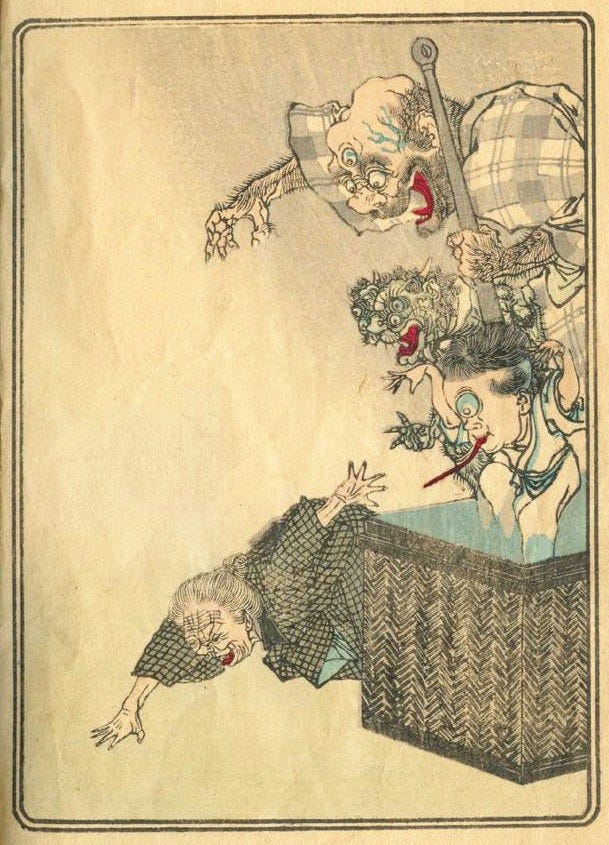
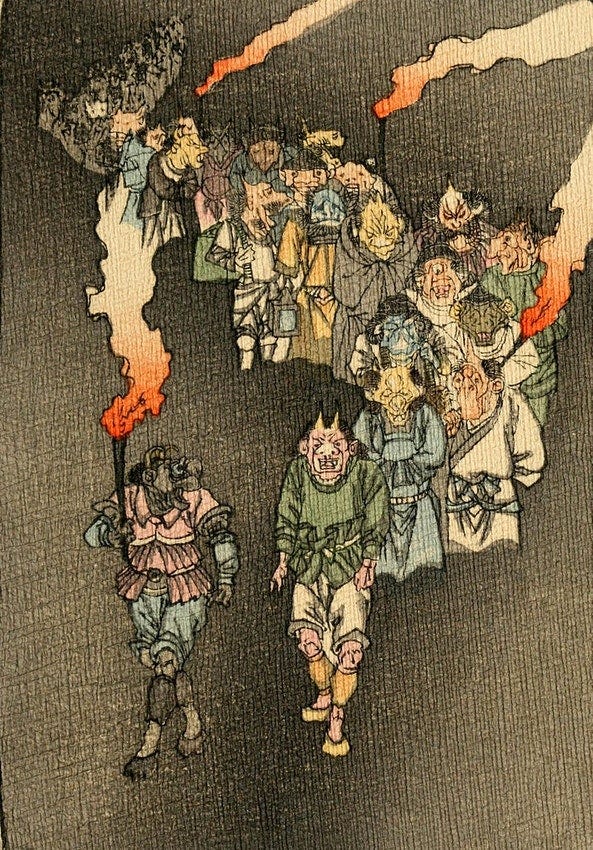
woodblock illustrations for ‘The Tongue-Cut Sparrow’ (1886) and ‘The Old Man & The Devils’ (c.1910) from Hasegawa’s ‘Japanese Fairy Tales Series’ [view license]

Takejiro Hasegawa published twenty volumes of his Japanese Fairy Tales Series, from 1885 to 1922, first in English and then a half-dozen more languages exporting the volumes across Europe and Russia. Japan had been an isolationist, ‘locked country’ into the mid-1850s, only opening up to international trade after 1868, marking the end of the Edo Period. To much of the world, Japan seemed mysterious and exotic so the books stimulated widespread interest in the untapped folklore of this strange land.

For a period at the close of the nineteenth-century London became a favoured foreign destination for the fashionable elite of Japan and some families began sending their sons to England for part of their education. Being able to read familiar fairy tales in English was a useful learning tool and the books became popular in the domestic market, their richly illustrated pages fixing what yōkai looked like in the popular imagination.

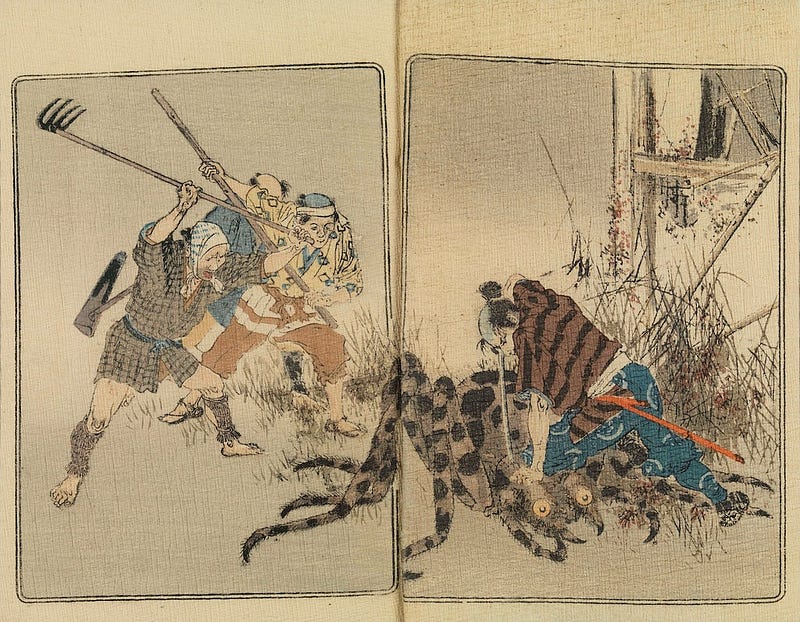
Hasegawa brought together some of the best woodblock artists of his day to illustrate his books and consulted the great folklorist and storyteller, Lafcadio Hearn who also contributed tales for the series. Hearn was a westerner who settled and married in Japan, becoming a citizen and establishing himself as the leading authority on the nation’s customs and folklore. He was responsible for documenting and translating many traditional tales.
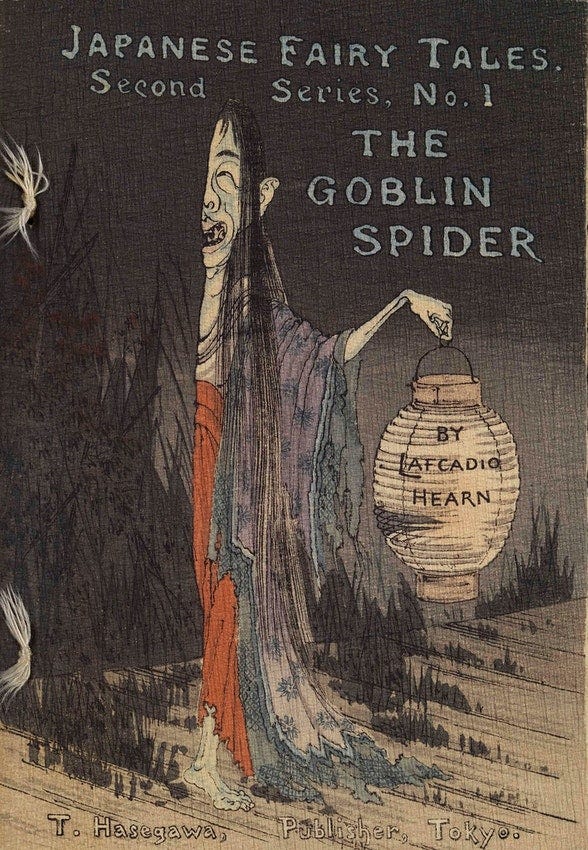
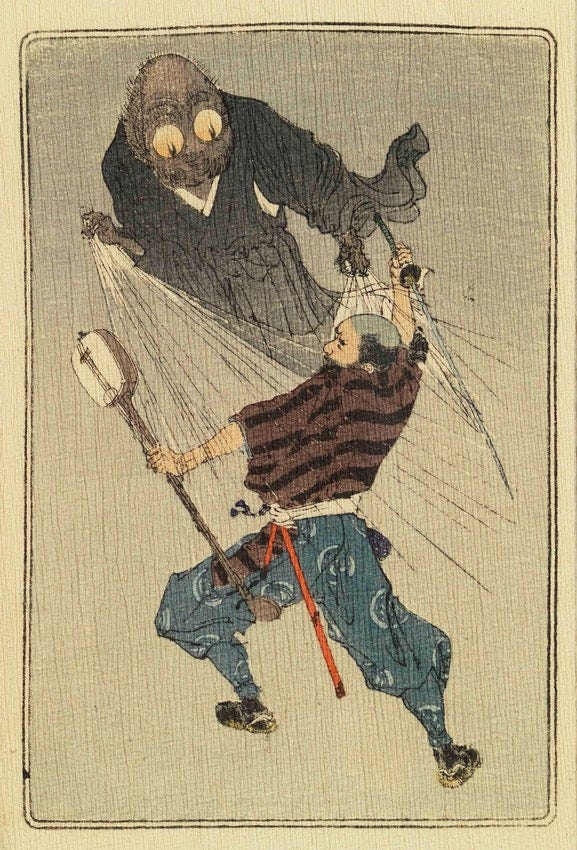
cover and illustrations for Lafcadio Hearn’s story of ‘The Goblin Spider’ (c.1910) *

The translated works of Hearn and the Fairy Tale books of Hasegawa helped to preserve an aspect of cultural identity during a time of dreadful turmoil as Imperialist Japan failed to adapt to internationalism and resorted to military aggression and war.

Before the war that ended Imperialism in Japan, the young Mizuki Shigeru had grown up listening to the old folk tales of the supernatural and, inspired by illustrations in popular books like Hasegawa’s Japanese Fairy Tales Series, became an artist of great promise. However, in 1942, he was drafted and fought in Papua New Guinea where the horrors of war left deep physical and mental scars. After an ill-fated battle, he found himself the sole survivor of his military unit and, as such, was expected to commit suicide. He determined not to do so. If he was to survive, he saw his duty to bear witness and do his best to publicise his profoundly pacifist beliefs in the hope of averting further wars.

He was left-handed and his injuries led to the amputation of his left arm. He would spend years retraining himself to draw with his other hand and his first manga comic book, Rocketman, was published in 1957. During the 1960s his long-running manga series featuring yōkai — Hakaba Kitarō, Kappa no Sanpei, and GeGeGe no Kitarō — became hugely popular. They brought the traditional characters back to the fore of the Japanese imagination, though he’d added his own unique twist.

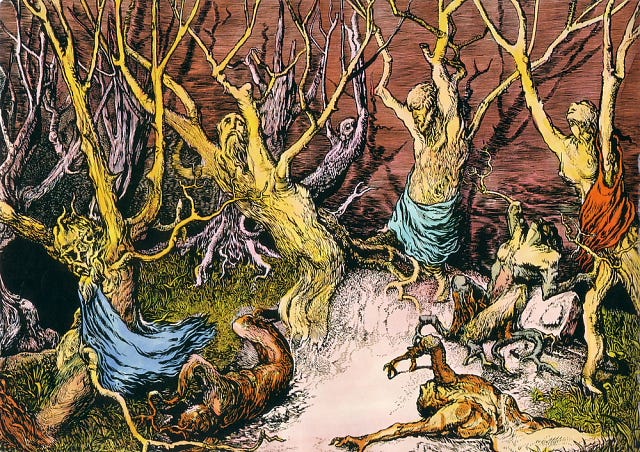
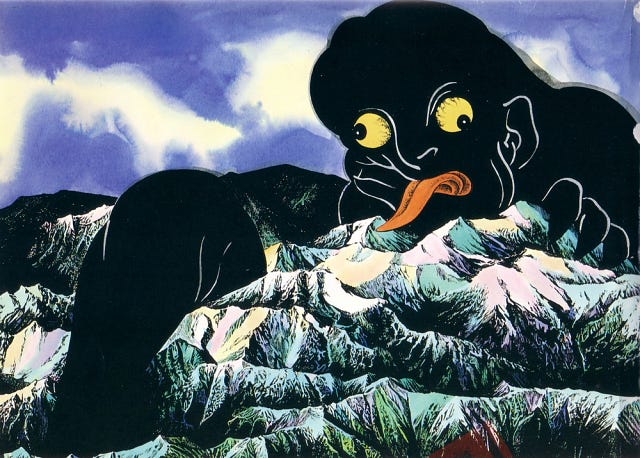
Generally, his yōkai were mischievous, fun-loving characters that only wanted peace and parties, though some still retained their more macabre, ghoulish aspects for narrative purposes. His graphic novel of 1972, Nonnonba was an homage to his nanny who’d first enlivened his imagination with supernatural folktales and, in 1974, he published the first in a series of his own yōkai encyclopaedias.
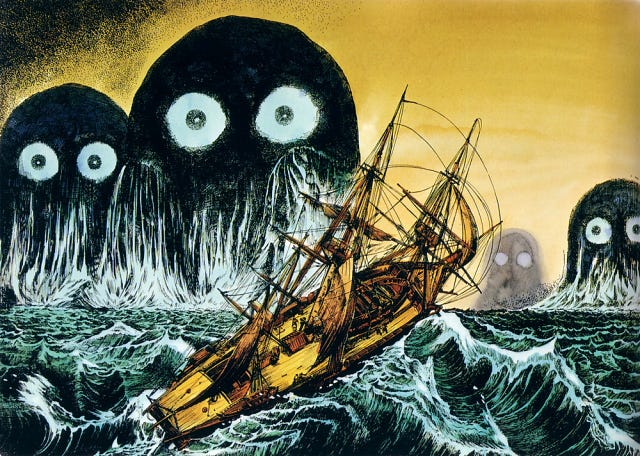
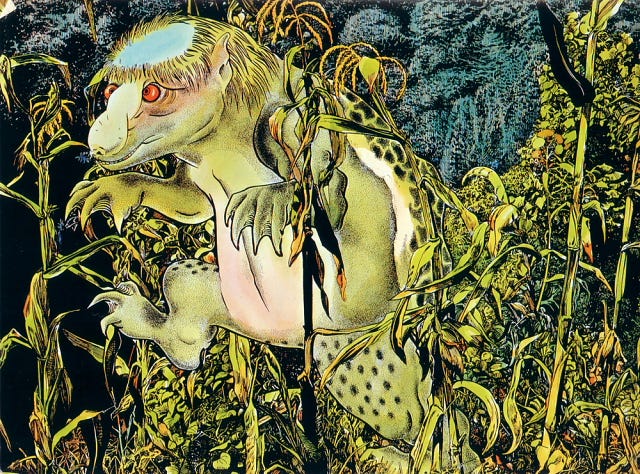
illustrations of Umibōzu, Kappa, Kobokunokai, and Ōnyūdō by Mizuki Shigeru from his Yōkai Encyclopaedias *

His anti-war, pro-love message pervaded all his stories. It was welcomed by the post-war peace movement and a nation needing to reassess its traditional heritage as it moved forward to a brighter future. Mizuki Shigeru continues to have a massive influence on Japanese culture and is honoured with a museum dedicated to his life and works in Sakaiminato City, situated in the coastal region where he grew up.

Satoshi Tajiri grew up with Mizuki’s manga and yōkai were the driving factor behind his designs for Pokémon in the mid-1990s, which became a popular franchise and is now an international multi-media phenomenon. Yōkai proliferate in the works of the animator Hayao Miyazaki and his popular Studio Ghibli productions. The story of a romance between a cute kitsune and her human partner has been unfolding in a long-running series of mainstream adverts, for Nissin’s Donbei noodles. In 2018, J-pop artist Kyary Pamyu Pamyu toured the lavish yōkai-themed concert show, The Spooky Obakeyashiki. And is it just me, or is there a definite poetic parallel with the world of The Moomins, created in the late 1940s by Finnish author and illustrator Tove Jansson?

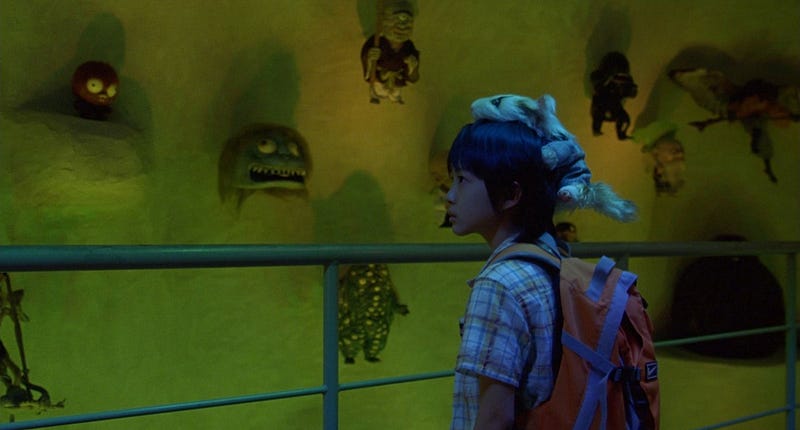
Mizuki Shigeru’s take on yōkai was the main inspiration for The Daiei Trilogy of films directed by Kimiyoshi Yasuda — which is quite fitting as a film is, basically, a very long picture scroll! They were recently restored and released as The Yōkai Monsters box set, consisting of 100 Monsters, Spook Warfare, and Along with Ghosts, originally made back-to-back during 1968. They are presented with Takashi Miike’s 2005 movie The Great Yōkai War, in which Mizuki Shigeru makes a brief cameo to reiterate his anti war message during the finale.

You can read my extended four-film review of the Yōkai Monsters box set at Frame Rated.
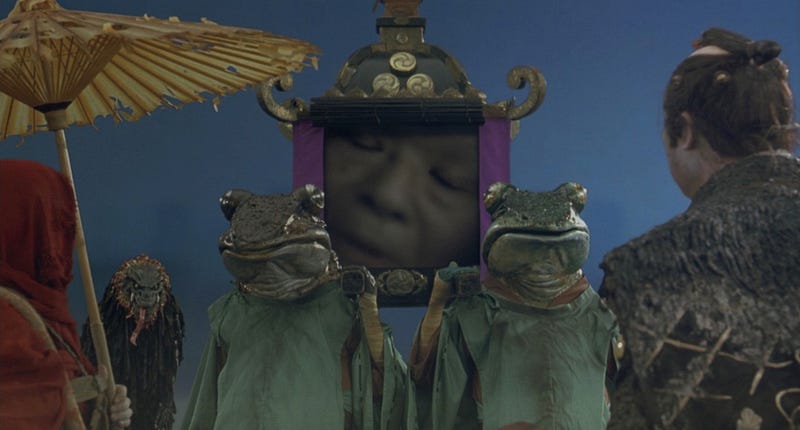
Mizuki Shigeru appears as the face of the Great Yōkai in ‘The Great Yōkai War’ (2005) and Ryûnosuke Kamiki, as the film’s protagonist, Tadashi, visits the Mizuki Museum in another scene from the film — the cute yōkai riding on his head is a Sunekosuri [courtesy Arrow Video]

* All images are used with permission or are in the public domain, and presented here for educational purposes under fair usage policy.

Art
Folklore
Japan
Art History
Illustration
Recommended from ReadMedium