
Slow Cognition: The Network Effect of Discovery (Draft)
A Case Study of the Project Network Analysis method
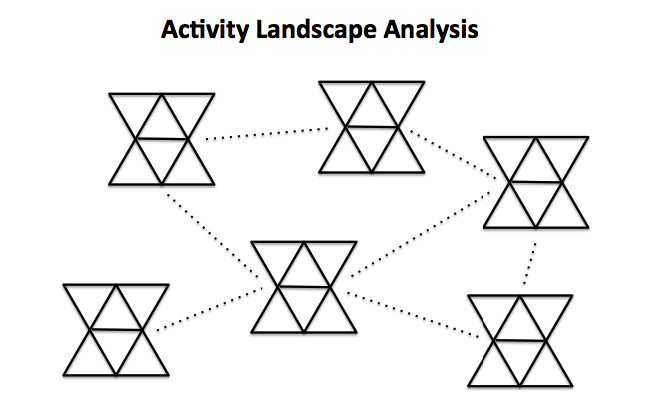
sjkljkgsdklg
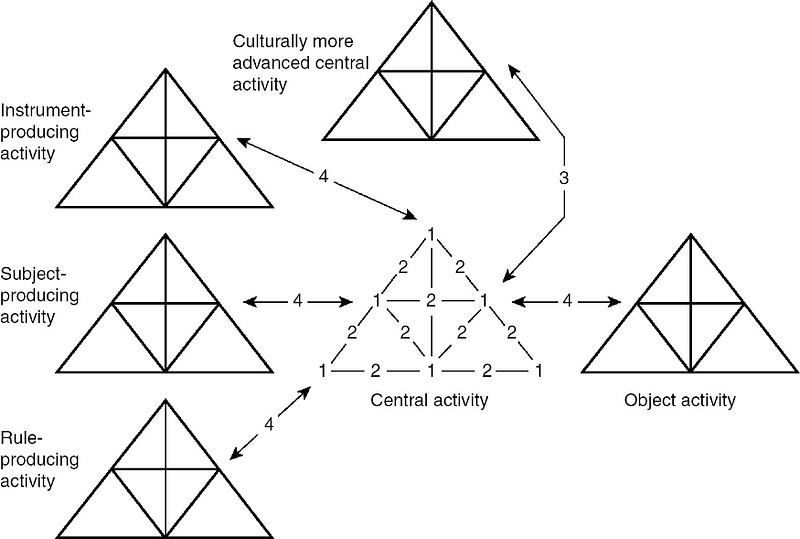
skldjklgdsjgsd
May 25, 2022 — Note
Symbol Awareness: Object Activity as Second-order Activity
The above diagram and words are the draft of Slow Cognition: The Network Effect of Discovery (Draft) which is a new possible article about Significant Insights Analysis.
Yesterday I published Slow Cognition: It takes a village to raise a creative mind and shared the summary of the Significant Insights Analysis project.
In the past four months, I captured several significant insights. I selected 12 insights for the project and used the following model and questions to guide the research.
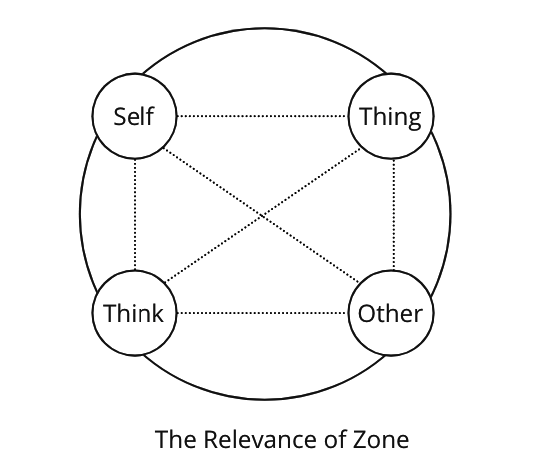
- Other: Who is the Significant Other for this insight?
- Thing: What’s the insight about? Why do I pay attention to it?
- Think: How did I get this insight? Is there a technique behind the process?
- Self: Where did I capture this insight?
- Self: When did I capture this insight?
- Activity: Is this insight part of an activity? What’s the activity?
- Activity: Has this insight led to a new action or a new activity?
Yesterday I only discussed the following three questions:
- Where did I capture this insight?
- Who is the Significant Other for this insight?
- How did I get this insight? Is there a technique behind the process?
I also analyzed the 12 significant insights from the perspective of Activity. However, this part is quite complex. I thought that I need to use a new article to discuss it.
Last night, I thought the title of the possible article should be The Network Effect of Discovery and I want to use the notion of “Project Network” to conduct the reflection.
The above diagram is the “Project Network” model which is inspired by the “Activity Network”.
This morning I wrote the title and posted the above two diagrams for the draft of the possible article.
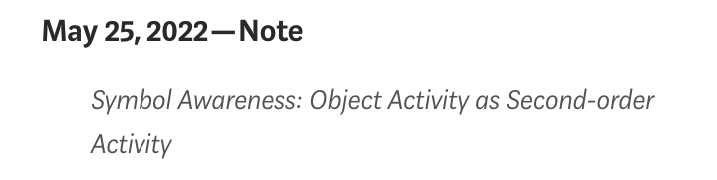
Then, I realized a new significant insight. I saw the concept of “Object Activity” in the above diagram of “Activity Network”.
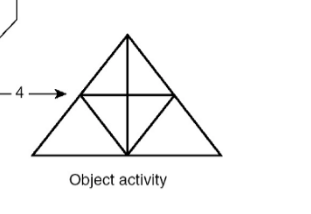
Thus, I wrote a short note. See the screenshot below:
In the previous article Slow Cognition: It takes a village to raise a creative mind, I mentioned the following techniques for capturing the 12 significant insights.
- Creative Attachance: #1, #2, #3, #5, #7, #10, #12
- Symbol Awareness: #1, #11
- Writing as Thinking: #2, #5, #11
- Double Container: #2
- Deep Analogy: #2, #11, #12
- Double Dialogues: #3
- Diagramming as Thinking: #4, #5, #6, #7
- The ECHO Way: #4
- Thematic Curation: #5, #12
- Concept Analysis: #6
- Expandness: #6, #7
- Co-creation: #8, #10
- Self-reflection: #8, #11
- Theoretical Development: #9, #12
- Empirical Research: #9
- Ecological Awareness: #10
- Immanent Development: #12
Do you notice “Symbol Awareness: #1, #11”? What does Symbol Awareness mean?
The above draft is an example of Symbol Awareness. I saw the word “Object Activity” and realized that “Object Activity as Second-order Activity”.
The concept of “Second-order Activity” is the core idea of the Anticipatory Activity System (AAS) framework.
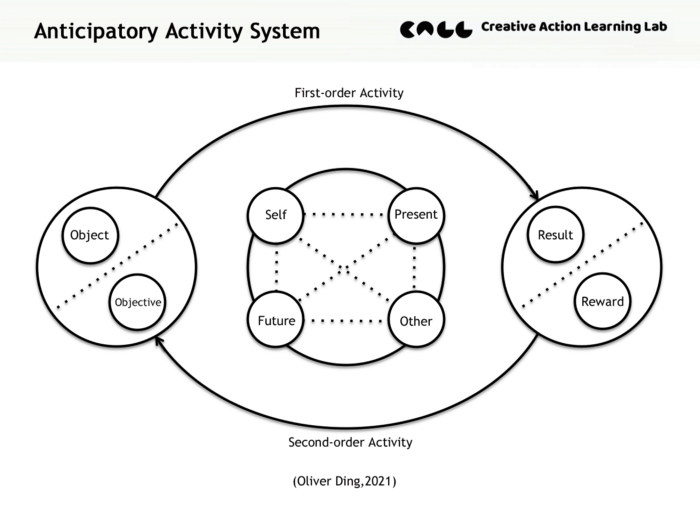
The new insight of “Object Activity as Second-order Activity” means I can use the concept “Object Activity” as the starting point of the concept of “Second-order Activity”.
Related Articles
- Knowledge Discovery: The “Perspectives — Views” Mapping
- The Project Engagement Toolkit (2022)
- Life Discovery: The Life-as-Project Approach
- The Life Discovery Toolkit (v1)
- The Life Discovery Canvas (v1.0) — Part 1: Theoretical Background
- The Life Discovery Canvas (v1.0) — Part 2: Spatial Structure
- The Life Discovery Canvas (v1.0) — Part 3A: Concepts (THINK and LEARN)
- The Life Discovery Canvas (v1.0) — Part 3B: Concepts (SAY and DO)
- The Life Discovery Canvas (v1.0) — Part 4: Inspirations
- Life Discovery: The “Being by Doing” Principle
- Life Discovery: The “Performance as Experiment” Principle
- Life Discovery: The “Engagement as Projection” Principle
- Life Discovery: The “Discovery as Development” Principle
- Life Discovery: The AAS Framework
- CALL for LIFE: Anticipatory Activity System for Life Transitions
- CALL for LIFE: Modeling A Developmental Project
- CALL for LIFE: Oliver Ding @ 2021 and Second-order Activity
- Life Discovery: Twelve Significant Insights from Four Months
- Life Discovery: “Points of Observation” and “Significant Insights”
- Life Discovery: Significant Insights Analysis
- Slow Cognition: It takes a village to raise a creative mind
- Life Discovery: The “Tacit” Type of Second-order Activity
- Life Discovery: The Unfoldness of Activity
I am also working on building a new website for the Platform Ecology project. You can save the following links:
- PlatformEcology.org
- Twitter: @PlatformEcology
- Linkedin: @PlatformEcology
You are most welcome to connect via the following social platforms:
Linkedin: https://www.linkedin.com/in/oliverding Twitter: https://twitter.com/oliverding Polywork: https://www.polywork.com/oliverding Boardle: https://www.boardle.io/users/oliver-ding


