
Neon Lights and Moon Shadows
Seeing the light through the poetic audio-visual installations of Cerith Wyn Evans…
A fascination with light runs through the career of artist Cerith Wyn Evans since he started out making art films in collaboration with Derek Jarman during the early 1980s. But, for me, his work first came to light when I started teaching experimental photography and lens-based media around the turn of the millennia. I recall his ingenious photograph taken in Munich during the 1999 solar eclipse. It became a perennial image that I would share with classes, inspiring us to look the other way when searching for a picture to capture. It was a brilliant and clear illustration that often the most interesting, individual image is not to be found where the attention of the crowd is drawn. One key role of the photographer is to show us what we may have missed.
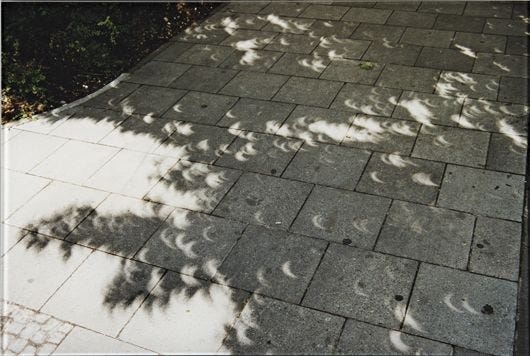
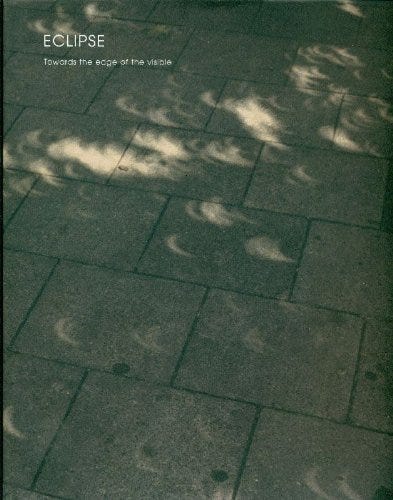
Whilst the majority of observers were, quite understandably, engrossed with watching this rare astronomical event through viewing filters, welding goggles, and similar safety apparatus, Evans demonstrated an artist’s understanding of light, remembering how the dappled shade of trees can act as a multi-aperture ‘pin-hole’ projector, throwing repeated images of the eclipse onto the pavement as it progressed. A moment of both simplicity and genius.
Light. Travelling through space. Casting shadows. Captured. The insubstantial made material.
Over the next decade, Evans increasingly built upon this crucial observation and transiterated the concept into gallery settings. He began including living plants, such as small trees, as part of his installation works. Sometimes, these stood alongside geodes that contrasted different time scales of the biological and the geological. Often, spot lamps and projectors would cast tree silhouettes onto the white walls of windowless interiors. Creating complex dapple drawings with foliage shadows.
The instant visual gratification linked viewers to the landscape outside — perhaps a not too distant place where these trees and the gallery visitors would be ‘happier’. The artificial replication of such a natural lighting effect may conjure memories of early morning long-light or sunsets, perhaps in exotic locations, romanticised by recall. We may begin to imagine somewhere else beyond the ‘sterile’ setting. In this way, Evans is dealing with the concept of site and non-site, brought to the fore by Robert Smithson in the 1960s, as well as linking back through art history to the Romantic landscape painters along with the Impressionists and their fascination with capturing light.
On top of all that, like Smithson, he explores media more usually associated with the sciences — the biology of living things and chemical processes such as photosynthesis. How do these plants remain healthy and green in an artificial environment lacking natural sunlight?
So, we may also enter into an environmental discourse and it’s difficult to use living trees as art without referencing Joseph Beuys, along with the green movement the German artist had helped instigate, plus ideas of process art and social sculpture.
Apparently, Evans had UV lamps brought in when the galleries closed, to ‘feed’ the plants with energy during the extended shows. Again, this brings us to issues associated with the global climate crises. In order to save nature, which our industrial progress has already irreparably impacted, we will have to act positively, finding technological solutions to undo the damage we’ve done.
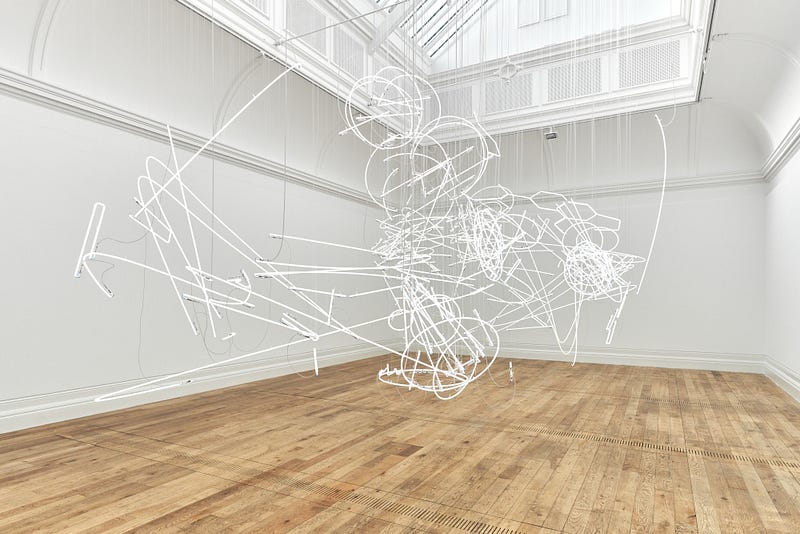
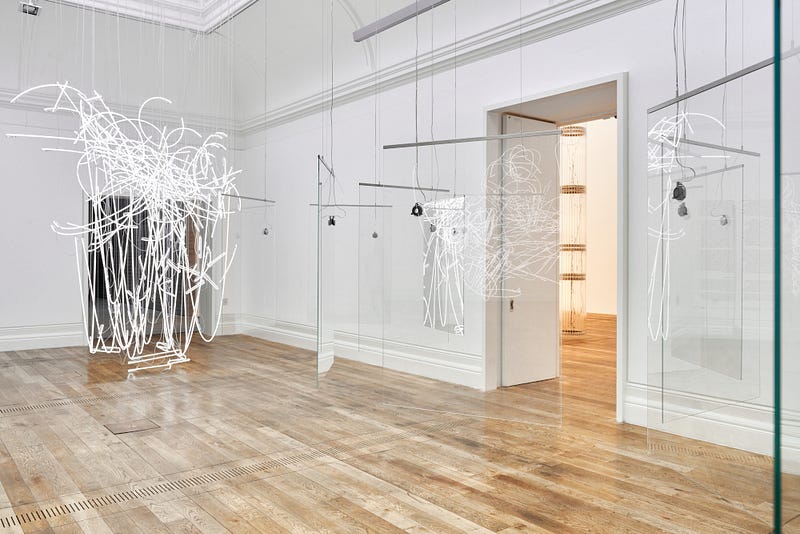
Major installations by Evans also incorporated other elements such as neon tubes and large transparencies that would present ‘invisible’ barriers whilst multiplying reflections to create seemingly suspended, though insubstantial sculptures. Relationships of spacial perception changed as each individual observer moved among the exhibits. Sound also plays a part and these large sheets of glass and perspex are sometimes electronically vibrated, turning them into resonators, pervading the space with another important though invisible element. Text became more prominent, appearing as typographic neon forms, or played back as narrations. In one way, he has returned to his beginnings in audio-visual art, deconstructing all the elements utilised in film and inviting us into his mise-en-scène.
Light. Travelling through space. Casting shadows. Reflected. The insubstantial made material. Materials made audible and directly interacting with our physical presence (via ears). Words transformed into light and directly entering our consciousness (via eyes). Time and space. Process and experience.
In 2003, Evans had represented Wales at the Venice Biennale with Cleave 03 — third in a series of installations relying on light and coded meanings that are either obfuscated or revealed through conventions of language. For this he set up a military searchlight, from World War II, to beam messages in flashing Morse Code up into the night sky. The text it carried was a transcript of Gweledigaethau y Bardd Cwsc / Visions of the Sleeping Bard, a poetic work by the priest and author, Ellis Wyn, first published in 1703.
Evans had become increasingly fascinated with communications and its disjoint when sound and vision interact, when codes overlap, and media modalities collide. Here a visual medium carried what started as text-based information encoded in Cymraeg — the indigenous language of Wales — recoded into Morse. It’s estimated the insubstantial beam of light penetrated Earth’s atmosphere as a visible column to a height of seven miles, or more… and continues to infinity through space.
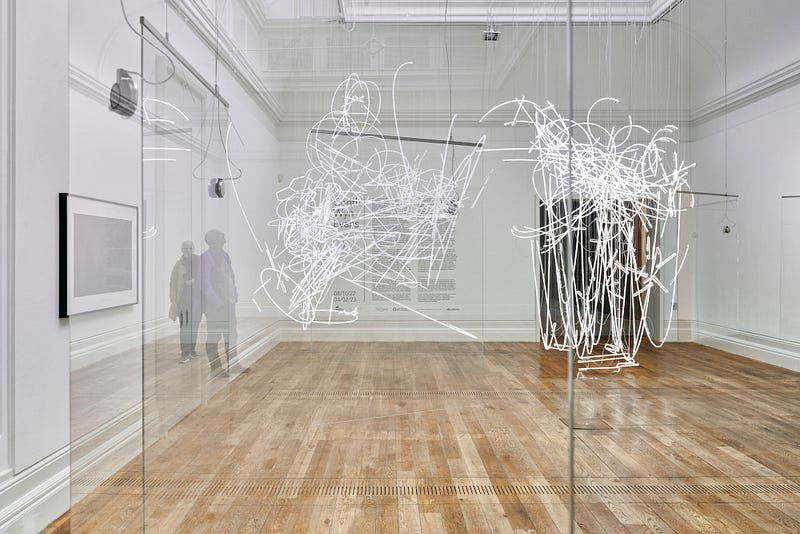
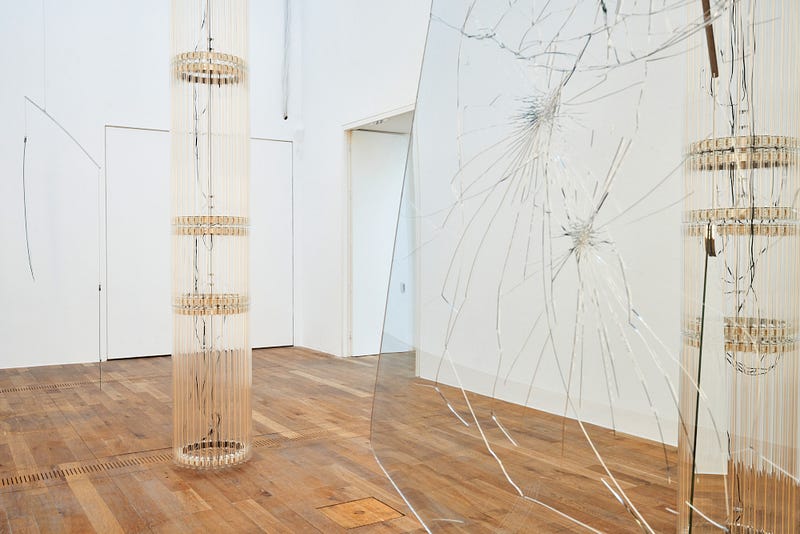
Recently, neon has become a dominant medium culminating in his installations titled with the code ….)( which bring together many strands from his career to date, and currently on show at Oriel Mostyn Gallery in Llandudno, Wales — a return to the artist’s homeland and heritage.
At first glance these large fragile sculptures look like abstract drawings of light through three-dimensional space — asemic expressions that alter as visitors approach them, moving around and among them. Adding to the sensory input is the sound coming from large, resonating, transparent mobiles in which the neon scribbles reflect and slightly shimmer making the sonic visible as they vibrate. This major, walk-through work explores spacial relationships and how meaning can be encoded, conveyed and disrupted by gradients and transitions of energy.
Again, we may think of similar obsessions that pervade the oeuvre of Joseph Beuys who interpreted aspects of nature as processes, of energetic interactions, and pondered how to harness these into human energy, by which he meant creativity. No doubt, Evans is very aware of this connection as he is of the visual references to Marcel Duchamp’s game-changing work, The Bride Stripped Bare by Her Bachelors, Even or The Large Glass (1915–23) which celebrates its centenary in 2023.
Evans makes explicit reference to Duchamp’s installation in the fractured surfaces of some of his suspended transparencies — seemingly repurposed windscreens and frameless windows of laminated glass — where the disruption of cracks draws attention to a surface which would otherwise be visible only by its reflection and distortion of surroundings. Also, the reflected image of the viewer becomes incorporated into these compositions. He has previously quoted Duchamp, particularly in his 2015 installation The Illuminating Gas… (after Oculist Witnesses), in which he reproduced instantly recognisable formal elements from The Large Glass in his arrangement of neon works.
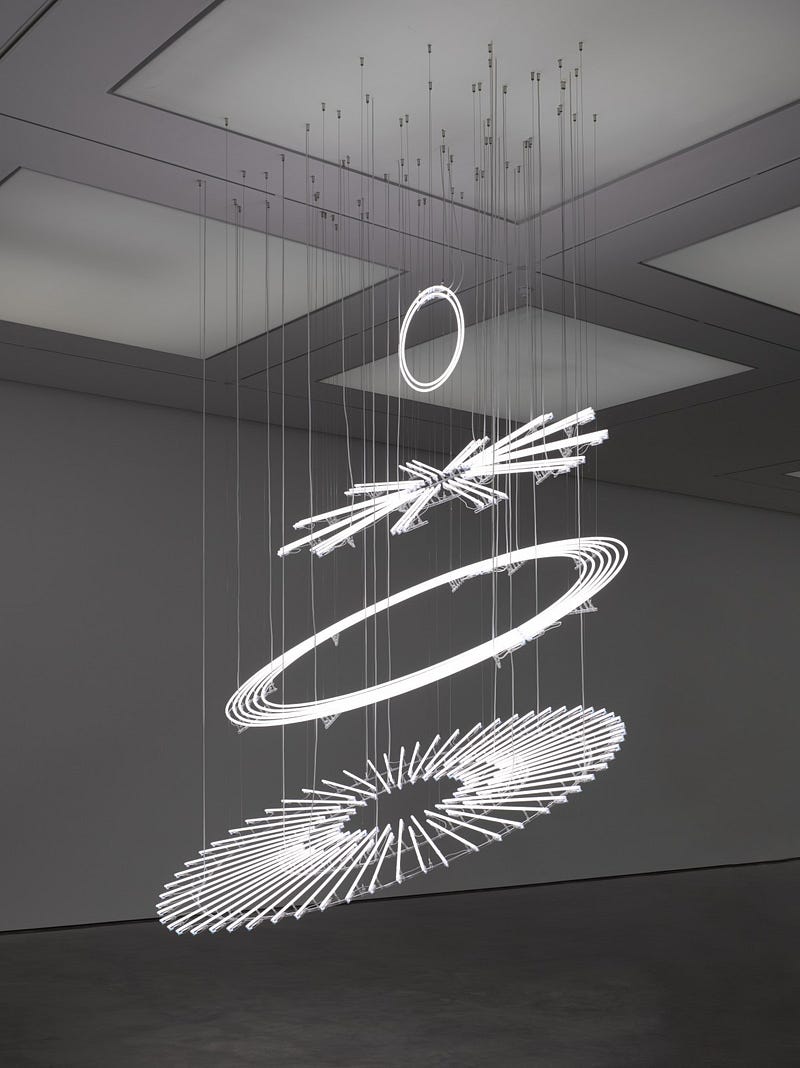
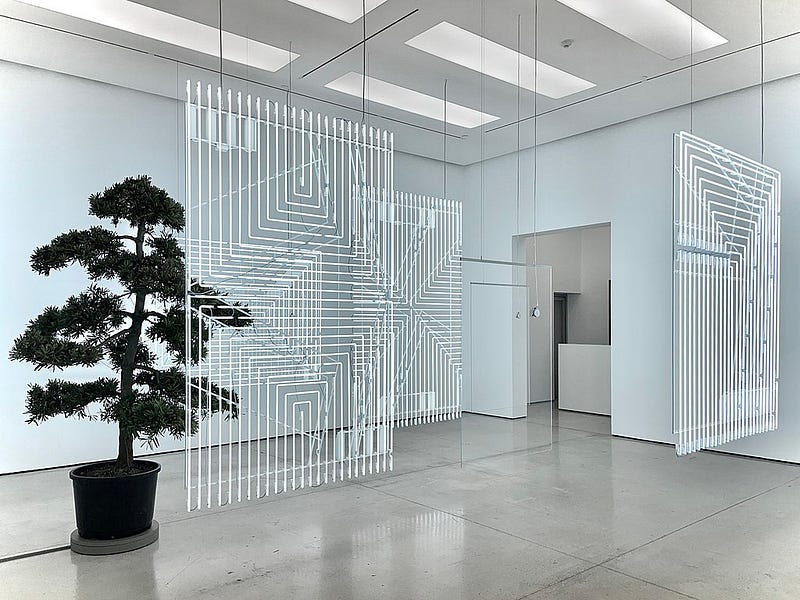
(_of,_a_clearing,_Cerith_Wyn_Evans,_White_Cube_Hong_Kong,_2022.jpg)
Cerith Wyn Evans, a radically inventive contemporary artist, recognises and draws from a rich contextual heritage that links literature, Romanticism, and Modernism, embracing the transmedia polyexpressiveness spoken of by the Italian Futurists who considered cinema to be (potentially) the most powerful medium for Modern art because film synthesises nearly all other art forms into a cohesive, time-based medium. When one considers this claim, it seems that Evans is still true to his roots as a post-Modern film-maker, deconstructing and reconstituting polyexpressive elements. He’s using audio-visual media to convey coded streams of information that compliment or contradict each other, celebrating ambiguity whilst revealing meanings through the time-based experience of the individual.
* All images are used by kind permission, or are presented here for educational purposes under fair usage policy.