
This Island, Earth
Season’s Greetings! To all on (and off) the planet as we revisit ‘Earthrise’, the most influential image of the twentieth-century.
With the splashdown of the Orion spacecraft earlier this month, on 12 December 2022, the Artemis 1 mission concluded successfully. heralding a new Moon Age. More than half a century ago, on 24 December 1968, the Apollo 8 mission’s CSM-103 spacecraft had orbited the Moon and its three astronauts — Frank Borman, James Lovell, and William Anders — had become the first humans to travel beyond the Moon and witness an Earthrise… and, almost accidentally, William Anders had captured a world-changing photograph — the first photo-portrait of our world.
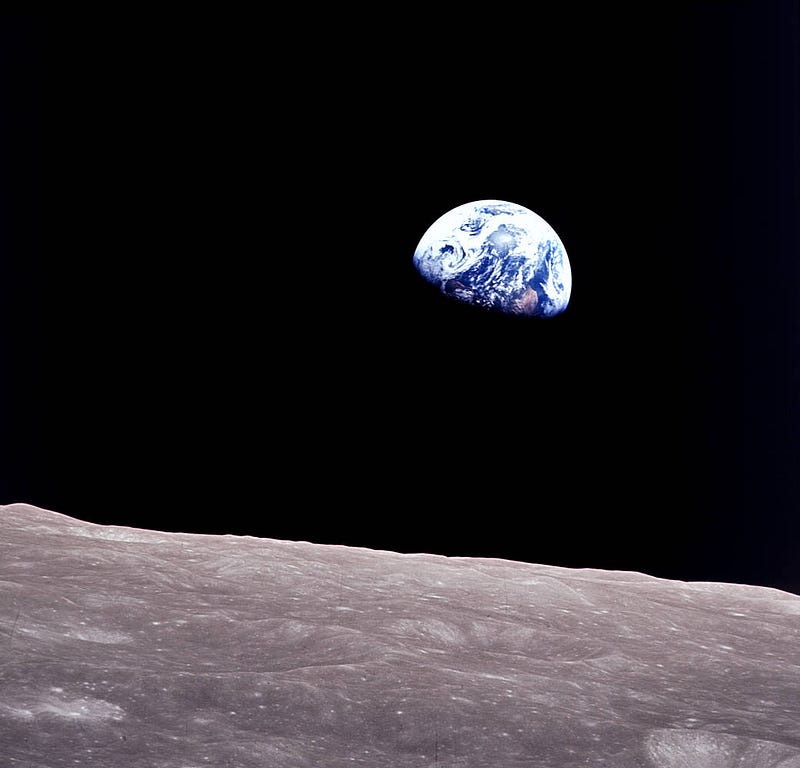
The very first ‘portrait’ was in black and white, taken before the Earth had risen clear of the lunar horizon, but swapping the film led to the photograph we all know: The planet’s colours and clarity are striking as it hangs in featureless infinite black over the barren, almost colourless surface of the cold Moon. It’s a beautiful photograph, both in formal composition and aesthetic purity. A powerful image, conveying a haunting poetic poignancy and evoking a strong emotional response.
From NASA recordings of the moment the image was captured:
Anders: Oh my God, look at that picture over there! There’s the Earth comin’ up. Wow, is that pretty! Borman [with irony]: Hey don’t take that, it’s not scheduled. [shutter click] Anders: You got a color film, Jim? Hand me a roll of color, quick, would you? Lovell: Oh man, that’s great.
Clearly, the astronauts knew those pictures were going to be great. Although they could never fully convey the excitement shared during those unique moments, perhaps they had an inkling of the transformative power of what they had captured. But did they know how profound the change in our collective human consciousness would be?
NASA (National Aeronautics and Space Administration) shared the iconic image far and wide across print and screen media. For the first time, the world could be seen and comprehended as one, unique, isolated object in the void of space. The stark contrast between the desolate lunar surface and the blue of oceans streaked with white clouds made a statement about all life on Earth and its absence elsewhere. It’s a sobering thought that every living human is, technically in this one photo… except for the three-man crew of Apollo 8.
Terminology like ‘our spaceship Earth’ and ‘the global village’ entered common conversation. Suddenly, the human species gained a deeper understanding that we all share our communal voyage through time and space on one comparatively tiny sphere. We depend (up)on it… and each other.
The rest of the world doesn’t seem so far away any more. The seas no longer appear endless and the atmosphere could be seen to be far more meagre than we imagined. Actions taken by a nation on the ‘other side of the world’ clearly concern us all. Pollutants we pump into the air, we will breathe back into our lungs. Poison poured in the ocean doesn’t simply disappear into the deeps… for better or worse, we are at one with the world and interdependent with all living things.
As a result of this single photograph, the nascent eco-awareness zeitgeist rapidly spread, globally. Rachel Carson’s seminal book, Silent Spring, published in 1962 had primed people to start reevaluating human impact on the natural world that we are intrinsically part of. A book, though, has to be read and talked about for its message to sink in. An image is instant.
When Apollo 8 was launched, no nation had any serious environmental policies or protective laws in place. Within just a few years of the publication of Earthrise, major political parties were beginning to include environmental policies in their campaigns.
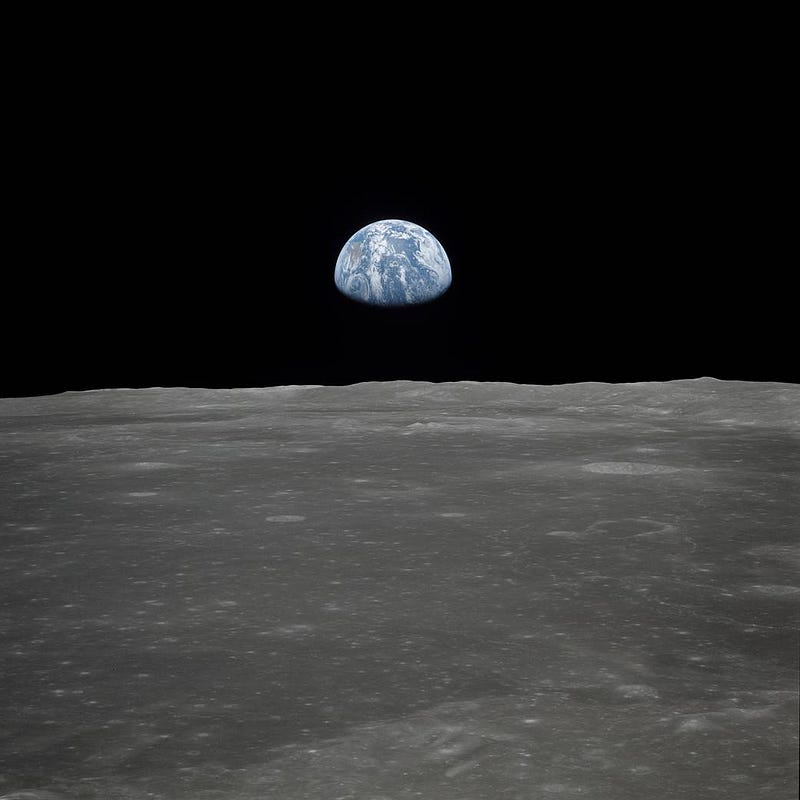
In 1969, NASA’s Apollo 11 moonshot held the attention of the world as its Lunar Module, Eagle, landed on the Sea of Tranquility and Neil Armstrong became the first human on the Moon, joined some 20-minutes later by Edwin ‘Buzz’ Aldrin. The two astronauts spent the next 21 hours doing science and exploring the Lunar landscape while Michael Collins piloted their Columbia spacecraft in orbit.
They brought back another earthrise photograph of similar austere beauty. A greater expanse of lunar surface fills more than half the frame, making the Earth seem all the more alive yet frighteningly fragile, adding to the ‘gravity’ of the Apollo 8 image.
At a 1969 Conference, UNESCO proposed annual events to honour world peace, global cooperation, and the health of the Earth. The first ‘Earth Day’ events were held on 22 April 1970, taking the form of activism and environmental awareness ‘teach-ins’.
The first significant state action was signed-off by President Nixon when he called for the formation of an Environmental Protection Agency and by 1970 legislation was being passed to control pollution and disposal of industrial waste in the environment. The same year, Britain was the first country to appoint a Minister for the Environment and by 1973 there were enough to form the EU Council of Environmental Ministers, setting-out the very first Environmental Action Programme (EPA). Environmental policy had become a core political concern by the mid-1970s and new, forward-thinking parties were beginning to campaign on predominantly environmental issues — the first ‘Green Parties’.
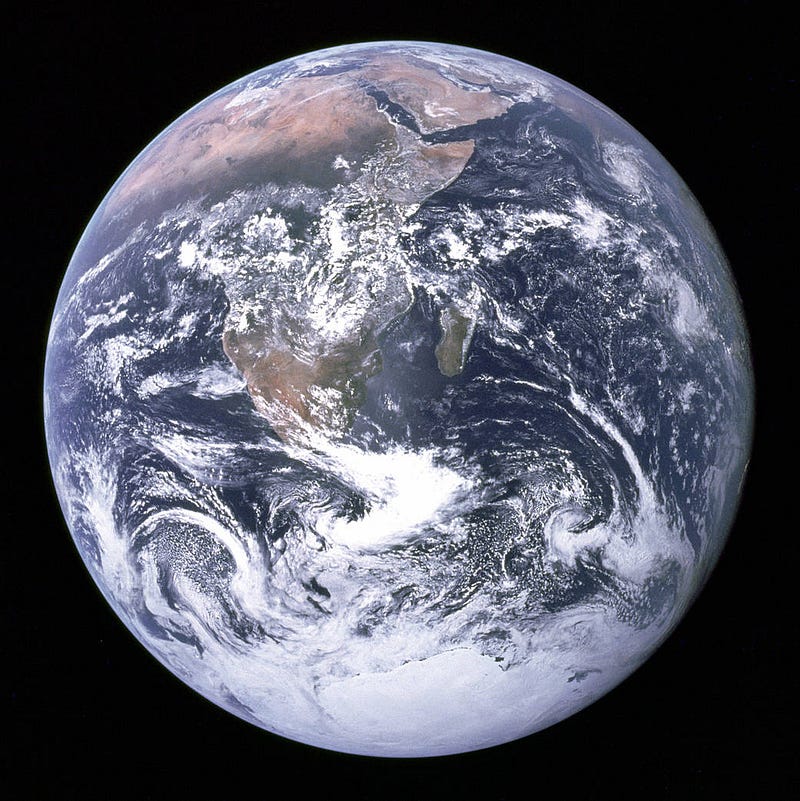
The 1972 Apollo 17 crew — Eugene A. Cernan, Ronald E Evans, and Harrison H Schmitt — captured another iconic portrait of the planet, one that would become one of the most reproduced and distributed image on the planet. Now referred to as The Blue Marble this photograph was, at the time, the clearest image of the whole Earth, fully lit to pick it out as a beautiful, marble-patterned disc in the blackness. A soft glow diffuses through the diaphanous atmosphere and there’s just enough chiaroscuro to indicate it’s a sphere, dominated by the distinctive blue of oceans of liquid water, dappled by the streaks, smudges, and swirls of purer water vapour, clouds. The most prominent landmasses to be seen here are the immense continents of Africa — banded with desert and lush jungles; Madagascar — greater and greener than many would’ve thought; and Antarctica — reflecting bright snowy white, and bigger then than it is now.
The Blue Marble was adopted by the Earth Day organisation as their emblem which, photo-transferred onto a deep blue background, they propose as the Earth Flag — a symbolic flag representing all the people of Earth. It represents a non-partisan, collaborative attitude to dealing with issues that effect the whole world, such as climate justice, ecological awareness, protection of biodiversity, and pro-peace protocols.
Powerful expressions of Green ideology began appearing in mainstream media. Films like Douglas Trumbull’s powerful, post-apocalyptic and heartrendingly poetic Silent Running was also released in 1972. It may be one of the most emotional please for environmental compassion ever to hit the big screen — effectively moving but too sad, for me, to watch often. It was closely followed by Richard Fleischer’s 1973 earthbound dystopian movie, Soylent Green. The scene where Edward G Robinson’s character, Sol Roth, undergoes voluntary euthanasia whilst watching a montage of how beautiful the natural world once was is unbearably poignant.
However, although the voice of Green Parties and associated organisations such as Earth Day, made it necessary for other major parties to bolster their environmental rhetoric, it wasn’t until the late 1990s that a Green Party was elected to government — in Germany from 1998–2002. Notably, their first Manifesto was written in 1978 by Joseph Beuys, one of the most important and influential artists of the twentieth-century.
Apollo 17 was the last of only six missions that have landed humans on the Lunar surface. Back then, it must’ve looked like we were entering a true ‘space age’. Hopefully, the beginnings of some federated future as envisioned by Gene Roddenberry’s Star Trek television series in the 1960s. Alas, it remained a ‘Moon Age Daydream’… until a new space race took shape in the second decade of the twenty-first-century. With the Artemis initiative, it seems technologies have caught-up with that dream and NASA plan to be back on the Moon and beginning construction of a permanent Moonbase by the mid-2020s.
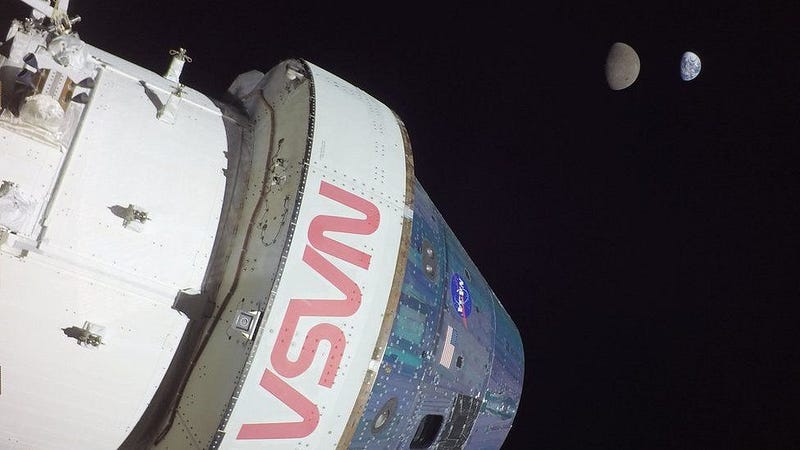
Another, inspiring image of the whole planet, this time looking even smaller and delicate was photographed along with all the moon in the same frame, viewed from the Artemis 1 mission’s Orion spacecraft. Although automated and crewless, this is the furthest point any craft designed to carry and sustain people has ever reached. It’s safe return to Earth earlier this month bodes well and yet, during the intervening half-century since the demise of the Apollo projects, our shared Spaceship Earth has continued to suffer the ravages of the Anthropocene. Ecology and the environment are at the fore of global discussion and debate more than ever. Agreements and pledges are being made aplenty, though effective actions are sadly lacking.
Just take a moment to look back over the four truly iconic images of our beautiful blue orb presented in this article. That’s it. The only place we know of, in the entirety of eternity, where we can live. As the Green movement reminds us, ‘there is no Planet B’, and we all share this tiny island in space.