
Life Discovery: “Project Engagement” and “Themes of Practice”
Life, History, and Multiverse
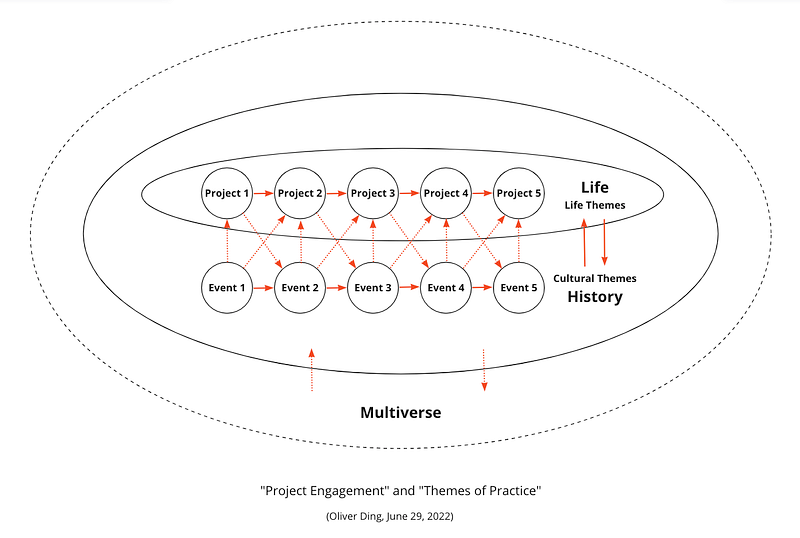
The above diagram is a significant insight about the Project-centered approach. I will consider applying it for the next version of the Life Discovery Program since it offers a zoom-out view for the Life-as-Project approach.
History as a chain of Events
On June 29, 2022, I adopted the perspective of sociology to reflect on the notion of “Activity as Project Engagement”. I realized that while we can understand Life as a chain of Projects, we can understand History as a chain of Events.
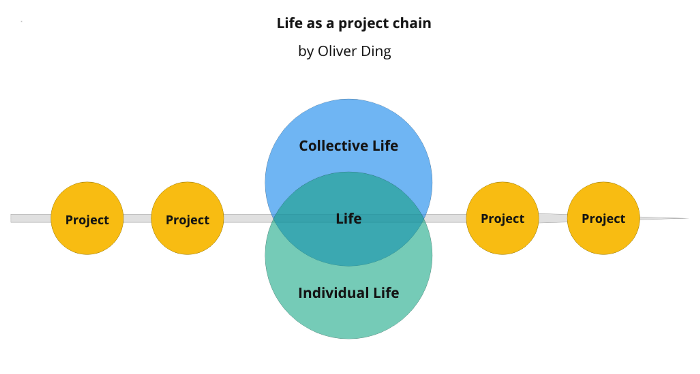
Thus, we connect “Event — Project”, “Life — History”, and “Life Themes — Cultural Themes” together.
This notion echoes my idea about “Event — Project” in Life as Activity (v0.3).
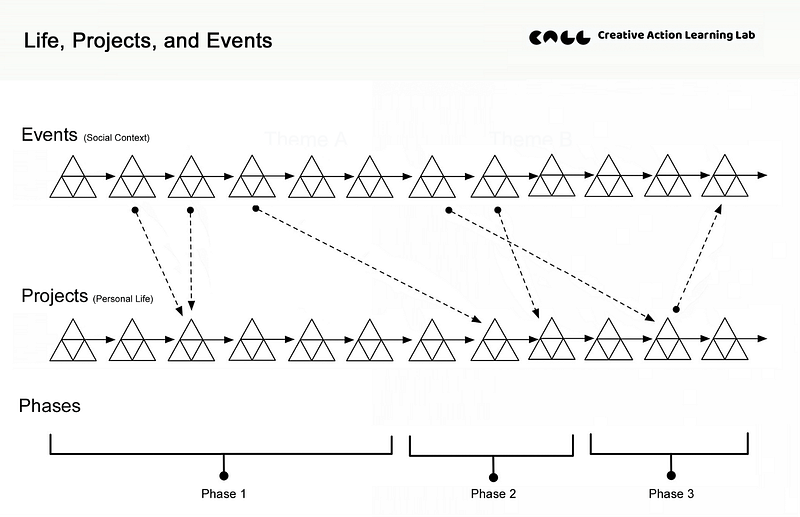
The Life-as-Project approach uses “events” and “projects” to present social context and individual biography. The difference between “events” and “projects” are individual involvement. If the person directly gets involved in an activity — it means she is the subject of the activity or part of the community of the activity — then the activity is a project of her biography. If the person doesn’t directly get involved in the activity, then the activity is an event of her biography.
Project as Thematic Space
I also connected the Project-centered Approach and the concept of “Thematic Space” together and consider the following schema.
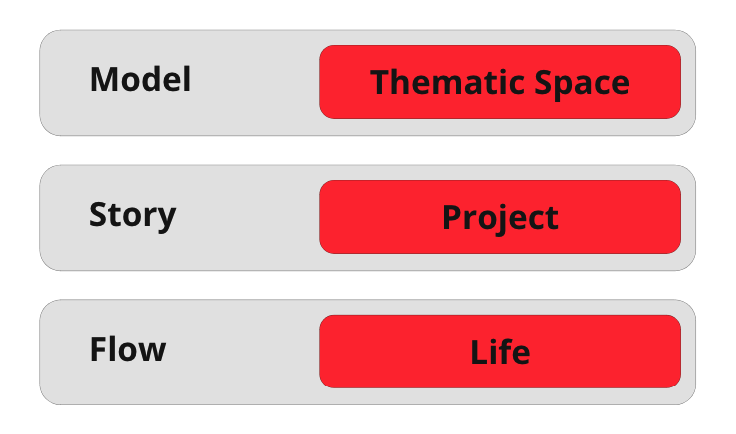
By connecting the Project-centered Approach and the concept of “Thematic Space” together, we can find the following connection:
Life = Project = Thematic Space
While Life is a chain of projects, it can be understood as a journey of moving between various thematic spaces.
Each project has its primary themes and other secondary themes. By joining projects and leaving projects, we are practicing our significant Life Themes. Thus, these projects are Thematic Spaces too.
This insight also echoes the model “Flow — Story — Model”. We can also find more details in Thematic Space: Project as Story.
Life and History
The newest insight of “Life as moving between Thematic Space” also connects the Project Engagement approach and the Themes of Practice framework.
Finally, we see a simple model of the development of life and history:
Life = Projects = Thematic Spaces = Events = History
In this way, the Life-as-Project approach echoes Andy Blunden’s notion of “a project is a concept of both psychology and sociology” (2014,p.15).
Related articles
- Life Discovery: The AAS Framework
- CALL for LIFE: Anticipatory Activity System for Life Transitions
- CALL for LIFE: Modeling A Developmental Project
- The Project Engagement Toolkit (2022)
- Life Discovery: The Life-as-Project Approach
- The Life Discovery Toolkit (v1)
- The Life Discovery Canvas (v1.0) — Part 1: Theoretical Background
- The Life Discovery Canvas (v1.0) — Part 2: Spatial Structure
- The Life Discovery Canvas (v1.0) — Part 3A: Concepts (THINK and LEARN)
- The Life Discovery Canvas (v1.0) — Part 3B: Concepts (SAY and DO)
- The Life Discovery Canvas (v1.0) — Part 4: Inspirations
- Life Discovery: The “Being by Doing” Principle
- Life Discovery: The “Performance as Experiment” Principle
- Life Discovery: The “Engagement as Projection” Principle
- Life Discovery: The “Discovery as Development” Principle
- CALL for LIFE: Oliver Ding @ 2021 and Second-order Activity
- Life Discovery: Twelve Significant Insights from Four Months
- Life Discovery: “Points of Observation” and “Significant Insights”
- Life Discovery: Significant Insights Analysis
- Life Discovery: The “Tacit” Type of Second-order Activity
- Life Discovery: The Unfoldness of Activity
- Life Discovery: Running A Developmental Project
I am also working on building a new website for the Platform Ecology project. You can save the following links:
- PlatformEcology.org
- Twitter: @PlatformEcology
- Linkedin: @PlatformEcology
You are most welcome to connect via the following social platforms:
Linkedin: https://www.linkedin.com/in/oliverding Twitter: https://twitter.com/oliverding Polywork: https://www.polywork.com/oliverding Boardle: https://www.boardle.io/users/oliver-ding


