
Inclusion Isn’t Extra Work, It IS The Work
Accommodating students in school is part of the job

This isn’t a knock on teachers
Our education system is a massive mess.
Teachers have too many students in their classroom and not enough training and resources to properly support them. Effectively supporting all students is well and truly a team job that is left mostly to the teacher with little help.
Whether teachers are given some level of support depends on their administration, school board, and political will.
It shouldn’t be like this. At all.
Whether or not our children’s needs are met shouldn’t depend on “luck of the draw” and whether we find our child placed with a teacher who gets it, or a teacher who absolutely does not.
It shouldn’t depend on whether we happen to live in a catchment area whose schools have strong leadership who truly understands inclusion, trauma-informed education, and supporting neurodivergent students.
The quality of our children’s school experience sure as hell shouldn’t depend on whether the current provincial government sees inclusive education as a politically important issue.
Unfortunately this is our reality.
Inclusion is part of the job
That said, creating an inclusive classroom and providing students with necessary accommodations is not “extra work”, it’s part of the job.
Again and again I come up against the brick wall of bureaucracy (often banging my head against it in the process). All along the chain of command, from the teacher all the way up to the superintendent, I’m met with resistance.
I’m told the team is working very hard and doing the best they can with limited resources.
I’m sure this is absolutely true.
However, if children are clearly showing us — through their words and behaviour — that their needs are not being met, then it’s not good enough. We can’t just sit back and allow the child to suffer because we’re “doing our best”.
If our best isn’t good enough, we need to figure out what is needed to do better and fucking do it. Seek out training, bring in outside resources. Fuck bureaucracy when you’ve got children in your school who are suffering.
I don’t know how or why we got to a point where we simply accepted that psychological trauma was a “normal” and acceptable part of the school experience.
Logical fallacies commonly used to avoid accountability
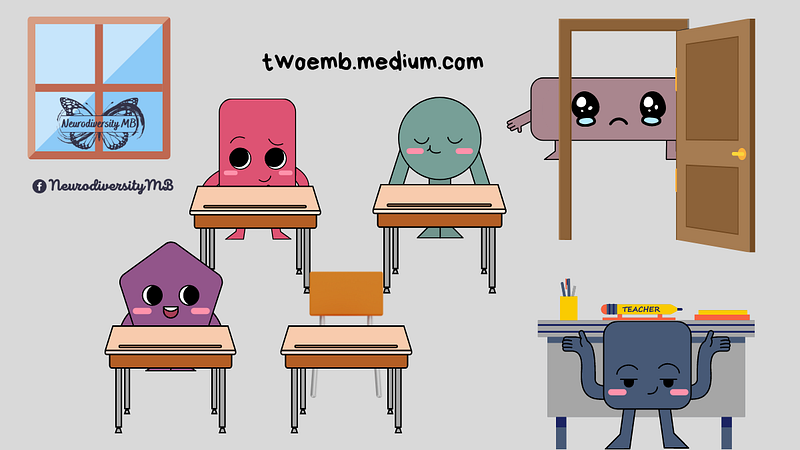
The false dichotomy fallacy:
The false dichotomy fallacy erroneously limits what options are available. “If it’s not this, then it must be this.”
Argument from ignorance fallacy:
The argument from ignorance fallacy asserts that a proposition is true because it has not yet been proven false, or that a proposition is false because it has not yet been proven true.
“Well, I haven’t seen any evidence of that!”
“It’s not a problem for anyone else… this must be a ‘home’ issue…”
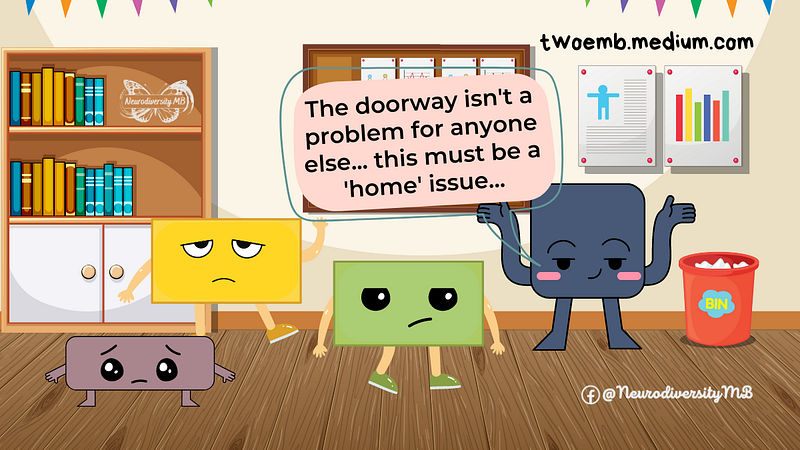
The “slippery slope” fallacy:
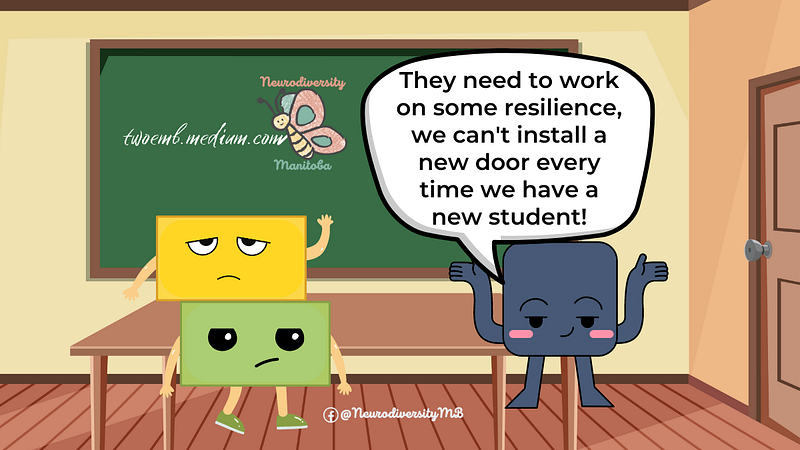
“If we do this for your child, we’ll have to do this for all the students!”
“They need to work on some resilience, we can’t just install a new door every time we have a new student!”
- This would probably be a good thing. Accommodations made for disabled and neurodivergent students often benefit all students.
- Children are better at understanding equity over equality much better than we give them credit for.
- Irrelevant. If a child needs an accommodation, then they need an accommodation.
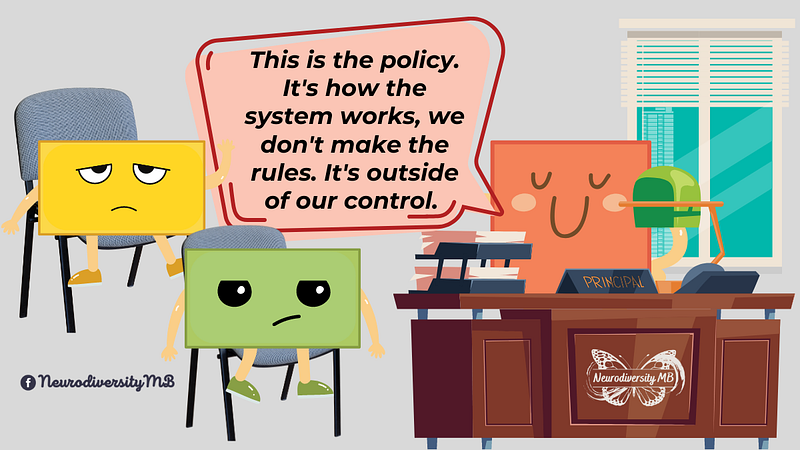
Homunculus fallacy
Using a “middle-man” for explanation (or lack thereof).
“This is the policy. It’s how the system works, we don’t make the rules. It’s outside of our control.”
And when all else fails…
When we can’t figure out an underlying cause, or come up with a solution, we presume intentional ‘misbehaviour’: Uncooperative behaviour, defiance, stubbornness, lack of effort, laziness, coddling, and/or bad parenting must be the cause.
… Which often lead us to resort to old-fashioned behaviourism.
“What if we set up a rewards chart, and they get a sticker every time they come through the door?”
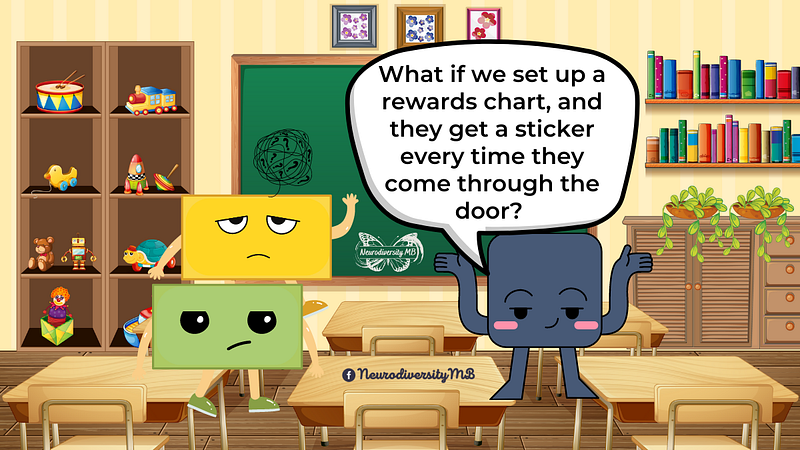
Rewarding and punishing behaviours assume the child has full control over their behaviour and is engaging in the behaviour intentionally.
When it comes to stress behaviours and behaviours stemming from neurodivergence or disability, this is rarely the case.
Our public education system needs a massive overhaul
Essentially we need to tear the damn thing down and start over, but since that is not going to happen any time soon, we need to — at the very least — go back to the source.
We need to change how educators, administrators, and school staff are trained from the very beginning. We need to provide proper training and ongoing professional development for supporting neurodivergent and disabled students.
We need a lot of things. Smaller class sizes, more resources, less bureaucracy, fewer hurdles to jump over just to get the basic needs of students met.
In the mean time, we cannot throw up our hands in defeat and accept that a portion of students in our schools will be left to flounder without adequate support, some left traumatized by their experiences.
If any change is to happen, it’s going to take push-back from all facets, at all levels: parents, teachers, administrators, and politicians. We need to work together on behalf on the children and students we care about.
Everyone will need to make noise and show our provincial government that this is a politically important issue. Re-election prospects are the only language these people speak, especially with October right around the corner.
Let’s get loud(er).
© Jillian Enright, Neurodiversity MB
Related Articles
When you join medium, as a member you’ll have access to unlimited reads for only $5 per month. If you use my referral link, I’ll earn a small commission, and you’ll earn my undying gratitude.
If you’d prefer give a one-time tip, you can support my writing on Ko-Fi — also, it’s free to follow me on Facebook and LinkedIn!


