
Handling Criticism from Family
I grew up being criticized daily. Now I’m changing my internal thought patterns to be more positive

“You are doing it wrong! You are useless!”
I would watch my mother criticize my father as they stood in the kitchen cooking together. She would carry on with her criticisms and nitpicking while my father tried to defend himself. I watched as my father got more and more frustrated with each barb lobbed at him by my mother. They started bickering loudly. On and on it went until my father finally threw his hands up and told my mother to cook by herself. He had had enough. Even when I was ten years old, I could tell what the problem was. My mother needed to chill out and stop nitpicking my father’s every move. Her criticism is the fastest way to drive other people away and ensure that she has to do all the work herself.
I watched this happen over and over again.
I hated watching them argue like that. It was stressful and frightening. I felt helpless to change the situation as they were too caught up in their own anxieties and frustrations and wouldn’t take my advice anyway. I felt so exhausted and hopeless watching them have the same argument over and over again. In the beginning, I would watch them for signs of danger. They would constantly threaten to leave each other. This was very scary for me and I was constantly in flight, fight, or freeze mode. I constantly monitored my parents to make sure no one blew up, hurt the other person, or made a real decision to divorce. After many incidents like this, I would go to my room and try to ignore them by closing all the doors and drowning out the arguing with music. It didn’t work. Thus went my hellish adolescence.
“We do not all hear the same thing when we are criticized. Some of us, the lucky ones, hear just the surface message from the here and now: that our work fell short of expectations, that we must try harder with our assignments. That our book, film, and song, weren’t excellent. This can be bearable. But the more wounded among us hear far more; criticism takes them straight back to the primordial injury. An attack now becomes entwined with the attacks of the past and grows enormous and unmanageable in its intensity. The boss or unfriendly colleague becomes the parent who lets us down. Everything is pulled into question, not only was the work subpar, we are a wretched, undeserving being, a piece of excrement, the worst person in the world, for that is how it felt back then in the fragile defenseless infant mind.” — School of Life, Criticism When You Had a Bad Childhood
I’ve been writing about how critical my parents are for the past three years yet I still find it quite difficult to deal with. I’ve written about the pressure I put on myself and my partner because my parents’ constant criticism and comparisons led me to develop perfectionist tendencies as a kid. Apparently, having perfectionist expectations in a relationship stems from insecurities. In other words, my parents’ constant criticism and comparisons led me to feel insecure in relationships. These perfectionist tendencies led me to feel the pressure to be constantly productive and to judge how my partner spent his free time if it didn’t consist of some form of work or self-improvement. Luckily, through therapy and online resources, I’ve learned that respecting one’s partner means not applying judgement to how my partner chooses to spend their time even if it’s different from how I would choose to spend my time.
I’ve also written about changing my negative core belief of having to face the world on my own. I grew up in an adverse environment where my parents and relatives rarely took my side. They were too busy being caught up in their own drama or trying to bully and compete with others in the family to cover up their weaknesses. I’ve picked a partner who is on my side. However, I sometimes get caught up thinking in the old dysfunctional dynamics and need to be reminded that no one I’m surrounded with is against me anymore. No one is actively trying to undermine, manipulate, or one up me like in my old environment. I’m developing a new habit of approaching discussions with an “us vs. the problem” mentality. I’m learning that normal couples do fight occasionally and the most important thing is to know how to fight productively instead of getting caught in toxic dynamics.
I’ve also highlighted the mental chatter in my head which can quickly turn negative if I don’t consciously find something positive to focus on. It either reruns what happened in the past few days, focusing on potentially embarrassing moments for me or starts to run negative tirades against my partner when he’s not around. I have been trying to change this automatic internal monologue for years. When I journal, mark down whenever I notice a critical thought pass my mind. This practice helps me bring awareness to how present this voice is and how distorted this way of thinking is. I’ve come up with several strategies to deal with it, like talking back to it directly to refute what it is saying. Doing this regularly helps to counter the conditioned negative thinking.
According to the School of Life, criticism is particularly difficult to deal with for the people who were shamed as children without being soothed, held, or reassured. Children who were never deeply appreciated don’t know how to defend themselves against criticism and thus take the criticism to heart. People like me who were surrounded by toxic family members find it hard to remain on my own side during challenging moments. I find this to be quite true as I often find myself shutting down in confusion and helplessness when faced with the barrage of my mother’s criticisms. I feel like I am slow to think of retorts and ways to defend myself when she attacks me. I feel threatened, worry that she might be right, my stress levels rise, and sometimes I criticize her back. It can take a day for me to calm down and feel safe and capable of intimacy again. I feel like the person pictured below.
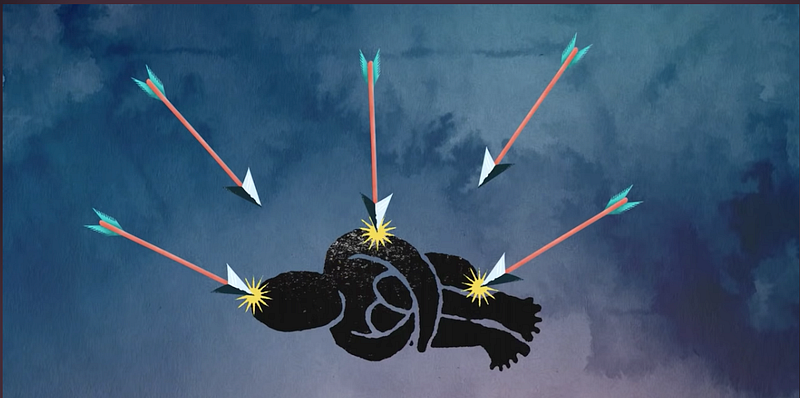
This is what I hear when I’m criticized, the messages I hear are :
- I am going to be abandoned.
- I’m not good enough. I am worthless.
I think this is a traumatic reaction to the trigger of criticism by my mother. According to Anna Runkle, the best way to respond to getting triggered by criticism is to step back from the situation, perhaps journal about the reaction I’m having, and when I’ve calmed down, express myself in response. It also helps to have supportive people in my life who can help me calm down and return to my safe place. Another great piece of advice I got was when it comes to bullying from family members, we can decide not to let their actions and opinions continually invade our hearts and minds. It’s also helpful to remind myself that criticism is often a reflection of the criticizer’s internal anxiety or pain. According to PsychCentral, it can be a way of trying to feel in control of something or someone that feels out of one’s control. Thinking about it this way helps me feel the criticism isn’t even about me. It’s about what the other person is going through.
I know the constant criticism and strict upbringing from my mother while I was growing up led me to adopt several limiting (yet unconscious) core beliefs that affected my self-esteem. For example, I believed I was inherently flawed or missing something and thus I was incapable of having healthy romantic relationships. These beliefs formed as I watched friends throughout school get into relationships and I didn’t understand how they got there. I was afraid that I wasn’t cut out for relationships or that my love was cheap and unworthy. None of this is true: I am perfectly capable of having healthy, normal romantic relationships and I am a good partner. I was just raised in an oppressive environment which led me to develop many self-limiting beliefs. I was not allowed to date as a teen and didn’t have the emotional support to navigate the various situations that relationships bring with them. Thus, I was a few years late in being able to go out and explore dating. That’s all it was.
I think I formed the negative core beliefs to protect myself in the oppressive environment I grew up in. My relatives gossiped about every man they saw me with. Instead of being supportive, I got the impression that they would be happy if my relationships went down in flames because they were unhappy themselves. I couldn’t get out of the suffocating family culture I was in and it was too unbearable to acknowledge how terrible it was so I blamed myself for having shortcomings instead. In psychology, this type of situation is known to be fertile breeding ground for automatic negative thinking. Now, I’m glad I can re-frame the situation and unearth and correct an unconscious belief that I developed as a teen and young adult when I didn’t have the emotional support to deal with my difficult upbringing. I know I deserve to be happy and in a healthy relationship.
“We all have successes and failures. Healthy people realize this. They don’t connect their own self-worth or self-value with things going perfectly and feeling like if they have a setback or a bad day, that their own value diminishes. They are actually connecting their own value to the effort they make, who they are, rather than what they are producing. They don’t hold you to a standard of perfection. They don’t hold you to a standard of having to have everything go right all the time. They extend compassion and patience to you and themselves.” — Mat Boggs
As I get older, I realize that the best way to deal with my mother’s constant criticism is to ignore the words she uses. Many are hurtful, yet she is so numb that she does not even realize the impact that her words have. As she mentioned to me once before, much of what she says is a knee-jerk reaction. I know she does love me and tries to express it through the meals she cooks for me and the things she gives me. That’s her love language. So I need to look past all the hurtful words — literally, let them go in one ear and out the other — and focus on what she is trying to say through her actions instead. She doesn’t have the capacity to put her love in words so I need to fill in the blanks for her. I think this approach will eventually help me bury the hatchet with her.


