
I’m Cultivating Self-Acceptance
I’m not perfect. I don’t have to be perfect to be accepted. I don’t have to expect other people to be perfect because, hey, we’re just human after all.

“Your hair is too long. You’ve gained weight. You’re not sitting up straight. You’re eating too much junk food. Your Chinese is so poor.”
Such are the things I heard repeatedly as a teenage and young adult in my parent’s household. They habitually commented on every little thing that I didn’t do right. The authoritarian, overprotective, competitive, and critical method of child-rearing was part of my family culture. Their dictatorial attempts to manage my behavior through constant corrections, criticisms, and commentary led me to develop the belief that I had to be perfect and it is not acceptable to my family and the world if I’m not. Not only that, I applied the same assumptions to everyone around me, assuming they were expected to be perfect and were managing to be perfect. This type of thinking made it difficult for me to be confident in myself.
My parent’s criticisms lodged themselves into my head as a critical inner voice that has bothered me in all aspects of my life for many years: work, friendship, and love. The critical inner voice takes on my parents’ pejorative tone, reminding me of past mistakes. It has told me statements such as, “I am going to fail. It’s going to be a disaster. I can’t do anything. I’m useless. I can’t deal with this. They are better than me.” It catastrophizes difficult situations, engages in paranoid mind reading, and contributes to my anxiety. It imagines that I’ll fall from grace when something positive happens for me. I got the message that I was “inherently bad” when an adult criticized me because the adult was always “correct.” That developed into another core belief. The combination of both unhealthy assumptions, that I “had to/should” be perfect and that I was “inherently flawed” became big, heavy rocks that I unknowingly carried around in my emotional backpack for many years.
As a child, I couldn’t defend myself from my parent’s criticisms, so my emotional reaction came out in other ways. I developed migraines, canker sores, cold sores, and nighttime teeth grinding. My migraines when I was ten or eleven became so bad that my parents took me to the chiropractor to try to figure out what the issue was. We didn’t realize it back then, but it was all the pressure, stress, emotional turmoil at home that was causing my symptoms. Physical reactions are the language through which we express painful feelings, especially when it isn’t safe to say them to people we’re upset with. We often say with our bodies what we can’t say with our mouths. My body was expressing my distress when I could not put it into words or share it with anyone among my family and friends.
“We dismantle the predator by countering its diatribes with our own nurturant truths. Predator: “You never finish anything you start.” Yourself: “I finish many things.” We dismantle the assaults of the natural predator by taking what the predator says and then discarding the rest. We dismantle the predator by maintaining our intuitions and instincts and by resisting the predator’s seductions.” — Women Who Run With the Wolves, Clarissa Pinkola Estés
It comes as no surprise that I developed the habit of criticizing others. When the critical inner voice wasn’t criticizing me, it was busy putting down and judging others around me. It was such a fixture in the internal chatter in my head that I was not even aware of it for the longest time. I judged someone’s actions or statements automatically. It felt so normal. I did it in my friendships, relationships, and work. The critical inner voice focused on others' weaknesses and shortcomings, saying they are irredeemable and doomed to suffer from their bad decisions and lack of personal growth. It applied the unrealistic expectation that everyone had to be perfect to everyone I knew. When people inevitably failed, it was quick to pass judgement. It was ready to abandon people at the first signs of character weakness.
Why do I do this? My hunch is my internal criticisms are manifestations of my fear of relying on people. I got anxious and frustrated that someone I could rely on may not meet my needs, leaving me let down and vulnerable. For example, I would be triggered by an indecisive person who had to make a choice that would affect me. In my head, I would criticize them for their doubt by thinking, “Why are they so indecisive? Don’t they know it affects me too?” Strangely, my critical inner voice is a mechanism trying to protect myself by warning me not to rely on others (or let them rely on me). It is a fight or flight response to what I sense as “danger.” I criticize others to place distance between me and them, making me feel less vulnerable.
Instead of being afraid though, I can take notice of my thought patterns and my feelings of vulnerability. I can accept that no one can meet all of my needs, but I can step up and take care of my needs. I can remind myself that these fears are coming from a place of fear from a long time ago and that I’m not a helpless child anymore. I’m a capable adult. If I feel secure in being able to take care of myself, I can also feel more secure relying on others. I can also remind myself that no one is perfect; everyone is going to have some character flaws. Becoming acquainted with a person’s character flaws doesn’t mean that I have to leave them. It just means they’re a human being who is imperfect, like all human beings. When I accept myself unconditionally as not being perfect, I can accept others as not being perfect.
“When you are around a critical person, the kind that finds fault with everything, you can set limits on your exposure to this person’s constant criticism. You can change subjects, rooms, houses, or continents. You can leave. But what if this critical person is in your own head? What if you are the person with the problem? What if you have met the enemy, and he is you?” — Boundaries, Henry Cloud and John Townsend
An important tool in combating criticism (internal and external) is setting boundaries. The first boundary is to limit the exposure to external criticism. I can speak up and defend myself against criticism. I can tell the person doing the criticizing that I do not appreciate the comments and I wish them to stop. If that doesn’t work, I can leave. The second boundary is generating my sense of self-worth from within. In this case, the boundary is between others’ opinions of me and my opinion of myself. I do not let the words and judgements of others affect how I regard myself because I do not measure myself against their standards.
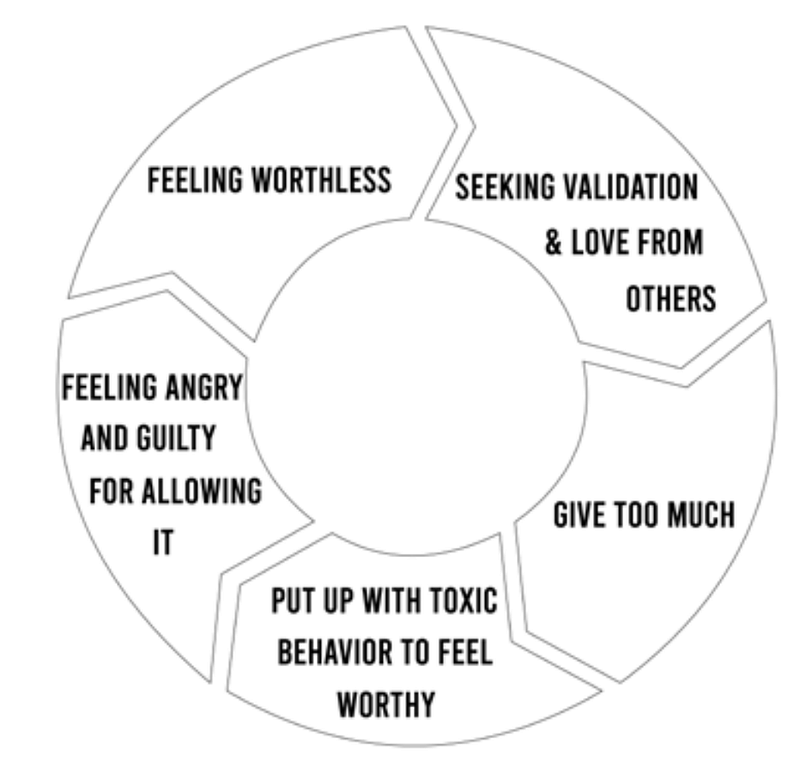
An internal sense of self-worth is one of the most important defenses against criticism. When I have a strong internal sense of self, I do not fuse with criticisms. I do not look to others for validation because I validate and accept myself as I am. When I do not get validation from others, I am not vulnerable to others’ criticisms. In this way, I can allow critical people to be who they are, without internalizing any of their opinion of me. Because I’m detached, I do not feel the need to win the approval of these people or get into heated discussions with them to change their opinion. Seeking validation from others can lead to a vicious cycle of low self-worth, especially if a person is surrounded by others who are critical (pictured below).
I came to understand that my mother’s criticizing wasn’t done out of strictness, but a desperate attempt at handling a situation that was beyond her capability. Parenting two kids was very stressful for her and she was likely out of her depth and feeling out of control. Criticizing was the only way she knew how to connect and manage. It was the same when she nagged, compared me to my cousins, or attacked my character. She was more desperate than judgemental. Although she made these comments, it didn’t mean that she would turn her back on the person she was criticizing. It was simply how it was done in her family by her authoritarian parents. She didn’t know how to get my attention in any other way and she didn’t feel heard. My mom often says to me, “You are just like your dad. He never listens when I tell a story, he always cuts me off before I’m done.”
Nonetheless, these criticisms came when I was at a young and impressionable age and they were damaging to my self-acceptance and self-esteem. I didn’t understand the driving force behind her statements at that time. I didn’t understand it was more about her than me. Although I didn’t agree with these statements, thinking of them as “lies” in my head, I still unconsciously absorbed them. The statements weren’t just directed at me. They were directed openly at my father too. She didn’t have the sense to shield me and my brother from them. I heard criticisms of him from my mother every day. The pejorative tones echoed in my head all the time.
As an adult, I made the time and effort to understand where my mother’s criticisms were coming from so I could disarm them in my head. I also stood up for myself in my recent conversations with her to say that I didn’t appreciate critical comments on my appearance or behavior. I wanted us to find other ways to connect. I did my part too in staying present, finding ways to connect with her, and interpret her statements with love. Now our conversations are less tense and more casual. My anxiety is no longer triggered by her. We manage to joke around and share some humor. It’s a far cry from the way our conversations went a year ago.
As for the critical inner voice in my head, I am using self-acceptance therapy and mindfulness techniques to become more aware of it and stop the derisive tape. It’s only when I stop judging myself that I can secure a more positive sense of who I am, according to Leon Seltzer, Ph.D. He believes self-esteem and confidence rise naturally as soon as we cease being so hard on ourselves. In order to experience, as our normal state of being, personal fulfillment and peace of mind, we must rise to the challenge of complete, unqualified self-acceptance. Self-acceptance is an act of kindness I give to myself. Accepting myself helps me extend goodwill towards others and stop my habit of criticizing them. I can see myself as not inherently bad. I can accept that I do not have to be perfect to deserve love. I deserve love because I am.
I notice I am being more self-accepting when I consciously acknowledge feeling a certain emotion instead of feeling embarrassed or ashamed of feeling it. It could be fear, nervousness, anxiety, loneliness, confidence, or excitement. Instead of hiding it or denying it, I acknowledge that this is how I truly feel and decide how to respond from a place of assurance and courage. From there, I can maintain a feeling of confidence that I am not perfect, but I am doing the best I can. I feel assured that this is enough. From this place, I can think more clearly and am not distracted or derailed by a critical inner voice very often. Even if I make a mistake, I can forgive myself easily for it. I do not linger on it for longer than necessary. I see these as the first steps I take on the path of self-acceptance.
“We set the standards for our self-acceptance. And once we decide to stop grading ourselves, or keeping score with ourselves, we can adopt an attitude of non-evaluative forgiveness. In fact, once we refrain from our lifelong habit of assessing, and reassessing ourselves — striving rather to compassionately understand our past behaviors — we’ll find that there’s really nothing to forgive [of ourselves]. Certainly, we can vow to do better in the future, but we can nonetheless accept ourselves precisely as we are today, regardless of our shortcomings.” — Leon F. Seltzer, Ph.D