
Yes, I’m Both Deaf & Sound Sensitive
Recruitment and misophonia in neurodivergent and Deaf people

Deaf vs deaf
Deaf (with a capital ‘D’) signifies a person who is culturally Deaf, as well as having hearing loss. This generally means the person is hard of hearing or deaf, uses sign language, and is involved in the Deaf community.
In contrast, deaf (with a lowercase ‘d’), is usually refers to someone who is legally deaf because their hearing is below a particular threshold. They may or may not know sign language, read lips, or be involved in the Deaf community.
People (like myself) who are hard of hearing (not legally deaf), but fluent in ASL and involved in the Deaf community, often refer to ourselves as Deaf with a capital ‘D’ for those reasons. So when I say I am Deaf, I don’t mean I am profoundly deaf.
My husband is a loud sneezer
ACHOO!
When my husband sneezes, he likes to announce it. He yells ACHOO! in a loud, booming voice, and it scares the shit out of me. Every. fucking. time.
I’ve known him for 20 years, we’ve lived together for nearly 17 years, and I still jump every time he ACHOOs. In fact, I often get mad at him for it because it makes my heart race, even though he doesn’t do it on purpose.
He can’t help it, it’s just how he sneezes. I’m sorry dear, I love you, but I hate your sneezes.
How can I be hard of hearing and also be sound sensitive?
A few reasons…
1) Sound isn’t only experienced through the ear
We perceive sound (and potential threat) through vibrations, tone, and tempo.
Think of the water vibrating in Jurassic Park when the dinosaurs were approaching — the vibrations felt in the ground would be setting off major danger signals in the brain!
When I have an intense reaction to certain sounds, it’s (in part) because my nervous system is responding to the auditory input (through neuroception). When sounds are loud, fast, reverberating, or in some other way convey a feeling of danger, my nervous system responds accordingly.
Even if I know logically that I am safe, my nervous system responds before the logical centre of my brain (the PFC) has a chance to evaluate and filter the information.
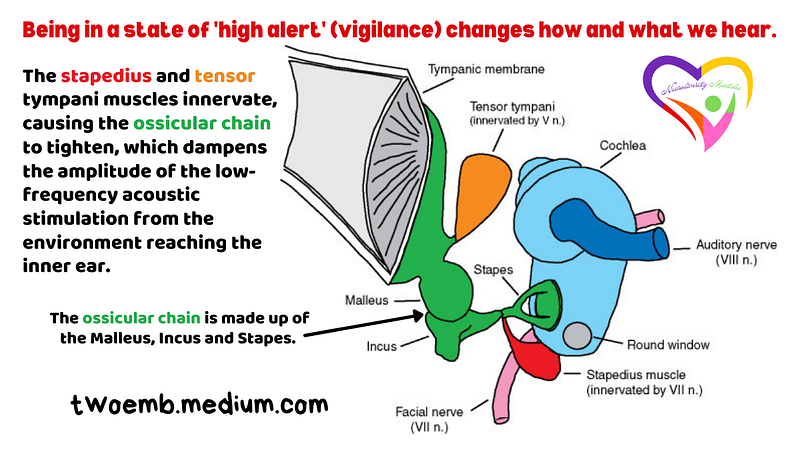
Being in a state of ‘high alert’ (vigilance) changes how and what we hear.
2) Recruitment
People who have unilateral hearing loss (hearing loss in only one ear) can experience a phenomenon called recruitment.
Recruitment causes sounds to be perceived as much louder than they actually are, despite the person experiencing significant sensorineural hearing loss.
*Sensorineural hearing loss occurs from damage to the inner ear, the nerve that runs from the ear to the brain (auditory nerve), or the brain itself.
So if we’re already sensitive to some sensory input, due to SPD, Autism, ADHD, PTSD, etc., and then experience recruitment in addition, it’s a recipe for misophonia.
What is Misophonia?
Misophonia describes when certain sounds trigger emotional or physiological responses, like when the sound of someone chewing is so aversive it triggers anger.
Misophonia is more common in neurodivergent folks, in particular people with ADHD, Autism, OCD, and mood disorders.
Believe us
Please believe people when they tell you they are experiencing sensory discomfort or overwhelm. Because you don’t share their experience does not mean they are being “dramatic”. Each nervous system is different.
When people are repeatedly told our perceptions are “wrong”, we begin to mistrust our own bodies, which — when done over time — can lead to pushing through discomfort to the point of mental health issues and burnout.
If you are prone to sensory overload, it can help to learn and understand your triggers.
There’s no “right” or “wrong” way to process our senses, everyone experiences the world differently. In fact, our tolerance or enjoyment of sensory input can vary from day-to-date, even hour by hour, depending on our mood and regulated state.
When I am regulated (calm, not feeling overloaded), I love loud, intense music. It’s a matter of feeling in control of our environment and experiences, and being able to tailor our surroundings to our present needs.
Having our sensory sensitivities understood and our needs met can have a significant positive impact on regulation, comfort, and overall wellness.
Plus, it’s kind of an asshole move to have someone tell you they’re uncomfortable or stressed, and respond with ‘no, you’re not’ or ‘it’s not bothering me, so it can’t be true’.
Just sayin’.
© Jillian Enright, Neurodiversity MB
When you join medium, as a member you’ll have access to unlimited reads for only $5 per month. If you use my referral link, I’ll earn a small commission, and you’ll earn my undying gratitude.
If you’d prefer give a one-time tip, you can support my writing on Ko-Fi — also, it’s free to follow me on Facebook and LinkedIn!
Related Articles
References
Hopkins, K. (2015). Deafness in cochlear and auditory nerve disorders. In Michael J. Aminoff, François Boller, Dick F. Swaab (Eds.), Handbook of Clinical Neurology (pp. 479–494). Elsevier. https://doi.org/10.1016/B978-0-444-62630-1.00027-5
Jager, I., de Koning, P., Bost, T., Denys, D., Vulink, N. (2020). Misophonia: Phenomenology, comorbidity and demographics in a large sample. PLOS ONE. https://doi.org/10.1371/journal.pone.0231390


