
What cuts did Christianity make to the Bible?
A religion edits its “sacred” text
The Bible was written by God, so Christianity claims. The religion doesn’t have an original manuscript. Is that the sort of thing you just throw away?
The Bible ends up being known only by much later copies. For the New Testament, scholars found some 5800 manuscripts in the Greek language. None are identical. There are some 500,000 textual differences.
As one study put it, there are “more variants than there are words…”

The religion was given a sacred text from God and set out to rewrite it.
That’s the story Christianity tells about itself. Around 250 A.D., the church father Origen writes:
“The differences among the manuscripts have become great, either through the negligence of some copyists or through the perverse audacity of others; they either neglect to check over what they have transcribed, or, in the process of checking, they make additions or deletions as they please.”
Christian scribes were well-known for ‘editing’.
Around 180 A.D., the pagan writer Celsus notes they “alter the original text of the Gospel three or four or many times, and modify it in order to be able to reject criticisms.”
Around 400 A.D., the Christian translator Jerome, likewise, complains that Christian copyists “write down not what they find but what they think is the meaning…”
I was raised Christian, and told the Bible is “inerrant.” What I see now is that if an original text survived, it would be a miracle.
Is the Old Testament perfectly preserved?
That’s what they said. Now I’m reading of the many versions of the Old Testament. When Origen set out to find all the distinctly different copies of it, he found six to seven.
There’s also the Samaritan Pentateuch, a distinctly different version whose details could totally re-write the whole story of the Bible.
The Greek translation called the Septuagint still exists, and it’s very different from anything Christians read. The Dead Sea Scrolls, found in the 1940s and 1950s, are often startingly different as well.
The version that Christianity likes is the Masoretic Text, which was prepared by Jewish rabbis in the Medieval years. After making the version they liked, they destroyed all earlier manuscripts.
That’s how you get “inerrancy.”
How much of the Bible was even preserved?
There are curious suggestions it was much larger. A text called 2 Esdras says the books everyone knows about were just a few released to the public. Most of the Bible, it says, was kept in secret for “the wise.”
The existing Old Testament refers to many books that don’t exist. ‘The Book of the Wars of the Lord’ (Num 21:14–15) or the ‘The Book of Jasher’ (Josh 10:13), etc., seem to have been ‘lost’.
We’re told in Kings 4:29–34 that Solomon wrote 1,005 psalms. In the existing Bible, there’s two. A note in the Dead Sea Scrolls says that David wrote 4,050 psalms. The current Bible has some 73.
The New Testament quotes books that don’t exist.
In Matthew 2:23, a prophesy of the messiah is noted. There’s no source for it. In Matthew 5:43, in the Sermon on the Mount, Jesus says: “You have heard that it was said, ‘Love your neighbor and hate your enemy.”
No existing scripture says “hate your enemy.” But there are apparent quotations of non-existing scriptures, as well, in Luke 24:46, 1 Corinthians 2:9, and 1 Corinthians 15:45.
The New Testament verse Jude 1:9 appears to quote a book called the Assumption of Moses. In this case, Christianity had a copy, then “lost” it.
There’s a huge array of what are called “apocryphal” texts — that seem biblical, but the religion doesn’t like them, for reasons that can be elusive.
A huge record of biblical “variants” exists.
Christianity largely ignored them, in a rush to establish a ‘canonical’ text. Only in the 1960s did scholars begin to see the many Bible manuscripts that have “odd” or “different” wording as worth examining.
The variants start from the first line of the Bible: Genesis 1:1. We expect to find: “In the beginning God created the heavens and the earth.”
But several early Christian sources quoted Genesis 1:1 to say:
“In the son God created heaven and earth.”
A line spoken by God at Creation was quoted in two early Christian texts, the dialogue Jason and Papiscus and the Epistle of Barnabas. The line is:
“Behold! I am making the last things just as the first!”
No existing manuscript of the Old Testament has such a line.
Jews appear to have been re-writing the Old Testament to remove messianic references.
That’s the claim of early Christian writers. In the 2nd century, Justin Martyr said that the Old Testament was being edited to remove passages that would seem to point to Jesus. He quoted a line he said was by Jeremiah:
“The Lord God remembered his dead people of Israel who lay in the graves; and he descended to preach to them his own salvation.”
The same line was also quoted by the early Christian named Irenaeus. No Old Testament manuscript has been found with this line.
The Hebrew text of Psalms 110:3 sings in praise of young men approaching God “like dew from the morning’s womb.” Several early Christians wrote of the verse as not having the word mrḥm or ‘womb’ but rather mrym, i.e. Miriam or Mary. The apparent edits go on and on.
The more ‘variants’ seem to exist as verses are key to Christian ideas of sexual relationships.
In a 1993 paper, the scholar David Parker studies the manuscript evidence for Jesus’ teachings on divorce. For each verse he found upwards of eight distinct versions.
He concludes that an ‘original’ of these verses “does not exist today…”
Sometimes the alternate version is absence. The lament by Jesus from the cross at Luke 23:34 — “Father forgive them, they don’t know what they’re doing” — exists in some manuscripts and not others.
The passage Luke 22:43–44 is often missing in early manuscripts. That’s the scene where Jesus is in “anguish.” The scene was later said to have displeased Christian copyists who thought Jesus looked “weak.”
The message I take is that any passages which survive are the ones that didn’t offend whoever was doing the copying.
Christian copyists seemed to think the text had to be revised until it “made sense”
Take the ‘Lord’s Prayer’ of Matthew 6:5–15, where Jesus says: “Give us today our daily bread.”
That makes sense? Just pray, and God will feed you.
Is that how the passage actually went? The first gospel, known as the ‘Hebrew Gospel’, was later lost, but several early Christians quoted it to have Jesus saying: “Give us today our bread for tomorrow.”
This seems unusual? With a little edit, changing ‘tomorrow’ to ‘today’, the sentence “makes sense.” But it could have concerned a theological concept: Jesus’ future Kingdom, where the resurrected saints are said to eat the “bread of angels” (Ps 78:24; cf. Exo 16:4 & Wis 16:20–21).
Can we be sure the line wasn’t revised by Christian scribes to “make sense” to them? That process seems to strip the spiritual reference and change the context to the physical world.
The ‘Hebrew Gospel’ is also the text in which Jesus calls the Holy Spirit his ‘Mother’.
Entire scenes appear to have been rewritten to remove or downplay the troublesome woman.
In the ‘variant’ manuscripts, that theme keeps coming up. There’s an emerging case that Mary Magdalene was more prominent — but was slashed to make her less prominent.
Or consider the ‘Freer Gospels’, a manuscript found in 1906 that has a scene with Jesus recalled by Jerome but not seen in any ‘official’ manuscript. Jesus calls the male disciples ‘blind’ and unable to see spiritually, unlike the women who had recognized him.
That was dismissed, just like a copy of the gospels called the Bezae Codex which surfaced in 1581. It had a different version of the book of Acts.
As the scholar Jenny Read-Heimerdinger explains, in this ‘different’ Acts, the disciples seem less like magical heroes and more like “fallible human beings who only gradually come to grasp the full extent of the radical nature of Jesus’ message.”
Not the story the religion wanted to hear.
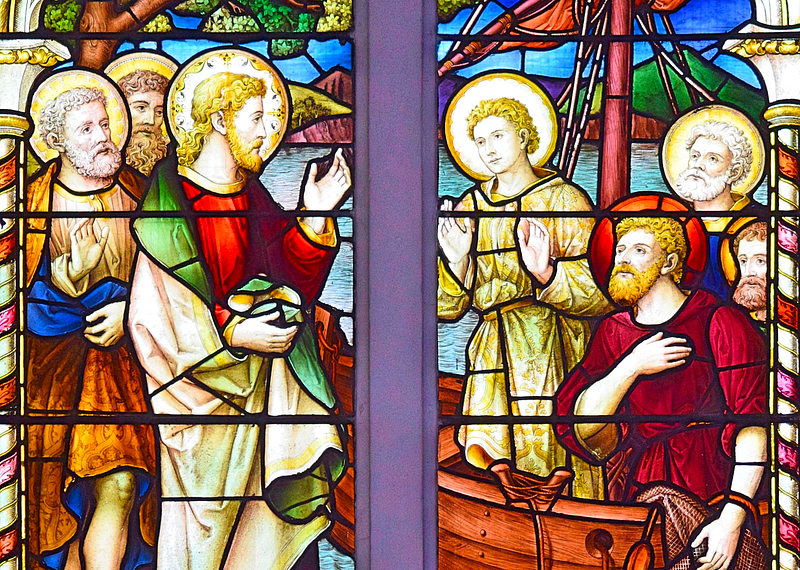
You know it’s “orthodox” if men are being praised.
But an unexpected alternate history of the religion seems to lurk. You might not hear about it in church, but a faith can seem to be described that wasn’t sexist at all.
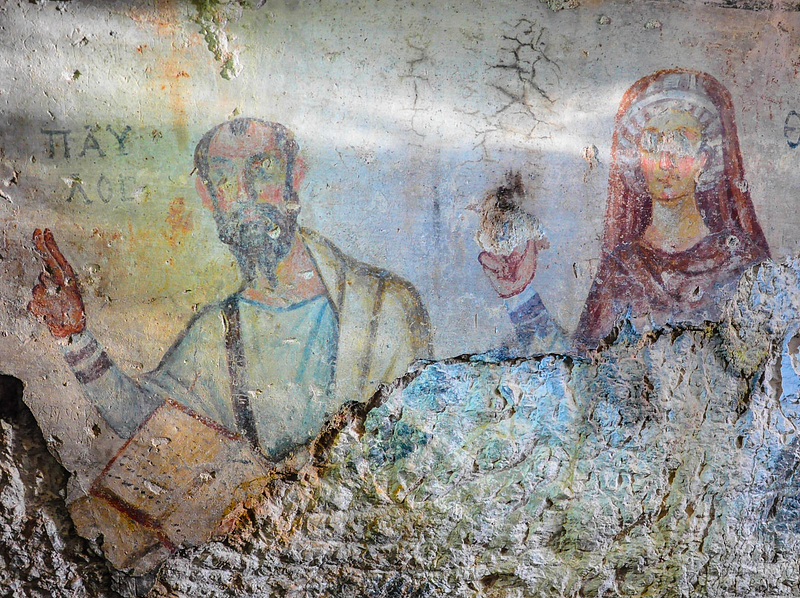
I think of a mural found by archaeologists in 1906, hidden behind a wall in an old church in Ephesus. The apostle Paul is seen with his female companion, Thecla — her eyes at some later point gouged out and her hand, raised in the ‘teaching’ position, burned away.
The artist had access to a Bible that suggested parity with men and women. A later Christian editor had different ideas.
Christianity became the Bible’s author.
That might be the impression we get. Take Philippians 1:1, the only verse in Paul’s writing that refers to the church offices of ‘bishop’ and ‘deacon’—terms known to every Christian. These are the men in power!
The oldest copy of the letter appears not to have that verse.
In 1 John 5.7–8, we find the only clear statement of the doctrine of ‘the Trinity’. It’s now widely considered a later insert.
The passages, that is, which set out ‘God’ in masculine terms, and define church offices—the religion wrote itself. Maybe it was the only way they’d get a Bible they actually liked. 🔶


