Scholars Found Another Version of the New Testament
The strange story of the Bezae Codex
In 1581, Theodore Beza, the Protestant leader of Geneva, sent a gift to the chancellor of Cambridge University — a very old New Testament.
On facing pages were Greek and Latin versions of the text. Beza didn’t say how he got this remarkable volume, only that it came from a Catholic monastery in Lyon, France, where it had “lain long in the dust…”
He provided no reason for why he was sending the book to England as an addition to the Cambridge library. He ended on an odd note.
This “corrupt” manuscript is “better hidden than published.”
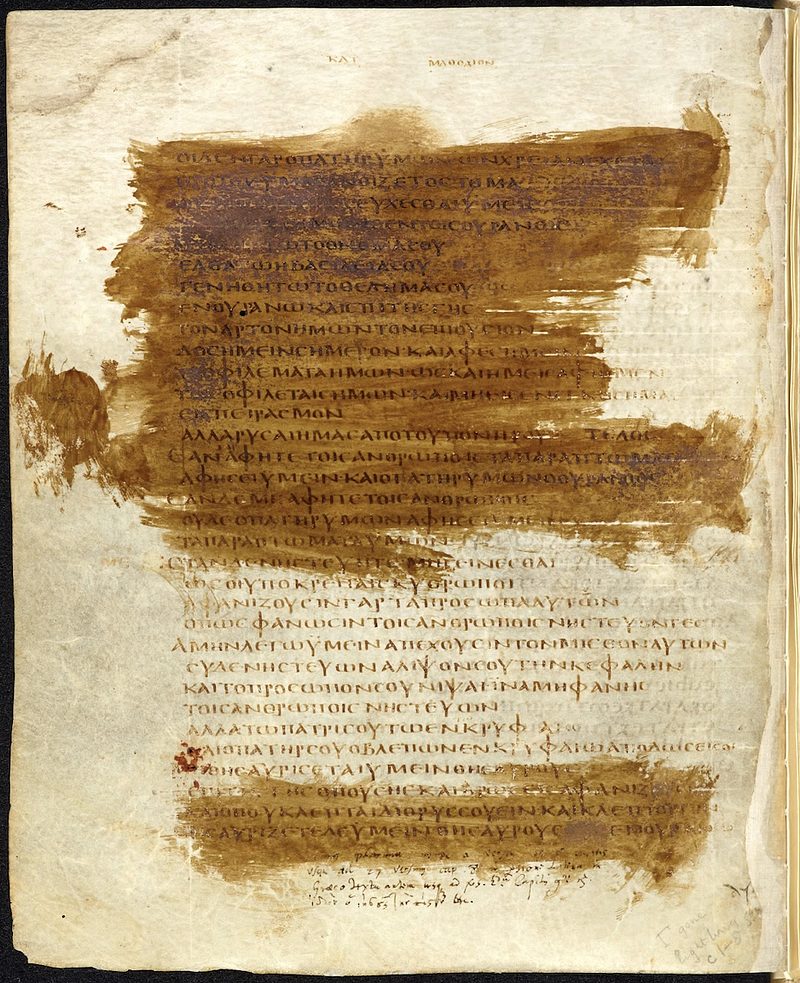
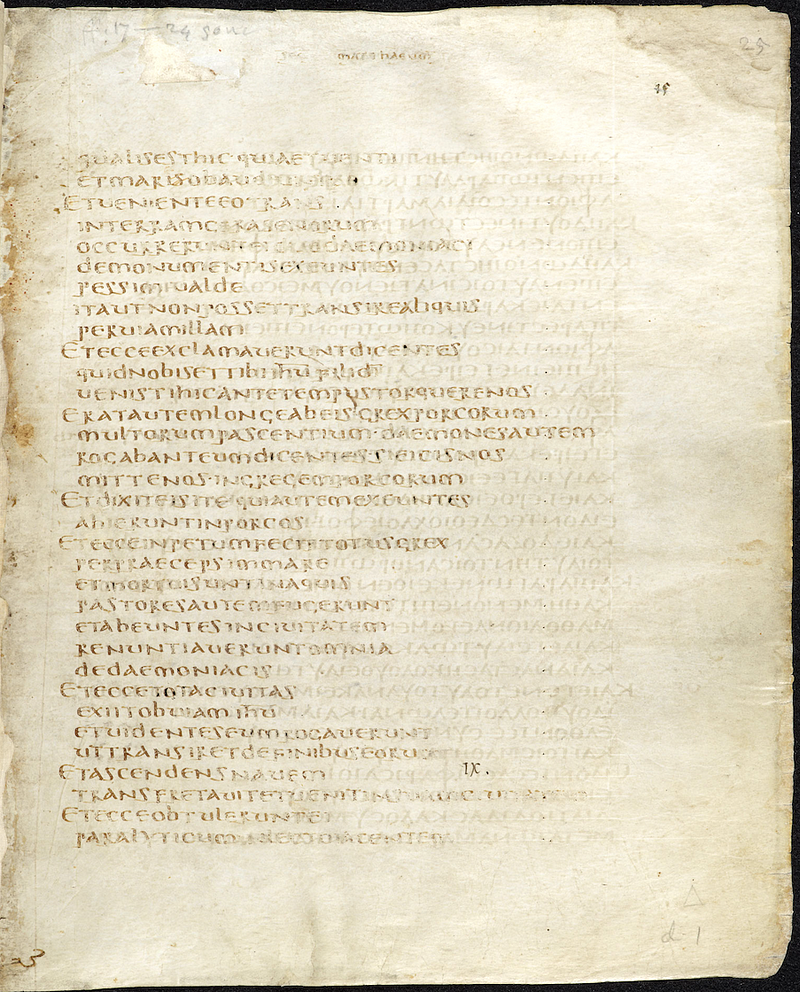
The ‘Bezae Codex’ —or ‘Codex Bezae’ — was a New Testament that was very different
There were new speeches by Jesus, and a longer, very different version of the book of Acts. Even small changes in wording threw familiar narratives into flux. When Jesus is a boy in Luke 2:33, Mary should be “amazed” or “astonished” by him.
In the Bezae Codex, she is “distressed” or “sorrowful.”
At Mark 1:41, Jesus is usually “having compassion,” but in the Bezae Codex he’s “becoming angry.”
In Luke 3:22, Jesus is baptized, and the voice of God speaks: “You are my beloved son, in whom I am well pleased.”
In the Codex Bezae, God says: “You are my son, today I have begotten you.”
How was Jesus ‘begotten’ on the day he’s baptized? That means being born.
In no copy of the New Testament had Jesus gotten along with his disciples very well. In Luke 9:55, typically, he “turned and rebuked them.”
In the Codex Bezae, he adds: “You do not know of what spirit you are.”
What was the story of this manuscript?
It seems to be from the fourth or fifth century, lately dated to around 400 CE. It’s full of misspellings, so perhaps the scribe’s native language wasn’t either Greek or Latin?
Scholars have made many guesses. “Our scribe was a native Egyptian,” announces Allen D. Callahan in 1994. In a 1992 study, David C. Parker suggested the scribe was from Berytus, or modern Beirut, and that seems to get more traction.
Berytus was devastated by an earthquake in 551 CE., and Jennifer Wright Knust imagines “some quick-thinking monk or cleric must have helped the codex escape just in time.”
Along the way it got shortened, stained, and scarred
Originally the codex had the four gospels. Only Luke survives intact. The book of Acts cuts off at chapter twenty-two. A long gap is then apparent whose length matches the book of Revelation.
There’s a surviving sliver, finally, of the 3 John letter. It seems this was a “canon” of the New Testament for some early Christians.
The pages of the codex have jottings, with some twenty writers over the centuries leaving a kind of biography. Some marks early on relate to fortune telling — a common use for Bibles. As Bruce Metzger explains the method:
“A number would be selected, perhaps by throwing dice, and then the pages of the Gospel codex would be turned until the sentence that corresponded to the number was found.”
The ghostly fortunes remain on the pages, as people they pertain to are gone.
The codex made its way to Lyon, France
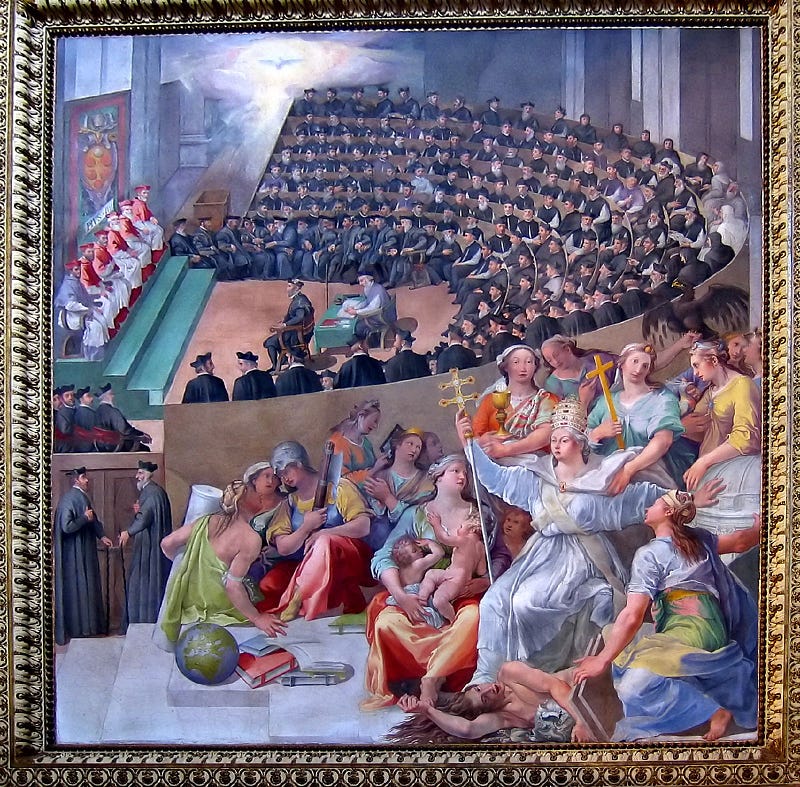
It was noted in the library of the Monastery of Saint Irenaeus in Lyon—the unusual readings of the text acting as signs of its presence. In 1546, a nearby Catholic bishop takes it with him to attend the Council of Trent, a meeting to assess Catholic doctrine.
The codex was said to have been used for a discussion of the celibacy of priests owing to a variation at John 21:22. In this passage, Jesus is discussing the unusual status of his ‘beloved disciple’ — the young man he ‘loved’.
The other disciples ask: What is to become of him after Jesus is gone?
In typical manuscripts, Jesus replies: “If I want him to remain until I come, what is that to you?” In the Bezae Codex, Jesus says: “If I wish him to remain thus until I come…”
Is there a subtext here?
In a 1891 study, J. Rendel Harris notes that the Council of Trent did not focus on priestly celibacy. He offers: “We may suspect then that the question at issue was something of a different kind…”
So many Christian manuscripts have been destroyed for being ‘different’, and I have to suspect what saved this codex from that fate was—fortune telling, and homosexuality?
The codex became known to scholars
The Geneva Bible, published in 1560, cites some of its ‘readings’ in the margins. As Bruce Metzger explains, these:
“…are printed in larger type than that which is used for the numerous marginal annotations on difficult passages and for the alternative renderings, as though to suggest that the variants have almost equal validity with the Scriptural text itself.”
A ‘valid variant’? Christianity didn’t usually think such thoughts.
Then it reaches Theodore Beza, and arrives at Cambridge. At first, readers there seem oddly confused. For a 1864 study, Frederick H. Scrivener goes over the initial efforts to transcribe the codex. He writes of one:
“I am grieved that truth compels me to state that never examined a performance more inaccurate than this. Besides numberless omissions, manifest typographical errors, a looseness and carelessness of citation which is really remarkable…”
The first formal study of the manuscript was done in 1769. This scholar ends up resigned to “the enigma of the codex.”
During these early years at Cambridge, further ‘leaves’ of the codex went missing
But what was there was put to some use. It was consulted by the committee overseeing the King James Bible. The ‘KJV’ translation of 1611 used some ‘new’ Bezean readings, like Luke 9:55.
Most were overlooked, including the most famous ‘new’ scene. It takes place following the scene in at Luke 6:4 where the disciples are picking grain on the Sabbath. For Jews, the Sabbath is a time for rest, but Jesus allows this activity. In the Bezae Codex, a ‘new’ scene then takes place between Jesus and an unnamed person:
“On the same day, when he saw someone working on the Sabbath, he said to him, ‘Man, if you know what you are doing you are blessed, but if you do not know then you are cursed and a transgressor of the law’.”
You can break the rules if you “know what you are doing”?
That wasn’t sounding very Christian—or so the KJV thought. It wasn’t included.
Likewise, another ‘new’ speech by Jesus, at Matthew 20:28, was ignored. This one concerns the problem of assuming one’s ‘importance’. Jesus advises:
“…seek to increase from that which is small, and to become less from that which is greater.”
If invited to a place to dine, he adds, don’t go sitting in a prominent chair, but start from “the inferior place.”
Conflict can be felt around the codex for years to come.
Bruce Metzger writes in 1968: “There is still no unanimity of opinion regarding the many problems that the manuscript raises.”
David C. Parker notes: “Codex Bezae is a manuscript that has generally managed to provoke strong emotions.”
In the 1990s, a South African scholar named Jenny Read-Heimerdinger undertook a more comprehensive study. Was the codex so remote from Christian tradition as typically thought? As she notes, the ‘new’ readings have “support from some second-century Church Fathers, and on occasions the early Greek papyri.”
The Bezae text, she thinks, features Jewish terms not present in the traditional New Testament, as if it was being written by “a narrator who was intimately familiar with Jewish methods of exegesis…”
Many scenes are quite different in the Bezae Acts.
The disciples hold an election to replace Judas. Did they make the right choice? Read-Heimerdinger thinks the cues in the Bezae Codex suggests they did not—that Barnabas had been the correct choice, but he was a Jew from outside Jerusalem.
The Bezae narrative, she thinks, places far more emphasis on the idea of the insular religious community of Jerusalem-based Jews being a problem. Jesus’ prompts to open the covenant to all people is shocking. Peter attempts this course, as Paul of Tarsus insists on it.
The ‘Council at Jerusalem’ in Acts 15 is convened to deal with the problems.
In the usual Christian text of Acts, as Read-Heimerdinger notes, the reader imagines that Paul has been called to Jerusalem to have “an open discussion that ends in mutual agreement.”
In the Bezae Codex, however, it’s “a court of law where James acts as the judge…”
Peter speaks on the Gentiles’ behalf. The usual text of Acts 15:7 reads: “After much discussion, Peter got up and addressed them…”
In the Bezae Codex, the passage reads: “Standing up, in the Holy Spirit, Peter said…”
Then note the speech of James in 15:19: “Therefore my judgment is…”
It seems that Peter acts in the deity’s power, James in his own.
Peter bows to James’ authority, as Paul sets out to spread the teachings to all people
Paul makes errors, and changes course. This is all different, Read-Heimerdinger notes, from the narrative of traditional Christianity:
“In the usual account, the disciples understand perfectly what Jesus teaches them in his final hours before he ascends to heaven, and they are ready to begin spreading the good news exactly in accordance with the divine plan.”
In the Bezae Codex we see instead, as she notes: “fallible human beings who only gradually come to grasp the full extent of the radical nature of Jesus’ message.”
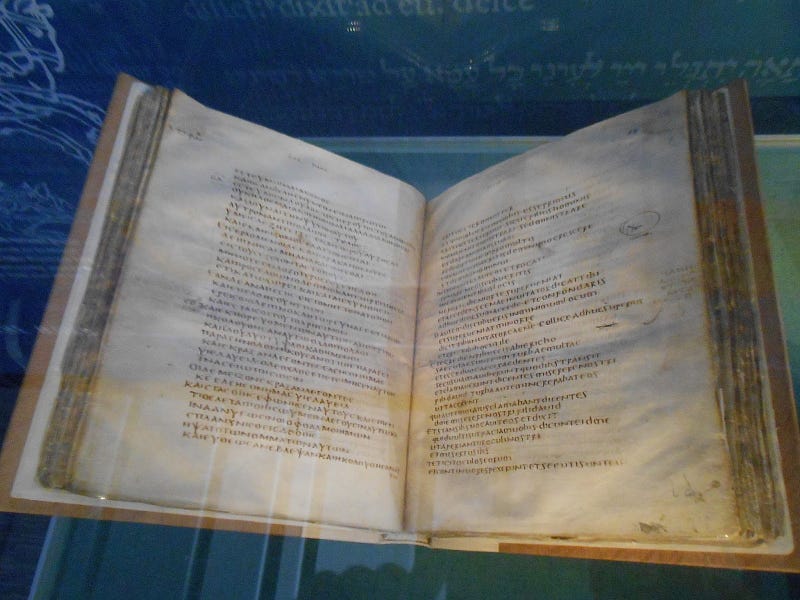
The codex is occasionally on display, last in 2016. Anyone might’ve walked by a glass case with the only copy of another New Testament. 🔶