avatarJonathan Poletti

Free AI web copilot to create summaries, insights and extended knowledge, download it at here

4526

Abstract

esis 49:26</a></figcaption></figure><p id="9571">The “mother” talk is also in the Samaritan Pentateuch, the copy of Genesis kept by the Samaritan kind of Jews. Here’s it’s presented in a scholarly edition side-by-side with the Christian Bible on the right:</p><figure id="c83a"><img src="https://cdn-images-1.readmedium.com/v2/resize:fit:800/1*d4tqqnRVUFQMp_RcEUi-pw.png"><figcaption><i>Genesis 49:26 in “<a href="https://www.amazon.com/Israelite-Samaritan-Version-Torah-Translation/dp/0802865194/ref=sr_1_1?hvadid=570512027971&amp;hvdev=c&amp;hvlocphy=1015254&amp;hvnetw=g&amp;hvqmt=e&amp;hvrand=14858202283665204164&amp;hvtargid=kwd-842682973899&amp;hydadcr=27889_14512676&amp;keywords=israelite+samaritan+torah&amp;qid=1684240421&amp;sr=8-1&amp;ufe=app_do%3Aamzn1.fos.006c50ae-5d4c-4777-9bc0-4513d670b6bc">The Israelite Samaritan Version of the Torah</a>” (2013)</i></figcaption></figure><h1 id="af4a">And what about the Fifth Commandment?</h1><p id="1809">The words seem so familiar: <i>“Honor thy father and mother.”</i> Is God telling people they have to take care of human parents? That’s often assumed.</p><p id="e9cf">It seems a quirky commandment to be coming from God. In the Bible, heroes typically disrespect their parents! Abraham leaves his parents. In Genesis 27, Jacob tricks his father.</p><p id="c367">In Judges 14:3–4, Samson disregards his parents’ wishes for choosing a wife — but the text adds that Samson knows God’s intentions.</p><p id="e5fe">It would seem that this is a deity who delights in sees humans as rather limiting on their children, and typically not knowing divine intentions.</p><h1 id="6346">Jesus, of course, is a terrible human son.</h1><p id="87c8">He never says the first thing about his human father. Then Jesus’ treatment of Mary is not exactly a Mother’s Day card. After she tried to have him declared ‘crazy’ in Mark 3:21, he seems to write her off completely.</p><p id="786b">In the gospel of John, Jesus takes to addressing Mary as a “<i>woman</i>” (e.g. Jn 2:4; 19:26). As the scholar Turid Karlsen Seim <a href="https://www.cambridge.org/core/journals/new-testament-studies/article/abs/descent-and-divine-paternity-in-the-gospel-of-john-does-the-mother-matter/D5CECE0F3CD73BF2882BFCBCCA596006">observes</a>: “It has the taste of a rebuke, saying that she has not as his mother any particular claim on him, even refuting that there is a relation.”</p><p id="b3b5">Jesus even seems to dismiss human parents (cf. Lk 11:27–28, etc.). Doesn’t sound like “honoring” to me.</p><blockquote id="a55f"><p>“If anyone comes to me and does not hate father and mother, wife and children, brothers and sisters — yes, even their own life — such a person cannot be my disciple.”</p></blockquote><p id="c9bc">If the Fifth Commandment was about human parents, then Jesus would seem to be openly violating it.</p><h1 id="2015">But Christians keep on saying: honor your parents.</h1><p id="df22">Indeed, they tell you, God is requiring you, all your life, to respect, accept, obey, and care for your parents. An amazing deal for parents, as many of them behave atrociously.</p><p id="125b">In retrospect, it was a conflict of interest. By saying the Fifth Commandment concerned parents, then parents were able to say their kids had to take care of them.</p><p id="43ab">Interestingly, in the <i>Zohar</i>, the book of Jewish mystical teachings, the commandment is said to be spiritual in nature. The ‘father’ to be honored is God the Father, as the ‘mother’ is “the Assembly of Israel.”</p><p id="93ac">To honor the ‘father and mother’ then means, the <i>Zohar</i> <a href="https://www.academia.edu/984688/Honoring_Father_and_Mother_in_Early_Kabbalah_From_Ethos_to_Mythos">explains</a>, to honor “everything, above and below.”</p><h1 id="0171">If read about human parents, the Fifth Commandment doesn’t even make sense.</h1><p id="f4ce">The text is not just a prompt to “honor your father and mother.” There is also a promise: You’ll live longer!</p><blockquote id="37a9"><p>“Honor your father and your mother, so that your days may be prolonged on the land which the LORD your God gives you.” <i>(NASB; Exo 20:12; cf. Deut 5:16)</i></p></blockquote><p id="d354">If you behave your parents you’ll live a long time? It seems to be a promise that is broken. As Robert Alter <a href="https://www.google.com/books/edition/The_Hebrew_Bible_A_Translation_with_Comm/S75SDwAAQBAJ?hl=en&amp;gbpv=1&amp;dq=%22It+is+hard+to+square+the+causal+link+between+honoring+parents+and%22&amp;pg=PT301&amp;printsec=f

Options

rontcover">notes</a>:</p><blockquote id="f44e"><p><i>“It is hard to square the causal link between honoring parents and longevity with empirical observation, and one probably has to regard this as part of the traditional wisdom of the ancient Near East, the sort of hopeful moral calculus reflected in the Book of Proverbs.”</i></p></blockquote><p id="bd1a">But the Fifth Commandment is repeated by Paul in Ephesians 6:1–3, emphasizing the idea of a ‘promise’.</p><blockquote id="534b"><p>“‘Honor your father and mother’— which is the first commandment with a promise — ‘so that it may go well with you and that you may enjoy long life on the earth.’”</p></blockquote><p id="9c62">People die young regardless of how they treat their parents. Does God make promises to break them?</p><h1 id="1c9c">Or have these passages been badly misread?</h1><p id="c9f2">The reality is most terms in the Bible could easily have metaphoric or spiritual meanings. When Paul refers to “children,” for example, he could mean “children of God”—a context more clear in the John writings (cf. Jn 1:12, etc.)?</p><p id="f3d8">If the ‘Father and Mother’ was God, then the long life is easier to explain. The long life would be eternal life with God.</p><h1 id="1c24">Could the Holy Spirit be God’s female side?</h1><p id="9909">If that idea seems unfamiliar to Christians, it’s more familiar to Jesus. The very first gospel, a text now lost but called the ‘Hebrew Gospel’, was <a href="https://www.amazon.com/Hebrew-Gospel-Development-Synoptic-Tradition/dp/0802862349/ref=sr_1_10?crid=9M1BPI7AKT87&amp;keywords=hebrew+gospel&amp;qid=1701975224&amp;sprefix=hebrew+gospel%2Caps%2C353&amp;sr=8-10">quoted by two credible sources</a> in early Christianity. Both Origen and Jerome have Jesus to say in this text:</p><blockquote id="7e38"><p>“Just now my mother, the Holy Spirit, took me by a lock of hair and lifted me up to great Mount Tabor…”</p></blockquote><p id="45de">But the gender of the Holy Spirit seems to have been achieved more by <a href="https://www.orcuttchristian.org/Wallace_Greek%20Grammar%20and%20the%20Personality%20of%20the%20Holy%20Spirit.pdf">mistranslation</a> than anything. As the scholar Mimi Haddad <a href="https://www.academia.edu/21424556/And_what_about_language_for_God">notes</a>:</p><blockquote id="614e"><p><i></i>Holy Spirit<i> (in Hebrew is feminine, ruah; in Greek, neuter) is frequently associated with the birthing process (John 3:5; cf. John 1:13, 1 John 4:7b; 5:1, 4,18).”</i></p></blockquote><p id="8870">In Christian theology, you get ‘reborn’ or ‘<i>born again’</i>.</p><p id="de74">That sounds a little…maternal?</p><h1 id="5f56">And so I wonder: maybe God is ‘Father and Mother’—and always was.</h1><p id="7642">The religion couldn’t see Her—but then it was being run by men, and if there’s one thing Christian men believe, it’s that they’re supposed to be commanding, respected, and ‘honored’.</p><p id="7848">Back in reality, they’re not God. <i>She</i> is.” 🔶</p><figure id="43e6"><img src="https://cdn-images-1.readmedium.com/v2/resize:fit:800/1*0WVV6b6vBMxzocRrLfqzYw.png"><figcaption><a href="https://www.turismoroma.it/en/places/catacombs-priscilla">Catacombs of Priscilla, Rome</a> (4th century)</figcaption></figure><div id="2a51" class="link-block"> <a href="https://readmedium.com/10-bible-facts-that-are-just-really-really-weird-7ed16375d4bb"> <div> <div> <h2>10 Bible Facts That Are Really, Really Weird</h2> <div><h3>Christianity doesn’t like it, but “God” is a trip</h3></div> <div><p>medium.com</p></div> </div> <div> <div style="background-image: url(https://miro.readmedium.com/v2/resize:fit:320/1*Z161mIWpbZVmi5PlM1Z2yQ.png)"></div> </div> </div> </a> </div><div id="bd42" class="link-block"> <a href="https://readmedium.com/the-woman-who-read-the-bible-for-the-first-time-c64a3bab2c54"> <div> <div> <h2>The Woman Who Read the Bible For the First Time</h2> <div><h3>Katharine Bushnell created Christian feminism—and the future?</h3></div> <div><p>medium.com</p></div> </div> <div> <div style="background-image: url(https://miro.readmedium.com/v2/resize:fit:320/1*FXtDg1Kh2nlza6tMDT6qRA.png)"></div> </div> </div> </a> </div></article></body>

Is the Bible’s God a ‘mother’?

Let’s look at a deity’s feminine side

I went to learn more about the Bible, and ended up meeting a woman that I had never even heard about in church. Her name is God.

She’s right there in the Bible that religious people read, though they don’t recognise her presence. She isn’t hiding. They just—can’t see?
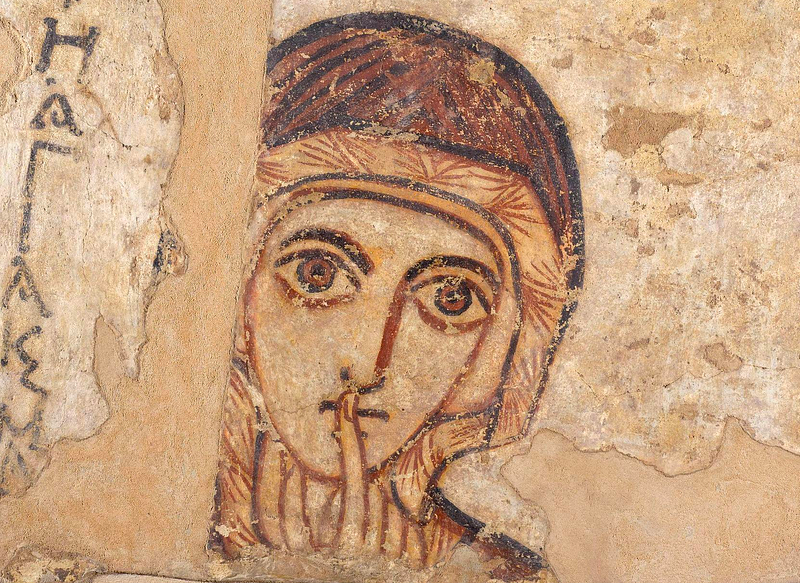
Anne the mother of Mary at Faras Cathedral in Sudan c.8th-9th century

God is known by many names and aspects, a plurality sometimes just called ‘Elohim’.

The reader of the Bible is never told that this is an all-male force. Rather, God is clearly “male and female.” That seems clear enough in Genesis 1:27, where the drama of creation is summarized:

“So God created mankind in his own image, in the image of God he created them; male and female he created them.” (NIV)

The scholar Johannes C. de Moor helps out. “The poetical structure of Gen. 1:27 clearly suggests that God himself too was both male and female.”

Even conservative theologians will admit that God is sometimes discussed in the Bible as female.

Here is Robert A.J. Gagnon in 2016:

“It is true that the Hebrew Bible describes God in both masculine (predominantly) and feminine imagery (for the latter, see Isa 42:14; 49:15; 63:13; Hosea 13:8; by inference Num 11:12; Deut 32:11, 18; Hos 11:1–4).”

When God is discusssed, female imagery often seems involved. To learn about religion, for example, is discussed as breastfeeding. As in 1 Peter 2:2–3, the believer is to “crave pure spiritual milk” (cf. I Thess 2:7–8; 1 Cor 3:1–3; Heb 5:12–13). Where is this ‘milk’ coming from?

Doesn’t that suggest the presence of a woman?

God sometimes appears as a female.

In Numbers 11:15, Moses is speaking to God, and uses a female pronoun. You wouldn’t know it from the translated text, where Moses says:

“If this is how you are going to treat me, please go ahead and kill me…”

The ‘you’ is a feminine singular pronoun. When Christian translators saw this, notes the scholar Nicholas Ansell, they “moved quickly on.”

God is addressed in female aspects. Sometimes the deity is “El Shaddai” — a word that Christianity translates “the Almighty.” But this name of God seems to be invoked in the context of fertility.

In Hebrew, the word means ‘breast’, with a suggestion of mountains, and so scholars see ‘El Shaddai’ as meaning “The Breasted One.”

God seems to be addressed as “Father and Mother.”

Such moments, at least, appear in variant manuscripts, which might mean less edited ones. In Genesis, the hero Jacob gives his children a blessing as he dies. He seems to be speaking of God.

“Your father’s blessings are greater than the blessings of the ancient mountains…” (49:26)

That’s the modern Christian Bible. But the Septuagint, the ancient translation into Greek, has this extra little bit:

NETS Genesis 49:26

The “mother” talk is also in the Samaritan Pentateuch, the copy of Genesis kept by the Samaritan kind of Jews. Here’s it’s presented in a scholarly edition side-by-side with the Christian Bible on the right:

Genesis 49:26 in “The Israelite Samaritan Version of the Torah” (2013)

And what about the Fifth Commandment?

The words seem so familiar: “Honor thy father and mother.” Is God telling people they have to take care of human parents? That’s often assumed.

It seems a quirky commandment to be coming from God. In the Bible, heroes typically disrespect their parents! Abraham leaves his parents. In Genesis 27, Jacob tricks his father.

In Judges 14:3–4, Samson disregards his parents’ wishes for choosing a wife — but the text adds that Samson knows God’s intentions.

It would seem that this is a deity who delights in sees humans as rather limiting on their children, and typically not knowing divine intentions.

Jesus, of course, is a terrible human son.

He never says the first thing about his human father. Then Jesus’ treatment of Mary is not exactly a Mother’s Day card. After she tried to have him declared ‘crazy’ in Mark 3:21, he seems to write her off completely.

In the gospel of John, Jesus takes to addressing Mary as a “woman” (e.g. Jn 2:4; 19:26). As the scholar Turid Karlsen Seim observes: “It has the taste of a rebuke, saying that she has not as his mother any particular claim on him, even refuting that there is a relation.”

Jesus even seems to dismiss human parents (cf. Lk 11:27–28, etc.). Doesn’t sound like “honoring” to me.

“If anyone comes to me and does not hate father and mother, wife and children, brothers and sisters — yes, even their own life — such a person cannot be my disciple.”

If the Fifth Commandment was about human parents, then Jesus would seem to be openly violating it.

But Christians keep on saying: honor your parents.

Indeed, they tell you, God is requiring you, all your life, to respect, accept, obey, and care for your parents. An amazing deal for parents, as many of them behave atrociously.

In retrospect, it was a conflict of interest. By saying the Fifth Commandment concerned parents, then parents were able to say their kids had to take care of them.

Interestingly, in the Zohar, the book of Jewish mystical teachings, the commandment is said to be spiritual in nature. The ‘father’ to be honored is God the Father, as the ‘mother’ is “the Assembly of Israel.”

To honor the ‘father and mother’ then means, the Zohar explains, to honor “everything, above and below.”

If read about human parents, the Fifth Commandment doesn’t even make sense.

The text is not just a prompt to “honor your father and mother.” There is also a promise: You’ll live longer!

“Honor your father and your mother, so that your days may be prolonged on the land which the LORD your God gives you.” (NASB; Exo 20:12; cf. Deut 5:16)

If you behave your parents you’ll live a long time? It seems to be a promise that is broken. As Robert Alter notes:

“It is hard to square the causal link between honoring parents and longevity with empirical observation, and one probably has to regard this as part of the traditional wisdom of the ancient Near East, the sort of hopeful moral calculus reflected in the Book of Proverbs.”

But the Fifth Commandment is repeated by Paul in Ephesians 6:1–3, emphasizing the idea of a ‘promise’.

“‘Honor your father and mother’— which is the first commandment with a promise — ‘so that it may go well with you and that you may enjoy long life on the earth.’”

People die young regardless of how they treat their parents. Does God make promises to break them?

Or have these passages been badly misread?

The reality is most terms in the Bible could easily have metaphoric or spiritual meanings. When Paul refers to “children,” for example, he could mean “children of God”—a context more clear in the John writings (cf. Jn 1:12, etc.)?

If the ‘Father and Mother’ was God, then the long life is easier to explain. The long life would be eternal life with God.

Could the Holy Spirit be God’s female side?

If that idea seems unfamiliar to Christians, it’s more familiar to Jesus. The very first gospel, a text now lost but called the ‘Hebrew Gospel’, was quoted by two credible sources in early Christianity. Both Origen and Jerome have Jesus to say in this text:

“Just now my mother, the Holy Spirit, took me by a lock of hair and lifted me up to great Mount Tabor…”

But the gender of the Holy Spirit seems to have been achieved more by mistranslation than anything. As the scholar Mimi Haddad notes:

Holy Spirit (in Hebrew is feminine, ruah; in Greek, neuter) is frequently associated with the birthing process (John 3:5; cf. John 1:13, 1 John 4:7b; 5:1, 4,18).”

In Christian theology, you get ‘reborn’ or ‘born again’.

That sounds a little…maternal?

And so I wonder: maybe God is ‘Father and Mother’—and always was.

The religion couldn’t see Her—but then it was being run by men, and if there’s one thing Christian men believe, it’s that they’re supposed to be commanding, respected, and ‘honored’.

Back in reality, they’re not God. She is.” 🔶
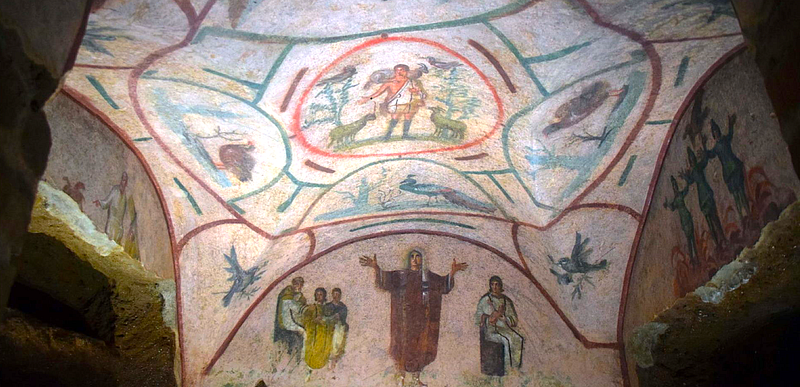
Catacombs of Priscilla, Rome (4th century)
Religion
Chrisitanity
Books
History
Motherhood
Recommended from ReadMedium