
The Woman Who Read the Bible For the First Time
Katharine Bushnell created Christian feminism—and the future?
A few years ago I set out to figure out what God thought about sex. Many scholarly books had footnotes citing a strange book with a radical reading of the Bible—published by a woman in 1921.
I kept an eye out for more, and a hazy story began to fill in. She had been a self-taught Bible scholar who self-published a book documenting how God didn’t disfavor women. She’d been famous for awhile, then died forgotten.
But for resurrection stories there’s Jesus and Katharine Bushnell.
In 1971, a Christian fan did the first digging.
Ruth Hoppin found Bushnell’s old pastor. He remembered the elderly woman he’d known as a young man. He recalled her as cheerful.
“Her work was like a rock dropped to the bottom of the ocean,” he added. “Kerplunk, it was gone, the end of it.”
But a new activity called Christian feminism was forming, and Bushnell’s book, God’s Word to Women, was their text. Other women had protested ‘patriarchal’ readings of the Bible, but as Catharine Clark Kroeger writes, “it was to be Katharine Bushnell who would bring out the heavy artillery.”
Mainstream Christian scholars began to mention her. She was cited in the footnotes for Gordon D. Fee’s 1987 book The First Epistle to the Corinthians calls her “frequently bold and unique.”
But who was she?
The first biography of Bushnell, by Dana Hardwick, came out in 1995. It was at best a thin outline of a life mostly devoted, it seems, to activism against sexual trafficking. Then she’d settled in to do a massive re-reading of the whole Bible.
In the early 2000s, a graduate student in history was studying Christian feminism, and noticed her. Kristin Kobes Du Mez recalls in an interview:
“When I ordered the book and I started reading it, I was blown away. I still remember I was in this little grad school apartment, just paging through this book thinking, ‘Is this for real? And how could I have never heard this before?’”
She picked Bushnell as a subject for her 2004 Ph.D. dissertation, and in 2015 published a revision as A New Gospel for Women: Katharine Bushnell and the Challenge of Christian Feminism. It set up, she’d suggest, her next book: Jesus and John Wayne, the era-defining critique of Evangelicalism.
It was like Bushnell’s mind worked in some other way. She saw differently, and others began to see the same way.
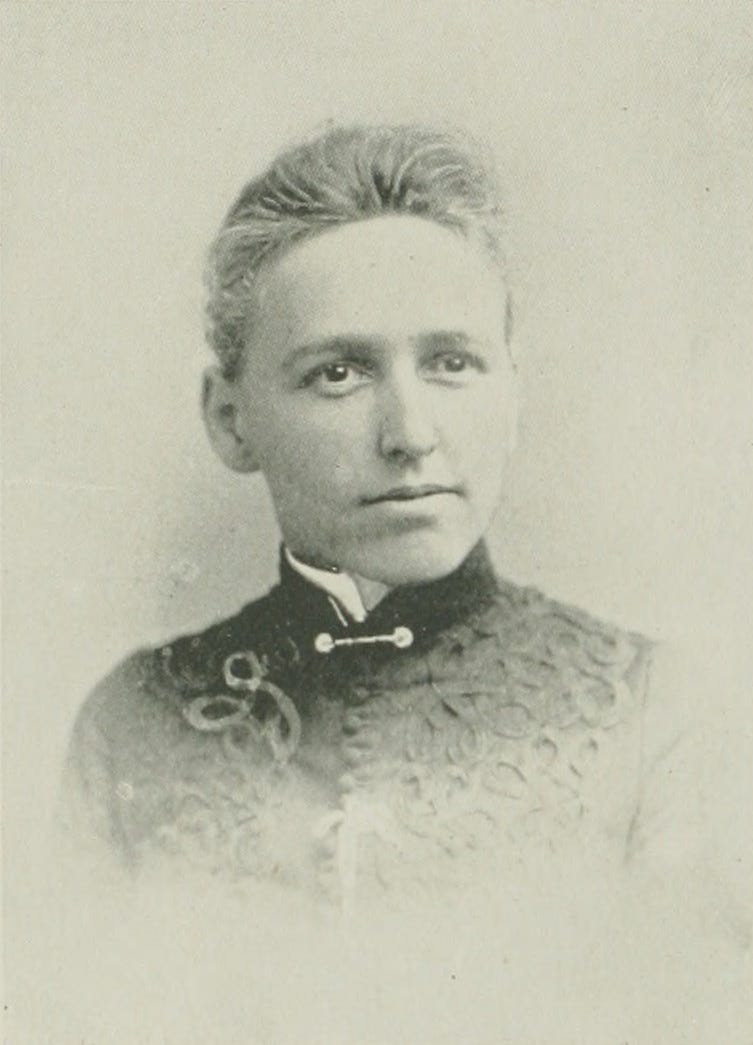
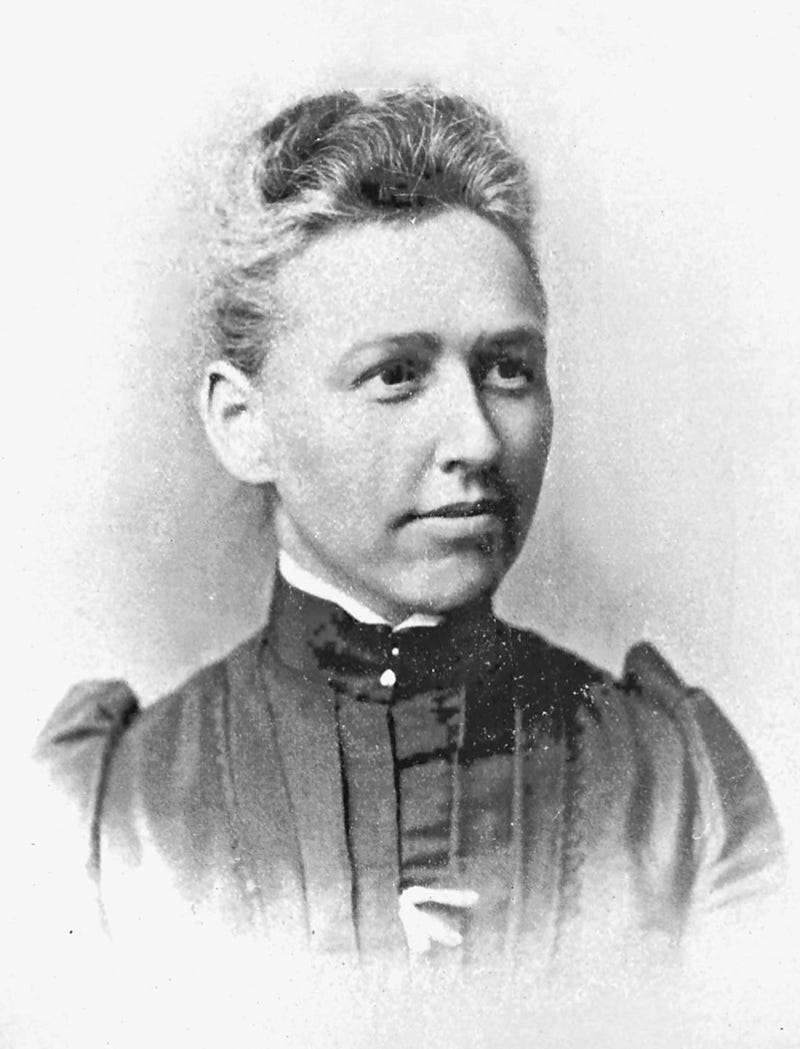
She was born on February 5, 1855 in Peru, Illinois, the seventh of nine children.
She recalled her childhood only in a brief biographical note. Her youth required her, she said, to develop “powers of detachment…”
She was gifted with languages, eventually learning seven. She went to Northwestern University to study ancient languages, then learned of the need of doctors in the Christian mission field. She trained to be a medical missionary, to do health care while male missionaries preached.
At age 24, she went to China. The climate and workload left her weak, feverish, and anxious. She came home with a spinal injury that kept her in lifelong pain. “I cut short particulars,” is how she put it.
The deeper wound came from Bible translation.
While in China, Bushnell noticed the Bible in Chinese had changed a verse. At Philippians 4:2–3, Paul writes about two women leaders who’d “labored with me.” The translation presented the women as men.
Bushnell asked about it, to be told it must’ve owed to “pagan prejudice against the ministry of women.”
That the Bible was altered for any reason left her “shocked,” she writes. “It had never before entered my mind that such a thing could be.”
Back in America, she went to work for the WCTU.
This was the Woman’s Christian Temperance Union, a famous organization run by Frances Willard. She’d known Bushnell as a teenager, and recalled that she had “no stronger or more chivalric ally than this gifted, individualized, forceful young nature.”
The WCTU was on the forefront of Christian messaging, as new ideas, growing out of ‘temperance’, were starting to form. Maybe Christian men couldn’t do whatever the hell they wanted? Maybe they had to follow their own rules. Maybe women had standing to critique them.
Bushnell was a star on the lecture circuit. A remarkable charisma seemed to pour out of her. A woman observer said of Bushnell in 1886 that “a power not human is infused into her face and words.”
She seemed to read as ‘unfeminine’. It’s suggested in newspaper reports. In 1888, she’d said in a speech that she’d never been tempted to sexual sin.
A woman in the audience replied: “I believe you, my dear. Look in your mirror and learn the reason why.”
She had to support herself as she went.
“All my lifetime I have been poor, and had I waited for money and time to do what I saw was needed,” she’d write.
It put the focus on bold actions that would show up in the newspapers. In 1889, she heard of women being kept for sex slavery in a mining town in Wisconsin. She went there, somehow managing to make her way through a mostly male miner’s camp.
She found the sex slavery was happening. The state had even known about it, and sent a fake inspector to file a false report.
A war of words played out between Bushnell and the inspector, who wasn’t pleased at being exposed. As her biographers skip the scene, I’ll reprint the details from the period newspapers.
“He thereupon repeated an obscene story concerning Dr. Bushnell, and declared it contained as much truth as the imputations placed on him.”
He was put in jail for saying “obscene language to an unmarried female.” A report seems bemused, saying the word, “if it were obscene had a double meaning, one of which was obscene and the other not.”
I’m thinking the guy called Bushnell a ‘bitch’.
Called to testify, she’d faced a room of irate men.
Their sexual playground had been splashed across the nation’s newspapers because of this odd woman. Bushnell writes about this scene:
“I was alone and trembling inwardly (for I feared I had not the wisdom to present the case effectually) as I ascended the platform to speak to a crowded house, in large part angry at me. There was not another woman in the room, as I looked about.”
She said a prayer, ready to proceed with her testimony before a hostile audience. She writes:
“Then the door opened quietly, and about fifty ladies of the highest social position at the State Capital filed in, and stood all about me.”
The Wisconsin legislature ended up passing a law against sexual trafficking, dubbing it the ‘Kate Bushnell Bill’. It was the #MeToo of 1887.
‘Dr. Kate C. Bushnell’ became a household name.
I find descriptions of her in local newspapers. In 1889, a critic informs:
“She is tall, angular and earnest; wears spectacles, and has a voice like a boy who is just bursting into manhood, so to speak.”
Another writer the same year:
“She is a forcible talker, never stopping for want of words, and she gesticulates more than the ordinary public speaker, but with good taste and at the proper times.”
Something about her was electric. A 1890 report finds she has a “personal magnetism that cannot be defined, yet it is very apparent.”
Bushnell spoke as a Christian but as if as an independent observer who’d arrived to reveal Christians to themselves. Churches would complain about hookers outside saloons, she noted, but then they themselves position women around churches to lure in men.
Bushnell startles people in 1897 by saying one should follow a “living Christ of today” rather than “the image of the dead Savior of ages ago.”
She worked and lived with a woman.
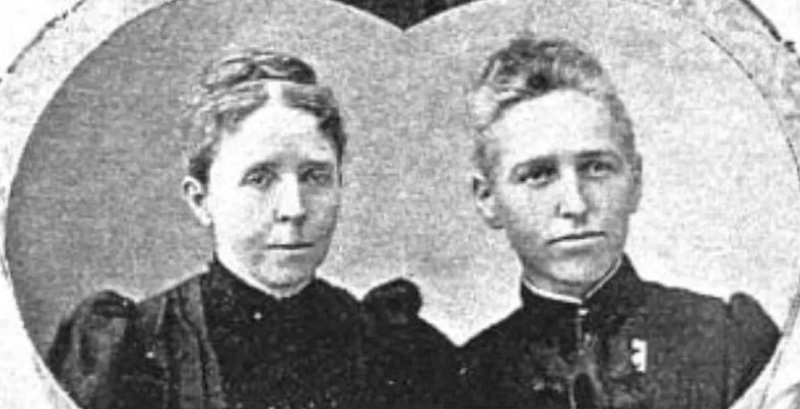
Bushnell would call Elizabeth Andrew her “companion in labour,” an allusion to Philippians 4:2–3. They’d be together for 26 years.
An 1894 interview with them together reports on their voices entwining as they spoke: “It was not easy to separate their joint remarks.”
An 1895 profile of Bushnell adds:
“Dr. Kate C. Bushnell is so closely linked with Mrs. Andrew in bonds of service and affection that it is difficult to write of her alone. All that has been said of her friend’s wonderful mission since 1890 may be said of hers, for they have worked together as one soul.”
Bushnell’s sexuality seems never to have been broached.
As I keep looking around, I keep wondering if secrets were being kept. It turns out that the WCTU was a lesbian haven. Frances Willard, known in real life as ‘Frank’, was clearly lesbian.
That subject is taken up in Lillian Faderman’s 1999 book To Believe in Women: What Lesbians Have Done For America. Willard might not have used the word, as Faderman notes, but would “in today’s parlance be called a lesbian…”
I write Faderman, asking her how to categorize Katharine Bushnell. She kindly replies:
“I think Bushnell fits perfectly with the women I discuss in To Believe in Women. I don’t think she would have called herself a ‘lesbian,’ anymore than I would call myself a ‘queer.’ But those are generational terms. And you provide wonderful material about her ostensible gender behavior and affectional preferences that make her very familiar to those of us who call ourselves lesbian today.”
Bushnell kept up her activism for years.
Traveling widely and being provocative for a living exhausted her, and she retired from the lecture circuit. She had the idea to focus on Bible scholarship, which she saw as the truer route to social change.
“I came away feeling like a bird set free from long imprisonment,” she writes. “I had longed to get out into this very work, but had felt held to the necessity of these public crusades against vice.”
She and Elizabeth Andrew moved to Oakland, California. Bushnell set to work teaching herself to be a Bible scholar. She’d studied classical Greek in college, and now picked up biblical Greek and Hebrew. She seems to have had the idea to set up a seminary in San Francisco.
The school was announced in the San Francisco Chronicle in 1904.
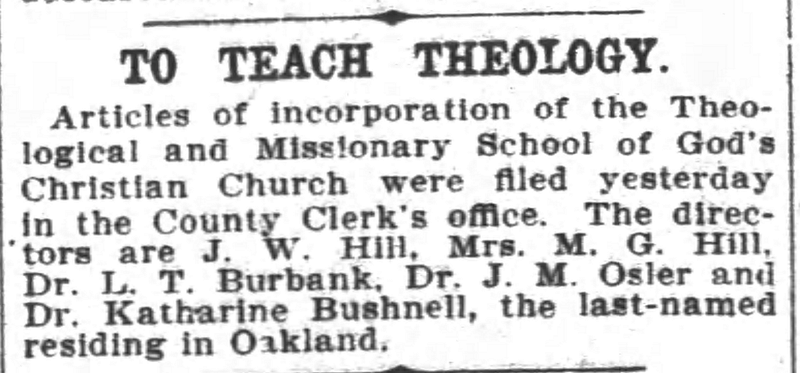
No existing seminary would’ve been open to a woman, or given much heed to women. But Christian theology, she wrote a friend, was a “fossilized system of theology,” created over time by men, and for men.
She wanted to start something new.
Bushnell valued the Bible as a sacred text and guide.
In that sense, she was conservative. But she was radical in her readings. She didn’t think God hated women or relegated them to some second-class status under men.
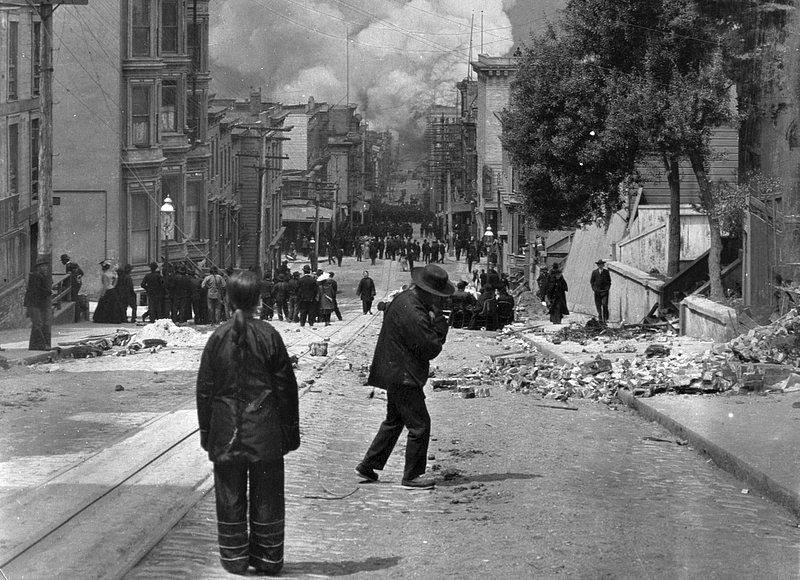
The seminary never happened. A note that Bushnell writes to her sister in 1906 was published in the local paper in Wisconsin, and may illuminate the reason. They were fine, but an earthquake had destroyed the city.
Bushnell re-conceived her Bible studies as a three-year correspondence course.
The school where she’d teach, it seems, would be the world. In 1916, she’d released God’s Word to Women . The title itself is revolutionary. In Christian tradition, God doesn’t speak to women—only to their husbands.
Bushnell’s tone is often dense and academic. But her basic findings were simple. The Bible has been mistranslated and misread by men. God loves all people — including women.
She made appearances over the years.
In 1927, Bushnell had a radio series, “Women’s Place in God’s Economy,” and made an appearance in the local paper.
“‘Women’s place in the work of the church is just as important as that of man,’ Dr. Bushnell says, ‘and it is only because of the ancient contempt that man had for her that woman’s place was lowered. It is both the right and duty of woman to preach the Gospel. The Bible makes no limitations because of sex.’”
The same year, Elizabeth Andrew died. She’d been unwell for years. Her obituary reports that Bushnell was at her side.
Of their partnership, Bushnell only writes that “the co-operation of her wonderful, well-balanced and highly cultured mind kept me from many a rash move.”
In 1931, she was in China.
A new edition of God’s Word to Women was printed there. She wrote that she would “see what more I could do for the help of these people I love.”
Her final book, in 1945, was on the book of Esther. She went to her eternity on January 26, 1946, at home, at nearly ninety-one.
Only the local paper seems to have carried an obituary.
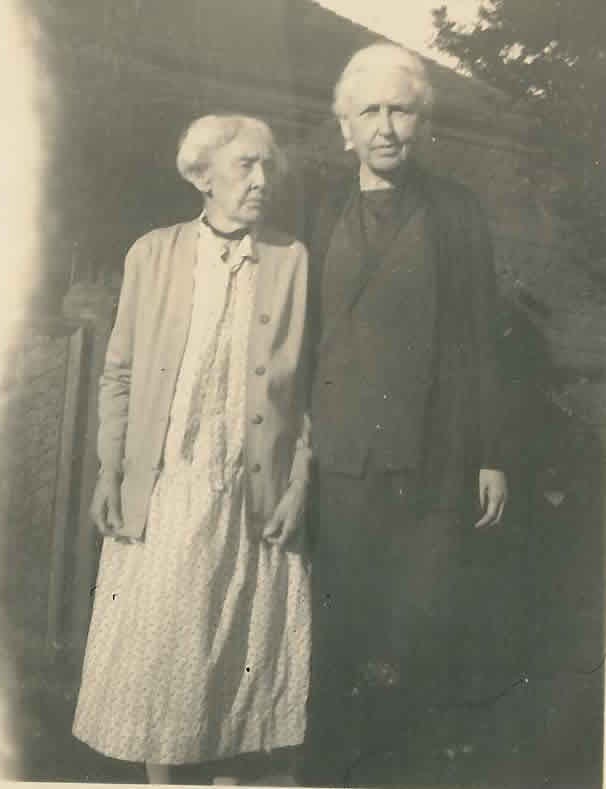
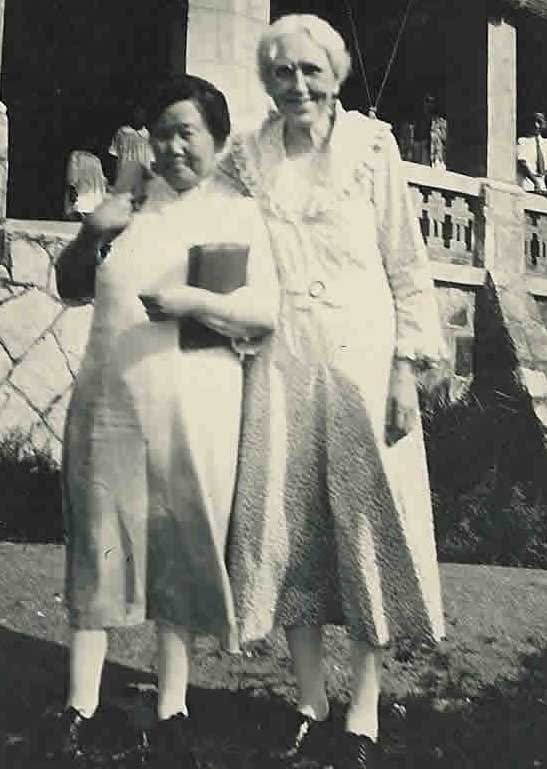
In Bushnell’s work, many new readings came in view.
There was a startling idea in the air: the Bible was badly misread.
But it was more than that. In Bushnell’s wake we see that the “God” of Christian tradition wasn’t the Creator of Everything. He was just some men staring in a mirror. 🔶


