
A genius of Christian music went missing in 1975
The unknown story of Linda Rich
Sometimes I go looking up information about Linda Rich. She’s the Christian musician who released three albums from 1969 to 1975 on a label that disappeared.
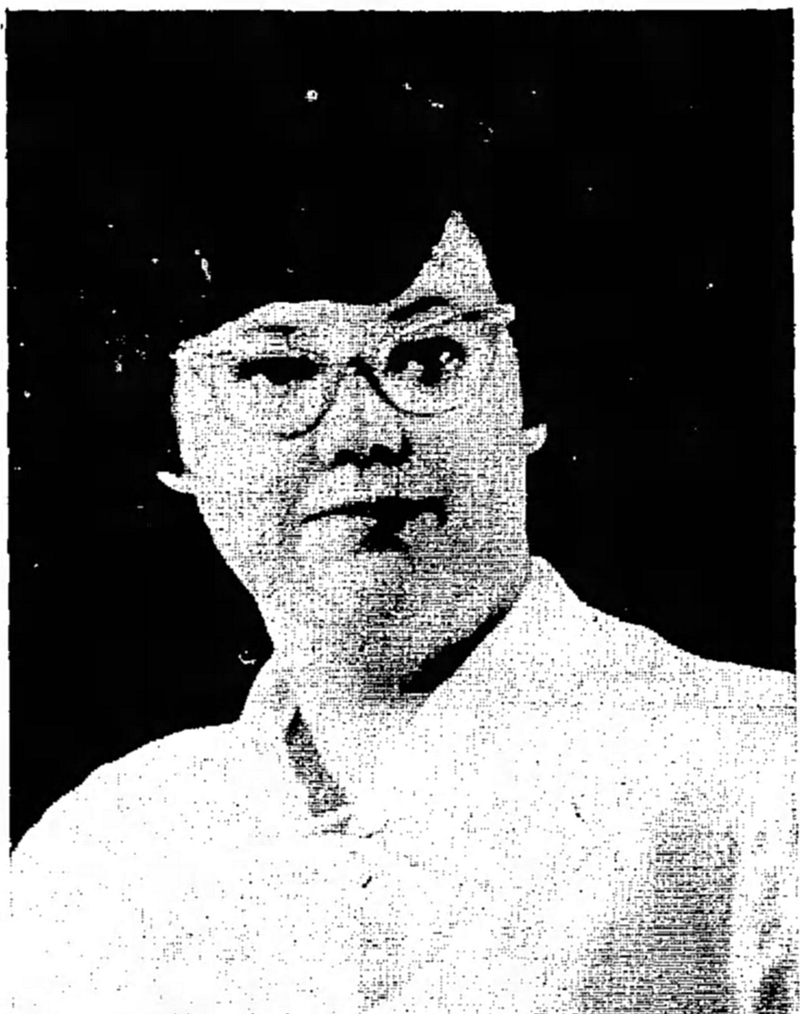
In her high school yearbook, sophomore year, I find a portrait of her, and think about a Christian girl in Augusta, Kansas, a small town known for an oil refinery. She was different.

I colorize and clarify.
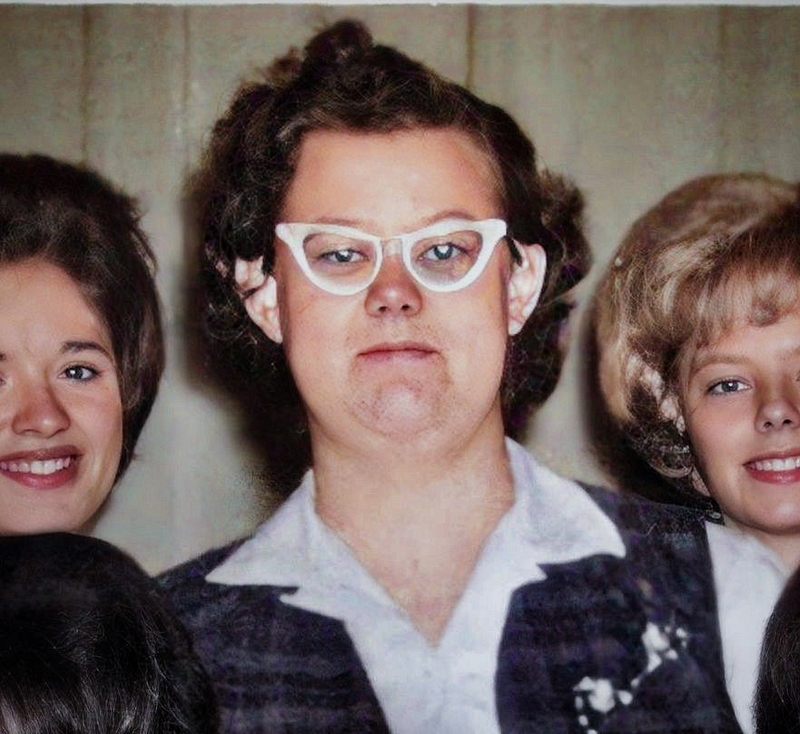

In 1966, she went off to Wichita State University and had an existential crisis.
In the liner notes on her first album she recalls a dark thought process: “I’m nothing! I’m no good.”
She couldn’t see any value to herself, or understand why God would spend any effort on her. “It wouldn’t be worth it to God,” she says. “He wouldn’t be getting a good bargain.”
Then she decided the deity was stuck with her, and would have to do something with her.
Music started to pour out of her.
In some kind of rapid spiritual “download,” it seems, she quickly wrote a hundred songs in a folk song-type mode—learning to play the classical guitar as she went.
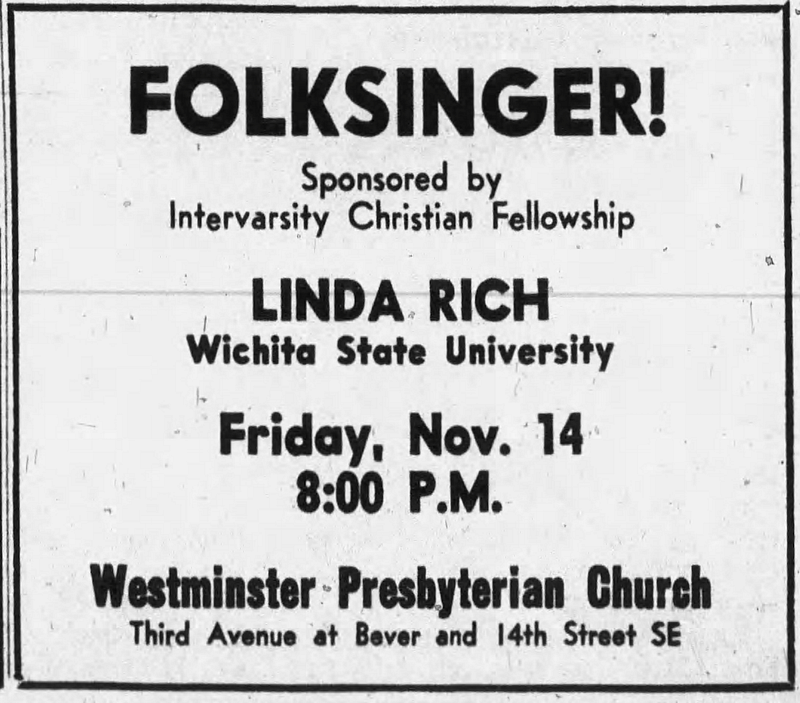
As a sophomore, Linda played a few of her songs in public. She was referred to InterVarsity, an Evangelical organization that did messaging on college campuses. They were looking for performers to play student events, and had started releasing albums on an improvised label.
Linda recorded her first album, There’s More To Living Than I Know So Far. The song everyone liked was “Man of Galilee.”
Then she was traveling around the country.
She played InterVarsity events and church services around the country singing: “I only want to be like the man of Galilee.”
A curious line from an Evangelical woman?
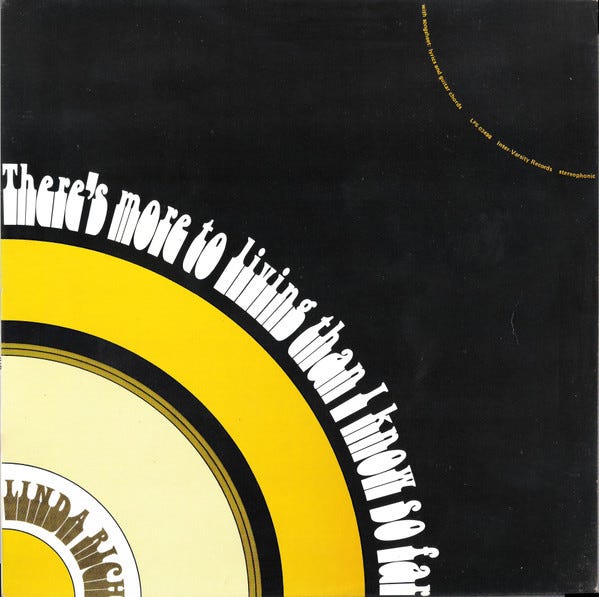
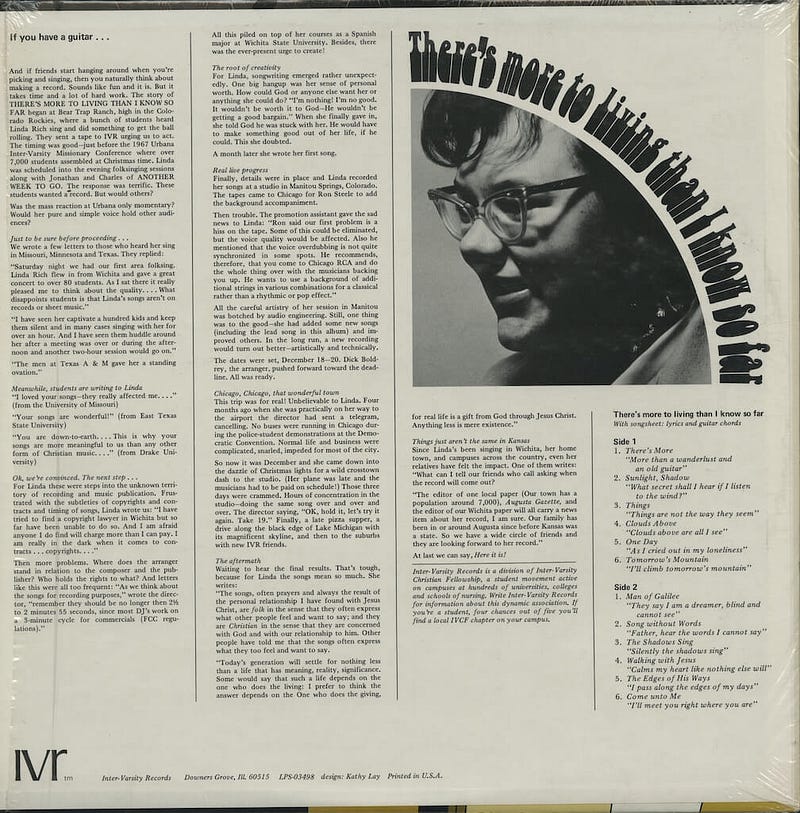
The very concept of a “Christian singer” was hazy.
The idea of a Christian singer-songwriter working out her ‘faith journey’ as she went along — was concept that did not exist at all.
She was oddly positioned commercially, not released by a regular record label. A Christian artist when there was no support for that category.
I find no reviews of her debut album. A recent Amazon review: “Loner psych-folk masterpiece.”
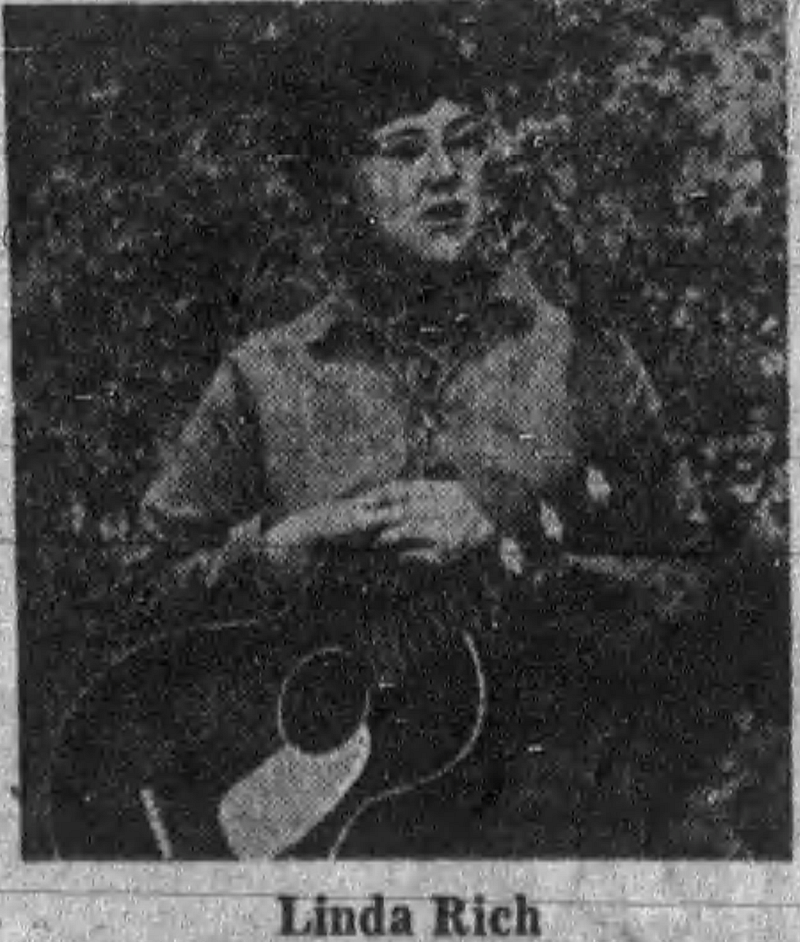
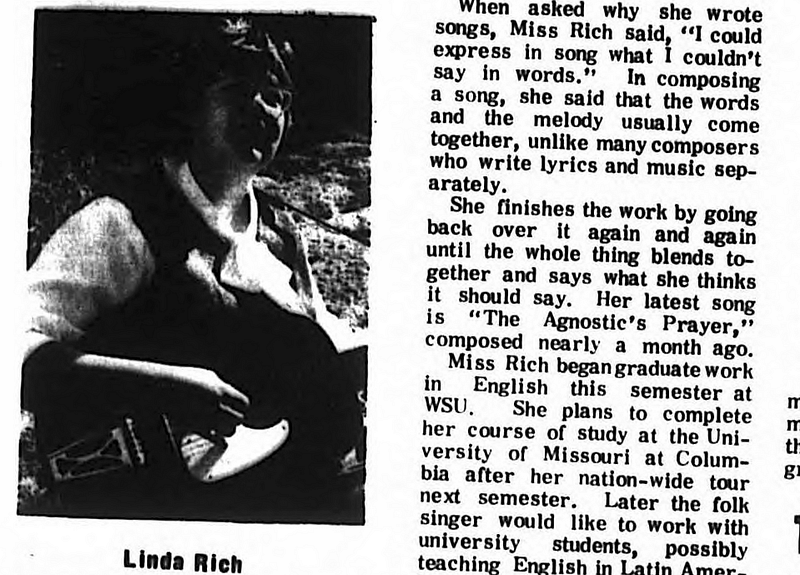
As she travelled, she’d be mentioned and interviewed in the local newspaper.
In one interview in 1969, she thinks back to her religious crisis as a freshman. “I did a lot of thinking and finally was convinced that Jesus Christ is reality,” she says.
She traveled the United States and Mexico. She played InterVarsity’s Urbana conference in 1970, where she sang to some 12,000 students.
The magazine Christianity Today covered the event, but didn’t mention her. I locate a photo of the performance.
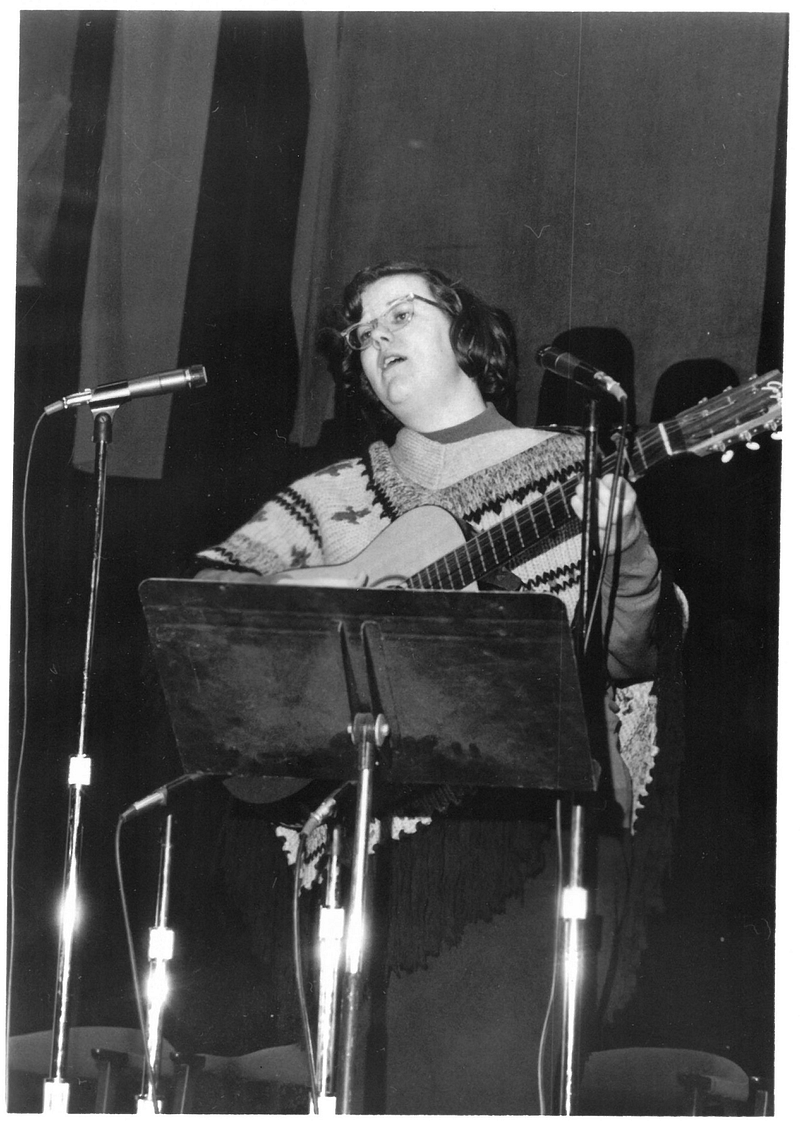
From 1969 to 1971, she turns from “folk singer” to “religious singer” to “Christian singer.”
Linda Rich was a new thing to be: a Christian singer-songwriter.


A few memories of her exist.
A blog post in 2006 became a forum for Christians to remember her concerts. One person recalls seeing her: “I was impressed by her gentle, Christ-like spirit and her passion for sharing her faith.”
Another says: “She taught us how to sing and play ‘The Man of Galilee’. A true inspiration musically and spiritually.”
In 1970, she released a second album.
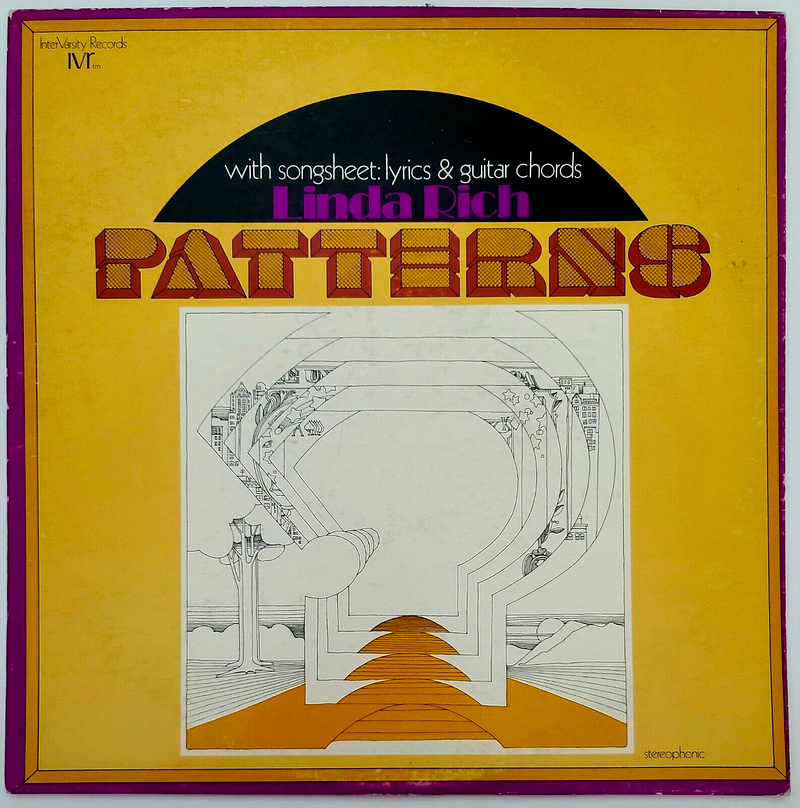
I don’t see any media coverage for Patterns. A later blog review: “Her poetic lyrics and stunning alto vocals have a dreamy quality that may appeal to 70s folk psych collectors, although there isn’t much variation.”
In “I Wander Down Dark Avenues” the singer travels, reflecting on not having her questions answered, having no real home, and life not making sense.
In “No One,” another wandering spirit wonders who and what it is.
I begin to develop a reading of these unusual songs as being sung in the character of Jesus. If this is true, she kept it a secret.

In college she double-majored in English and Spanish.
She seemed to feel connected to Latin America. She went to graduate school at the University of Missouri to pursue a Ph.D. in English. I can’t find that she graduated.
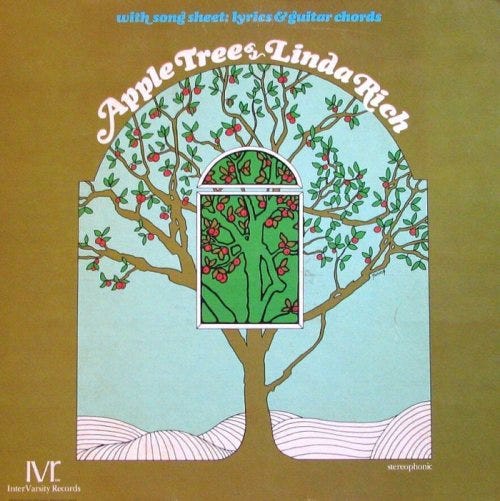
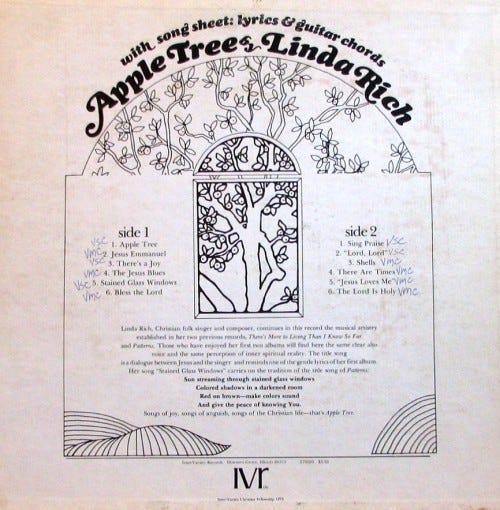
She worked on her third album, Apple Tree. Here, she very clearly sings not to Jesus or of Jesus, but as Jesus.
The messiah is reflecting on his followers, seeing people name-check him while ignoring his teachings completely.
To me, her masterpiece is the song “Apple Tree.”
It folds the whole biblical story—from Eden to Apocalypse—into another Jesus speech. The messiah reflects on his time on earth, telling his story.
“I loved you freely but in return I was crucified.”
It sounds like a break-up song? With the human race.
She was giving concerts as of 1973.
I last find Linda Rich noticed in newspapers in July 1973. There’s reports of her being heard on the radio. A professor included her in a lecture on ‘Religion in the 1960s’.
In 1975 she released Apple Tree, her last album.
I find the file on Linda Rich in the archives of InterVarsity at Wheaton College.
I sit with a pile of administrative documents telling a story, primarily, about a problem that started around 1971. An officer of InterVarsity had said something to Linda that was insulting, and she basically shut down.
What was said is not recorded. It’s just called “the incident.”
InterVarsity was ready to drop Linda, except they liked her unreleased 1970 song “Lord Lord” and wanted keep using it for events and for release on an anthology LP. She refused its use, saying she’d planned it for her third album. InterVarsity got a lawyer to determine if they could use the song without her permission, and were told they couldn’t.
They agreed to release her third album.
It came with a contract that assigned InterVarsity ownership of all three of her albums. There was also an NDA, prohibiting Linda from speaking about any “defamatory, libelous or slanderous” statements made about her by any officer of InterVarsity.
She’d be paid $2500, which would be around $13,500 today.

She took the money and ran.
Apparently, she just moved away without telling friends or family. In the 2006 blog post, a former friend writes: “We visited her when she was living in Columbia, Missouri. We lost contact when she moved and left no forwarding address.”
James Rich, her brother, shows up in the comments. “Linda is deceased or steadfastly does not wish to be found,” he writes.
I email him, and he gets back with a terse reply. Linda’s whereabouts remain unknown to him.
She had fans over the years.
A blog review: “All three albums are fantastic: melancholy, spiritual, sparse, gentle, rich, and luminous.”
Of her songs, only “Man of Galilee” was much noticed. It was covered by a few Christian groups, including a 1971 version by the Gamble Folk.
In a curious 2004 interview, the singer James Mason, of the Beta Band, said she was a “religious nut”—and his grandmother. He later said that, as typically in interviews, he’d been lying. He’d picked Linda as a joke.
I send her music to a friend who knows about music. He gets back to me: “Clearly a lesbian. Surprisingly beautiful voice.”
She’d spoken of wanting to teach in Latin America.
Maybe that’s where she went. She wanted to be somewhere else, or someone else. Maybe she could only be herself if she did.
Her three albums are online.
- There’s More to Living Than I Know So Far (1969)
- Patterns (1970)
- Apple Tree (1975)
They’re an epic of a woman who started to sing as Jesus, or Jesus began to sing through her. Evangelicals mocked her and forgot about her. 🔶


