
Was “Luke” a woman?
A Bible scholar lays out a shocking case
Not much is known about who wrote the Bible, and the books assigned to “Luke” are especially tricky. The third gospel and Acts circulated for two centuries without a name attached to them.
Many scholars think of the two texts as anonymous. I’m looking over a new paper which suggests the real author has been known all along.

There was no information from tradition about the author of the third gospel and Acts.
By the time Christians decided to attach a name to the third gospel and Acts, all they had to go on was the books themselves.
Two big clues seemed apparent. In the prologue to the third gospel, the author is said to not have witnessed the earthly life of Jesus.
So this person wasn’t named in the gospels.
The second clue really narrowed it down. In a few passages between Acts 16–28, the pronoun sometimes shifts to “we.” So the author was present with the apostle Paul on his travels.
Christians thought it over, and by the mid-to-late 2nd century, had their man. If the author was with Paul, then the author’s name would be mentioned in Paul’s letters, as the thinking went.
A ‘Luke’ was named three times in letters, without being named in the text of Acts. So Christians decided the writer was Luke.
They didn’t consider Paul’s female companion.
Nowadays, Christians wouldn’t even have heard of her. Christian scholars don’t trouble them with the knowledge. A 2018 biography, Paul by N.T. Wright, for example, has no mention of the female companion.
Only from ‘secular’ scholars do we learn she was noted by many ‘church fathers’—Clement of Alexandria, Tertullian, Jerome, Augustine. A key feature of the life of the apostle Paul was almost completely forgotten. To the faithful, he—like Jesus—is just around men.
But in the gospels, Jesus’ most devoted and ideal followers seem to be women, and Paul often seems to be around women, noted as fellow leaders.
And he seems to have had a regular female companion.
We see this in Paul’s own writings, through her presence is subtle. In Philippians 4:3, he is discussing a conflict among some Christian women, and in an aside, asks his “true companion” to help them.
In 1 Corinthians 9:5, Paul defends his right to have a “sister wife” travel with him. This is often translated as “believing wife,” as Christians typically think it means a romantic partner.
The actual phrase is much debated, as “woman sister” or “sisters woman” are strong possibilities. This wouldn’t seem to be a typical wife, as Paul had clarified a chapter earlier that he was single.
So it seems he was traveling and working with a woman who was not his wife. She was a Christian ‘sister’.
Joan Taylor has been on this beat for awhile.
A British Bible scholar, she’s made a specialty of biblical references to female disciples. Her eye-opening 2014 paper “‘Two by Two’: The Ark-etypal Language of Mark’s Apostolic Pairings” was made into a BBC documentary.
She points out that early Christians seem to travel in pairs—sometimes two men, or two women, but most often a man and a woman. This seems to have been theological. God is ‘male and female’ since Genesis 1, so would be represented by a pairing of both.
And in ancient Rome, a man and woman missionary working together would just make sense. In that highly gendered environment, men just didn’t go talking to women, or vice versa.
In the narratives of Acts, however, Paul’s company is often making approaches to women. In Acts 16:13, this “we” writer writes:
“We sat down and began to speak to the women who had gathered there.”
How was Paul managing these female contacts?
Back in 1997, an English professor named Randel Helms had an idea. He was mostly known for his scholarship on modern writers, especially J.R.R. Tolkien, but he wrote a few books on the Bible—often to point out how less is known than supposed.
He was mostly disregarded by Bible scholars, and his book Who Wrote the Gospels? fell out of print. But Joan Taylor noticed that Helms made a provocative suggestion. When reading Acts 16, he’d noted it was “simply unthinkable” for Paul to just start talking to women he didn’t know.
He added: “But if one can speculate that Luke was a woman, an explanation comes forward.”
In a paper published in 2020, “‘Paul’s Significant Other in the ‘We’ Passages,” Taylor expands on the suggestion, and proposes to the Christian world—a female ‘Luke’.
Taylor focuses on the passages in Acts that use the “we” pronoun.
To look over all the “Luke” writings, it might not be clear, actually, that they were written by the same person. The book of Acts itself can seem to be two parts. In the first part, up to Acts 12:24, there’s a story of Peter and Jews of Jerusalem, and then there’s a second part which concerns Paul — but the style is different.
To follow the “we” writer is to see this person isn’t one of the boys. When Paul and Silas are arrested, the “we” writer isn’t arrested with them. This suggests, Taylor thinks, that the writer “is a female companion, not an active culprit in the eyes of the authorities.”
While the men are in prison, “we” keeps doing missionary work—and that work seems to focus on women (Acts 17:4, 12).
The interplay of “we” and “they” seems to mark the difference between male company vs. mixed male/female company. To read “they” is to know the writer is reporting from sources, then “we” signals the writer has joined Paul and is now an eyewitness.
When together, the “we” writer has a remarkable ability to focus on Paul—to be totally devoted to, and perceptive of him. As Taylor notes, this writer “is simply with Paul, come what may, like a wife.”
Her name, of course, was Thecla.
A popular late 2nd century text called the Acts of Paul and Thecla appears to narrate Paul traveling with a woman named Thecla, who was from Iconium, a city in Turkey. As Taylor writes:
“Thecla is portrayed as a high-status girl (who would have been educated and likely literate) who refuses to be married after hearing Paul speak in Iconium (correlating with Paul’s first missionary journey of Acts 13–14).”
Thecla gets in trouble with her family and the city authorities, and so, off she goes with Paul.
But there’s a twist. Thecla travels with Paul, often while cross-dressing.
Much of this was clipped out of later Christianity as it tried to re-write its past, but pieces survive. Taylor discusses a sarcophagus lid from the 4th century, found in 1897, in which three figures are seen on a boat.
It seems to be a scene from Acts. Paul and Thecla’s names are printed. Everyone seems to be male.
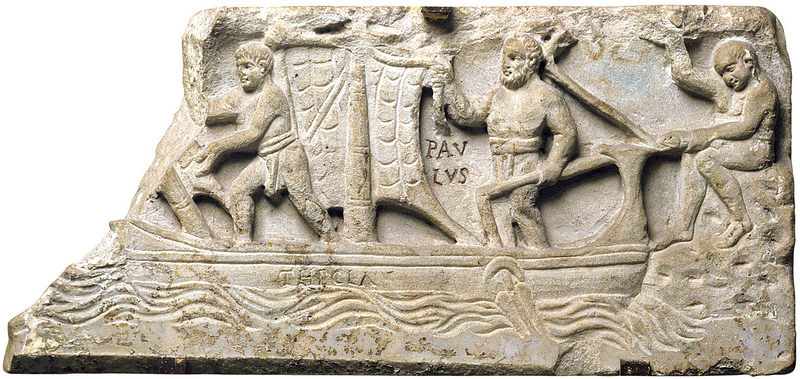
Early Christians loved cross-dressing women.
In a 2002 paper, Stephen J. Davis documented an array of similar narratives from the early days of the faith, and Thecla was the central exhibit. An early Christian narrative called the Acts of Eugenia has the heroine declare:
“For I am a woman by sex, and because I could not attain my desire and serve God as I deemed necessary and in fair security on account of being a woman, therefore I disguised myself as a man, and in a just and fitting way concealed my charms; in emulation and after the example of my teacher Thekla… I disguised the frailty of my sex under male attire.”
To find cross-dressing, even a version of ‘transgenderism’, in early Christianity and indeed in the New Testament itself is unexpected. But it may make a kind of sense?
Scholars point out that, in the cultural context of the time, Paul seems to come off a bit feminine. For his female partner to be on the masculine side might be—a match made in Heaven?
Did Christianity make the right choice in identifying “Luke”?
A thought occurs to me. When travelling as a man, Thecla might have used a male name. Could that name have been—Luke?
The two figures, Thecla and Luke, are notably similar. Note that Paul called Luke a “beloved physician” in Colossians 4:14, and Thecla was often later associated with healing.
That Thecla/Luke was a ‘queer’ figure on the margins of gender might suggest why Paul had so much trouble getting financial support for his “sister wife.”
His appeal in 1 Corinthians 9:5 for payment for Thecla takes on the unexpected context of demanding equal pay for queer people.
Thecla was also seen as a woman.
In 1906, archaeologists found a small cave near Ephesus. A wall painting had been covered up, but underneath, there they were: Paul and a female-presenting Thecla.
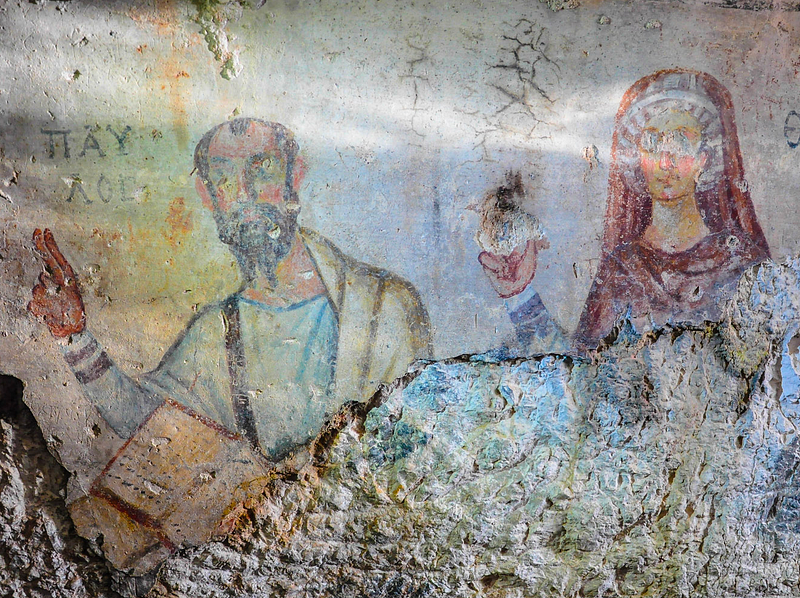
As the painting survives, her eyes are scratched out, and her hand, raised in the teaching position, is erased. It leaves her, as a scholar notes, “blinded and silenced.”
Still, we see that she was teaching beside Paul. They were a pair. One could easily imagine this formidable woman — being ‘Luke’?
And one can see some Christian men saying: ‘Hell no.’
That the Bible is radically free of gender bias is mostly unknown to Christians today.
They might have learned it from Paul’s writings. In a 2016 paper on Paul’s relationship with Thecla, Samuel Onyedika Nwokoro notes:
“Paul seemed to have been gender neutral. In Christ, he claims that all forms of inequality dissolve (Gal. 3:28). This would imply that hierarchies of gender, class and race find their ultimate collapse in the person of Jesus Christ.”
But Christians chose to listen to later clerics and their extreme misreadings of Paul’s letters, turning him into a misogynist—as if the apostle would hate God’s own feminine self.
And Thecla—the woman who’d helped write the Bible—was erased. 🔶


