

The quantified-self trend is mindfulness 2.0
So many people have checklists and keep track of their activities in the most detailed way but never really think of the mindfulness process behind it.
In psychology, perfectionism is seen as a mask that protects us from showing vulnerability and weakness because somewhere along the way we’ve been shamed, bullied, abused or rejected for showing some of those less polished sides of us. The resentment and discomfort built in the context of such an event can follow us throughout our entire life if we don’t recognize how we are now defending that hurt little child inside us with the perfectionism mask. Among many other similar masks, perfectionism is the one that gets more social acceptance and praise which makes it even more difficult to give up on the habit and really go deep into the trauma behind it and heal that.
The dopamine and serotonin coming from keeping yourself accountable and thus following through on perfectionism are undeniable. We get praise, ego boost and a lot of attention for being someone mature, reliable, who is always on top of their things and in control. However, if we step into the “garden” of control and obsessions, it quickly becomes an issue rather than a quality of being someone predictable and reliable. Then you start noticing the different masks that help serve the same purpose as mentioned before which is protecting the inner child from getting hurt again. These other masks that society doesn’t look up to as much are:
- Obsessive compulsion disorders( OCD)
- Control freaks
- Overthinking
- Dominant
- Entitled
- Attention seeking
- Narcissistic
Being an overachiever will not be condemned by society though and that creates precedent and room for overwhelming results on a personal level. Many people often notice that overachieving comes at a high price like burnouts, meltdowns, too high standards for ourselves which ultimately leads to depression because there’s no satisfaction anymore if you always think you underperform.
The quantified self trend explained
When technology enables us to track everything a lot easier, there’s a certain degree of curiosity that drives the need to know more about how we operate in a certain context.
The problem with that though is that we don’t know yet when to stop tracking and simply live. That’s where mindfulness comes at play.
These high standards come from a low self-esteem structure built in childhood and a modus operandi learned for surviving based on putting the “hard work” on the first position on our to-do list in life.
Don’t get me wrong, I used to be this person as well. I used to do 10 things at the same time and almost do all of them with excellent results. I was the kid who did 2 universities at the same time while also holing an agency which is more than a job and having a boyfriend in my personal life. I was juggling so many balls at the same time until…I simply dropped all of them at the same time. I never wanted to admit to myself that the summer I moved to a new country was the most difficult summer of my life. My entire world as I knew it collapsed and I had to start from scratch. It’s only a matter of time until someone who is trying to do this much will crack and either die young or go through burnouts. My burnout lasted then for about 6 months in total. I realized the importance of routine and going back to a less demanding set of daily activities pretty quickly and I was able to put the boat back at float but some people get stuck and get depressed for years when facing burnout. Luckily I still had at that point my grandma and my family to fall back on when things got tough emotionally. But that was the first time I started learning about self-compassion.
My journey to learn about self-compassion when through some stages:
1. The critical self which doesn’t want to give up juggling too many things
In 2013 I started going to different coaches to ask for help to “focus” better because I was handling too many things at the same time and I had a hard time converting all these things into assets I could fully represent myself with in the world. That year got me from a freelancer mindset to an entrepreneurial mindset.
2. The quantified self who puts very high standards on their outcomes
In 2015 I was already almost 1 year into a new country and freelancing again, trying to start a company with a product and because I was so limited in financial resources, I was A-cing at being calculated about my finances to the last penny. I was also struggling with the high standards I now had on how I work. I was not delivering some projects to clients and incubators where I enrolled to attend with my startup due to the high anxiety of failure. While struggling with the impostor syndrome, I faced the reality of having to work more on my leadership skills and stop pretending I know and can do everything. It was also a time when I started practicing yoga. Bit by bit I build compassion over the way I allow myself to take breaks, to not work 16h/ day anymore and to eat at normal hours and workout and sleep like a normal person.
3. Allowing failure to beat you down
In 2017 I had to face reality. My startup failed. I was miserable. My grandma wasn’t there anymore to help me grief with her but instead, I was griefing after her and my startup altogether. That year was hard on many levels. I was forced to start therapy because coaching was no longer working anymore for me. Regardless of how much cycling I was doing to steam off the heat and anger of the failure and death of my ego with it, it wasn’t doing the trick anymore. I was doing yoga 2–3 times/ week at this point. Rebalancing took a while. In 2018 I was back. My year went better and I learned to embrace the change and to see how being rock bottom allows for a rebirth. By this point, I knew already how harsh my inner critic was to not allow me to feel this way up until this point. This story allowed me to revise all my previous experiences through new lenses.
4. Accepting that even if you’re doing better, things can still go wrong at times
The path I was on was clear. Much more sharp in my focus, allowing myself to do only what was contributing to my growth, only doing what made me happy and really looking at how I can leverage my time best without exhausting myself to pull out gigs that are “cool” and nothing more. But despite planning how to allow these options to soften my hard edges and to open my mind to new ways and perspectives, failure still followed me, this time on a personal life situation with a really bad relationship blowing up in my face. As such, I hit rock bottom once again. I was in a moment of despair when I started reading about my emotional blockages, beyond the cognitive level with which I was working with already since 2013. So 6 years later, I was finally able to dismiss my need to control things and to be perfect at all times, but, I realized I was still not accepting myself. I read about codependency and it all started to make sense for me.
5. Testing how you apply perfectionism as part of your ego vs part of your mind discipline
Looking back at what 2019 meant for me, I would say it was the year with the biggest growth of my life on all levels. I grew from a scared little girl with no confidence backed up by walls of protection in perfectionism, overachieving and grit to a confident young woman, now in her 30’s with a lot of emotional resilience due to her life experiences and lessons she learned from without being overwhelmed anymore.
The mental discipline was something that got me from a place of despair to a place of control and safety. While discipline implies rigor and perseverance and at some points stoic mindset, I also introduced empathy and compassion from my yoga practice. This finally enabled me to check my intention about the reasons why I was doing something before I invest myself in it. For example, if I choose to learn a certain skill just to prove myself to a client, I would rather not do it and move on to a new client where I can use my current skills and slowly and gently push myself in acquiring new skills while doing something that I am already mastering. This mindset made me lose some clients, but I taught me more about the place of intention and letting go of perfectionism while staying on top of things with my current “craft”.
Finally, there are many ways in which we qualitatively and quantitatively assess our performance in either work or personal life. Some people journal a lot and especially entrepreneurs are obsessed about their agendas and keep track of how they spend time in different slots they precisely monitor.
Being myself a fan of discipline, I often embraced this mindset but since my context was to the most part uncertain, I never formed the rigorous discipline of keeping track of my every move. However, I noticed that a mindfulness discipline was already in place for some years. The moment I noticed that I allowed myself to indulge in the idea that I am a quantified self. That was a complete change in perspectives for me.
The moment I no longer put pressure on being the perfectly scheduled entrepreneur with an agenda for how I do every task, I saw the benefits of wanting to make that part of who I am.
It started with having a Fitbit and starting to see how my energy is used every day. It became a central piece for my emotional regulation practices and allowed me to get down from my head into my body and heart and love to see how my body performance improves when I am aware of what mental resources I allocate to those processes.
I find it extremely useful to see how modern technology allows us to track different data points that influence our mood and emotional balance and label them as part of the forces that drive us further.
Lastly, the more we step into a data-driven era, the more we would be able to keep evidence of all activities we do even if we don’t actively engage in monitoring because data points can be collected passively from the devices we use and show us insights into our behavior. The only question here is to what extent do we want to put into practice the change in behavior that allows us to lift the burden of perfectionism and life a full happy life without feeling like we underperform or lack ambition?
Which trackers would you use to step into Mindfulness 2.0?
In 2019 I used a couple of digital tools to track my mood. Mood trackers are quite popular these days. However, it didn’t satisfy my thirst for contextually correct qualitative data. While using formulas to detect which forces influence your mood most, these trackers are also flawed in the way that they actually trigger more anxiety when you read a question about how you could feel but you realize you don’t. This applies to the FOMO of the fitness trackers as well!
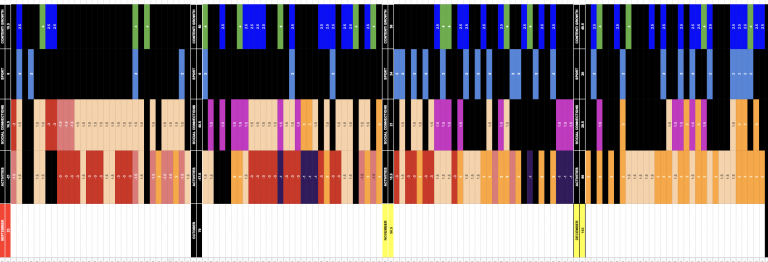
Unless we want to be able to simply keep track of mood swings and keep an eye on a depressive episode, apps like Moodpath can help with that. Otherwise, a deeper understanding of your context is required to balance out the forces influencing your mood. In my yoga practice, I learned how to build self-compassion through 2 basic elements:
- Having a choice ( or creating a context in which you don’t feel limited and you have room for alternatives and options you can choose from )
- Being present
This last part made me develop my system to evaluate what helps me keep afloat and what doesn’t. Being able to notice the difference between what is in your power ( from a choice perspective) and what isn’t from an external factors perspective, allowed me to divide the forces that influence my mood in 4 different categories:
1. The resources
To handle different levels of complexity, you need to understand the type of resources you have. We all have resources that we are aware of and some that we are not aware of. If you apply the Johari Window model explained below you will find out much more about what you actually have as resources and thus learn to manage your capabilities a lot better.
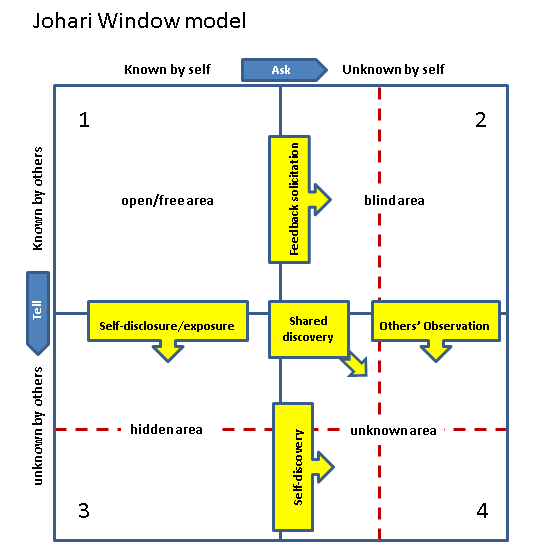
The 4th quadrant of unknown and untapped potential can be something to look into when you are facing doubts about what you have as resources. So don’t shy away from asking around what others have observed and use that in your favor for growth.
Being able to keep track of how we use resources ( energy, emotions, skills, assets, support network, etc) is part of our emotional intelligence that ultimately allows us to take control of our lives.
2. The emotions
As much as emotions are resources, they are also variables. In this case, some of the feelings we have might not serve us for the long term. In Daniel Kahneman’s book on Thinking fast, Thinking slow we come across the concept of impulsive mind and short-lasting emotion that drives the NOW with an auto-pilot and the gut feeling which drives the long term decision making and helps us make the FUTURE decisions. This idea of zooming in and out of perspectives to allow both the long term thinking and the short term thinking to come into play enables us to influence our mood and regulate the bad temporary feelings with this way of adjustment.
3. The struggles
Our blockages and symptoms are not bad! They show us that something is wrong. They enable us to practice awareness and stay in the now. Every struggle allows you the opportunity to go deeper into yourself and find the real reasons why we do what we do. That is the leader of our gut feeling and intuition because it contains all our prior programming both genetically and through generational transcendence of experiences.
4. The dynamics
The tensions we encounter are the best teacher for letting our guard down and becoming more flexible and open to change. How we notice the struggles and the dynamic we create with it becomes a modus operandi. If we allow the bad patterns of behavior to keep occurring, we can keep a certain dynamic for a lifetime. All the relationships we develop are impermanent and can be changed if we become aware of them and work on activating new dynamics. For example, we might say that the attachment style is permanent. That’s not true. The same goes for personality.
We can rapidly change almost anything so keep up with working on yourself to bring more mindfulness into your life through self-awareness!


