

What’s your emotional wound and what type of therapy suits you?
There’s a lot of research done in the area of relationships and love, but there’s very little connection between that and our primary love relationships with our parents or main caretakers. I’ve been looking into it and brought some new perspectives on how that influences our adult relationships.
For the last year, I’ve been doing a different type of therapy than the traditional psychotherapy focused on cognitive-behavioral patterns. My interest was mainly triggered by a depressive episode after a breakup. Despite being a highly cognitive person, with an incredible skill set of reconfiguring and reframing myself, I was deeply buried into depression. I wrote about my experience through the lenses of codependency recovery here. As such, since last year I’ve been focusing on going from my mind and head to my emotions.
Emotionally focused therapy allows us to look in-depth at how we relate to people around us and how we translate that into emotions into our own bodies. Eric Berne tackles the subject in his theory of transactional analysis. And then new emerging research comes from Hillary Jacobs Hendel who speaks about the difference between a cognitive analysis of the transactions between individuals and the experiential level of awareness about the same transactions through the lenses of emotions. The powerful thing about Hillary’s approach is that it brings the intelligence of the body into play.
The psychosomatic experience which is actually hardwired into our subconscious allows us to tackle more profound wounds and to hold space for compassion towards our humanness.
Stacy Hoch, a somatic experience focused psychotherapist explains the difference between the way we mesh our emotions with our behavior and translate that behavior into a self-belief. Her video on the types of emotional connections we develop with our primary caretakers made me reflect on my own type of love relationships I learned and I develop in my adult life.
Here’s what I came up with a classification of types of love we learn in our initial relationships with parents
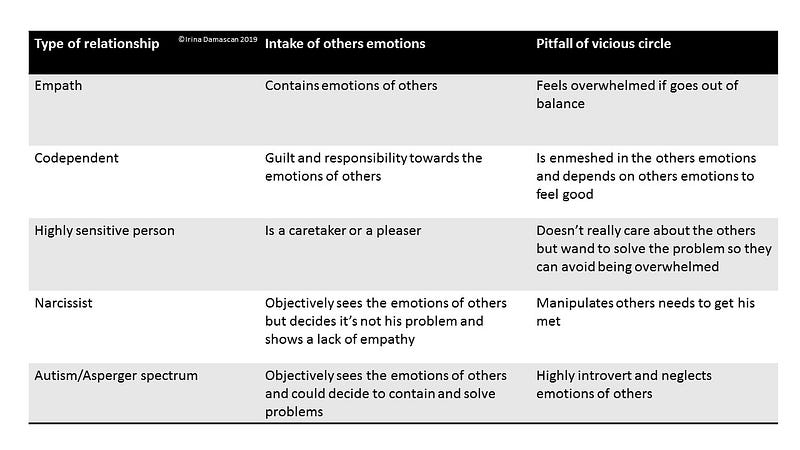
Being able to spot which type you are will be a little bit more complex than you think. So here are 3 simple steps:
- Think of the way your mom offered attention and love to you in your early childhood
- Now think of your dad and identify the same patterns
- What is the hybrid pattern that you developed and what is dominant in that hybrid that you manifest most of?
If you’ve done this quick check, you may now know how you received love from your parent's love language. If you already see a clear pattern for yourself, you may not need the following structure, but if you haven’t spotted it yet, it will be useful to go deeper into your emotions.
The connection between emotional deprivation and how we manifest love today
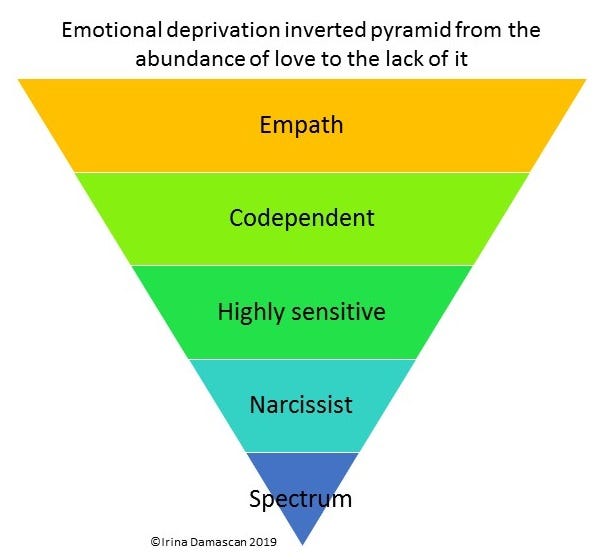
Looking at emotional deprivation through the lenses of stages and degrees, we notice how the least amount of love is received ( or perceived in the case of people on the spectrum of autism or Aspergers) is the least at the bottom of the pyramid where the narcissists are. To put it more simply, if you’ve been neglected more, chances are you are more narcissistic than a person who got more unconditional love from their parents.
This is a practical exercise to make also with the coworkers or people we do business with or people we get into conflicts with. The tenser the relationship with them, the more we need to explore what is their trauma and how can we solve the conflict by offering the opposite of what they are expecting to get from their past experiences with people neglecting them in the past. Even the most intense people will react to genuine care and compassion.
Emotional wounds and their coping mechanisms
Emotional wounds from your early childhood will form a framework of behaviors that helped you cope with the pain in the past. However, today they may no longer serve you and thus you might need therapy in order to correct the types of behavior that are bothering you now despite being part of “who you are”.
There are now multiple types of therapy that can help you at different levels of your healing process. The most important part is to remember that no therapy will completely solve your problems and that only doing a complex system of therapies will enable you to heal and move on from the traumas that got you here in the first place.
I started categorizing types of therapy according to the tools they offer to visualize your situation from different angles and using different lenses.
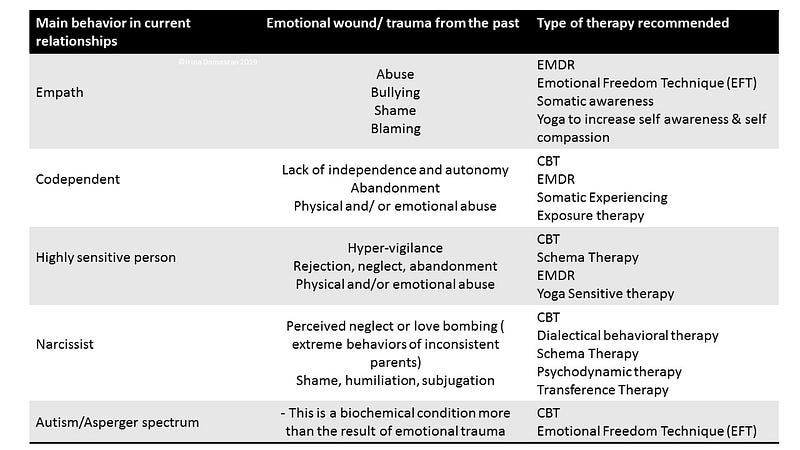
One of the most important things to remember about types of therapy and healing processes is that everything is individual and highly subjective. While one method might work for some, for others it might not show any results. I learned about this through my own healing journey and through the ups and downs of this process in which I tried everything! And then, at some point, I met someone who told me in a very compassionate and non-violent way that I am harming myself more by digging up the past when I don’t need to. Sometimes, things surface at another pace than the one practiced in an intense therapy process and we might want to leave those wounds unhealed there until they are ready to surface and ready to come up and show us the lesson we had to learn from it. Emotional wounds develop hardwired protection mechanisms that help us survive in critical stages of our development and sometimes, giving up on those walls might take years and serve a new purpose than the initial one. The important thing to do is to practice observing rather than judging ourselves for it and to kindly embrace the nature of things as it is.
Acceptance and compassion will guide the healing process at the right pace.
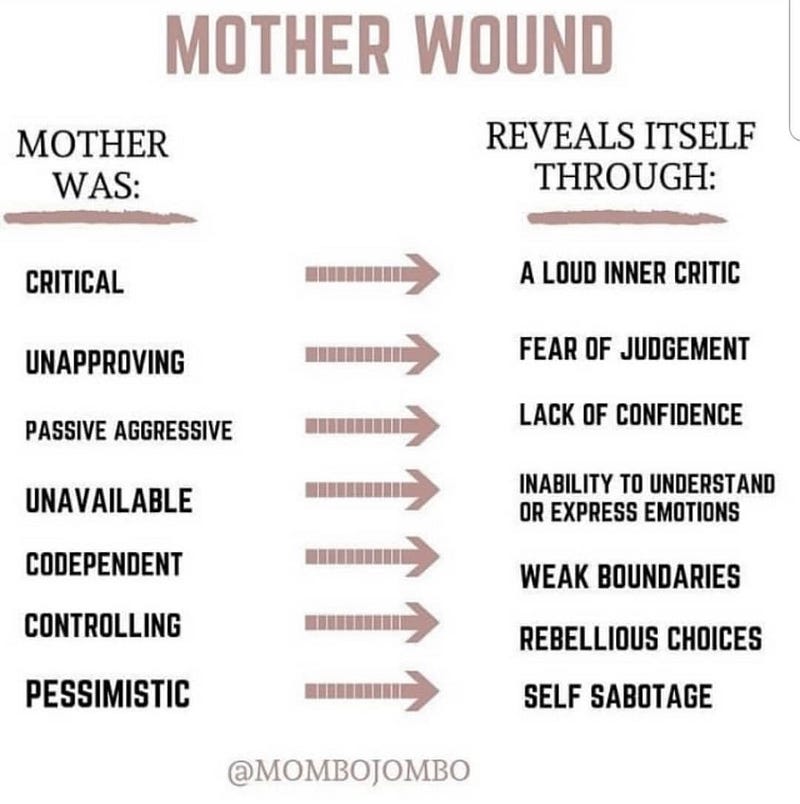
While the following instances show what wounds can look like depending on who was the caretaker who created them in the first place, the most important part to remember when doing this inner work of healing is to not blame the parents for it and work with the inner child wounds and comfort that little version of ourselves with the adult we have today inside us.
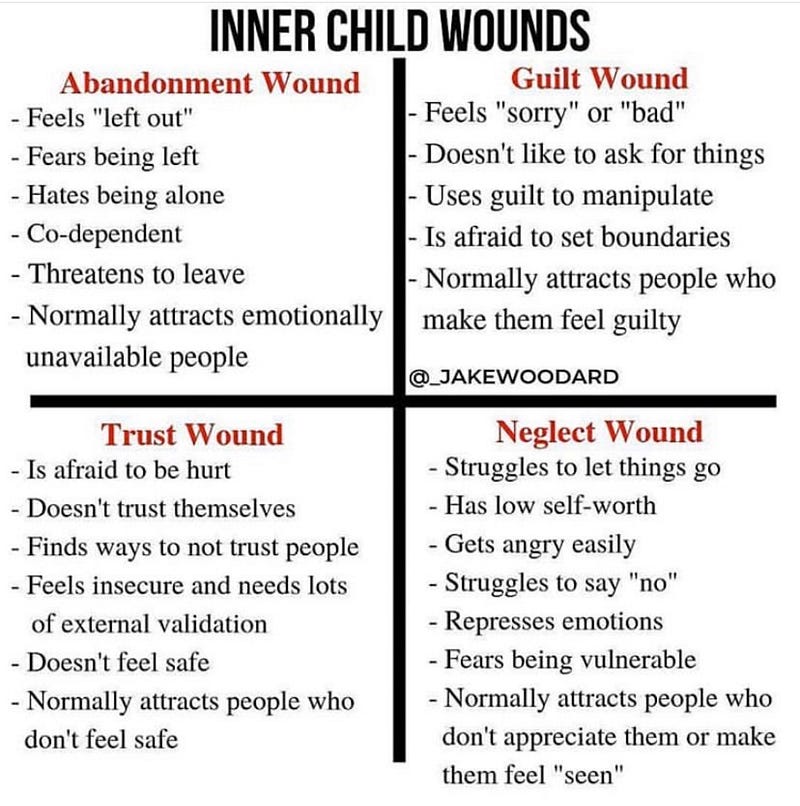
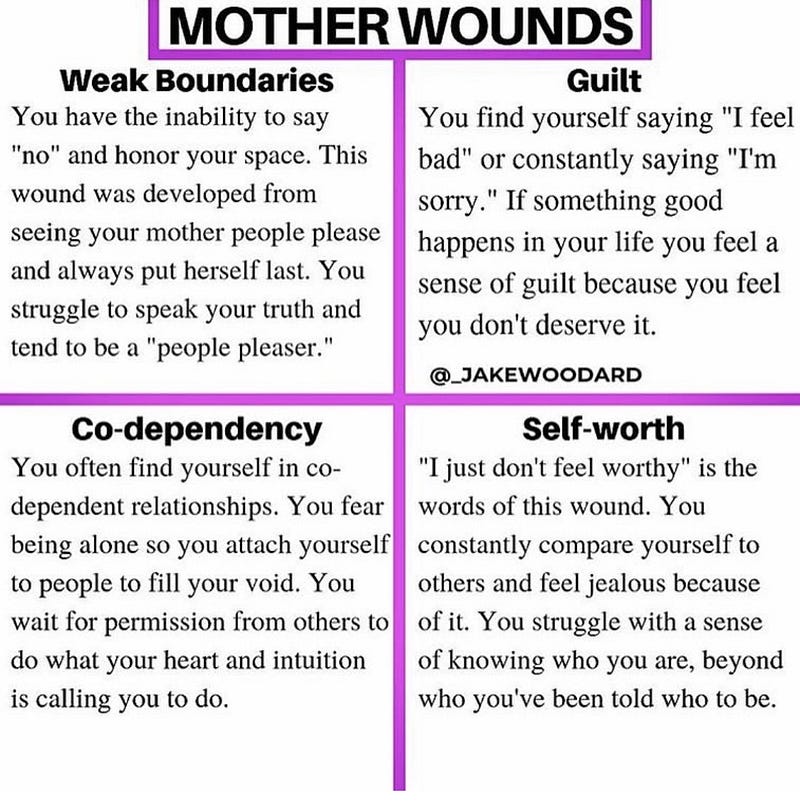
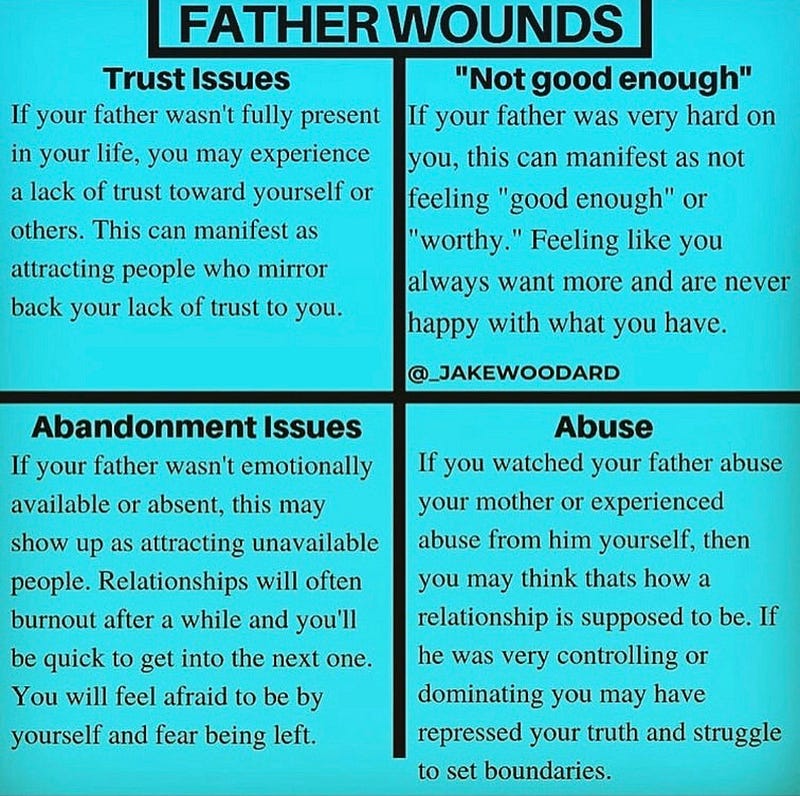
Finally, the types of therapy suggested above have evolved from the more classical ones for a good reason. I would like to emphasize that therapy is just like any science, evolving together with the people using it on both sides of the „couch”.
It used to be psychoanalysis that was the beginning of therapy work in the beginning of the 1900's with Freud, the „father” of this new thought leading school at the time. This was based on a human revolution need coming from the industrial revolution. Part of the industrial revolution combined with the new mindset of people looking deeper into their unconscious brought the wars and thus created a new need for a therapy method that covers the trauma and focuses on the NOW and here. That was why Aaron Beck developed cognitive-behavioral therapy. People had very deeply routed traumas back then from wars and early deaths of loved ones from lack of medicine and health care. He also made a depression assessment which is still in use today.
In the 50’s the after behaviorism, there were 2 new concepts developed: cognitivism and human-existentialism (gestalt therapy) which had a lot to do with dealing with less emotions and more cognitive processes to ensure people use ration rather than emotions to guide their actions. In Gestalt therapy, there’s a specific way of handling the patient by focusing on the How instead of the What.
In the meantime, there was a need to combine behavioral therapy with cognitive therapy which resulted in CBT second and third wave ( DBT) in the ’70s.
Also in the 70’s schema therapy was developed were family systems also took a major role in understanding human psychology. This need came from the evolving economies that allowed major developments of industries around the world where women entered the workforce and soon the big dramas of the wars had to be replaced by smaller dramas of a more stable family environment with micro traumas.
Tackling complexity made it possible for new types of integrated and holistic therapies to emerge in the ’90s as such that we now have emotionally focused therapy, EMDR, dialectical behavioral therapy and many more focused on family dynamics.
The more complex elements we introduced into the development of a child into adulthood, the more we needed therapies that can help smooth the process of the transition from a dependent child to an independent adult in society. However, the more types of therapies we have, the fewer data on how they perform we collected. As such, this is an unprecedented situation in human history when we have the means to collect the data on how effective every therapy type is for a specific person, but we don’t collect it and create benchmarks for the individual tracks.
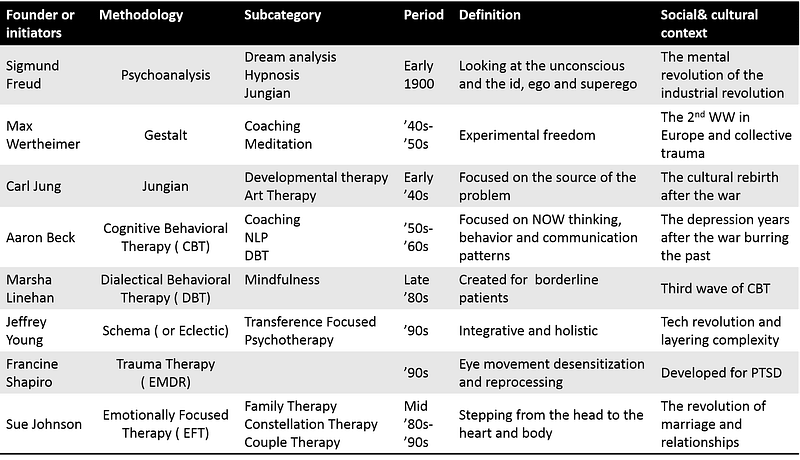
Here is a summary of the context in which different types of therapies were developed that should help you see a holistic picture of the way in which human evolution lies in both collective evolution as well as individual revolutions. We would be able to come up with more types of therapies today that have more alternative qualities and look for healing processes adapted to individual situations, however, a pre-testing of the conditions in which such alternative solutions are valid is necessary. Some people will find the intensity of one process too much for their needs and some would prefer to go deeper rather than scratch the surface. Either way, the “optimal” dosage relies heavily on the patient and how he alone defines wellbeing. Ultimately, the balance and yin and yang of life will bring more happiness than any specific method followed through thoroughly.
If you’d be able to design your own process of therapy, where would you start assessing your wellbeing?


