
Navigating emotional intelligence in the gig economy
How to achieve emotional resilience when you’re navigating uncertainty and complexity in your career is the question that we ask ourselves when we think of the success of the gig economy.
Emotional intelligence is not an inborn talent. It’s always the result of education.

As a freelancer and entrepreneur for over 7 years, I am asked many times by friends how I manage to stay positive and not surrender to depression whenever I face months of financial instability or loses due to failures in my business. It wasn’t until 2017 that I asked myself “how do I manage this?” after a turning point with my startup that failed to deliver to a first customer and got myself into the situation of losing all the money invested and merely all my self-confidence that I can ever make it as an entrepreneur.
I then stepped back for a while from the arena of entrepreneurship by being an employee but had the bad luck of getting myself into more trouble as the company hiring me was also very unstable financially and turned out to not be able to afford to pay me a salary. However, it did turn on a light bulb in my brain about what it means to be able to live with this uncertainty and operate from a place of resources ( intellectually speaking) even when your financial resources are at risk or minimum. Since then I met many more people like this me who were able to contain their fears and anxiety and form an emotional resilience and desensitize the effects of being bankrupt while still making all the efforts to overcome the situation.
Emotional resilience is formed in kids according to Ken Ginsburg from 7 components:
- Competence ( to get a task done end to end)
- Confidence ( to know you have the skill to do it)
- Connection ( to feel you understand who that connects to the rest of the work of others)
- Character ( to add your mark to it and not just execute like a robot)
- Contribution ( to be able to determine what your part is from the bigger project)
- Coping ( to deal with failure and challenges)
- Control ( to be able to step back before acting on impulse)
The idea behind resilience is not to avoid mistakes but to learn how to cope with failure. And the more we face different types of stimuli from various sources, the more subtle the mistakes are and the less we can fully control everything so the best way to deal with it is to form emotional resilience.
The culture and creative industries help shape our emotional intelligence. That’s why it’s important to integrate various forms of learning in the upbringing of kids and to allow them to compare sources of information through various filters. But the more we have creative education in our cultures, the more likely we are to want to become freelancers, artists, independent creators operating in the gig economy. So how do we operate with the mindset while still maintaining our rational brain wired to help us solve problems and keep a certain level of certainty and predictability?
The creative brain and its challenges
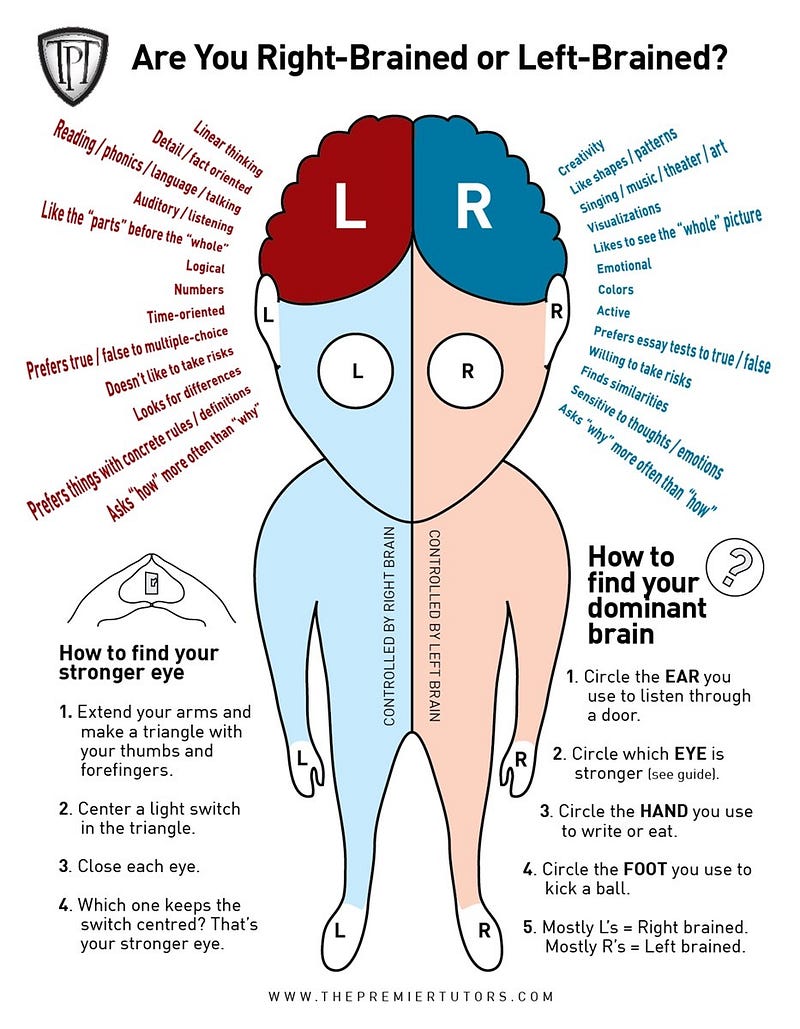
Our ability to intellectualize problems is connected to our rational left side of the brain. As such, if you put more emphasis on your right creative side you will face a lot of trouble being able to make things concrete and tangible and you will live more in your dreams and feelings than in reality.
The biggest struggles of someone with a creative brain and connected to the gig economy
- Timeboxing activities
- Boring repetitive tasks ( the linear thinking) which includes accounting and sometimes client acquisition
- Delivering something in parts ( agile working or sprints are included here because it means working in small chunks with no overview of the holistic perspectives)
- Listening to client needs and being able to figure out details missing from the process ( partly problem solving)
- Following a preset structure of execution
- Deadlines
- Making the reflections of a project and learning from mistakes
- an important note here is that I took the extreme example of someone who is deeply hardwired to think more with the right brain than the left one. However, most people have a bit of both even if one is more developed.
The biggest struggles of a rational brain in the gig economy
- Loneliness and not having a support group
- Not being able to see the bigger picture and operating too local
- Being less prone to take risks and more dependent on constant revenue streams
- Having less certainty about decision making because they need to embrace the grey area between extremes
- Being too specialized and not broad enough to be flexible and operate in ever-changing environments
- Not having enough empathy to solve problems and relying too much on the accuracy and fairness of others to deliver like them
- Being less creative and able to map their thinking into visuals to help simplify complexity
- again this is probably the most radical version of the situation. As such, I would like to expand and map what emotional intelligence can do to help both of these extremes stay more in the middle and overcome challenges easier. Also, another important aspect to have in mind is that the gig economy in its self is a vast concept and would have to be detailed for specific industries to show what are the most likely challenges to occur in those industries with these 2 types of hardwiring of the brain.
Future of work
Gig economy as also documented in numbers here is growing every year and is the expected future of work. However, navigating the future of work through the lenses of emotional intelligence is a completely different ball game, and not many economists are looking at it and even fewer people are facilitating and enabling specific industries to thrive in these new paradigms.
As someone who has been for over 15 years in the creative industries from advertising and PR in my early adolescence years and to marketing and design and tech now, you could easily fit me into the right creative brain part. But over the years I noticed that I have seen many industries in this bigger class of creative industries failing to make ends meet financially because they burst of creativity but lacked the structure and organization required to maintain cash flow. Then I went back to my background to see why I see this as a failure. And that’s when I realized I was a mix more than one side predominantly. I studied in a highly rational high-school orientated around math, logic, and computer science ( I even learned how to program in basic C++ and HTML). I later followed architecture school where I did physics and structural engineering and many scientific subjects that developed my thinking. On top of it, my biggest problem from an early age was that I have a hyperactive brain. So I read A LOT. More than 1000 books in my 20’s. So even though I worked in the creative fields, I was always highly rational. As such, staying in my emotions was a challenge for me. Thus, now talking about making ends meet with understanding where skills like the ones developed with my education work with my brain’s natural hardwiring.
The true power of gig economy is therefor heavily relying on discipline of the mind to educate both parts of the brain serve us where we need them to do the work for us.
Let’s see where different jobs require more shift and learning curve than feasible.
Currently, the gig economy is represented in a higher percentage by creative people in arts, liberal professions and workers of the popular “sharing economy” who are mostly blue-collar and make a living from opportunities.
There’s a bit of bias here when I say that I also see a growing number of tech freelancers who do programming and highly specialized tech jobs.
Ten highest-paying freelance and contract jobs of 2018:
- Artificial intelligence/ deep learning ($115.06/hour)
- Blockchain architecture ($87.05/hour)
- Robotics ($77.46/hour)
- Ethical hacking ($66.33/hour)
- Cryptocurrency ($65.37/hour)
- Amazon Web Services Lambda coding ($51/hour)
- Virtual Reality ($50.18/hour)
- React.js Developers ($40.75/hour)
- Final cut pro editors ($37.12/hour)
- Instagram marketing ($31.23/hour)
This is also because as a PwC report says “using gig-economy workers only suits certain circumstances, which will vary between industries. It’s something employers will have to give a lot of thought to over the next few years.” It makes sense that I don’t employ someone on a permanent contract if my need for his services is temporary and as soon as I get that need done I need another competence to maintain it. As such, team dynamics also change radically and employment opportunities as well. But how do we in this context navigate the challenges if we are, for example, Robert?
Robert: IT guy, knows 4 programming languages, likes financial stability and predictable workplace scenarios, is a bit introverted and does not fit easily in any team because he lack communication skills.
If you are Robert, then you have 3 major issues:
- you won’t be able to adapt to having to look for new clients all the time, but you also can’t stay too long in a team without having to learn to communicate better
- you are highly specialized so you don’t have enough creativity to be able to expose yourself to the risk of failure and uncertainty by trying out new things
- you are not the social type to got out of your comfort zone to respond to client needs in empathetic ways and do the problem solving you are designed to be very good
Looking at what Robert needs to solve we see the need for Robert to open up his right creative side of the brain to comply better with the ever-changing demands of a gig economy. However, if we think of how far from his true nature this is, we end up advising him to stay in a corporate job where he can get some training on communication and use a coach to help him boost his self-confidence in approaching new projects in the company differently. He would then undergo a process of becoming more emotionally intelligent and maybe in 5 years he will change the company for another similar company where he can start integration again but with less friction, because now he knows a bit more about how to respond to situations that were though before. There’s a great video on that at the School of Life explaining emotional intelligence vs intellectual intelligence.
Another example is Amanda. She is a creative graphic designer. She makes beautiful sketches and is highly creative. She is able to work well with clients to understand their emotions and intentions and put that into her designs.
However, Amanda will struggle as well in the gig economy with the following 3 things:
- She will not be able to always keep her cash flow going because she hates dealing with invoices
- She will often struggle to work alone or from home because she can’t be productive enough without the motivation of a fixed schedule.
- She is not good at saying no to multiple iterations from clients and ends up spending a lot of time on reviews instead of getting more paid work
Now if you are like Amanda, then you also have a few options. You can either start working on your productivity and organizational skills but having in mind this is not your strong point and that you will feel less creative every time you do that, or you will find it impossible to survive more than a few months and you will end up looking for an agency to book you on a consistent basis and offer you different paid jobs to keep your pipeline filled, your daily schedule and even a desk in an office. You’re basically employed but still free to say no if you don’t like a project. But keep in mind, most agencies have at least a few freelancers they can work with and if the relationship alters, you may suffer from being cut off completely from all future “gigs”.
To summarize, if you want to work in the gig economy and you are more one side of the brain than the other, see what you struggle most with, spend some time thinking which industries would not mind having you without those critical things and use an optimal amount of effort to improve what you can still work on to balance more the 2 sides of your brain. Remember that emotional intelligence is not an inborn skill. You will have to develop that throughout your entire life. Work the 7 areas mentioned Ken Ginsburg and trust the future of work not to be a 9 to 5 in a tiny box for a company you might not like.