
The Nymphs and Satyrs of William-Adolphe Bouguereau
How a ‘scandalous’ French Romantic painting was bought by a murderer and became a nineteenth-century feminist emblem…
Romantic painting was popular throughout the Victorian era and tended to deal with mythical themes, death, transient beauty, and eroticism. Many artists, particularly the Decadents, pushed the boundaries of ‘decency’ and challenged the often hypocritical moral standing of a society that had blatant ‘double standards’ and vast class and gender divisions. It wasn’t uncommon for a society gent to visit the brothel on the way home from his club, but frown upon any hint of impropriety displayed by his wife.
Modesty demanded that a ‘lady’ covered her wrists and ankles in public and wore full-length, sleeved dresses with high collars. For wives, sex was purely for procreation, not their own pleasure, and — I won’t go into details here, but — even in the bedroom a couple may remain separated by specially designed sheets during ‘the act’. I mean, they even dressed the furniture in reception rooms because the glimpse of a table leg may prove too much for a young man to bear. To avoid inflaming such desires they were prepared to put up with the considerable fire risks!
So, it may come as no surprise that this, now famous, painting by William-Adolphe Bouguereau shocked and scandalised society in its day. But not for the reasons one may assume…
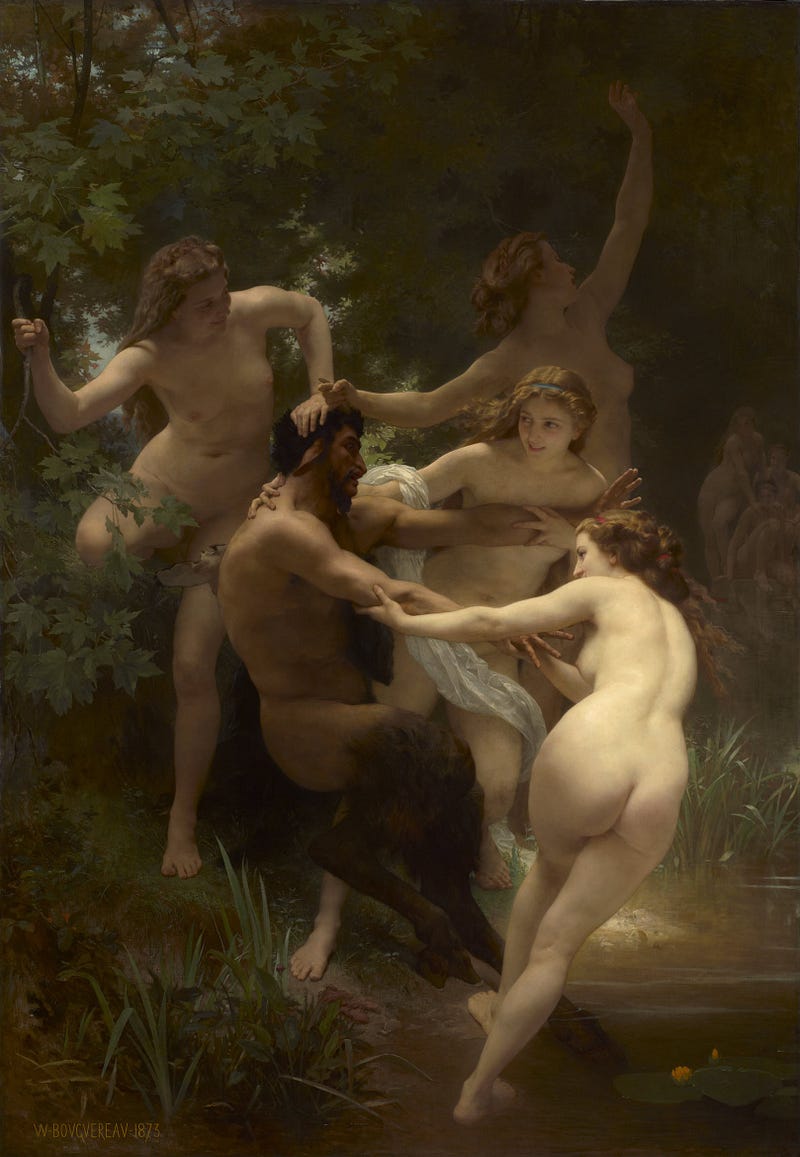

Bouguereau painted Nymphs and Satyr in 1873 depicting a satyr from Greek mythology seemingly being dragged away by a group of nubile nymphs who intend to have their way with him. One is beckoning for backup as she suggestively takes their quarry by the horn...
Another interpretation is that the image illustrates a passage of poetry by the first-century Roman poet, Publius Statius, in which a group of nymphs catch a satyr spying on them as they frolic. The hapless voyeur finds himself unable to resist the nymphs who drag him into their watery domain to, quite literally, dampen his ardour. He’s overwhelmed by this deep metaphor of unbridled feminine power and, weighed-down by his manly shagginess, drowns.
This image was highly controversial for its depiction of dominant female sexuality which clearly scared ‘the socks off’ uptight Victorian patriarchal society. Nudity in art was not controversial at all, so long as it pandered to the male gaze by offering an image of passive flesh waiting to serve the viewer’s libido. But to show young women asserting their sexuality over a traditional symbol of masculinity struck a chord with the Victorian moralists, marking this work apart from most of Bouguereau’s other more acceptable treatments of similar subjects or his sentimental genre paintings. After all, he was a phenomenally popular artist at the time.
There’s no denying the accomplished treatment of light in this cleverly executed composition that solves a somewhat complex spacial problem. Bouguereau was already considered unsurpassed as a figure painter, an opinion consolidated by this dynamic work with its meaningful placement of feet (and hoofs) along with the structural rhythm of arms holding the canvas together. He attributed this ability to his early immersive studies of the Renaissance greats, particularly Raphael, formal training at the École des Beaux-Arts, medical studies of anatomy, and direct observation from life.
Despite critical acclaim, Nymphs and Satyr was reputedly ‘banned’ in Britain when a potential purchaser was ordered to never publicly display it. Soon after, John Wolfe, an art collector from the USA snapped it up at a Paris auction and added the huge painting to his private collection of French historical and academic paintings until it was auctioned off in 1888.
The masterpiece then found itself in pride of place in the saloon bar of a famous hotel. Surprisingly, it attracted so many female viewers to venture into this masculine domain that it’s said to have directly inspired expansion of the area’s emergent feminist culture, earning the district the nickname of ‘Ladies’ Mile’, by which it is still referred to.
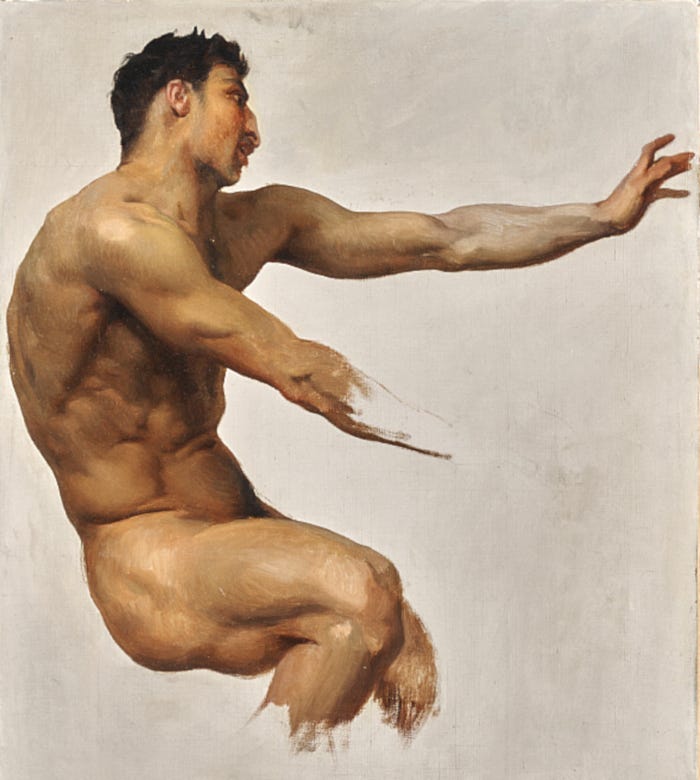
That hotel was the now legendary, though no longer standing, Hoffman House on Manhattan’s Madison Square. Such was its reputation that two sisters, Victoria C Woodhull and Tennessee C Claflin, who made the news for being both women and successful stockbrokers, based their offices there. However, the story of how Nymphs and Satyr got there, and subsequently disappeared, is straight out of a sordid Victorian melodrama rife with love triangles, racketeering, blackmail, murder, and reactionary moralists.
For a time, William M Tweed, AKA ‘Boss Tweed’, was one of the most powerful men in New York. That’s before being uncovered as an axe-wielding gangster and imprisoned for a string of crimes too long to list here. In 1873, he was tried on 220 counts and found guilty of 204 mainly related to bribery and corruption, fraud, extortion, embezzlement…
The Hoffman House Hotel was named for John T Hoffman, a ‘protégé’, some might say ‘puppet’, of Tweed’s who became first the Mayor, then Governor of New York. During the latter half of the nineteenth-century the hotel hosted many high-profile businessmen, politicians, and celebrities. Among them were Sarah Bernhardt, Buffalo Bill Cody, P T Barnum, Ulysses S Grant, and many others. Its saloon bar was famed for a lively society atmosphere and an inspired mixologist who invented several classic cocktails… until it became notorious for its connections with organised crime and indelible association with the murder of Jim Fisk by Edward Stokes, manager and part owner of Hoffman House.
Jim Fisk and Edward Stokes were long-standing business partners and both had been involved with the same woman, Helen Josephine Mansfield. All three seemed to have had shady dealings with Boss Tweed somewhere along the line involving various degrees of fraud, bribery, and blackmail… eventually of each other.
The details are for history detectives to unpick, but things certainly soured between the three friends and, in January 1872, they ended up in court together dishing the dirt and implicating one another to deflect suspicions from themselves. The morning after their day in court Fisk and Stokes ‘bumped into’ each other at the Ladies Entrance of the Grand Central Hotel which was next door to the Hoffman. Both men were apparently armed but Stokes got his pistol out first and shot Fisk twice.
Fisk died of his wounds a couple of days later and when Stokes returned to court it was for the charge of murder. He would face three trials for the crime and, after the initial sentence to be hanged, he receive lesser sentences each time, eventually serving four years in Sing Sing Prison. On his release, in 1876, he’d somehow accrued extra wealth and was able to take over management of the Hoffmann House Hotel which he set about modernising, buying several grand paintings to redecorate the famous saloon. Most notably these would included Caravaggio’s Baroque Narcissus, painted circa 1598, and William-Adolphe Bouguereau’s Nymphs and Satyr.
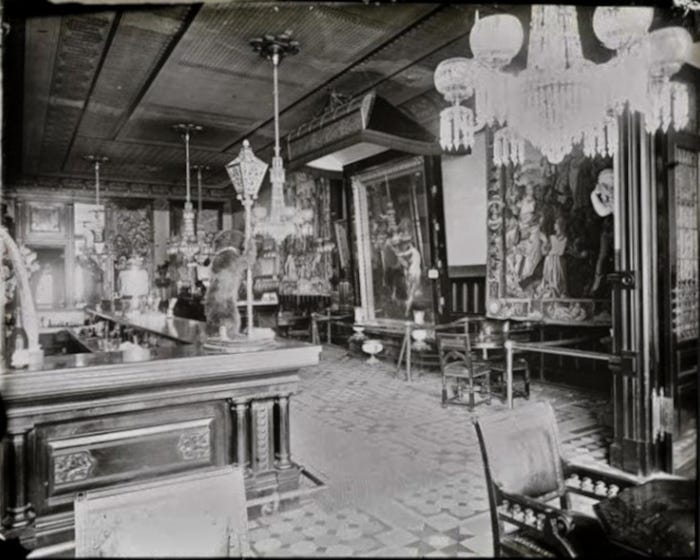
We know from western movies that there was a kind of tradition to have an ostentatious painting of an immodest woman in saloons, to amuse the male gaze. So, hanging the painting of nude nymphs opposite the bar was nothing too radical. Yet the clientele were surprised to find more and more ladies joining them, some drinking together in small groups, others strolling in to contemplate the painting. It seems that Bouguereau’s highly gendered and flattering treatment of sexually liberated femininity fascinated the female gaze as much as it did the male. Perhaps some strolled in to see what the fuss was about, but a few were certainly interested on a deeper level, appreciating the obvious prowess of the artist and his loving treatment of the female form.
Local moralists protested, letters were written, they were scared about the effect such a lude ‘pagan’ image was evidently having on the ladies it attracted. This and perhaps the fact it had been bought and hung by a convicted murderer. The bar thrived from the attention until the death of Edward Stokes in 1901 when his art collection was sold-off. Nymphs and Satyr went to an unknown buyer who it’s thought purchased it for puritanical motivations with the sole purpose of removing it from public view. The work was lost for the following four decades...
Sometime during it’s long disappearance, it was moved to a warehouse where by chance Paul Durrand-Ruel, the international art-dealer and gallerist, had stored work by Claude Monet, Edgar Degas, Pierre-Auguste Renoir, and other French Impressionists whom he patronised. It was the director of his New York gallery who apparently wandered into the wrong section of the warehouse and saw, among stacks of old broken down pianos, the ornate corner of a gilded frame poking through a dustsheet covering what must be a very large painting. Further investigation revealed it to be the lost Bouguereau masterpiece.
That was 1942 and in January of 1943 the painting was unveiled in the Durrand-Ruel New York gallery, which was otherwise empty for the exhibition of this (in)famous lost work. Ticket sales and donations went to the Fighting French Relief Committee which, in turn, supported the resistance fighters in Nazi occupied France. This special showing attracted plenty of attention from the press. Vogue magazine devoted a whole page to the image, reproducing it in full colour for the first time and reviving public interest in Bouguereau.
Now, one may assume that a gallery specialising in Impressionism and Modernist works would’ve had little interest in the outmoded French academic style. However, Bouguereau was considered the greatest example of the approach and had been one of the most famous and successful artists of his day. Reputedly, when Edgar Degas and Claude Monet were asked who would be remember as the greatest French painter of the nineteenth-century, they both agreed that it would be William-Adolphe Bouguereau.
He was to French art what Sir Lawrence Alma-Tadema was to British. Both were technically supreme, and able to execute complex compositions of epic subjects. Both, victims to the fads of fashion, fell from favour around the turn of the century. Dismissed along with the morass of mawkish Victorian kitsch, they’ve been criminally overlooked in many art histories ever since.
_-_The_Nymphaeum_(1878).jpg)
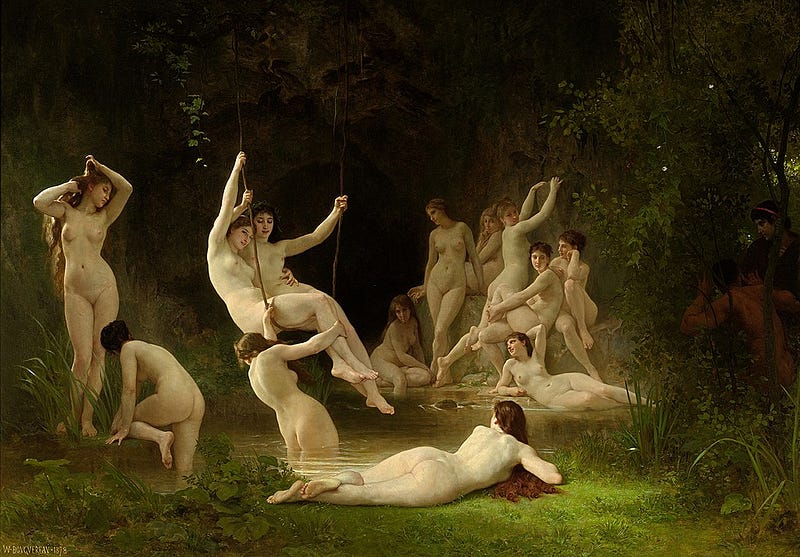
Bouguereau painted another take on the same subject in 1878. The Nymphaeum is a big group portrait of 13 nymphs bathing in a far more passive arrangement. However, on closer inspection, the voyeur is still present, this time lurking in the shadows with a friend, but they are as yet undiscovered. Just like the viewer of the finished work, they are unseen and unchallenged by the female subjects. This was deemed far more acceptable and caused no outrage.
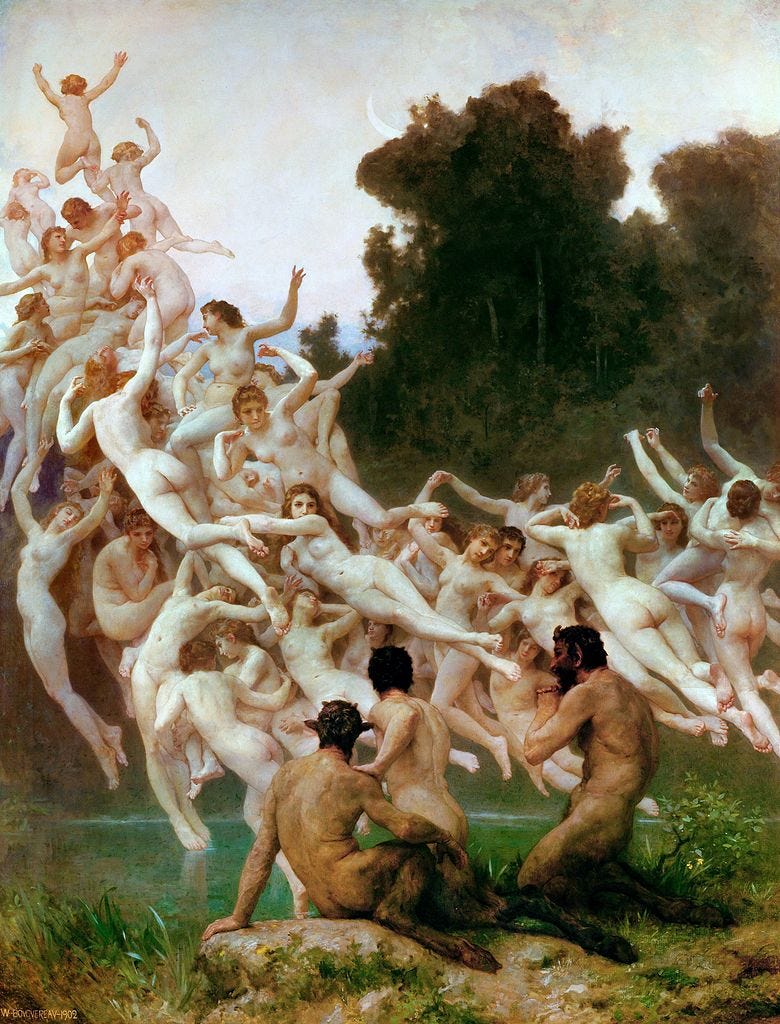
Incidentally, around the same time that Nymphs and Satyrs disappeared in 1901, Bouguereau returned to the subject yet again in another painting featuring nymphs and satyrs. In Les Oréades we see a scene from classical mythology as a trio of satyrs, drinking from a pool at dawn, are surprised to witness a torrent of nude nymphs rising into the sky.
They’d been bathing in the mountain lake by moonlight under cover of the night and now rise up, returning to the stars where they’ll rejoin their mistress, Artemis, goddess of the Moon and of the hunt. This work was acclaimed as a masterpiece due to its tour de force of figure painting in an impressively complex, almost sculptural structure. Again, the gaze of the satyrs and of the viewer remains unchallenged as the nymphs are frozen mid-flight for delectation. It caused no controversy and was immediately popular, becoming one of the most reproduced and well-loved of Bouguereau’s late career paintings.

Nymphs and Satyr is currently the largest painting in the collection of The Sterling and Francine Clark Art Institute, Williamstown, Massachusetts, USA.
The darker ‘Graveyard School’ of Victorian Romanticism is also discussed by Remy Dean in Signifier.
* All images are used with license, or presented here for educational purposes under fair usage policy.