avatarKim Vertue

Free AI web copilot to create summaries, insights and extended knowledge, download it at here

2940

Abstract

g-class woman, a dressmaker, Aline Charigot (the woman depicted in the foreground of his <a href="https://readmedium.com/a-narrative-of-colour-and-form-b042adb37e93#f9d0"><i>Luncheon of the Boating Party</i></a> painting, holding a small dog). Renoir’s focus on the enjoyment seized by the working classes as a subject matter was a conscious choice, as Renoir observed, “There are enough unpleasant things in this world. We don’t have to paint them as well.”</p><figure id="64f1"><img src="https://cdn-images-1.readmedium.com/v2/resize:fit:800/1*eHU5w5SYTxXfv_WiFFuGBw.jpeg"><figcaption></figcaption></figure><figure id="736c"><img src="https://cdn-images-1.readmedium.com/v2/resize:fit:800/1*n-roXNIbLBkhyTehyliJXA.jpeg"><figcaption><b>‘Bal du Moulin de la Galette’ (1876)</b> and <b>‘Luncheon of the Boating Party’ (1881) by Pierre-Auguste Renoir </b>[view license<a href="https://commons.wikimedia.org/wiki/File:Auguste_Renoir_-_Dance_at_Le_Moulin_de_la_Galette_-_Mus%C3%A9e_d%27Orsay_RF_2739_(derivative_work_-_AutoContrast_edit_in_LCH_space).jpg"> 1 </a>and<a href="https://commons.wikimedia.org/wiki/File:Pierre-Auguste_Renoir_-_Luncheon_of_the_Boating_Party_-_Google_Art_Project.jpg"> 2 </a>]</figcaption></figure><p id="5e98">Renoir took several years to paint <i>The Umbrellas</i>, and it shows the developments in his style. For example, the figures on the right are brightly coloured, using feathery brushstrokes typical of his Impressionist manner. They dress at the height of fashion in 1881. The girl on the left, however, is painted in a more classical manner with a smoother finish, and her muted clothes reflect the later fashions of 1885. X-rays have revealed that she was painted over an earlier figure that matched the higher bustle style of 1881 — so, this painting took years to complete and, although capturing an instant, bears witness to changing times.</p><p id="6cc1">Renoir had been influenced by Monet, who persuaded him to paint <i>en plein air</i>, and by the experimental approach of <a href="https://readmedium.com/out-of-darkness-into-light-c40515dbab9f">Paul Cézanne</a>. But in 1881, Renoir travelled to Italy and was most impressed with the Renaissance style of Raphael and works such as his 1511 fresco, <a href="https://readmedium.com/a-school-of-athens-reunion-4ec9fa081d4b"><i>The School of Athens</i></a>. Renoir was seeking a different approach to painting, moving on from Impressionism and (rather ironically) <i>The Umbrellas</i> marked the beginning of his so-called ‘dry period’ as he searched for a different style, exploring a more precise, structural approach.</p><p id="3302">The tight cropping of the scene reinforces the impression of crowded streets. The frame cutting through figures and the hem of the dress shows an influence from the new medium of photography. One could also argue that the composition and predominant use of blue has been influenced by Japanese prints which were ju

Options

st arriving in Paris — <a href="https://readmedium.com/the-great-wave-4d9653cb5aea">Hokusai</a> and Suzuki Harunobu had enjoyed the dynamic potential of umbrellas and produced images of beauties or groups with them.</p><p id="38c5">The auburn of hair echoes through the warm browns of gentlemen’s coat sleeves, umbrella canes and ferrules, to the basket carried by the <i>grisette</i> drawing the eye across the canvas. This use of narrative colour implies the movement of the crowd and the chaos as they hurry to open their umbrellas. It also serves a structural purpose, holding the composition together and guiding the eye back to the face of the <i>grisette</i>. There is delicate conjuring of light, the sheen on the silk umbrellas and the pale ground suggesting dark skies. At the upper left, the short down-strokes in the brushwork of tree foliage eloquently represent rainfall.</p><p id="374a">Renoir was painting <i>The Umbrellas</i> at the same time as Georges-Pierre Seurat worked on his <a href="https://readmedium.com/the-politics-of-pointillism-24672be70db2"><i>Bathers at Asnières</i></a>, which shows a summer scene enjoyed by the factory employees on a rare day off — a radically different approach to portraying the working-class Paris they both loved. While Seurat developed Pointillism, Renoir continued to search for his own style, which has always proven popular even if it did not always impress art critics.</p><p id="abac">Renoir once remarked, “art is about emotion. If one needs to explain art, it is no longer art.” He’d be happy to know that <i>The Umbrellas</i> is often used by art teachers at primary schools as the little girl and the busy scene makes this work immediately accessible to their pupils.</p><p id="8b29">Renoir died in 1919, a successful artist after producing over 6,000 paintings, some of which hung in the Louvre and collections in America. On his last day, overcoming pain from crippling rheumatoid arthritis, he painted some flowers and said, “I think I am beginning to understand something about it…”</p><p id="7a42"><a href="https://readmedium.com/a-narrative-of-colour-and-form-b042adb37e93"><i>The Luncheon of the Boating Party</i> and Renoir’s structural use of colour have also been discussed, by Remy Dean, in Signifier</a>.</p><div id="bebd" class="link-block"> <a href="https://readmedium.com/this-womans-work-99908ae277e8"> <div> <div> <h2>This Woman’s Work</h2> <div><h3>Paintings by Berthe Morisot now command some of the highest prices at auction of any woman artist, but it wasn’t always…</h3></div> <div><p>medium.com</p></div> </div> <div> <div style="background-image: url(https://miro.readmedium.com/v2/resize:fit:320/1*MZyG6wcTe-_oZsajsHvjyQ.jpeg)"></div> </div> </div> </a> </div></article></body>

A Rainy Day in Paris

With his popular painting, ‘The Umbrellas', Pierre-Auguste Renoir invites us to step into a moment suspended in time…
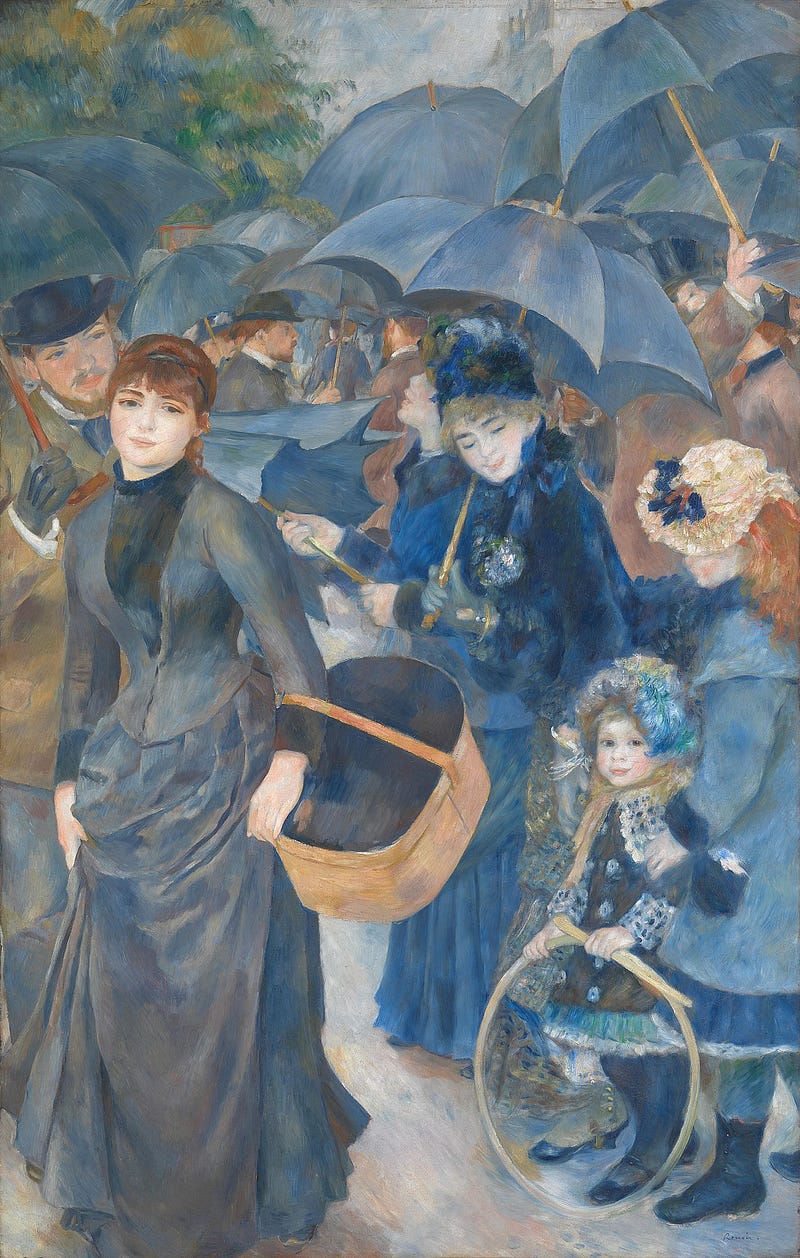
‘The Umbrellas’ (c.1881–86) by Pierre-Auguste Renoir [view license]

Pierre-Auguste Renoir spent five years between 1881 and 1886 on his painting, The Umbrellas, yet it seems to capture a moment suspended in time. Rain is starting to fall and the bustling pedestrians pause to put up their umbrellas. The people are so close the shapes of the open umbrellas are held at awkward angles above them. At the centre one woman is in the process of opening her umbrella, while in the left foreground is a grisette — a colloquialism of the times meaning a young woman working in the garment industry as a cutter, seamstress, or in this case, a milliner's assistant — one assumes she’s delivering a hat in the bandbox, though she is hatless, gloveless, and without an umbrella.

With one hand she raises her skirt clear of the dampening dirt, with the other she steadies the bandbox she carries over her arm. At this time, umbrellas were expensive items, and this clearly shows the class divide, although a gentleman at the far left seems about to offer her shelter under his umbrella. The grisette is looking directly at us. The little girl carrying a hoop and stick also gazes out at the viewer, acknowledging our presence and inviting us to step into the scene. At 1.8 metres high, it’s a large canvas and, although not quite ‘life size’, big enough to create that illusion if viewed from a short distance.

It’s hard to believe that Renoir and his fellow Impressionists were the first artists to capture such aspects of everyday life in the city. His earlier paintings such as Bal du le Moulin de la Galette (1876) and Luncheon of the Boating Party (1881) had shown relaxed gatherings of people in a summery setting, and he aimed to show the pleasant side of Paris life — but from the viewpoint of the Parisian worker at play rather than the upper classes.

This reflects the artist's own background — he worked from the age of 13, as an apprentice to a porcelain maker, to help support his family as his father was a tailor by trade. When machine production made Renoir redundant he studied art under Charles Gleyre, who also taught Claude Monet and Alfred Sisley.

Renoir eventually fell in love with a working-class woman, a dressmaker, Aline Charigot (the woman depicted in the foreground of his Luncheon of the Boating Party painting, holding a small dog). Renoir’s focus on the enjoyment seized by the working classes as a subject matter was a conscious choice, as Renoir observed, “There are enough unpleasant things in this world. We don’t have to paint them as well.”
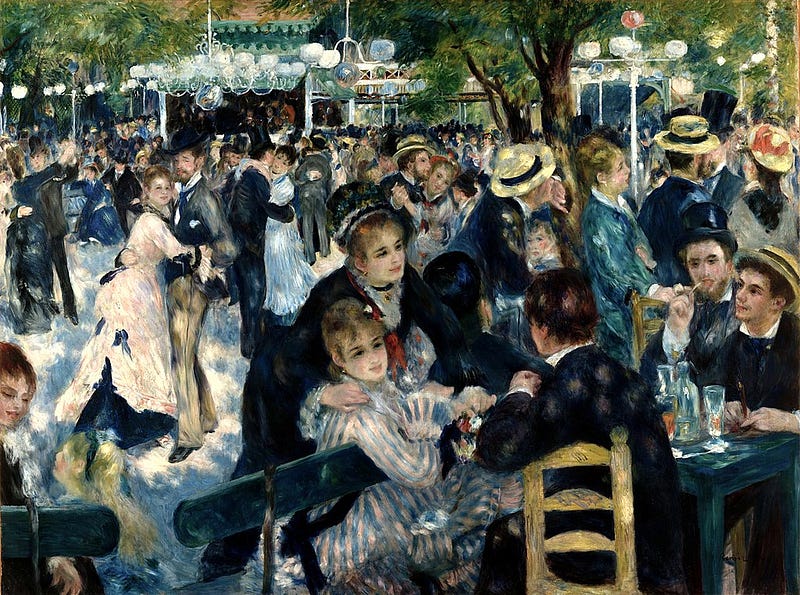
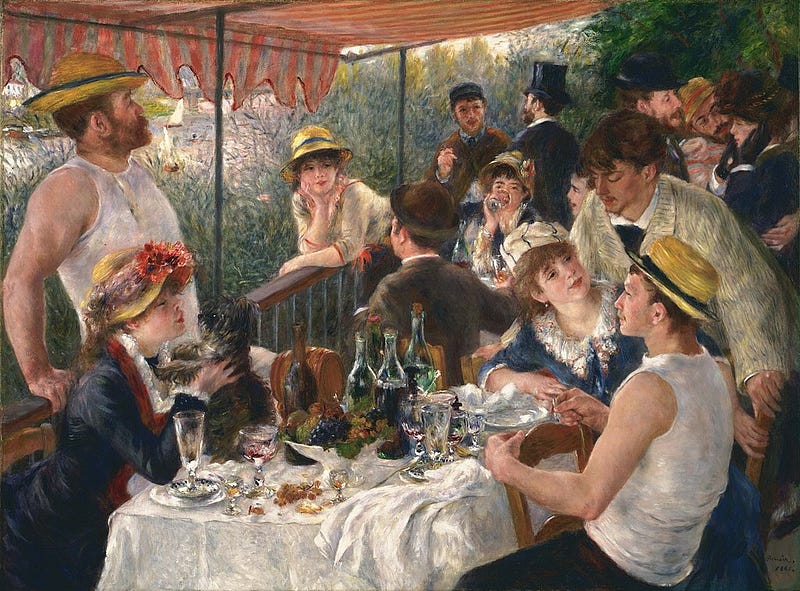
‘Bal du Moulin de la Galette’ (1876) and ‘Luncheon of the Boating Party’ (1881) by Pierre-Auguste Renoir [view license 1 and 2 ]

Renoir took several years to paint The Umbrellas, and it shows the developments in his style. For example, the figures on the right are brightly coloured, using feathery brushstrokes typical of his Impressionist manner. They dress at the height of fashion in 1881. The girl on the left, however, is painted in a more classical manner with a smoother finish, and her muted clothes reflect the later fashions of 1885. X-rays have revealed that she was painted over an earlier figure that matched the higher bustle style of 1881 — so, this painting took years to complete and, although capturing an instant, bears witness to changing times.

Renoir had been influenced by Monet, who persuaded him to paint en plein air, and by the experimental approach of Paul Cézanne. But in 1881, Renoir travelled to Italy and was most impressed with the Renaissance style of Raphael and works such as his 1511 fresco, The School of Athens. Renoir was seeking a different approach to painting, moving on from Impressionism and (rather ironically) The Umbrellas marked the beginning of his so-called ‘dry period’ as he searched for a different style, exploring a more precise, structural approach.

The tight cropping of the scene reinforces the impression of crowded streets. The frame cutting through figures and the hem of the dress shows an influence from the new medium of photography. One could also argue that the composition and predominant use of blue has been influenced by Japanese prints which were just arriving in Paris — Hokusai and Suzuki Harunobu had enjoyed the dynamic potential of umbrellas and produced images of beauties or groups with them.

The auburn of hair echoes through the warm browns of gentlemen’s coat sleeves, umbrella canes and ferrules, to the basket carried by the grisette drawing the eye across the canvas. This use of narrative colour implies the movement of the crowd and the chaos as they hurry to open their umbrellas. It also serves a structural purpose, holding the composition together and guiding the eye back to the face of the grisette. There is delicate conjuring of light, the sheen on the silk umbrellas and the pale ground suggesting dark skies. At the upper left, the short down-strokes in the brushwork of tree foliage eloquently represent rainfall.

Renoir was painting The Umbrellas at the same time as Georges-Pierre Seurat worked on his Bathers at Asnières, which shows a summer scene enjoyed by the factory employees on a rare day off — a radically different approach to portraying the working-class Paris they both loved. While Seurat developed Pointillism, Renoir continued to search for his own style, which has always proven popular even if it did not always impress art critics.

Renoir once remarked, “art is about emotion. If one needs to explain art, it is no longer art.” He’d be happy to know that The Umbrellas is often used by art teachers at primary schools as the little girl and the busy scene makes this work immediately accessible to their pupils.

Renoir died in 1919, a successful artist after producing over 6,000 paintings, some of which hung in the Louvre and collections in America. On his last day, overcoming pain from crippling rheumatoid arthritis, he painted some flowers and said, “I think I am beginning to understand something about it…”

The Luncheon of the Boating Party and Renoir’s structural use of colour have also been discussed, by Remy Dean, in Signifier.

Art
Paris
Impressionism
Romantic
Modern Art
Recommended from ReadMedium