
This Woman’s Work
Paintings by Berthe Morisot now command some of the highest prices at auction of any woman artist, but it wasn’t always this way…
This small oil painting of a mother and child, by Berthe Morisot, was shown at the first Impressionist Exhibition of 1874, where it appeared alongside the work of exclusively male contemporaries including Cezanne, Degas, Monet, Pissarro, Renoir, Sisley… Morisot had already shown paintings at the Paris Salon and she was the first woman to exhibit with the Impressionists. Today, it’s perhaps her most famous painting but was never sold and remained with the family until her death in 1895.
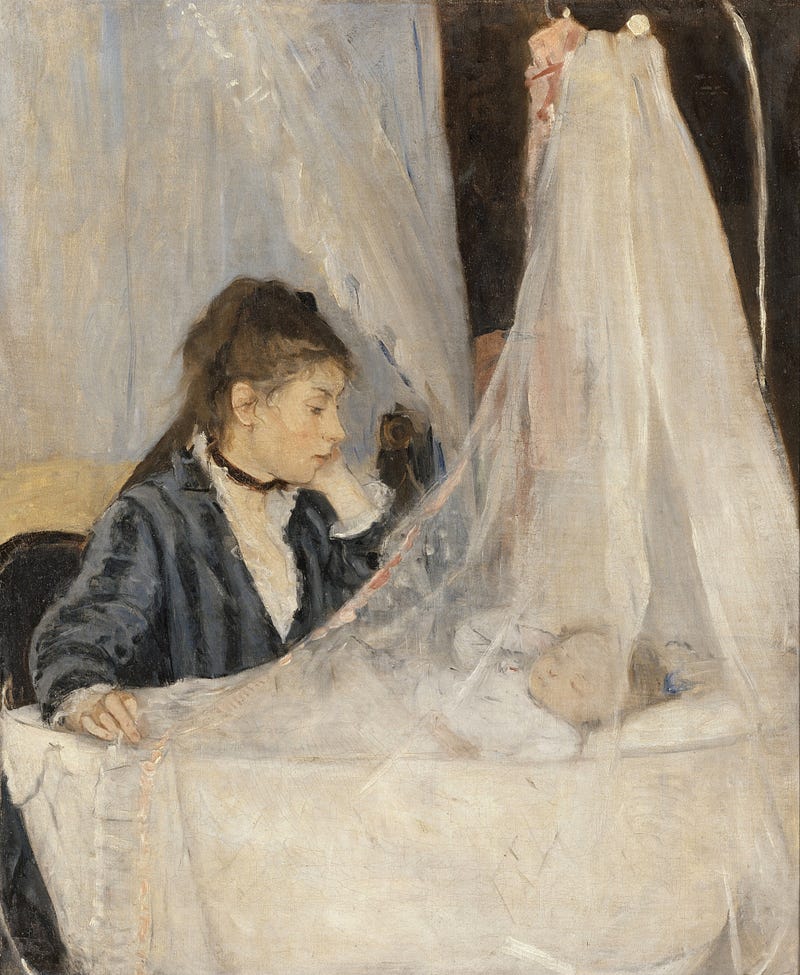
The subject of mother and child, of course, is everywhere in Western art, particularly as Madonna and child. In Morisot’s time, the woodblock prints of Japan’s Edo period had reached Paris, and also showed intimate mother and baby scenes in a more natural, domestic way. Morisot’s painting is very intimate and yet restrained. It’s a portrait of Berthe’s sister, Edma, and her first child, her daughter Blanche.
Berthe and Edma were remarkably close as children, and both had studied painting together. They were granddaughters of the French Rococo painter Jean-Honoré Fragonard, their family was affluent and encouraging of their talents and employed Camille Corot, an important landscape and figure painter, to teach them. His style influenced the impressionist movement, although he never joined it. So, as his pupil, Berthe showed independence when exhibiting with the impressionists. Yet Edma had married which at the time meant choosing, with rare exception, the path of domesticity and motherhood.
Edma’s expression is ambiguous as she watches over the sleeping child — she is exhausted like all new mothers, tender, and perhaps with a touch of melancholia. The responsibility of bringing a new life into the world is daunting, yet these thoughts will be chased away by smiles of delight when her baby awakes.
When Berthe painted this portrait in 1871, Paris had been occupied by the Prussians during the Franco Prussian War (1870–71) and a civil war had led to the establishing of the Paris Commune, which was brutally suppressed in May 1871. Berthe had remained in Paris throughout these troubles and so this Mother and Child image presents a complete contrast, a symbol of calm and peace and renewal of hope.
The portrait is very much a la mode of its time. Edma is dressed in the height of Paris fashion, and the cradle itself was a relatively new style of nursery furniture. The structure of the painting, the triangular veil, and the triangle formed by Edma’s body, shows the protective bond between mother and child. The position of Blanche’s left arm is mirrored by Edma’s own. The delicate veil is painted in soft gestural strokes, as is the background behind Edma, so that the textures of oil paint capture the light.
Morisot was to become famous for her ‘unfinished painting’ technique, gestural mark-making, and the subtle suggestions of her images that usually stemmed from a figure and their intriguing, ambiguous expressions.
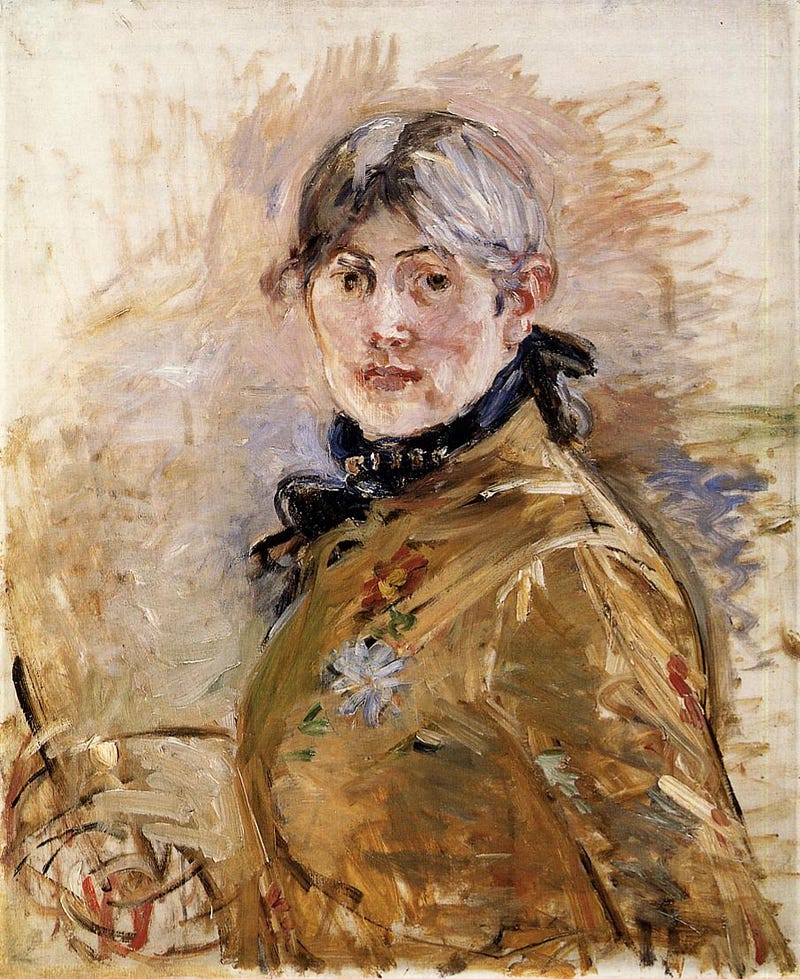
As with all Impressionism, this explores and conveys the way the eye sees the image of the outside world, reproduced on our retina, interpreted by our brains. Most detail processed by the retina and brain is devoted to the centre of the field of vision — the face we survey and its expression that we hope to interpret — while our peripheral vision is sketchy, rendered in just enough detail by the brain to suffice. Often, we do not see as much as we think we see. Berthe’s facility to suggest this with paint — as shown in Berthe’s later self-portrait, for example — caused controversy and admiration just as it did with Rembrandt, or Turner.
The mother and child is a subject she continued to explore — at the time women could not easily paint en plein air or in the bars of Paris Society which her male contemporaries could access unchaperoned, and so her domestic scenes contrast with the subjects chosen by Degas, Lautrec, Manet, for example. However, the Impressionist circle often met at her family home so that she could take part in their discussions. Berthe and Manet became close, their families regularly visiting each other, and he painted her often.
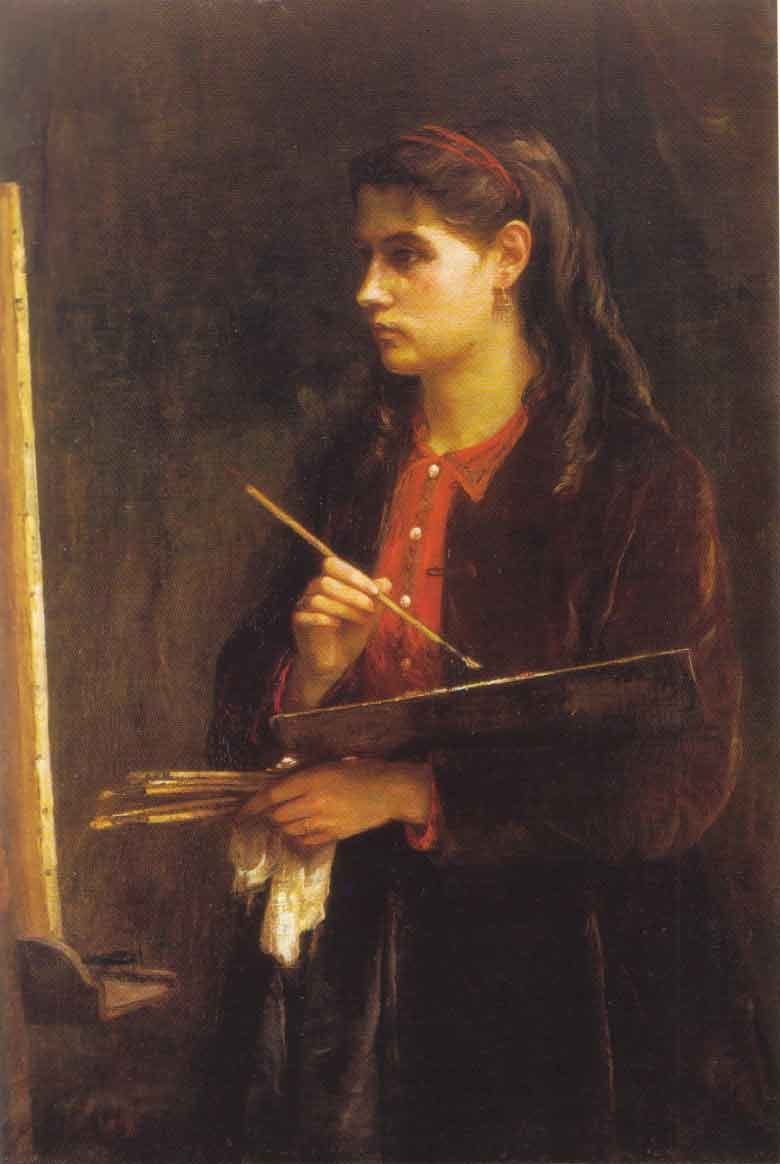
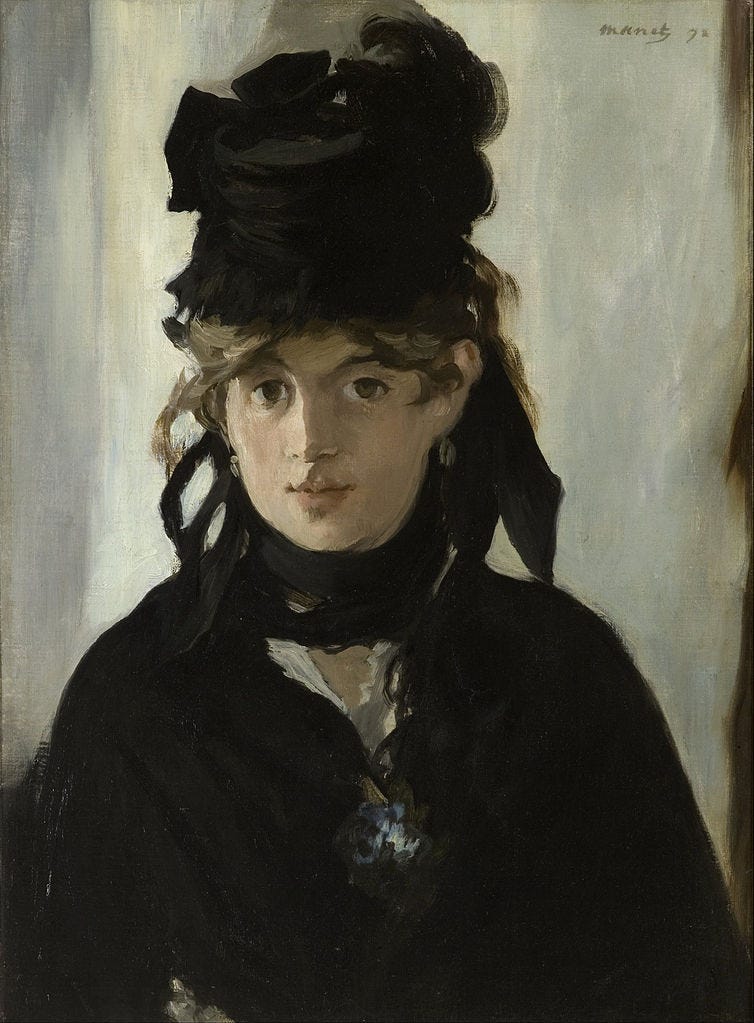
Later, Berthe Morisot married Edouard Manet’s brother, Eugène. She continued to paint after her marriage, and only missed one impressionist exhibition. Sadly, she developed pneumonia while nursing her sick daughter Julie Manet (who lived until 1966). At the time, Berthe was considered one of the belles dames of Impressionism yet at her death in 1895 Camille Pissarro said, “Poor Madame Morisot, the public hardly knew her.”
In these modern times, she continues to gain more attention. In 2013 she was the most expensive woman artist when her portrait of a young redheaded woman in a straw hat entitled After Lunch (1861) was sold for $10.9 million at a Christie's auction. Some of her paintings usually in private collections are represented in the ‘Gaugin and the Impressionists’ exhibition at London’s Royal Academy this year.


