
The Poppy Field, a Celebration of Summer
Claude Monet’s well-loved landscape was just one of a handful of radical paintings that heralded the Modern era…
Claude Monet’s Poppy Field, painted in 1873, is one of the world’s most famous landscape paintings. The expanse of scarlet poppies grow among high summer grasses below a backdrop of blue sky and white cloud. The rhythm of a treeline, complete with villa in the distance, divides the canvas horizontally. Four indistinct figures share their celebration of an idyllic summer’s afternoon. Yet this simple canvas challenged the strictures of traditional painting when it was shown at the first ‘impressionist’ exhibition in Paris, which launched a new movement towards modern painting.
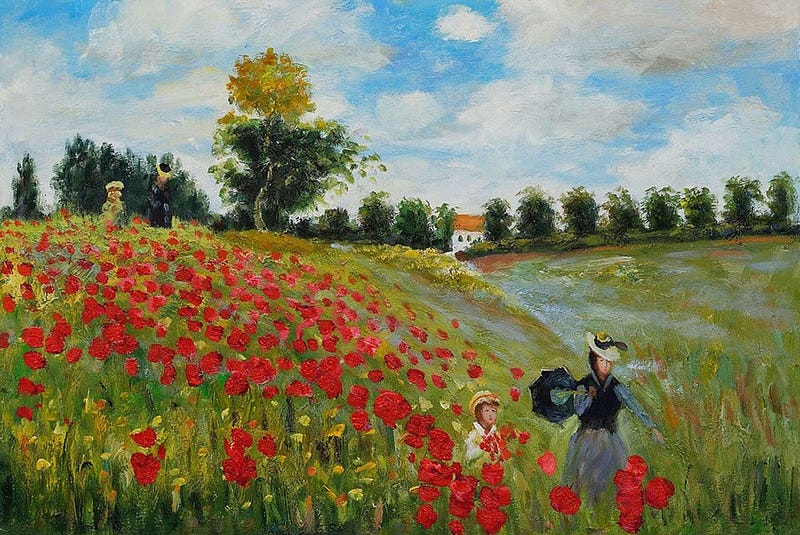

Its original French title is simply Les Coquelicots, referring to common corn poppies, and it is generally catalogued as Poppy Field, at Argenteuil. The Franco-Prussian War had ended in 1871 and France was seeking to recover from this turmoil. Monet had just returned from studying in England, where he was influenced by the landscapes of John Constable and J.M.W Turner. He was impressed by their freshness and ability to capture the infinite variability of light within the landscape in a naturalistic manner.
He had married Camille just as the war had broken out, and on his return to France they had settled with their young son, Jean, in Argenteuil, a town on the banks of the Seine a short distance from Paris. He was at the cusp of wider recognition as an artist and receiving financial support from art dealer Paul Durand-Ruel. Therefore, the cheery poppy field reflects a period of domestic happiness, financial stability, and renewal in Monet’s life.
Monet was an expert in oils by this time and painted en plein air, in the open air, to capture the delicate quality of light of the Ile de France region. Poppy Field shows informal brushwork which suggests working rapidly to capture a ‘snapshot’ of a moment. He once said that his best paintings were finished in half-an-hour, though he often continued to enhance the colour and texture after that initial response to a scene. What obsessed him was to capture the eye’s impression on canvas and had to race against the changing light. Paul Cézanne later commented, ‘Monet is only an eye — but my god what an eye!’
The figures are clearly middle-class and probably include Camille and their son, Jean, but their presence and position is mainly to accentuate the diagonal of the landscape. The placement of the villa in the background further suggests this is not an idealised landscape but a contemporary scene, which challenged the traditional conventions of landscape painting. Although he is carefully considering composition, he hasn’t forced the scene into a conventional format, such as the ‘golden section’ or similar traditional layout. The artist intends no extra symbolism or meaning in the picture — it is simply a celebration of what is there.
For that reason, Monet chose not to submit to the Paris Salon but exhibit this, along with eight other canvases, including Impression, Sunrise, at an exhibition held in the spring of 1874, at the disused studio of pioneering photographer, Gaspard-Félix Tournachon, professionally known as Nadar. This was a fitting venue as the new style of paintings was influenced by, and partially a response to, the coming of photography. Monet’s works were hung alongside those of six other radical artists — Paul Cézanne, Edgar Degas, Camille Pissarro, Pierre-Auguste Renoir, Alfred Sisley, and Berthe Morisot.
Impression, Sunrise, also painted in 1873, is in oils on canvas and hastily sketched, probably in one sitting, a view from a window of the harbour at Le Havre as the sun rises through early morning mist mingled with industrial smoke from the city, and reflects earlier views Monet had painted of fog and smog over the Thames while in London in 1870.
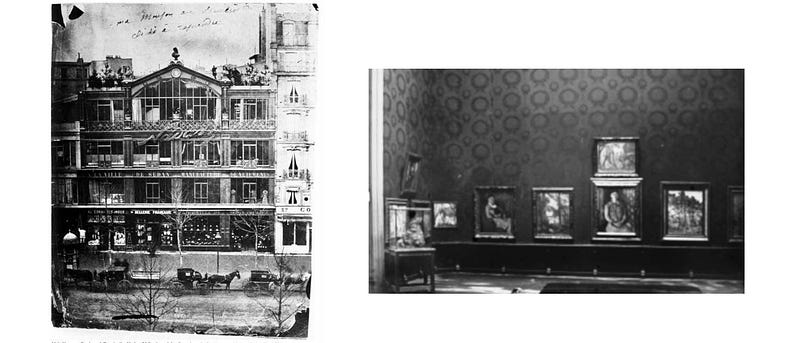
The reception to the exhibition was almost unanimous ridicule — critics considered the works to be, not simply informal, but unfinished. It was not a financial success, though left a legacy of controversy that ensured the group of artists were worthy of discussion among critics and collectors. Louis Leroy’s derisory review of ‘The Exhibition of the Impressionists’ drew its title from Monet’s painting and may have given the Impressionist movement its name before it would go on to change painting forever, ushering in the Modern era.
* All images are used with permission or are in the public domain and presented here for educational purposes under fair usage policy.