Victoriana-o-rama
Recognition and success were enjoyed by Alma-Tadema in his lifetime but his art suffered the the vagaries of fickle fashion since his death…
Sir Lawrence Alma-Tadema is a rare breed — an artist who became well-known, wealthy and, despite predictions of an early death, lived long enough to enjoy the rewards of stardom. By many criteria, he was the most successful painter of the Victorian era. He won high accolades, prestigious commissions, and critical acclaim. His work was popular with the public, the most reproduced, and originals changed hands for the largest sums. He was technically brilliant, pushed the envelope of moral acceptability, re-defined the genre of history painting, and left a legacy that still echoes throughout cinema, graphic novels, and fantasy art. Yet, within decades of his death, an Alma-Tadema painting would struggle to sell at auctions and was considered bric-a-brac that could be yours for around £20.
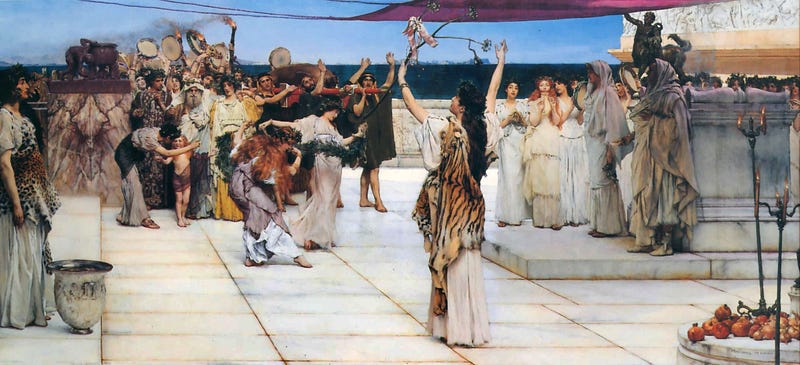
Although thought of as a British artist, he was born in the Netherlands and, in many ways, could be considered the last in a long line of Dutch Masters. For example, his art often relies on similar geometric structure, attention to detail, and an almost clinical clarity we see in the works of the great Johannes Vermeer.
However, young Lawrence Tadema was not expected to become an artist but to follow his father into the legal profession. His mother encouraged his artistic interests and he joined his older siblings for drawing classes where he showed a natural aptitude.
In his mid-teens, he fell ill, was diagnosed with tuberculosis, and ordered to rest. His legal studies were suspended and he was allowed to bide his remaining time in the pursuit of painting. To the surprise of those around him, his health rapidly improved and within a year he was well enough to enrol at Antwerp’s Royal Academy where he was to win several accolades. By 1855, he was apprenticed to the painter Lodewijk Jan de Taeye who had taught history and the study of period costume at the Academy.
Lodewijk Jan de Taeye was particularly interested in the Frankish history of northern Europe under the Roman rule of the Merovingian dynasty. He was better known as Louis Jan de Taeye, preferring the modern derivation of the name Clovis, who had been the first Christian King of the Merovingians. His enthusiasm for history and historical subjects was to be a huge influence on Tadema’s career. So much so, that Lawrence’s first significant work would be The Education of the Children of Clovis, which met critical approval when shown at the Antwerp’s 1861 Artistic Congress and was bought as a gift for King Leopold of Belgium.
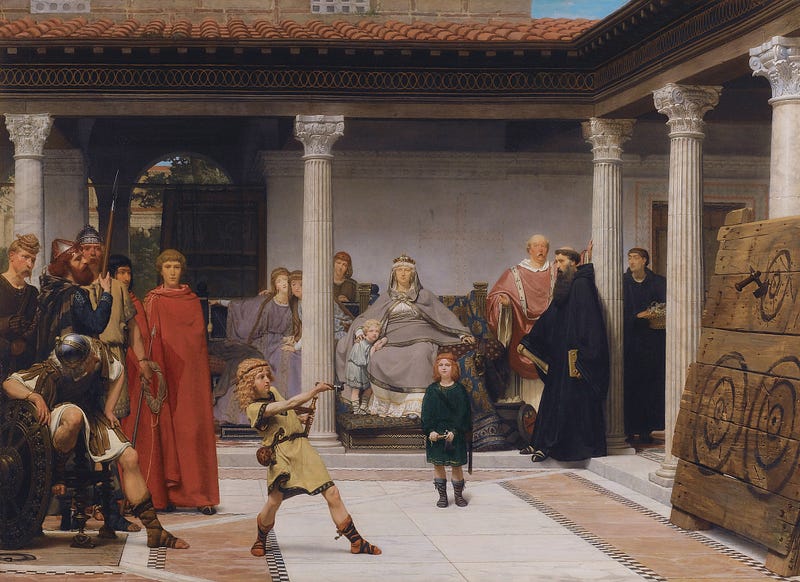
It was an overt tribute to Jan de Taeye but, by then, Lawrence Tadema had moved on from his apprenticeship and was assisting Baron Jan August Hendrik Leys in his prestigious studio, where the piece was produced. This early success established him as a painter of note and he set up his own studio the following year where he produced more works depicting scenes from Merovingian history. Although admired for their evident skill and accuracy, the subject matter didn’t prove popular with collectors.
He married in 1863 and the couple honeymooned in Italy where he visited major museums and studied, first-hand, the notable sites of antiquity in Florence, Rome, Naples, and Pompeii. Here began the lifelong pursuit of historic veracity that would set him aside from other painters. Over the years, he would amass an extensive collection of museum catalogues, prints, studies of detail, copies of patterns, and, increasingly, photographic reference material.
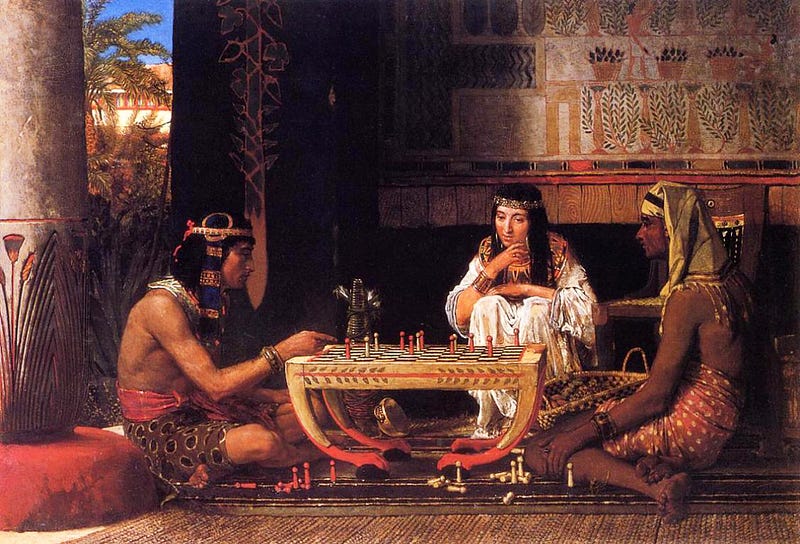
In 1865, he showed his first major painting of a classical scene, Egyptian Chess Players, to an international art dealer who promptly placed an order for more than 20 paintings and arranged for three to be shipped for exhibition in London. That same year, by royal decree, he became a Knight of the Order of Leopold but, sadly, this sudden success coincided with the death of his son, a victim of the smallpox epidemic. His first wife also contracted the disease, never fully recovering. She finally succumbed in 1869.
Understandably, Lawrence Tadema suffered from a deep depression and, needing a change of scene, headed for London where his work was already being exhibited. The following year, with the outbreak of the Franco-Prussian War across continental Europe, he decided to re-settle with his daughters in England which, as he put it, was “the only place my work has met with buyers.”
He was befriended by the respected painter of historical and allegorical subjects, Ford Madox Brown and quickly welcomed into the social circles orbiting the Pre-Raphaelites and their associates among whom he met Laura Theresa Epps. To begin with she was his student, and later his wife who forged her own career as an acclaimed painter and illustrator.
Laura appears as a recognisable figure in many of his works. In fact, most of the characters in Tadema’s paintings are also portraits of recognisable, real people. Some are family and friends, and the same models show up repeatedly like an ensemble cast. This helped him to connect the contemporary with antiquity and to tell relevant human stories within subtle narratives.
Lawrence became a British citizen in 1873 and took the opportunity to anglicise the spelling of his first name and double-barrelling his surname to incorporate his middle name, Alma. It’s said the shrewd reason for this was to move his works to the front pages of catalogues. In 1879, he was made a Royal Academician and is said to have cherished this accolade above all others, despite being knighted twice for his contributions to art, the second time by Queen Victoria in 1899.
Alma-Tadema was an innovator but also a populist, eager to please his patrons and sell his work. He accrued a waiting list of clients which grew steadily as he spent more and more time on each work, some major paintings taking years to complete. This was because he set himself compositional challenges and took time to research authentic objects, settings and costume. In most of his works, every artefact, item of jewellery, piece of furniture, statuary, and architectural detail can be identified from real world sources either in situ at one of the sites he visited, or from museum catalogues.
His attention to detail encompassed the flowers and fruit that he included, not only for their symbolism and colours, but to fix the scenes in a specific place and season. He was known to pay excessive fees to have flowers shipped from as far as African and the Middle East, quickly rendering them within days of delivery before they wilted. For The Roses of Heliogabalus, painted in the winter of 1888, he had weekly shipments of roses sent from the South of France and it’s said that each petal was painted from life. That’s a lot of roses!
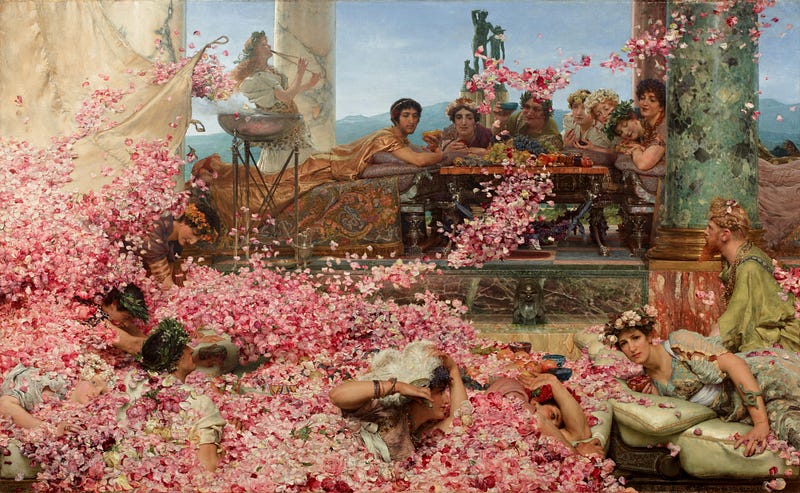
The painting depicts an apocryphal scene from the scandalous life of the third-century Roman emperor Elagabalus who was assassinated by the age of 18 because it seems he was just too decadent for the Romans! In his short, four-year reign he married four times, kept a bevvy of young male courtiers, and was said to trade in sexual favours as currency. He neglected affairs of state for the affairs of the flesh and devoted himself to the full-time pursuit of pleasure. He threw lavish parties and at one of these, he was supposed to have rigged a false ceiling that when pulled aside flooded the room with so many flowers that many of the young revellers were suffocated by them.
Tadema substituted the violets described in the original Latin text for roses. He felt licensed to do so as the tale is almost certainly a fiction to begin with and roses keyed into popular Victorian symbolism. Red roses represented love and passion but also the delicate, transient beauty of youth destined to wither and fade.
Here, each petal is preserved in its perfection, as too are the young maidens about to have their aging arrested in its prime, never to lose their youthful beauty to disease and decrepitude. As discussed previously in Signifier, dying young was just as much a sad reality in Victorian age as it was in the Roman and the Romantic artists were attempting to find some poetic sense in the seemingly random and senseless.
Like many of his contemporaries, his compositions were influenced by the emergence of photography that led him to crop figures and details abruptly at the edges of the canvas and to introduce interesting, often elevated points of views rarely seen in traditional paintings. Equally, he produced large canvases crammed with figures and encyclopaedic period details as well as clean, uncluttered paintings with a strong structural composition…
Completed in 1894, Spring remains one the more impressive and meticulously detailed of his historical works. He spent four years on this ambitious composition, repeatedly reworking the arrangement of figures. It depicts a procession celebrating a major spring festival approaching the viewer down a long flight of marble stairs in a grand and distinctively Roman street. Alma-Tadema did not mention which festival is represented here and scholars disagree. Some have suggested it may be Cerealia, though this was in honour of Ceres, the goddess of grain, and it’s flowers that are clearly being gathered and celebrated here. Some suggest Maia, for whom the late spring month of May is named. But it’s most likely to be honouring Flora, goddess of flowers, fertility, and most pertinently spring.
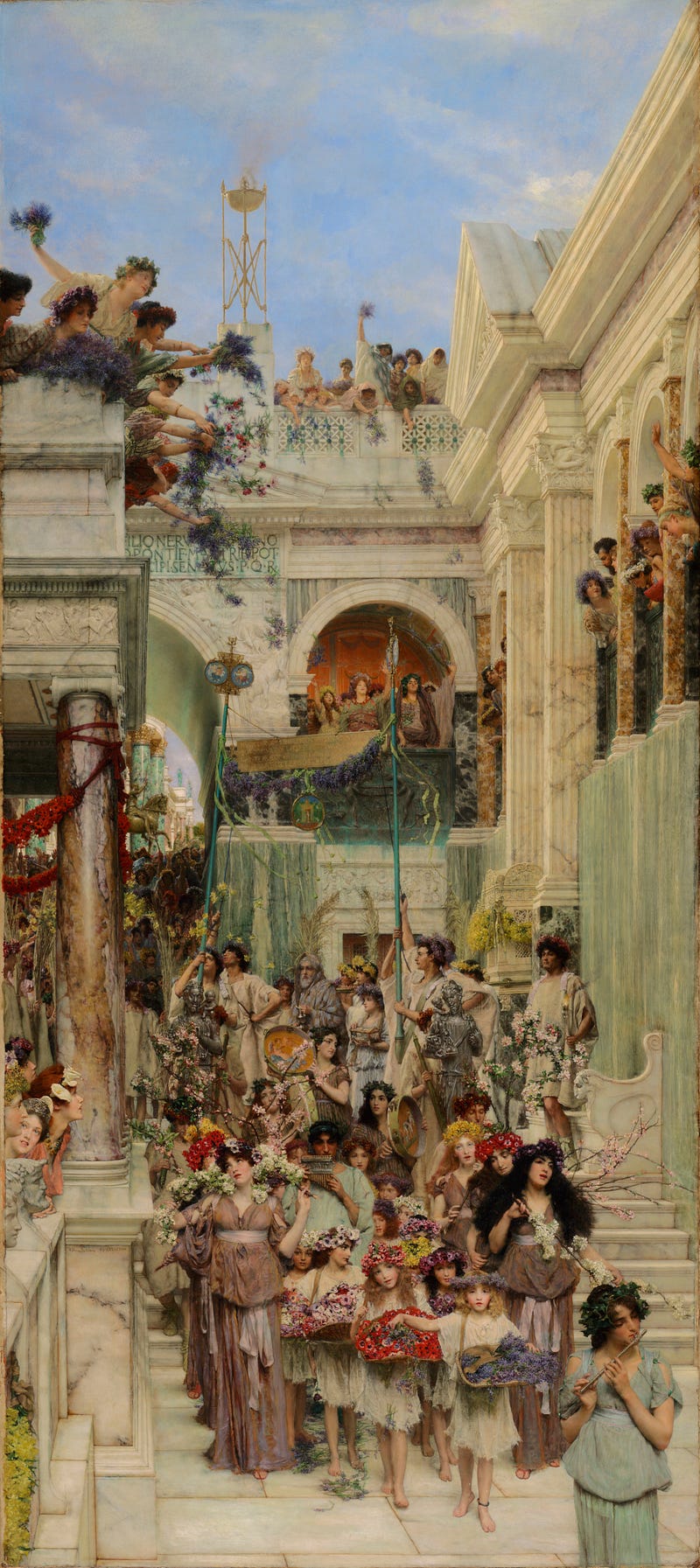
The composition of Spring conjures a strong sense of depth created by bold architectural perspective and the receding scale of the figures, all of whom were drawn faithfully from life and comprise a group portrait of his family, friends and associates. Every detail, flower and feature is painstakingly rendered and every artefact and inscription matched to an authentic historical source, though it’s highly unlikely they ever came together at any real festival!
Spring was perhaps Alma-Tadema’s most successful painting. It was well-received at the 1895 Royal Academy Summer Exhibition, shown again at the 1899 Große Berliner Kunstausstellung in Germany, and at the 1900 Exposition Universelle in Paris where he won the Grand Prix Diploma. It was also reproduced as a best-selling print. Much later, it was one of several of his works used as ‘concept art’ for Hollywood period dramas and is known to have directly influenced the production design for Cecil B. DeMille’s 1934 epic, Cleopatra.
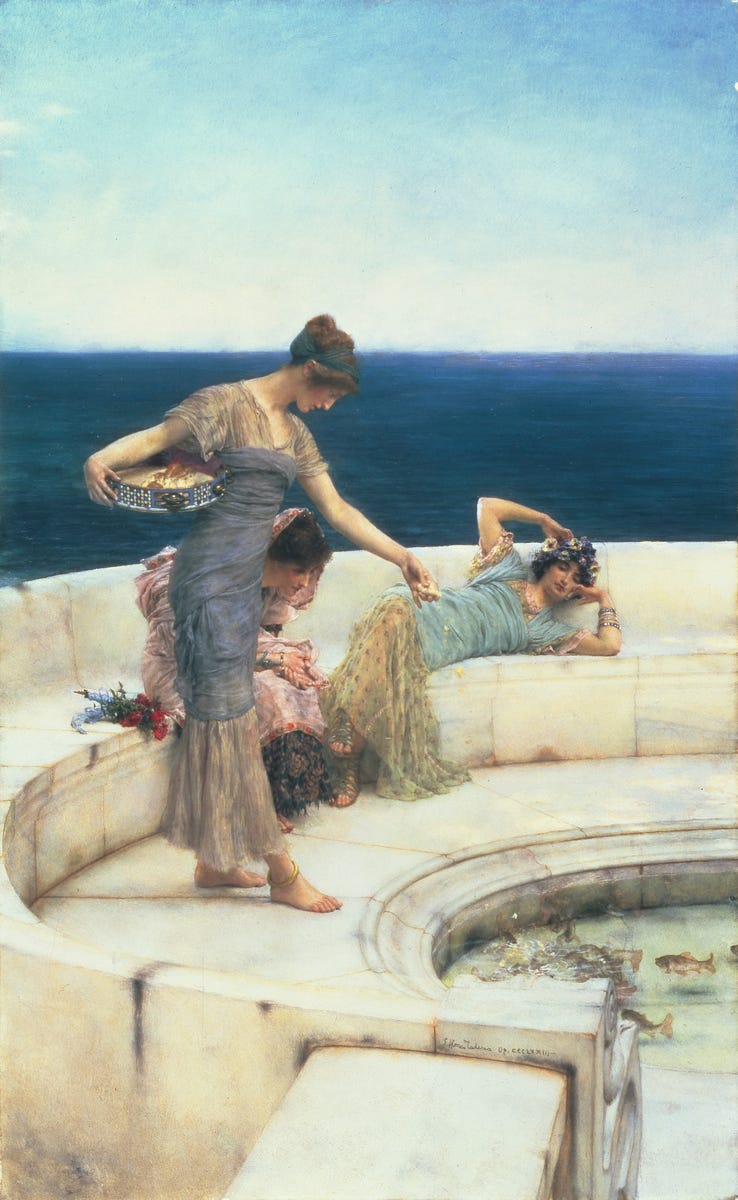
As with his 1903 painting, Silver Favourites, his later works often featured blocks and bands of colour and tone, famously the bright blues of sea and sky contrasting with white marble, rendered almost luminous in the Mediterranean sunshine. This divisionist approach prefigured early twentieth-century art and Modernism. By this time, he had also consolidated his style and felt more relaxed in his treatment of historic detail, sometimes evoking an the essence of an era rather than a precise time and place. He had branched out into fashion, interior décor, theatre design, furniture and fabric design — all informed by his knowledge of classical examples — and he began to include items of his own design in his paintings.
At the time of his death in 1912 Sir Lawrence Alma-Tadema had signed more than 400 paintings and produced a great many more in addition to sketches, studies, illustrations, and numerous designs. He was interred at St Paul’s Cathedral and a major commemorative exhibition was presented the following year at the Royal Academy.
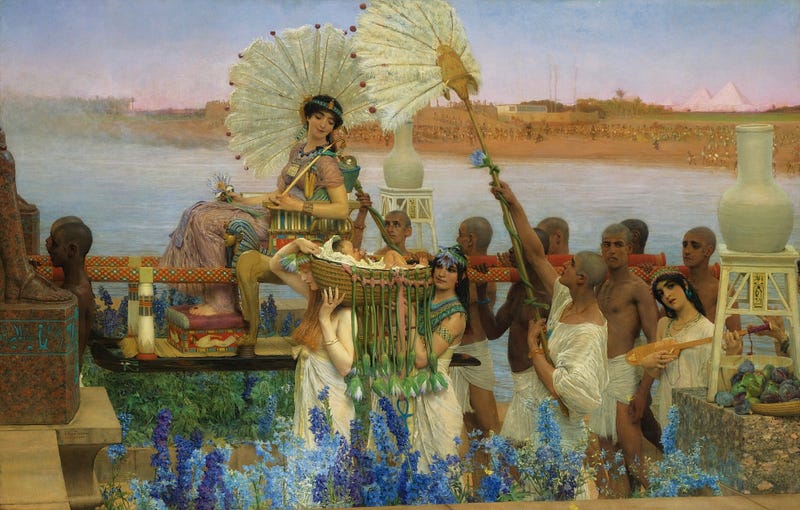
Of course, art never follows but leads fashion… and, despite its obvious skill and integrity, collectors were becoming less interested in Alma-Tadema’s ‘photo-realistic’ work and, instead, the Impressionists, Post-Impressionists, and the first inklings of Cubism, were the new fashion. For one of his last major paintings, The Finding of Moses (1904), Alma-Tadema had been paid £5,250. In the mid-1930s it came up for public sale valued at less than £900. It next came up for auction in 1960 and failed to sell…
In 2010 that same work was auctioned in New York and sold for nearly 36 million US dollars, the highest price ever paid for a Victorian painting. So, anyone who managed to pick up an Alma-Tadema from a bric-a-brac shop for twenty quid whilst out of fashion, well done!