
Shedding Some Light on the Subject: Vermeer’s Everyday Enlightenment
Paintings from an era when art and science were united in the exploration of our very existence, a time when reality was truth, and truth was absolute…
Johannes Vermeer often chose the everyday activities of ‘normal’ people as his subjects. Here, he shows a maid preparing milk and bread in the early morning light that comes through the window at the upper left of the canvas. The angle of the light is ideal to pick out the forms and textures of the maid’s dress and the bread.
The painting appears almost photo-real and, though this is an illusion, there’s a very plausible explanation…
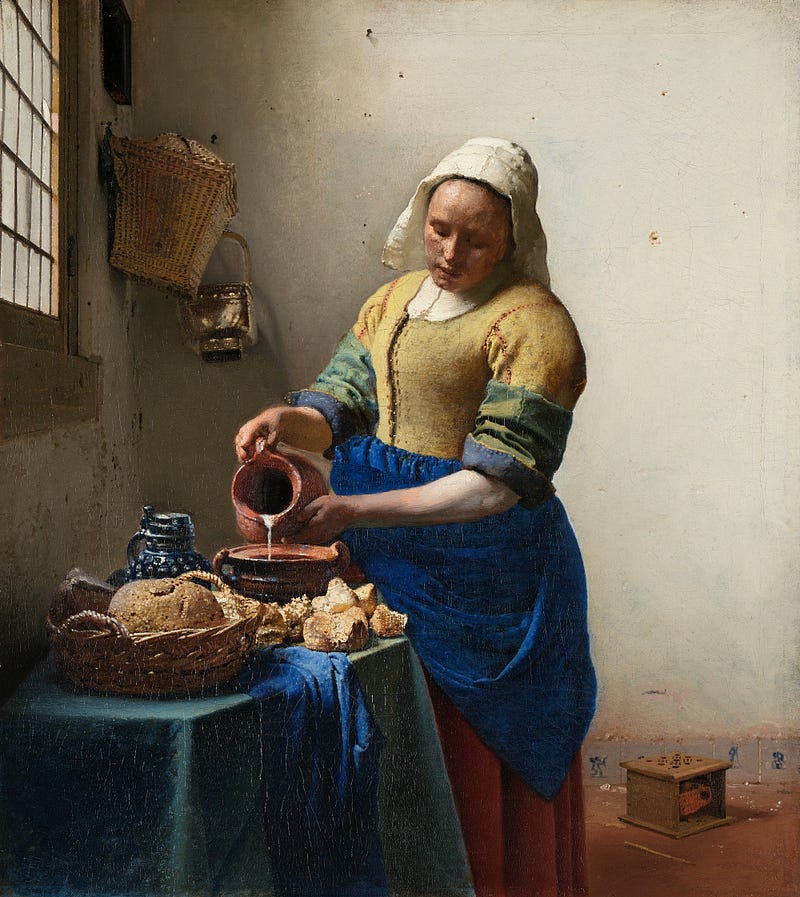

Vermeer was actually very economic with detail and sometimes left blank canvas visible, yet the details he included were the important ones that mimicked the way we see. He carefully depicted the details the eye would naturally pick out. It seems that every stitch of the clothing is rendered, every pit and chip in the wall.
Light from the upper left was generally reserved for religious subjects, often representing the light of God and signifying the holiness of the subject. It was also a metaphor of truth, literally ‘shedding light on a subject’ and revealing it for what it is. Audiences of the time would have been used to saints shown in such light and (though not through conscious analysis) would have perceived these ordinary people being elevated in importance.
Normal, ‘everyday’ subjects were not a popular choice for artists at the time. Just like today, an audience likes to see themselves reflected in their media and anyone in the market for a painting would’ve been exceptionally rich, compared to the contemporary average. A kitchen maid, for example, would not have the spare cash to splash out on a fine painting.
Perhaps it was because Vermeer found people interesting. He had a large family and ran a tavern. He mixed with all strata of his local community, servants, traders, journeymen, suppliers, makers and growers. He saw them as individuals, each with their unique stories.
Along with his contemporary master painter, Diego Velázquez, he was a notable exception in choosing to spend so much time and material on capturing everyday people and places. Being the official painter of the royal court of Spain, Velázquez had a guaranteed retainer and could afford it. Vermeer may have had other income streams, but was nowhere near as wealthy…
Showing normal folk in ‘unremarkable’ settings was not fashionable and Vermeer’s paintings, although admired enough to secure his position as a painting teacher at the local Delft Academy, did not attract the attention of major patrons and collectors. Most of his work was bought by a local art dealer and friend, so Vermeer’s paintings stayed in Delft and were not exposed to a wider audience.
These factors, and his duties as a father of eleven children along with his job as an Inn keeper, meant that his output was relatively small. It seems he only produced around 30 paintings in all. Nevertheless, Vermeer was perhaps the greatest of the Dutch school during the dawning of the Enlightenment period and was a true innovator of technique.
The Enlightenment would push back against Romantic ideals and elevate rationalism as the ideal method of deciding the worth of anything, from ideas and art to dogma and politics, and was primarily a literary and philosophical movement. It would look upon all traditional knowledge, religious orthodoxy, superstition and preceding arts and sciences with skepticism and believed that all things could be explained by a reasonable, critical, and ‘Newtonian’ approach. The world could be understood through keen observation and rational deduction in the ‘light of reason’.
.jpg)
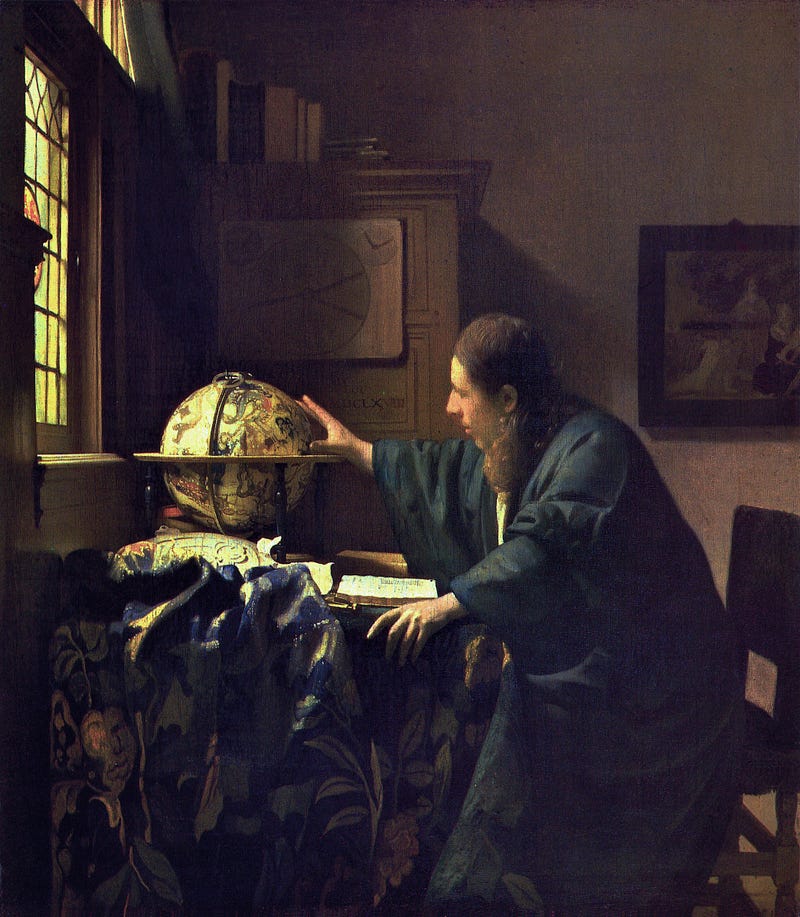
Innovations in optic technologies meant we were beginning to see the very far away and the very small with a greater degree of clarity. Dutch eyeglass maker Hans Lippershey had patented the first telescope, his ‘looker’, in 1608. German astronomer, Johannes Kepler, was documenting the rings and moons of Saturn around the time Vermeer was painting The Kitchen Maid…
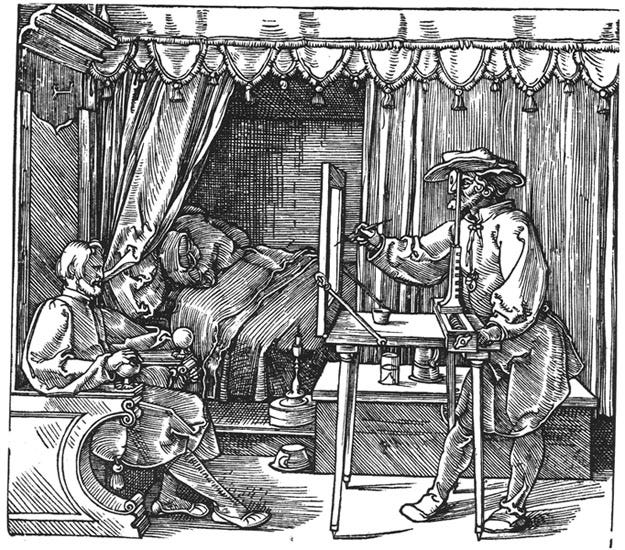
We know that artists had been using ‘drawing machines’ since the early Renaissance. Leonardo da Vinci drew an artist using a perspective viewer right at the beginning of the Sixteenth Century. Albrecht Dürer employed, innovated, and documented various such machines that combined the pin-hole camera obscura techniques with grids and strings. Around the time of Vermeer, artists naturally experimented with combining these old methods with the new and improved mirror and lens technologies of their times.
.jpg)
Art experts and historians have put forward various theories about which optical aids Vermeer may have used but haven’t reached agreement other than he (almost) certainly used one, or more. This has mainly been evidenced by analysing the point of view, perspective and optical distortion evident in his finished works.
Some have also experimented by recreating the settings for his paintings, either as scale models or full-size replicas of the rooms, and trying out different arrangements of apertures, lenses and mirrors. The evidence is compelling that Vermeer was also trying different ways to combine the camera obscura effect, possibly with lenses involved and angled mirrors that could ‘superimpose’ the optical image onto a canvas — either directly or by using a variation on the stereoscope to visually combine the projected image with his initial sketches.
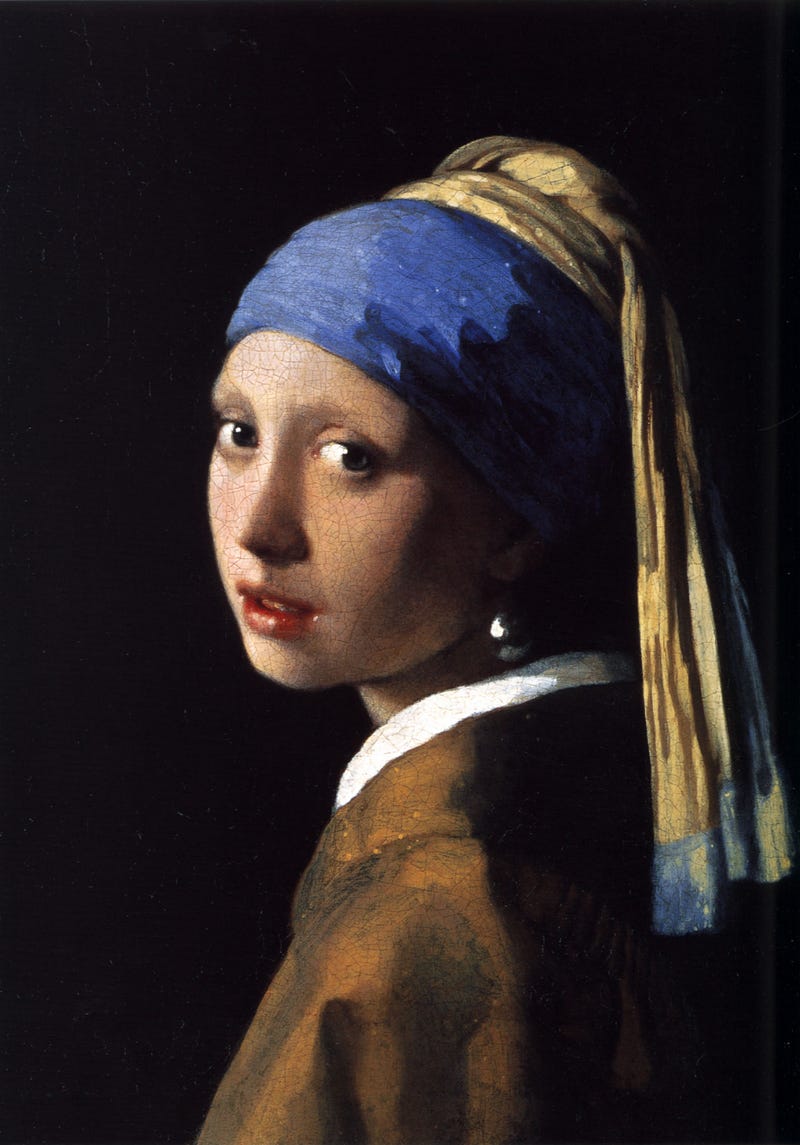
It may be apocryphal, but it’s said that when he presented what is now his most famous paining, one of his daughter wearing a pearl earring, those who first saw it thought that magic had been involved! One viewer stepped into the next room, believing the painting was really just a window through the wall. Others requested to see his daughter and the painting at the same time, to prove she still existed separate to the image and had not somehow been flattened and pasted onto the canvas… Its level of realism earned it the nickname ‘Gioconda of the North’, a reference to the Mona Lisa.
_-_The_Girl_With_The_Pearl_Earring_(1665).jpg)
The use of dramatic light and deep shadow to balance the canvas is reminiscent of his Baroque predecessors. Note the beautifully observed and rendered highlights glinting on eyes, lips, and the pearl. There’s a clever use of light bouncing off the white collar to soften the shadow on her cheek. Vermeer’s formal approach would influence many painters to follow, including the Impressionists and many Modernists.
The art of the Enlightenment was to become preoccupied with the act of seeing and understanding how light revealed the world. There was a belief that ‘reality’ and ‘truth’ were one and the same. Vermeer’s meticulous composition and attention to tiny detail marked a new approach to depicting ‘reality’.
The Love Letter by Johannes Vermeer is also discussed by Remy Dean in Signifier.
A version of this article was first published in my book Evolution of Western Art (questing beast books, 2012)