
A Crime of Compassion
Three centuries after Vermeer painted ’The Love Letter’ it was stolen for ‘noble reasons’, but how many lives is a priceless painting worth?
The Love Letter is a late-career painting by the Dutch master, Johannes Vermeer, completed around 1670. It’s a great stimulus for discussing different ways of reading an image as it readily invites both formalist and iconographic approaches. The work also lends itself to extended anecdotal and narrative engagement due to the subject it depicts and its contextual history, not least due to its high profile, politically-motivate theft in the early 1970s. I knew that it had been stolen and recovered, that’s usually a footnote in textbook mentions of the painting, but I only just followed-up the story behind the headlines whilst writing the review for a recently restored Italian giallo, directed by Lucio Fulci…
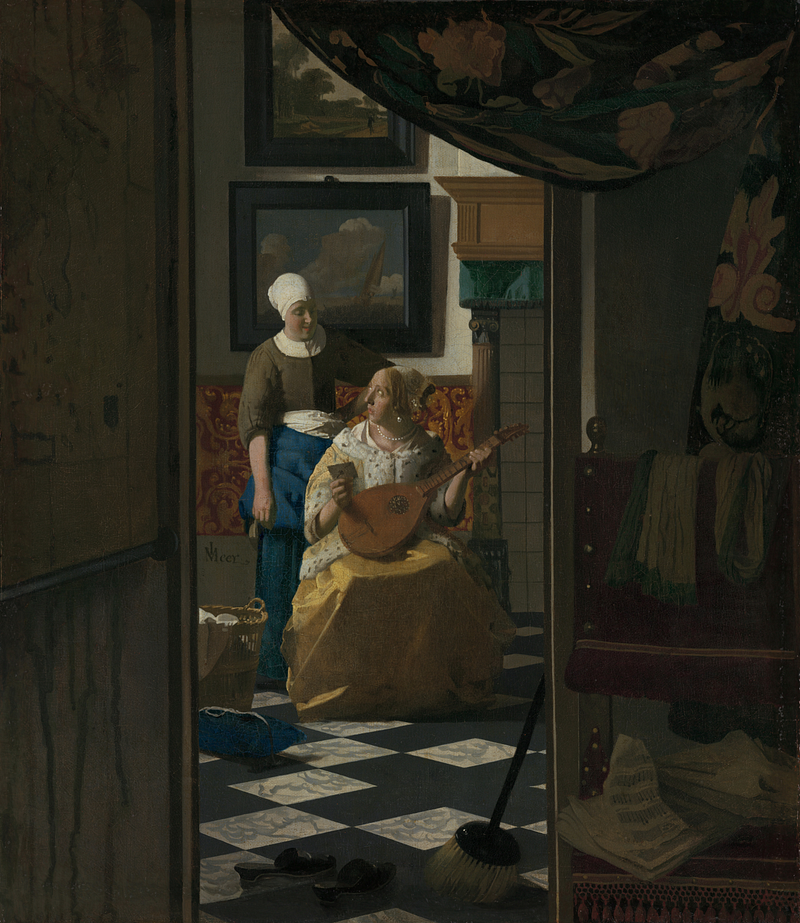
Vermeer was always concerned with visual integrity and his paintings became increasingly structural. Here, the canvas is divided into a rectilinear grid that pretty much adheres to the Golden Ratio. Vermeer often used frames within frames, setting-up a rigid rhythm that helped achieve harmonious balance in his more complicated compositions. A similar, albeit simplified, approach was employed by Marie-Denise Villers and then by James Abbot McNeill Whistler, almost exactly 200 years later, and was hailed as a herald of Modernism.
The largest rectangle in the progression is the border of the canvas itself that crops two elongated verticals at either side. They show shadowy details of another room, implying the space beyond the frame, occupied by the viewer. One of the forms to break the grid is the heavy tapestry that’s been pulled aside to reveal the action.
Visually, the folds of this curtain are echoed in those of the maid’s blue skirts which draws our eye to the figures — organic, living forms that also interrupt the grid. The angled crease that slopes from the seated woman’s knee is picked-up by the strong diagonal of the broom resting at the threshold with her shoes.
The scene’s lit by the slanting light from an unseen window that lends form to the figures and they seem to exist in a three-dimensional world beyond the picture plane. This increased sense of depth is aided by the interplay of the contrasting floor tiles as they recede in forced perspective, leading the eye to the tiled recess at the back of that perceived space.
So, that’s the brief formal overview, but the painting’s central appeal lies in its narrative and plentiful symbolism that invites a more considered, emotional engagement… It’s as if the women are unaware of the audience, peeking-in at their private exchange, which begs the question of what we’re being privy too, and why the artist thinks we’d be interested enough to take a closer look.
It appears that the maid has interrupted the lady of the house who was playing her cittern — a lute-like instrument that became very popular during the Renaissance because its innovative wire strings of twisted brass or steel gave a distinctive bright, jangling sound. From the crumpled sheet of music in the foreground, lower right, we may gather she’s in the midst of composing a new, or revised, song.
At the time, the presence of a cittern itself symbolised feminine passion and sexuality and, if shown being played, indicated that’s where the player’s thoughts were heading. Those thoughts seem to have prompted her to kick-off her shoes and lay aside her broom. Removing shoes indicated a form of immodesty and were often a metaphor of desire for a more physical relationship. The replacing of a shoe, especially in the presence of suitor, hinted at consummation. (Ah, so that’s what Cinderella's slipper shenanigans were all about!)
We can guess, therefore, that the letter may be from an absent suitor. The women share a ‘knowing look’ implying an informal connection beyond that of lady and servant. The expected class-divide is further blurred because it seems the lady was tending to the domestic chore of sweeping the floor whilst the maid got on with the laundry.
A letter clearly symbolises distance and that part of the narrative is certainly confirmed by the presence of so much iconography related to travel. One of the two paintings within the painting is of a lonely wanderer walking a forest path. The other is a boat that seems to be at shore rather than at sea, implying departure or arrival. There’s a map on the wall of the antechamber, taking up a large portion of the left-hand rectangle. It goes to show Vermeer’ meticulous attention to detail that scholars can identify it as a 1621 map of Holland and West Friesland by the famous cartographer Willem Blaeu, a prop which features in other paintings by Vermeer, most prominently in his earlier painting, Officer and Laughing Girl, from around 1657.
Vermeer had a collection of props and costumes that he kept because he liked them and enjoyed the painterly challenges they offered. These included some famous pearl earrings, of course, also the fur-trimmed yellow jacket worn by the recipient of the letter. So, one cannot always interpret any ‘hidden meaning’ in their presence. However, the same yellow jacket features in Mistress and Maid, another painting completed a couple of years prior, around 1667, to which The Love Letter may well be a sequel.
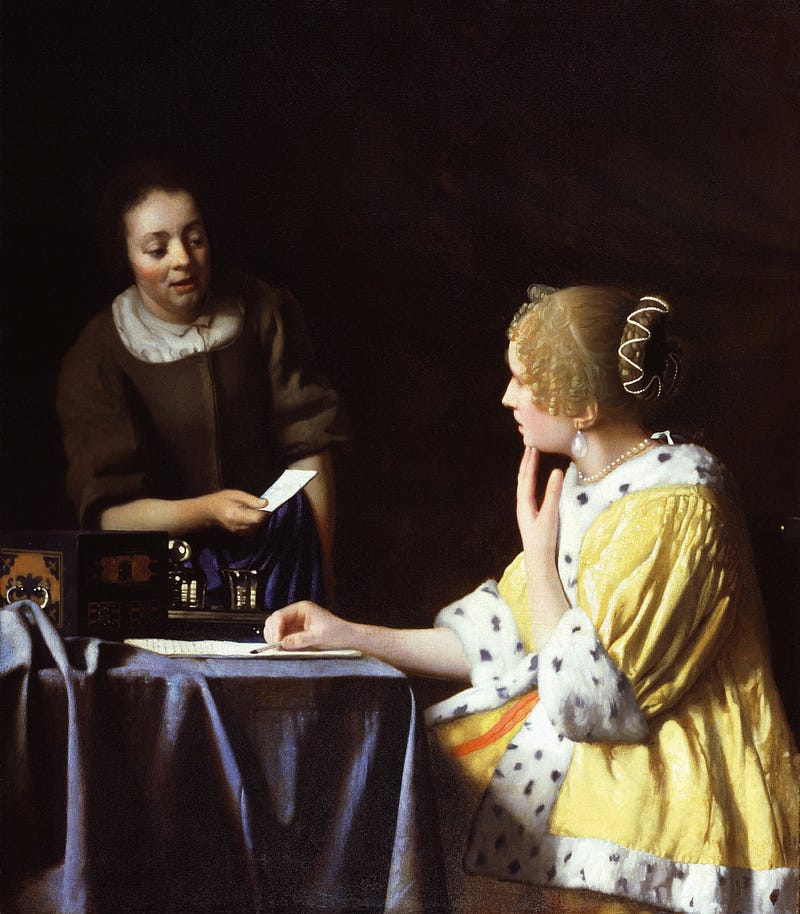
When considered in sequence, a clear narrative extends across the two works. The mistress and maid in both works are dressed identically, so we can take them as the same characters. In this earlier instalment, it seems the lady has just laid down her quill and the maid is querying something. She may be simply asking for further delivery instructions, but the folded letter in the maid’s hand does not appear to be sealed, as yet. So, is she suggesting an addendum? There’s still time for a P.S.
On hearing her confidant’s comment, the mistress touches her fingers to chin in a thoughtful, perhaps apprehensive way. Is she doing the wise thing by writing this letter? What is she risking by revealing her feelings? Has she expressed herself clearly and honestly enough? Will she or won’t she receive the desired response?
This creates what is known as an ellipsis… we have a set of clues that, when taken together in context, imply that something else will happen as a result. There is then a wait as the mind attempts to predict the outcome and figure out what response the stimulus might elicit. This is the basis of all narrative, the hook of “What happens next?” that makes stories work…
The sending of a letter can also be taken as a clever commentary on art in general. Vermeer is aware that in all forms of non-verbal communication, there is a delay between transmission of information and its reception. Once a letter is sent, or a painting finished, the response of the recipient is out of the control of the transmitter. The intended meanings of the artist may not necessarily match the interpretations of the audience.
In the later painting, the two women know from the seal who has sent the ‘love letter’. That seal, though, remains unbroken. So, we are sharing a momentous and rather intimate moment from our secret vantage point in the dimly lit antechamber. Are we too on tenterhooks, secretly spying to see if she responds how we hope she will? The maid seems supportive, confident that it will be a positive response, but the lady remains apprehensive. It’s another ellipsis, drawing us deeper into the narrative…
Which is precisely how mystery thrillers work, so it’s rather fitting that The Love Letter, or rather its high-profile theft, inspired a pivotal plot point in Sette Note in Nero / The Seven Black Notes, an assured giallo from 1977, directed by Italian maestro Lucio Fulci, and better known by its English-language title, The Psychic. The wherefore and whys surrounding the painting’s theft are completely fictionalised to serve the film but spurred me to research the true story behind the fortnight in 1971 when Vermeer’s masterpiece went missing…
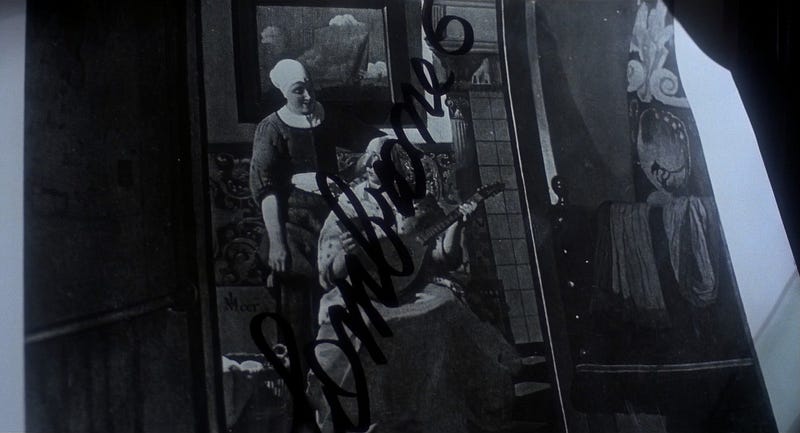
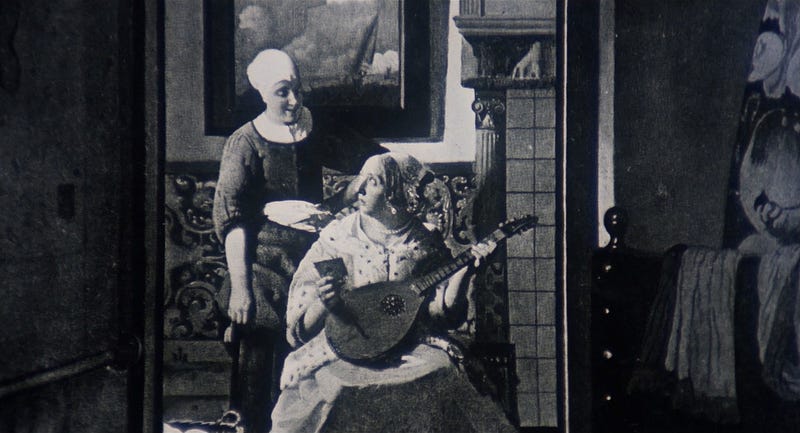
In the September, The Love Letter was stolen from the Museum of Fine Art in Brussels, whilst on lone from the Rijksmuseum of the Netherlands. Mario-Pierre Roymans, had visited the gallery and, when it came to closing-time, locked himself in a dimly lit antechamber, the electrical closet.
After hours, when all had gone quiet, he ventured out and lifted the painting off the wall. It’s not a large work, measuring 17 x 15 inches, but was too big to fit through the small window Roymans intended as his escape route. So, he crudely cut the canvas from its mount using a potato peeler, and folded it into his back pocket!
Over the next few days, he hid it in various places including under his pillow in his room at Soetewey Hotel where he was employed. He later buried it in nearby woodlands, but retrieved it again to protect it from rain. He was not a known art thief, nor did he have the necessary connections in the underworld to ‘fence’ the Vermeer, which would’ve be valued in tens of millions. (Which is why no less than 13 Vermeers have been stolen over the years.)
Surprisingly, the motivation for the crime was not personal gain. Roymans was a self-proclaimed art-lover who regularly visited galleries and museums, but he was deeply affected by hearing news of the genocidal massacres taking place in Bangladesh. At least hundreds of thousands, probably as many as three million Bengali men and women were murdered, starting with systematic executions of the so-called intelligentsia — doctors, teachers, poets, and scholars — and resulting in the mass displacement of 30 million refugees.
After a newspaper reporter consented to being blindfolded, Roymans drove them out to a secret location where they were allowed to photograph the painting to prove he had it. He then asked for a ransom of 200-million Belgian francs to be donated to relief funds in aid of the Bengali refugees in East Pakistan who were dying en masse from starvation. He recognised the value of great art but thought that human life was even more valuable.
He was arrested and the badly damaged painting was back in the Rijksmuseum by early October. Mario-Pierre Roymans was fined and received a two-year custodial sentence. He was released after serving six months. Vermeer’s The Love Letter spent a year with the restoration team before it could go back on public display…
* All images are used with permission or presented here for educational purposes under fair usage policy.


