
Lust for Life
The ‘Graveyard School’ artists of the Victorian Gothic Revival were the spin-doctors of Death.
By the mid-1800s, the Industrial Revolution was driving global change at an unprecedented rate. New technologies were rapidly changing the human way of life. In times of turmoil and uncertainty, people often seek solace in the certain and permanent. As Benjamin Franklin famously pointed out, “ in this world, nothing can be said to be certain, except death …and taxes.”
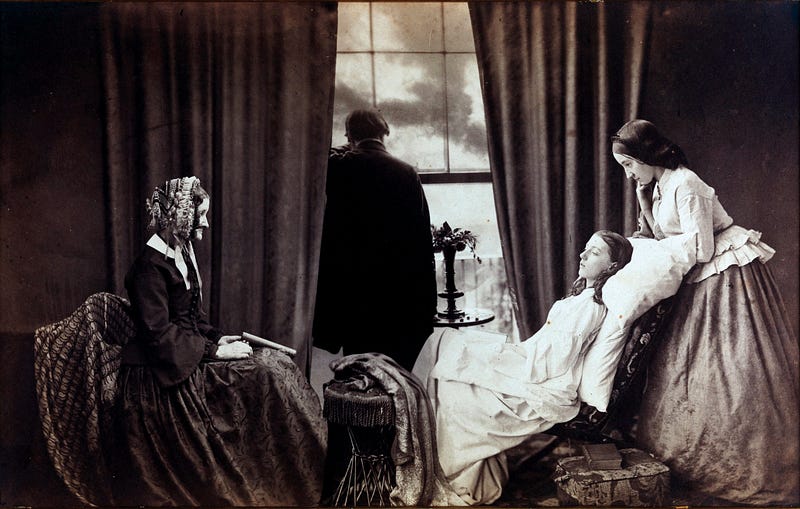
To begin with, photography was mainly studio-based and was used either to document people and places, or to ape the role of painting. In Fading Away, a famous early photograph by Henry Peach Robinson, the models have been arranged and lit in much the same way as sitters for a painting, except the composition has been captured by chemical reactions, not the brushwork of a painter. The technique may be new, but the visual language is in keeping with the Romantic sentiment of the time.
The young girl is dying and her two companions, perhaps mother and sister, attend to her. The older woman has broken off from her reading, sensing that the end is drawing near. A man, the father or perhaps physician, stands with his back to the scene, looking out of the window where dark stormy clouds are gathering.
Like the paintings of the so called ‘Graveyard School’, this posed and controlled photograph is depicting the chaotic and uncontrollable event of death. The folds of material and positioning of the figures have been arranged with the same care as would be seen in a painting and as a result is clearly a visual fiction. Apparently, five separate negatives were used to composite the image in order to control the exposures and bring out the desired details and textures of fabric.
Photography was a new technology that called the validity of painting into question. It soon became fashionable to have photographic portraits of family members, instead of painted portraits. Photographs were modern, comparatively cheaper and took much less time in the making.
To the people of the time, the photographic likeness had a sense of magic. It was an instant of life, frozen and preserved. Also, it seemed that any good photographer could capture a true likeness, whereas accomplished painters were much more difficult to find, cost more money and took up so much of the sitter’s time. As we now know, painting continued, but changed and innovated in response to the challenge of photography, and this was the catalyst for Modernism.
The origins of the dark, melancholy and somewhat morbid aspects of Romanticism, and more recently the subculture of ‘Goths’, can be traced back to a few figures active in the early Gothic Revival of the mid 1700s. Horace Walpole, author of The Castle, a Gothic Story (1764), bought Strawberry Hill, a farm in Twickenham, and converted it into a Gothick castle, installing stained glass and architectural details to create this illusion of mediaeval grandeur. This was in keeping with notions expressed by many of the early Romantics.
The Pre-Raphaelites revered Romantic writing that harked back to ancient traditions, folk-lore and fairy-tales, from before the ‘age of reason’, particularly Celtic and Norse mythologies. For example, Thomas Percy translated runic poems from their original Icelandic in 1763, Thomas Gray got his inspiration from Scandinavian epics for his writings, such as The Descent Of Odin (1761), and more notably, James Macpherson’s works, such as Fingal (1761), borrowing from Irish folk tradition by way of Scottish myths and very loosely re-telling, or ‘translating’, the tales of Ossian, a semi-mythical third century Irish bard.
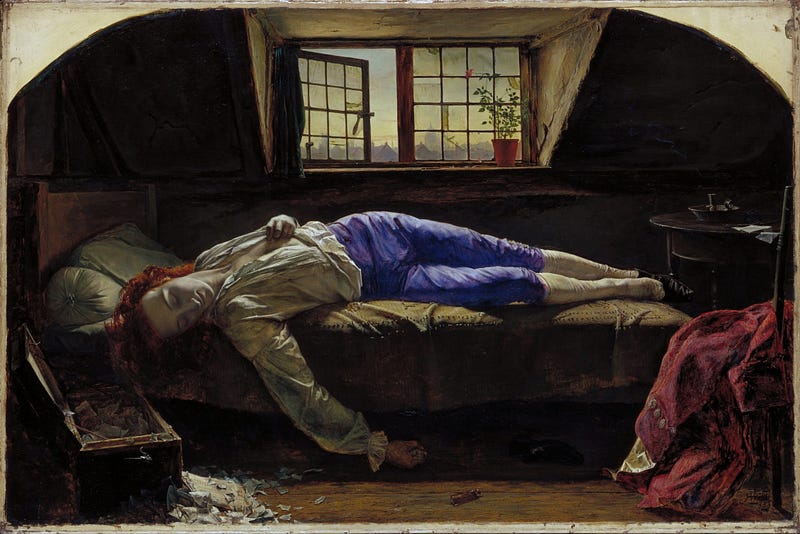
Thomas Chatterton wrote, in addition to poems in his own name, medieval pastiche that he attributed to a fifteenth century author by the name of Rowley. He committed suicide in 1770 and became a symbol of the tortured soul and ‘persecuted romantic’ that would endure as the stereotype embodied in the widely reproduced painting by Henry Wallis.
For the Pre-Raphaelites, Chatterton was a metaphor of the dehumanisation brought by the industrial age. They thought art and poetry was necessary to bring beauty and meaning to life. Yet art was was undervalued in a time of mass manufacture and mechanisation. Without fiercely holding onto art, they knew we were in danger of becoming nothing more than ‘components’, simply servants of ‘the machine’.
The exhibition caption for the painting was a quote, “ cut is the branch that might have grown full straight,” taken from the writings of Shakespearean contemporary Christopher Marlowe. This also linked the work with its literary heritage and the Romantics were also responsible for rekindling interest in the works of Shakespeare.
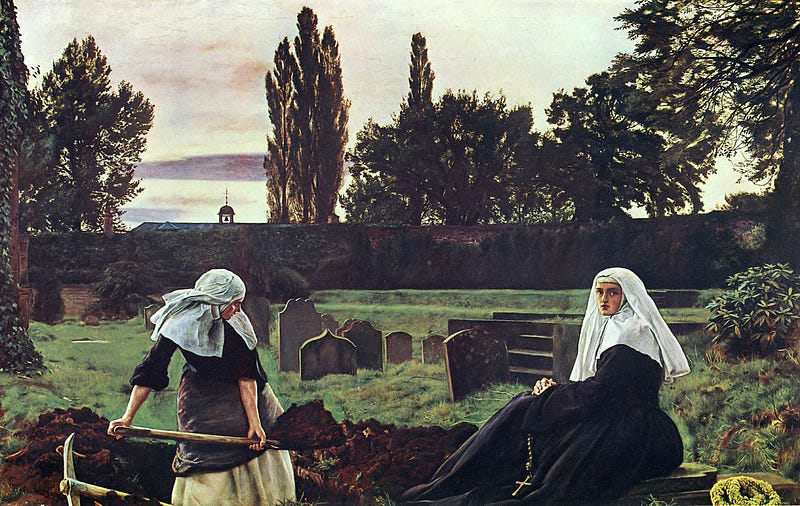
The Vale of Rest (1859), a painting by prominent Pre-Raphaelite John Everett Millais, is a definitive image of the Gothic Romantic ‘Graveyard School’. One nun supervises another in digging a grave… but for whom? By the way the sitting nun is looking towards the viewer, it could be for you.
This is a sombre painting using the subdued palette of sunset. Apparently, it was a personal favourite of Millais who became obsessed with the composition, re-painting the digging figure every day for seven consecutive days, and adding the tombstones months later.
It’s a narrative painting that suggests a story beyond the canvas and, again, draws literary comparisons. As a memento mori, it also suggests that we each have a story, and like all stories, ours will eventually reach a denouement. If this is so, then who is writing our stories? Is there an author? Is there a god, as the religious iconography in this painting suggests? Or do we take-on the responsibility of writing our own stories?
The painting also poses the question of how will your story be remembered? A life of toil and labour, working for others, is akin to digging your own grave — your legacy will be but a few lines carved on a tombstone. But, through art, our stories may be better expressed, recorded… remembered.
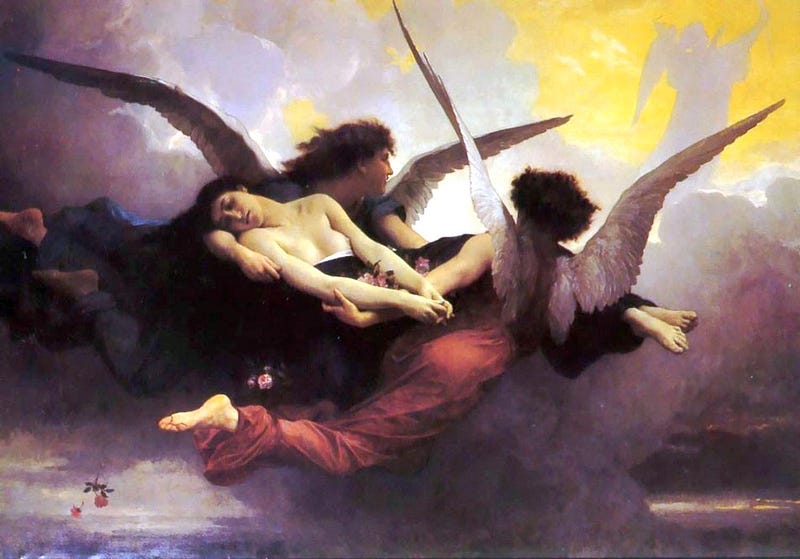
William-Adolphe Bouguereau was popular for his figure painting, particularly nudes that often caused scandal due to their overt eroticism. His dark Romantic painting, A Soul Brought to Heaven, shows two angels carrying a young woman up towards the golden glow of heaven.
This image celebrates the beauty of transient youth, its symbolic flowers scattering back down to earth before they have withered. These blooms and the girl are forever portrayed in their prime, before they withered with age. It would sit well on the cover of a Doom Metal album…
Death surrounded the Victorians and was a powerful theme in most aspects of their culture. This was before antibiotics and vaccinations. Childhood mortality was high as was the death of mothers during childbirth. Most people would have experienced death in the family from an early age and Bouguereau was no exception, having lost two children and his wife.
Inevitable death seemed random and chaotic. One way to assert some symbolic power was to portray it using a systematic method, such as painting and sculpture. By placing order onto the subject, it created a feeling of some control when otherwise feelings of helplessness would be all-consuming. By romanticising death in general, and dying young in particular, the Victorians attempted to come to terms with it.
Tragic as dying young is, it avoids the onset of old age and its associated diseases. In some respects the morbidity of Romantic imagery is actually an attempt to put a ‘positive spin’ on the subject. The combination of eroticism and death is a, not-so-subtle, poetic reference to how we can engaging with the physical pleasures in life whilst combatting death… by procreating.
Likewise, acts of artistic creativity were championed as the antithesis of demise. Death was an ever-present reality of their everyday lives and, just as religion had tried to do for millennia, art was attempting to make sense of the senseless. Nowadays, many people still turn to art in times of spiritual crisis.
A version of this article was first published in my book Evolution of Western Art (questing beast books, 2012)


