avatarPanos Grigorakakis

Free AI web copilot to create summaries, insights and extended knowledge, download it at here

3528

Abstract

l parties had reached an agreement, the effects of the Great Depression were hitting the shipping lines hard.</p><p id="b03a">Further work on the project was postponed and later canceled due to the collapse of the Royal Mail Steam Packet Company, which owned the White Star Line. The half-built hull of the Oceanic was then dismantled and recycled while loans intended for the construction of the ship were diverted to the construction of two other liners, the MV Britannic, and the MV Georgic. It was a sad and inglorious end for the ambitious project.</p><figure id="2ad3"><img src="https://cdn-images-1.readmedium.com/v2/resize:fit:800/1*-Sv5Ca0Z-M2-oXeLKZ20hw.jpeg"><figcaption>Loans backed by the governments of England and Northern Ireland intended for the construction of Oceanic were diverted to the construction of the last two ships built for White Star, the Britannic, and her near-twin sister, Georgic. (Above) MV Britannic / <a href="https://commons.wikimedia.org/wiki/File:Britannic_(III).jpg">Wikimedia Commons</a></figcaption></figure><h1 id="efd6">What-If Scenarios</h1><p id="bcf5">What would have happened, had the Oceanic been completed? There are many ways in which her completion would have affected maritime history.</p><p id="b2e6">If the White Star Line had never merged with Cunard, its arch-rival shipping company, Oceanic would have competed with Cunard’s Queen Mary and the French Line’s Normandie on the North Atlantic service. All three ships had fairly similar proportions and overall design, yet Oceanic would have been the largest <b>[3]</b>. Perhaps, and thanks to her powerful engines, she could also have been the fastest.</p><p id="9b27">Oceanic would definitely have added more competition to the “Great Duel” for speed, which was taking place at the time.</p><blockquote id="70db"><p>To learn more about this great contest which defined the transatlantic crossing of the 1930s read the following article:</p></blockquote><div id="9632" class="link-block"> <a href="https://readmedium.com/blue-riband-and-the-great-duel-of-the-1930s-c7e54403e590"> <div> <div> <h2>Blue Riband and the “Great Duel” of the 1930s</h2> <div><h3>The Normandie and the Queen Mary defined the transatlantic crossing during the interwar period…</h3></div> <div><p>medium.com</p></div> </div> <div> <div style="background-image: url(https://miro.readmedium.com/v2/resize:fit:320/1*oilNCzj5_wt2SDGLeV4sPg.jpeg)"></div> </div> </div> </a> </div><p id="4221">If the White Star had merged with Cunard, the former would have been in a better position with a completed Oceanic, and perhaps it could still be around today. The completion of both the Oceanic and the Queen Mary would mean the early retirement of the pre-war vessels. Ships such as the <a href="https://readmedium.com/the-story-of-titanics-unsinkable-sister-24c0a2a6ffbb">Olympic</a>, Mauretania, <a href="https://readmedium.com/bigger-than-titanic-meet-germanys-largest-ocean-liners-866cab03f72d">Majestic, Berengaria</a>, and Aquitania would instantly look redundant and expensive to operate.</p><p id="8d86">The Cunard-White Star could have operated a two-ship express Atlantic service with Queen Mary and Oceanic as early as 1936. Thus, there would be little incentive for the construction of Queen Elizabeth, the eventual running mate of Queen Mary. Whatever the outcome, Oceanic’s

Options

completion would have greatly impacted the history of both Cunard and White Star Line.</p><figure id="704b"><img src="https://cdn-images-1.readmedium.com/v2/resize:fit:800/1*GytS0u1rn2wV3FmTTc07eg.jpeg"><figcaption>Digital drawing of the RMMV Oceanic by AntonLogvynenko / <a href="https://commons.wikimedia.org/wiki/File:RMMV_OCEANIC_III_Day_version.jpg">Wikimedia Commons</a></figcaption></figure><h1 id="5e49">Epilogue</h1><p id="b00f">The Oceanic is probably the most famous of all the uncompleted ocean liners. Had she been completed, she would have been a truly magnificent ship, the biggest and possibly the fastest of her day.</p><p id="756d">Unfortunately, the financial problems the White Star was facing together with the drop in passenger numbers and the effects of the Great Depression did not allow the realization of this ambitious project. Thus, Oceanic remains to this day the greatest ocean liner that never existed.</p><h1 id="7d6e">Notes</h1><p id="31e1"><b><i>[1]</i></b> <i>The first set, submitted January 28, 1926, shows a four funneled ocean liner with a cruiser stern that would bear more than a ‘family resemblance’ to the Olympic. With a length of 904 feet, a beam of 96 feet, and a height 99 feet, this ship would have been a very close sister of the Olympic, fitted with a grand staircase modeled after the ones that became a trademark of that class of ships.</i></p><p id="0009"><i>The second set, drawn later the same year, shows a 935 feet long and 100 feet wide ocean liner with three squat funnels, roughly the same size as Bremen and Europa.</i></p><p id="54c4"><b><i>[2] </i></b><i>Lord Kylsant who controlled the White Star Line wanted to use diesel-electric instead of the traditional steam power. White Star proposed having over 40 diesel generator sets driving four propellers through geared electric motors. Harland & Wolff was reluctant to adopt this system, preferring to continue the use of trusted steam turbine propulsion. A compromise of sorts was reached and the final design used four conventional low-speed ‘cathedral’ diesel engines, each directly driving one propeller shaft — which would have made Oceanic the first quadruple-screw Motor ship.</i></p><p id="3755"><b><i>[3]</i></b><i> Oceanic was estimated to have been 1,050 ft in length, whereas Normandie and Queen Mary were 1,029 ft and 1,019.4 ft long respectively.</i></p><h1 id="1cda">Relevant Read:</h1><div id="776e" class="link-block"> <a href="https://readmedium.com/the-story-of-the-so-called-ship-of-the-century-ce7e9c6fb456"> <div> <div> <h2>The Story of the So-Called “Ship of the Century”</h2> <div><h3>Oceanic was the pinnacle of 19th-century shipbuilding…</h3></div> <div><p>medium.com</p></div> </div> <div> <div style="background-image: url(https://miro.readmedium.com/v2/resize:fit:320/1*ielvhAQgiyYncTycB4pugA.jpeg)"></div> </div> </div> </a> </div><h1 id="7b45">References</h1><p id="353a"><i>Richard de Kerbrech (2009), Ships of the White Star Line, Ian Allan Publishing</i></p><p id="e8d0"><i>John P. Eaton, Charles A. Haas (1990), Falling Star: Misadventures of White Star Line Ships, W W Norton & Co Inc</i></p><p id="af93"><i>Richard, Williams, David & De Kerbrech (1982), Damned by Destiny, Teredo Books</i></p><p id="466a"><i>Roy Anderson (1964), White Star, T.Stephenson & Sons Ltd</i></p></article></body>

The Greatest Ocean Liner That Never Existed

The Oceanic was intended to be the best ocean liner of its time…
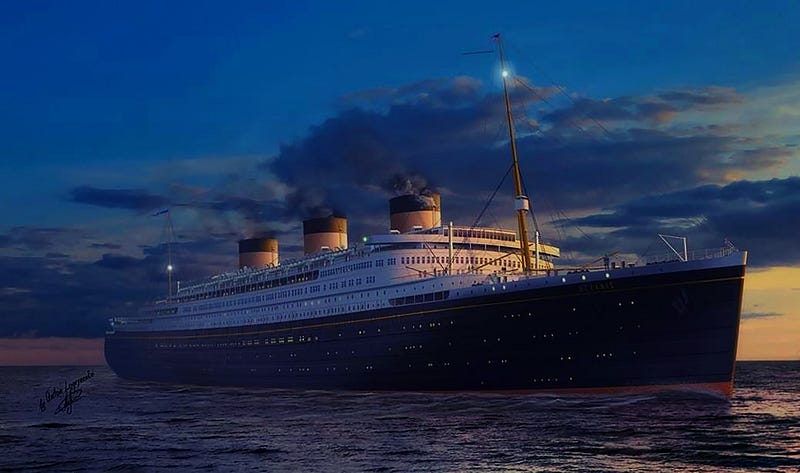
Digital drawing of the RMMV Oceanic III / AntonLogvynenko / Wikimedia Commons

The Oceanic was intended to be the greatest ocean liner of the interwar period. Luxurious, fast, and reliable, this ship was the largest vessel ever designed for the White Star Line, the prominent shipping line that operated the ill-fated Titanic. Sadly, this ambitious project never came to fruition.

This is the story of the most famous unfinished ship in history.

A Special Name

The White Star Line had always a special attachment to the name Oceanic. The company’s first-ever liner (1871) and its 1899 flagship both bore this name. The second Oceanic was the largest ship afloat till 1901 and was considered a pinnacle of 19th-century shipbuilding. So successful she was, that passengers nicknamed her the “ship of the century”.
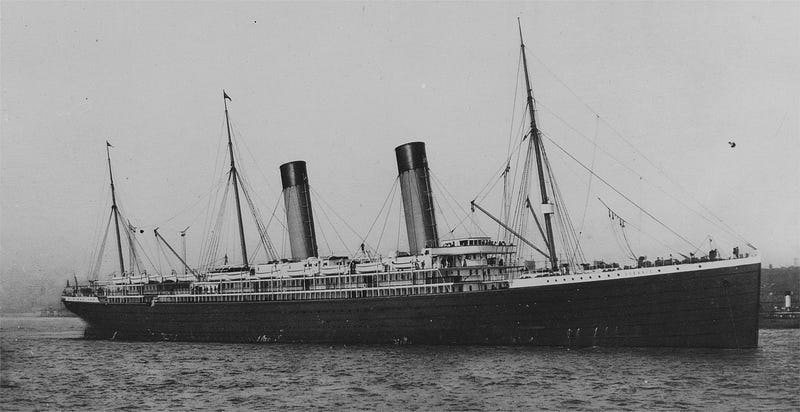
The RMS Oceanic, the nicknamed “ship of the century” /Maritime Museum / Wikimedia Commons

The third Oceanic was to be a special vessel too: she was intended to be the first 1,000-foot (300m)-long ocean liner, surpassing in size the famous Titanic and her sisters from the former period.

Conception

The concept of the new Oceanic dates back to 1923. However, White Star’s board of directors silently withdrew the idea of a new large ship because of restrictions placed on immigration by the United States government and the subsequent drop in passenger lists during this period. It was the introduction of the tourist class in ocean liners that made designers rethink the prospect of building a brand-new, giant liner.

Between 1926 and 1930 at least three general arrangements plans for the Oceanic were drawn, with the final set showing a 1,000 feet long and 120 feet wide ocean liner with three funnels and a cruiser stern [1].
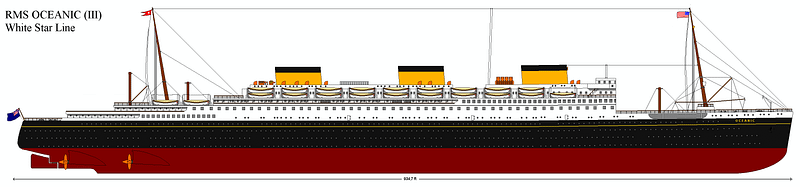
Design of the Oceanic III / Stas Eygi / Wikimedia Commons

Construction & Subsequent Cancellation

The White Star Line officially placed the order for the Oceanic on 18 June 1928. The ship would be constructed at the famous Harland & Wolff shipyard in Belfast. Work began almost immediately with the keel being laid just ten days later. Soon, though, the work slowed down. Initially, there was a dispute over the newest ship’s power plant [2]. By the time all parties had reached an agreement, the effects of the Great Depression were hitting the shipping lines hard.

Further work on the project was postponed and later canceled due to the collapse of the Royal Mail Steam Packet Company, which owned the White Star Line. The half-built hull of the Oceanic was then dismantled and recycled while loans intended for the construction of the ship were diverted to the construction of two other liners, the MV Britannic, and the MV Georgic. It was a sad and inglorious end for the ambitious project.
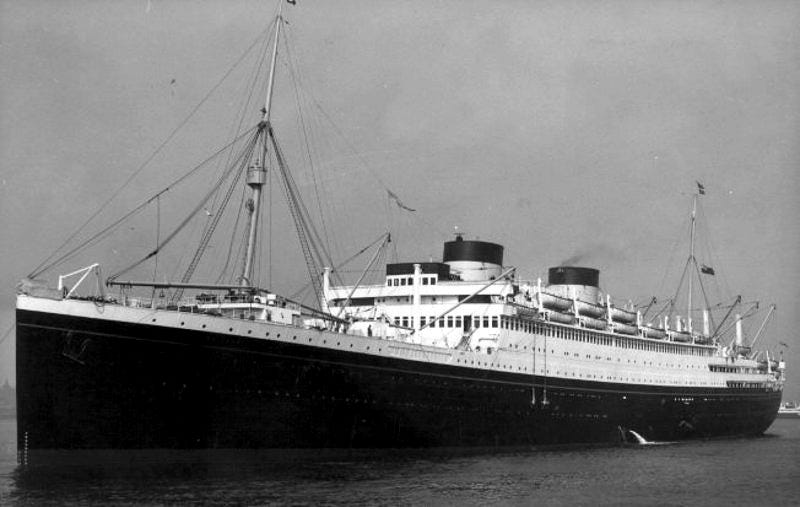
Loans backed by the governments of England and Northern Ireland intended for the construction of Oceanic were diverted to the construction of the last two ships built for White Star, the Britannic, and her near-twin sister, Georgic. (Above) MV Britannic / Wikimedia Commons

What-If Scenarios

What would have happened, had the Oceanic been completed? There are many ways in which her completion would have affected maritime history.

If the White Star Line had never merged with Cunard, its arch-rival shipping company, Oceanic would have competed with Cunard’s Queen Mary and the French Line’s Normandie on the North Atlantic service. All three ships had fairly similar proportions and overall design, yet Oceanic would have been the largest [3]. Perhaps, and thanks to her powerful engines, she could also have been the fastest.

Oceanic would definitely have added more competition to the “Great Duel” for speed, which was taking place at the time.

To learn more about this great contest which defined the transatlantic crossing of the 1930s read the following article:

If the White Star had merged with Cunard, the former would have been in a better position with a completed Oceanic, and perhaps it could still be around today. The completion of both the Oceanic and the Queen Mary would mean the early retirement of the pre-war vessels. Ships such as the Olympic, Mauretania, Majestic, Berengaria, and Aquitania would instantly look redundant and expensive to operate.

The Cunard-White Star could have operated a two-ship express Atlantic service with Queen Mary and Oceanic as early as 1936. Thus, there would be little incentive for the construction of Queen Elizabeth, the eventual running mate of Queen Mary. Whatever the outcome, Oceanic’s completion would have greatly impacted the history of both Cunard and White Star Line.
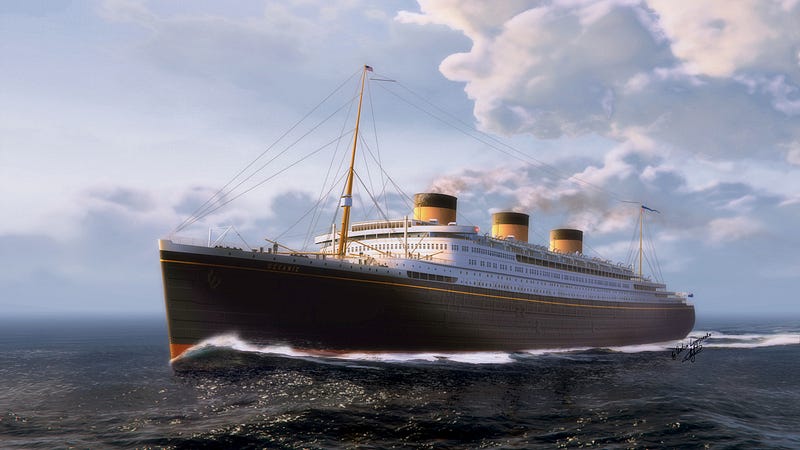
Digital drawing of the RMMV Oceanic by AntonLogvynenko / Wikimedia Commons

Epilogue

The Oceanic is probably the most famous of all the uncompleted ocean liners. Had she been completed, she would have been a truly magnificent ship, the biggest and possibly the fastest of her day.

Unfortunately, the financial problems the White Star was facing together with the drop in passenger numbers and the effects of the Great Depression did not allow the realization of this ambitious project. Thus, Oceanic remains to this day the greatest ocean liner that never existed.

Notes

[1] The first set, submitted January 28, 1926, shows a four funneled ocean liner with a cruiser stern that would bear more than a ‘family resemblance’ to the Olympic. With a length of 904 feet, a beam of 96 feet, and a height 99 feet, this ship would have been a very close sister of the Olympic, fitted with a grand staircase modeled after the ones that became a trademark of that class of ships.

The second set, drawn later the same year, shows a 935 feet long and 100 feet wide ocean liner with three squat funnels, roughly the same size as Bremen and Europa.

[2] Lord Kylsant who controlled the White Star Line wanted to use diesel-electric instead of the traditional steam power. White Star proposed having over 40 diesel generator sets driving four propellers through geared electric motors. Harland & Wolff was reluctant to adopt this system, preferring to continue the use of trusted steam turbine propulsion. A compromise of sorts was reached and the final design used four conventional low-speed ‘cathedral’ diesel engines, each directly driving one propeller shaft — which would have made Oceanic the first quadruple-screw Motor ship.

[3] Oceanic was estimated to have been 1,050 ft in length, whereas Normandie and Queen Mary were 1,029 ft and 1,019.4 ft long respectively.

Relevant Read:

References

Richard de Kerbrech (2009), Ships of the White Star Line, Ian Allan Publishing

John P. Eaton, Charles A. Haas (1990), Falling Star: Misadventures of White Star Line Ships, W W Norton & Co Inc

Richard, Williams, David & De Kerbrech (1982), Damned by Destiny, Teredo Books

Roy Anderson (1964), White Star, T.Stephenson & Sons Ltd

History
History Of Technology
Shipbuilding
Titanic
Ocean Liner
Recommended from ReadMedium