

Blue Riband and the “Great Duel” of the 1930s
The Normandie and the Queen Mary defined the transatlantic crossing during the interwar period…
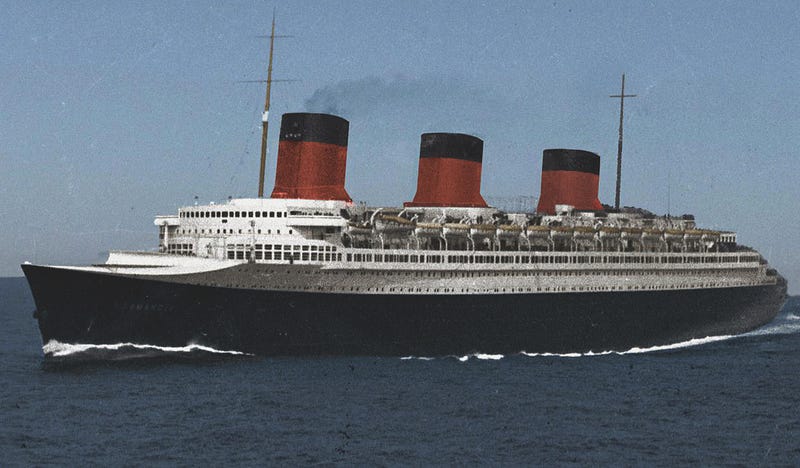

The interwar period was marked by the devastating effects of the Great Depression (1929–1939) and the increasing rivalry among the most powerful European nations.
Nationalism was gaining momentum and in the shipbuilding industry, this was expressed by an intense contest for capturing the Blue Riband — an unofficial accolade awarded to the liner that could cross the Atlantic Ocean the fastest. Ships that were Blue Riband holders were making great profits and publicity. It was, thus, of great importance -in terms of prestige- which country could build the fastest ships of the world.
During the interwar period, no rivalry for capturing the Blue Riband was greater than the one between the French and the British. Their ships were the biggest, fastest, and finest of the time, and their “Great Duel” defined the transatlantic crossing during the 1930s.
This is the story of their epic contest.
A French Superliner
The French line, known as the Compagnie Générale Transatlantique in an effort to suppress foreign competition (coming mainly from Germany and Italy) made plans to construct a 1,000-feet long, 79,000-tonne liner. The aforementioned dimensions meant that she was going to be the largest vessel in the world. The construction of the French titan, named SS Normandie, began on 26 January 1931. Her fine lines, novel art-deco design, and lavish interiors immediately captured the world’s imagination.
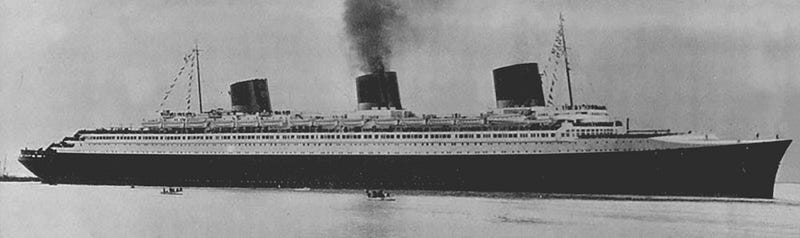

British Answer
Great Britain, the world’s leading maritime nation, had seen the decline of its shipbuilding industry. Cunard and White Star Line, the nation’s most prominent shipbuilding companies were operating at a loss and were gradually left behind in the shipbuilding race from foreign competition. Both were unable to proceed to the construction of new liners due to serious financial debts. When the French announced the construction of the Normandie, panic spread across the other side of the Channel.
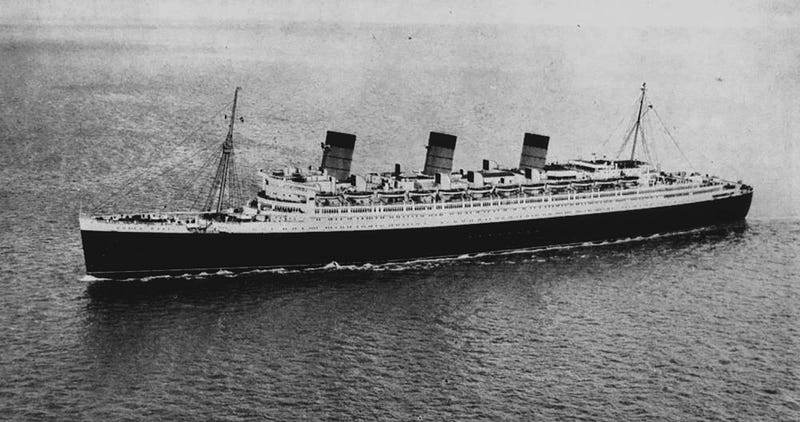
With the nation’s prestige as a maritime superpower at stake, the British government finally decided to take action. It forced Cunard and White Star to merge in 1934 and agreed to provide the necessary funds to finish Cunard’s idle keel number 534, construction of which had halted since December 1931. Keel number 534 eventually became the Queen Mary, and she was to be the answer to the French superliner.
.jpg)
The “Great Duel”
With the completion of the Queen Mary, the British and the French were eventually locked into an extraordinary duel for dominance of the North Atlantic, a “Great Duel” for capturing the Blue Riband.
SS Normandie sailed for her maiden voyage on May 29th, 1935. Four days later she arrived in New York in record time, capturing the Blue Riband from the Italian liner Rex.
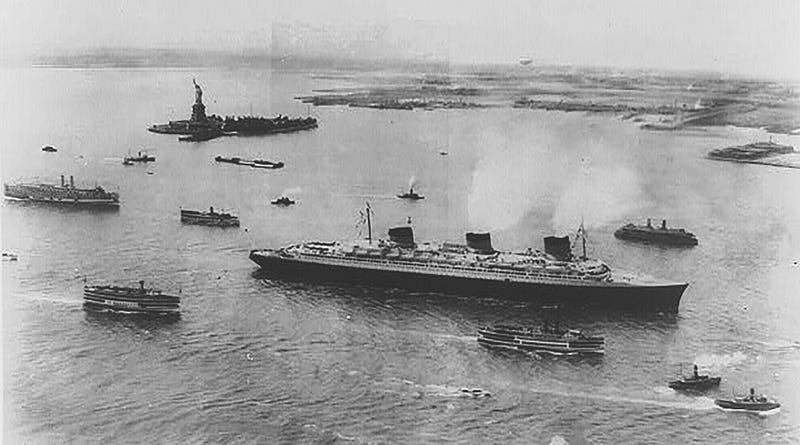

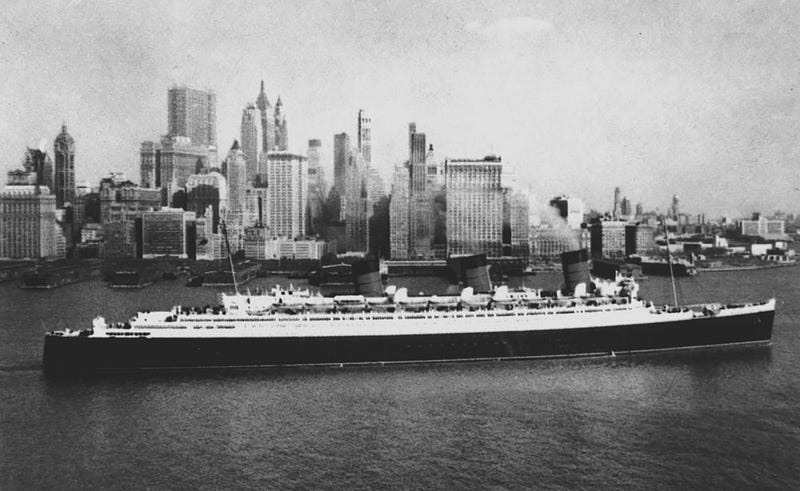
Queen Mary’s maiden voyage was scheduled for May 27th, 1936. Even though she failed to break Normandie’s record on her first crossing (mostly due to unfavorable weather conditions), she proved herself a few months later when she became the first liner to cross the Atlantic in less than four days. Averaging 30.14 knots, Blue Riband was hers for the taking.
The following year, Normandie reclaimed the title from her British rival, powering up her engines to an average speed of 30.58 knots. In August 1938, Queen Mary managed to outpace Normandie’s record from the previous year, averaging an impressive speed of 30.99 knots. She managed to complete the crossing in 3 days, 21 hours, and 38 minutes. This record-breaking performance would not be surpassed for almost 14 years [1].
.jpg)
World War II Ends The Contest
The outbreak of World War II on September 1st, 1939 ended the infamous rivalry.
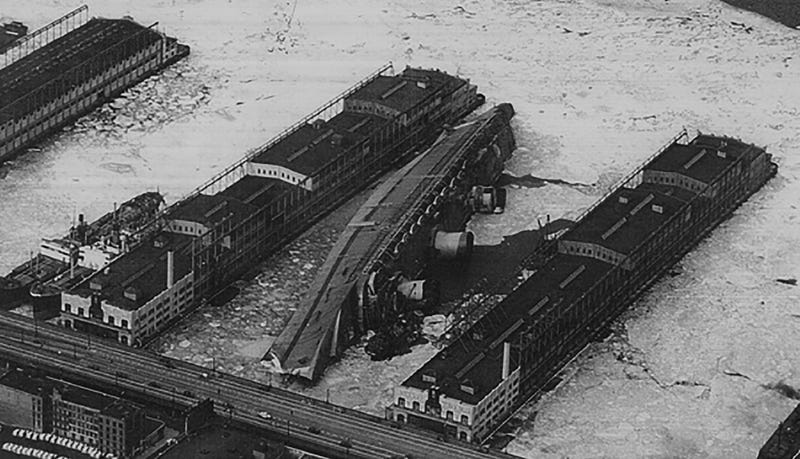
Normandie was seized by the United States and renamed SS Lafayette. On February 9, 1942, whilst in the process of being converted to a troopship, she caught fire and capsized at Pier 88 on the Hudson River. Rumors about enemy sabotage soon began to circulate, but they were never proven. Although the vessel was eventually salvaged, restoration costs were too high and in October 1946 the once-great liner was sent for scrap.

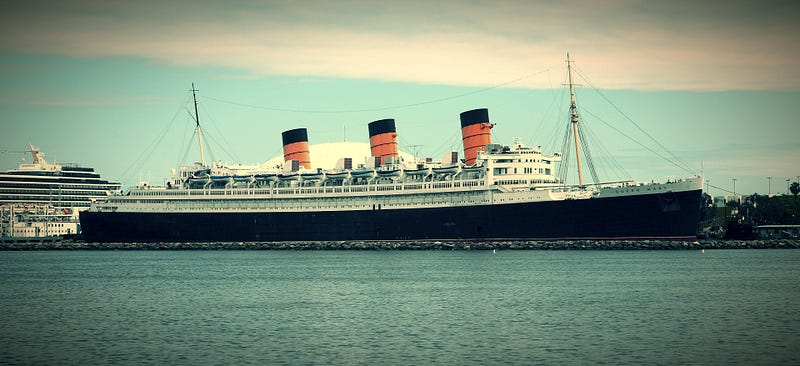
Queen Mary was more fortunate. During the war, she was converted to a troopship carrying thousands of Allied soldiers from all parts of the world. After the war she continued her successful career, dominating the North Atlantic route together with her sister ship, Queen Elisabeth. With the dawn of the jet age in the late 1950s, passenger lists dropped dramatically and she eventually retired from service in 1967.
Today she remains permanently moored in Long Beach, California, where she serves as a tourist attraction and a live museum.

Epilogue
Queen Mary and Normandie defined the interwar period of the transatlantic crossing. Normandie’s stunning art-deco interiors and novel design were unlike anything previously taken on the seas. Queen Mary’s more traditional approach proved to be more commercially successful in the end, making her one of the longest-serving ocean liners of all time.
The “Great Duel” of these magnificent liners pushed the limits of naval architecture to new frontiers. Had World War II not happened, those two great ships may have engaged to an even longer and more impressive “rivalry” breaking even more records.
Unfortunately, war and competition from the newly emerging airline companies proved too much for them. By the early 1960s, jets reduced the total amount of traveling time in hours, rather than days. Ocean liners were not anymore the only way to cross the oceans, and they gradually became obsolete. Their glorious age was coming to an end…
Notes
[1] Eventually, Queen Mary’s record would be broken by the SS United States in 1952. The particular vessel is the largest ocean liner constructed entirely in the United States. Averaging 34.51 knots, the American liner is the current Blue Riband holder.
References
Maxtone-Graham J.,(1972), The Only Way to Cross, Barnes & Noble, Inc.
Dawson P.,(2005), The Liner Retrospective & Renaissance, Anova Books Company Ltd
Fischer A., Kröhnert L., Schulte E., Valent J.,(2008), Luxury Liners Their Golden Age And The Music Played Aboard, edel entertainment GmbH
lblythe01,” The Liners: The Great Duel — e03", Online video clip, Youtube, 12 Sep 2010, Link: https://www.youtube.com/watch?v=iDqlwlwLBcI
Panos Grigorakakis is a journalist particularly interest in history, evolutionary biology, anthropology and…ocean liners! Connect with him on Linkedin or say hi on Twitter.