
Why Titanic’s Story is Captivating?
When it comes to maritime disasters everyone’s mind goes to the Titanic. But, why?
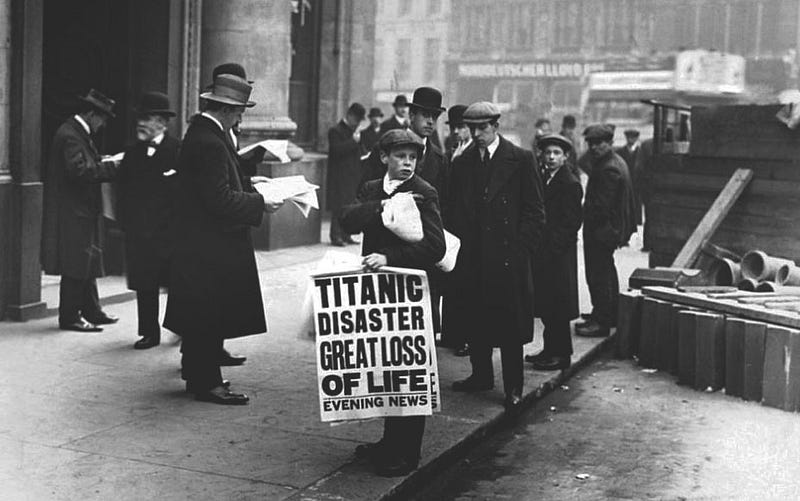
On December 20, 1987, a ferry named Doña Paz bound for Manila, collided with the oil tanker MT Vector in the Tablas Strait. The resulting fire and sinking left an estimated 4,400 dead. This is the deadliest maritime disaster to happen during peacetime. Yet, when it comes to maritime disasters no one seems to remember poor Doña Paz. Instead, everyone’s mind goes to the Titanic.
In Titanic 1,496 souls perished. A staggering number, yet not nearly as many compared to 4,386 people dying in Filipino sea. Besides, Titanic foundered more than a century ago, Doña Paz much more recently. One would expect the latter incident, not the former to be familiar to us today. But this is not the case.
So, why everyone knows about the Titanic, but most probably has never heard about Doña Paz and other greater maritime disasters?
A Disaster Full Of Symbolism
Titanic’s story still resonates a hundred years later because it’s a tragedy with strong symbolic nature.
It is not just another disaster of the 20th century; it is a symbol and a wake-up call against human arrogance. Titanic is not just a ship, it is a metaphor for technology overconfidence. The collision with the iceberg marks not only the end of the liner but also the end of the age that made Titanic possible. A real event that unfolds in a way of well-written fiction, Titanic’s disaster echoes universally common themes still relevant in our times.
This is why we still remember Titanic after so many years, and why most probably will continue to do so.
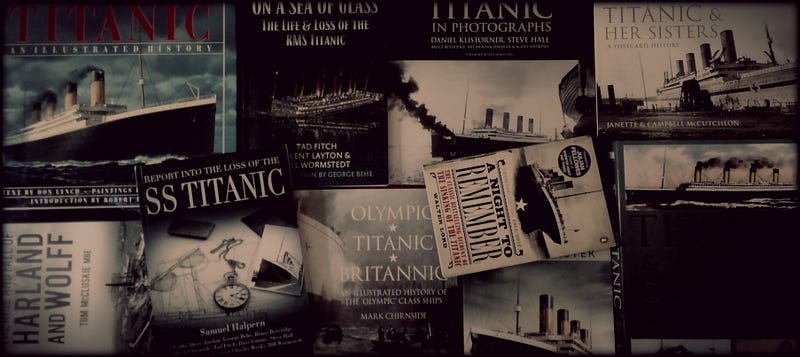
1. “God Himself Could Not Sink This Ship”
The story of the Titanic is often associated with the element of hubris. One needs to look no further than the ship’s name: Titanic translates to something gigantic in size or power. This pompous name reflects confidence, invincibility, and dominance over Nature.
Titanic is also famous for being perceived as unsinkable. Although her designers in Harland & Wolff never made such claims, the feeling that the ship could not sink seems to have been quite widespread [1].
In ancient Greek tragedies, hubris is followed by nemesis, the moral punishment for those who exhibit a lack of humility before the gods. The Titanic disaster proved in the most tragic way that no ship can be truly unsinkable and punished man’s sense of dominance over Nature.
2. Technology Overconfidence
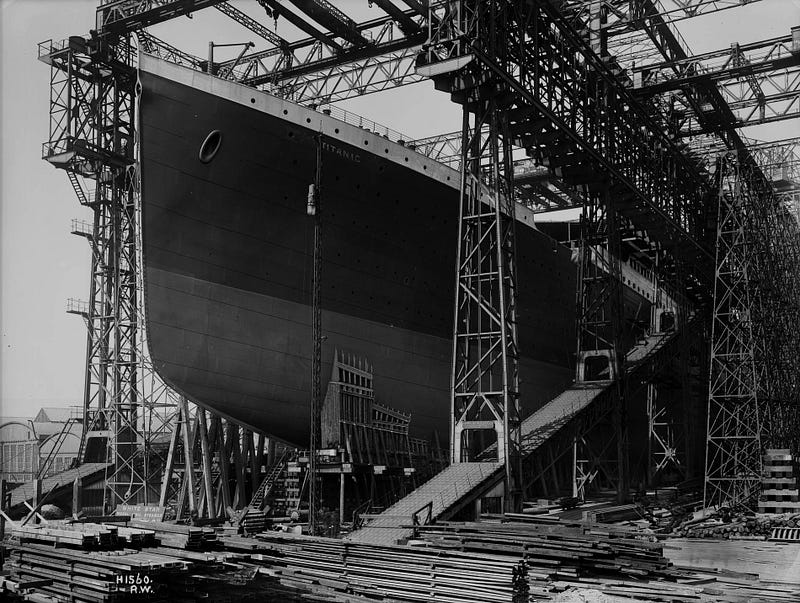
Titanic incorporated several safety features adding to the widespread feeling of her invincibility.
For example, she was divided into sixteen watertight compartments with heavy watertight doors that could close off each segment safely in case of an emergency. The ship could stay afloat with any two of her compartments flooded. In fact, Titanic would not sink even with three or four compartments open to the sea, provided that some specific combinations were met.
Titanic was reinforced by a double-bottomed hull that extended through the entire length of the ship and provided an extra seal of strength in the event of a collision. She was also equipped with the newest Marconi wireless telegraph and, in case of need, could communicate with other ships to require assistance. Unfortunately, all these safety features failed to prevent Titanic from sinking.
The disaster became a strong wake-up call against human’s blind faith in technology and reminded us that even the most complex and seemingly perfectly designed human inventions or objects have limits we always ought to consider.
It’s an important lesson to be learned, especially in our times where technology plays such a significant role in our daily lives.
3. Class Distinction
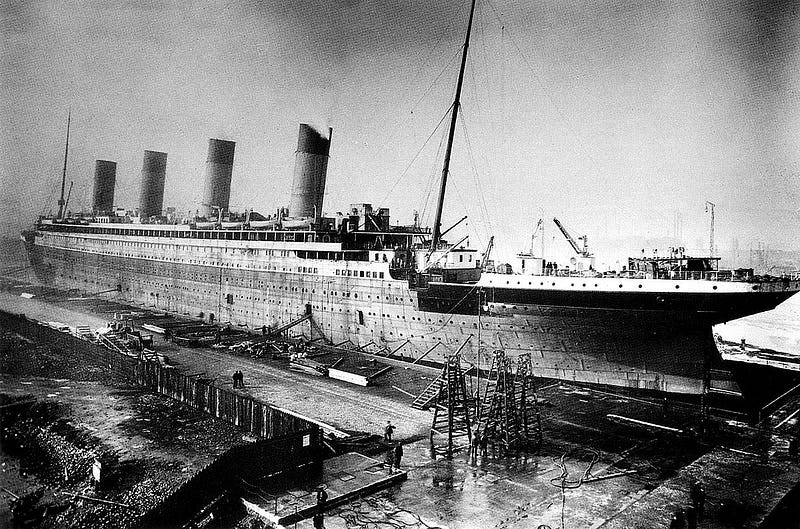
Early 20th-century society was highly segregated and Titanic was designed to reflect that reality. Passengers from different classes weren’t supposed to mingle with each other and had different accommodation facilities.
When the ship sank and the survivor names became known, it turned out that class had indeed played a part in one’s chance for survival. While, for example, there was a “women and children first” attitude, more First Class men than Third Class children survived [2].
The shocking realization that many women and children could not secure a place in the lifeboats, while some First Class gentlemen had done so caused public dismay and anger. Although not necessarily intentional, the loss of so many Third Class passengers brought to the surface the ever-going struggle between the rich and the poor, a struggle we can all easily identify with today.
4. Human Drama
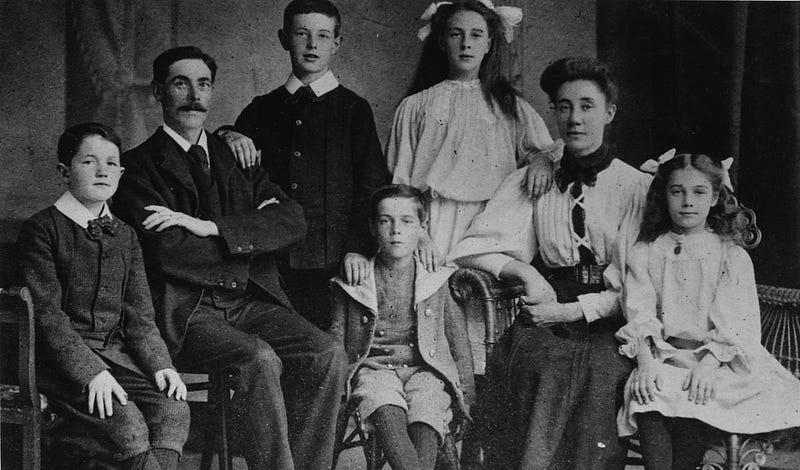
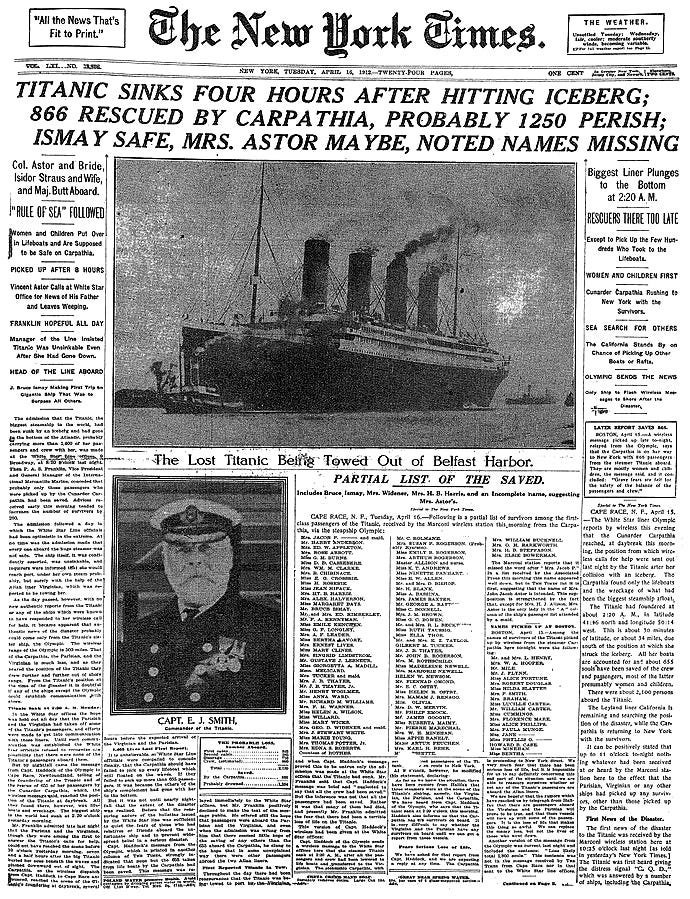
In the disaster's aftermath, the public was craving for news regarding the frantic moments of the sinking. Soon stories circulated in the media and some of them had long since entered popular culture folklore.
From the fate of the Captain, E.J. Smith who took full responsibility and went down with his ship, to the band who played the entire night to calm down the passengers. The self-sacrifice of the electricians, the engineers, and the stokers who gave their lives trying to keep the Titanic afloat for as long as possible. The designer of the ship, Thomas Andrews, who was the first to realize that the Titanic was doomed and whose body was never recovered. The manager of the White Star Line, J.B. Ismay, who saved himself only to live forever in disgrace.
The dying Titanic became the stage where all aspects of human drama were played out, with each story touching us in distinct, but profound ways.
5. Unthinkable Yet True
The biggest man-moving object of the time, the most beautiful and -ironically enough- the safest vessel afloat sinks on her maiden voyage with a tragic loss of life. A series of human errors and misjudgments that could have been avoided combined with the rare weather conditions of that night led to the perfect disaster [3].
Titanic’s story truly resembles a fictional piece of art-as far as dramatic narrative is concerned, it just doesn’t get better. It’s one of the few times in human history that reality surpassed fiction, where the unthinkable truly happened.
6. End of An Era
Titanic was a conception of “La Belle Époque”, a time of prevailing optimism in human abilities to overcome any problems through knowledge gained from science and technology. The Second Industrial Revolution resulted in new technological and scientific advancements, making people’s belief in everlasting progress a dominant thinking trend.
The Titanic disaster stands as a symbolic forerunner of the end of this “Beautiful Era”. Man’s confidence and belief in technology were wrecked after the Titanic and was profoundly shattered two years later with the outbreak of World War One.
Epilogue
If the Titanic hadn’t sunk, her story would have been quite different and surely less dramatic. You can check this alternative history scenario below:
Yet, it was the tragedy of the sinking and the great loss of life that made her a legend. Like all legends, Titanic has a unique appeal and meaning for each and every one of us. Her designers imagined her to be unsinkable and perhaps they weren’t that wrong after all. More than a century later, the Titanic remains ‘unsinkable’ in our minds…
Notes
[1]
First Class passenger Mr. Thomson Beattie, for example, wrote to his mother three days before the sailing: “We are changing ships and coming home in a new, unsinkable boat.”
Second Class passenger Mrs. Sylvia Mae Caldwell recalled a short conversation she had with a crewman prior to the ship’s departure at Southampton. She asked one of the deckhands carrying up luggage if Titanic was really non-sinkable. His answer is remembered to this day. “Yes, lady”, he said to her. “God Himself could not sink this ship.”
Third Class passenger Margaret Devaney said, “I took passage on the Titanic for I thought it would be a safe steamship and I had heard it could not sink.”
[2]
First Class men:Total:176/Saved:58
Third Class children:Total:76/Saved:30
[3] The Titanic might have hit the fatal iceberg because of a rare weather condition that created a ‘fake horizon’, leaving the crew unaware of the threat until it was too late. The same rare phenomenon might also have meant that a nearby ship, the Californian, was unaware of the scale of the disaster and failed to save passengers from the stricken liner.
References
Mendelsohn D.,(2012), Unsinkable, “Why we can’t let go of the Titanic.” The New Yorker, Link: https://www.newyorker.com/magazine/2012/04/16/unsinkable-3
Halperin S., Akers-Jordan C., Behe G., Beveridge B., Chirnside M., Fitch T., Gittins D., Hall S., J.Mitcham L., Weeks C.C., Wormstedt B., (2016), “Report Into The Loss Of The SS Titanic”, The History Press
Lord W., (1956), “A Night To Remember”, Longmans Green & Co
Titanic University, (2020), “Why Titanic Never Dies”, Link: https://www.youtube.com/watch?v=nwSEytFNLvQ
Wauch R., (2012), “Did a MIRAGE sink the Titanic? New research finds that freak weather might have ‘hidden’ the iceberg until it was too late”, Mail Online, Link: https://www.dailymail.co.uk/sciencetech/article-2118103/Did-MIRAGE-sink-Titanic-New-research-finds-freak-weather-hidden-iceberg-late.html
“Why Did People Consider the Titanic Unsinkable?” History on the Net
© 2000–2020, Salem Media. June 16, 2020, Link: https://www.historyonthenet.com/the-titanic-why-did-people-believe-titanic-was-unsinkable#:~:text=The%20shipbuilders%20Harland%20and%20Wolff,myth%20grew%20after%20the%20disaster.
Panos Grigorakakis is a journalist particularly interest in history, evolutionary biology, anthropology and…ocean liners! Connect with him on Linkedin or say hi on Twitter.


